
Seven Of Swords As Love Outcome (Upright & Reversed) Tarot Card Meaning
Drawing the Seven of Swords in the outcome position of a love spread rarely points to a clean ending. It describes a relationship where someone is holding something back, working an angle, or quietly removing themselves rather than saying what they feel. This guide breaks the card down by relationship stage, upright and reversed, so you can read it against your actual situation instead of a generic warning about dishonesty.
What the Card Shows
In the Rider-Waite-Smith deck, a man in a red cap and soft boots tiptoes away from a military camp in broad daylight. He carries five swords bundled awkwardly in his arms, gripping them by the blades rather than the hilts. Two swords stand upright in the ground behind him. He looks back over his shoulder with a smirk, pleased with himself and watching to see whether anyone has noticed. In the distance, a small cluster of soldiers gathers around a fire, oblivious.
Every element of that scene translates into relationship behaviour:
- The five stolen swords are what someone is taking without asking: time, trust, affection, information, or options they intend to keep open.
- The two swords left behind show the plan is incomplete. He could not carry everything. In love, this is the detail that gets missed, the text that gets seen, the alibi that does not hold.
- Gripping the blades means the person doing the sneaking is likely to get hurt by their own scheme.
- The smirk signals that the behaviour is deliberate, not accidental. He knows what he is doing.
- Daylight matters. This is not a midnight heist. The deception happens in plain sight, which is why it so often succeeds for a while.
- The camp represents the shared life, the agreements, the “we” that the figure is stepping away from.
As an outcome card, the imagery tells you the relationship’s trajectory is being shaped by a private agenda rather than an open conversation.
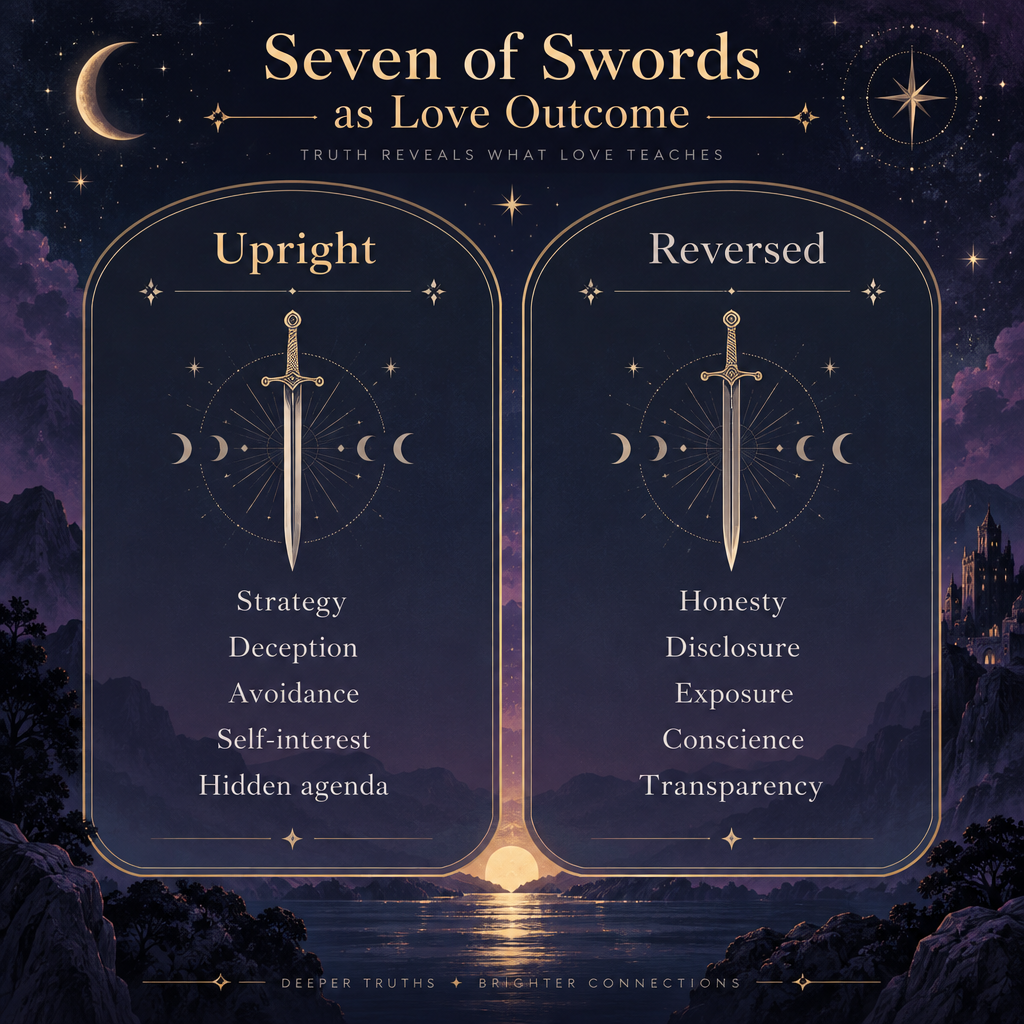
Keywords at a Glance
Upright
| Theme | What it looks like in love |
|---|---|
| Strategy | Playing it cool, managing how much you show |
| Deception | Lies of omission, hidden contact, double lives |
| Cunning | Getting what you want without asking directly |
| Caution | Guarding yourself after being burned |
| Avoidance | Ghosting, dodging the “what are we” talk |
| Preparation | Quietly arranging an exit or a backup plan |
| Self-interest | One person’s needs running the relationship |
Reversed
| Theme | What it looks like in love |
|---|---|
| Honesty | Finally saying the thing you have been sitting on |
| Disclosure | A confession, voluntary or forced |
| Transparency | Phones unlocked, schedules shared, nothing to hide |
| Conscience | Guilt catching up with the person who was sneaking |
| Exposure | Getting caught; the two swords left behind are found |
| Doubling down | The less common reading: deception gets more reckless |
Astrology, Element, and Number
The Golden Dawn assigned the Seven of Swords to the Moon in the first decan of Aquarius, roughly January 20 to 29, and titled it the Lord of Unstable Effort. That title is the whole card in three words. The Moon wants emotional security. Aquarius wants distance, independence, and the right to think its own thoughts. Put them together and you get someone who craves closeness but handles that craving by detaching, rationalising, and keeping options open. In a love reading this often describes the partner who is physically present and emotionally somewhere else, or who intellectualises the relationship rather than feeling it.
The suit of Swords belongs to Air. Air governs thought, speech, and communication, and the Sevens are where each suit tests its own integrity. Air at seven becomes clever talk, selective truth, and arguments that are technically accurate while being fundamentally misleading. When this card lands as your outcome, the problem is almost never passion or compatibility. It is what is being said versus what is being withheld.
Seven as a number carries themes of solitude, inner work, and testing. The Seven of Cups daydreams alone, the Seven of Pentacles waits alone, the Seven of Wands fights alone, and the Seven of Swords sneaks off alone. All four Sevens describe a person acting on their own rather than with a partner. For a love outcome, that is the core message: at least one of you is operating solo inside a relationship that is supposed to be shared.
Upright Seven of Swords as a Love Outcome
Upright, the outcome is that concealment continues or succeeds in the near term. Nobody is forced into honesty yet. How that plays out depends on where the relationship stands.
Singles and Early Dating
If you are single and asking what is coming, expect connections that feel promising and then go quiet. The person you are talking to is likely keeping several conversations going at once, or is not as available as they claim. Watch for someone who is charming on the apps and evasive about weekends, who never suggests a specific plan, or whose story about their last relationship shifts between tellings.
The card can also describe you. If you have been dating with a wall up, presenting a polished version of yourself and withholding what you actually want, this outcome says that strategy is producing exactly the shallow results you would expect. You cannot be chosen for who you are if nobody is allowed to see it.
A New Relationship
For a relationship under six months old, the Seven of Swords as outcome means the honeymoon has a hidden floor. Something is not being disclosed: a recent ex who is still in the picture, debt, a job situation, children, a living arrangement, or simply a lack of real interest dressed up as enthusiasm. The relationship will proceed on the surface while the undisclosed thing sits underneath.
Practically, this card at this stage is a timing warning. The two swords left in the camp mean the full picture will emerge later, and the longer you invest before it does, the more it will cost. Ask the direct questions now. Someone with nothing to hide will answer easily. Someone channelling this card will redirect, joke, or make you feel unreasonable for asking.
An Existing or Long-Term Relationship
This is where the upright card bites hardest. In a committed relationship, the outcome points to one of three patterns:
- Active deception. An affair, an emotional attachment outside the relationship, hidden spending, or a secret contact with an ex. The daylight imagery is relevant: it is usually happening in plain view, through a phone that is never left face up or a colleague mentioned slightly too often.
- Quiet withdrawal. No third party, but one partner has mentally left. They are going through the motions while planning a different life, saving money separately, or deciding they will leave once a milestone passes.
- Conflict avoidance as a lifestyle. Nobody is cheating, but neither of you says anything real. Problems are managed around rather than discussed. Resentments are stockpiled like swords.
The outcome is not necessarily a breakup. It is a relationship that continues under false pretences until the strain becomes unsustainable. If you drew this card, you probably already have a sense of which of the three patterns applies.
Reconciliation With an Ex
Upright, the answer to “will we get back together” is unfavourable, and the reason is specific. One of you wants something other than the relationship itself. The ex who is reaching out may want the comfort of your attention without the commitment, a soft place to land between other partners, or confirmation that they still have the power to pull you back. Alternatively, you may be the one keeping the door open as insurance while you look elsewhere.
A reconciliation built on this energy will replay the original problems, because the honest conversation that should precede getting back together is being skipped. If an ex returns with vague promises and no account of what has changed, this card says believe the vagueness, not the promises.
Infidelity, Third Parties, and Emotional Unavailability
Readers want a straight answer on whether this card means cheating. Here it is: the Seven of Swords is one of the three or four cards in the deck most consistently associated with infidelity, alongside the Three of Swords and, in some positions, the Lovers reversed or the Devil. On its own, in an outcome position, it indicates concealment. It does not prove a physical affair. The surrounding cards decide which form the concealment takes.
Three distinct scenarios fall under this card:
Physical or emotional infidelity. A third person is involved and the partner knows the behaviour is a betrayal, which is why it is hidden. Supporting cards: Three of Swords, Lovers reversed, Three of Cups reversed, the Moon, Knight of Swords reversed, Page of Cups reversed.
Third-party interference without an affair. A friend, family member, or ex is influencing one partner against the relationship, and that influence is being kept quiet. The partner has not cheated but is taking counsel from someone who does not want you together. Supporting cards: Five of Swords, Queen of Swords reversed, Seven of Cups.
Emotional unavailability. No outside person at all. One partner is simply unable or unwilling to be present and hides that behind busyness, humour, or vagueness. This is the Moon-in-Aquarius face of the card. Supporting cards: Four of Cups, Hermit, Knight of Cups reversed, Two of Swords.
If you pulled a clarifier and got the Four of Wands, Ten of Cups, or Two of Cups, the concealment is much more likely to be about something other than a third party. If you got the Three of Swords or the Tower, prepare yourself.
Self-Protection or Betrayal: The Card’s Two Faces
Not every Seven of Swords is a villain. The figure is leaving a military camp, and in some readings he is a scout retrieving weapons from an enemy, or someone escaping a situation that was never safe for him. The card describes strategic concealment, and whether that is healthy depends entirely on who is being protected and from what.
Self-protective strategy looks like: keeping your feelings private until someone has earned them, not disclosing past trauma on a second date, declining to tell a controlling partner about your savings account, or quietly planning your exit from a relationship where announcing it would be dangerous. The Seven of Swords as an outcome here says your caution is working and should continue.
Malicious deception looks like: maintaining a second relationship, lying about where you were, making a partner doubt their own perception, or stringing someone along because leaving is inconvenient. The smirk belongs to this version.
The test is simple. If the hidden thing came to light, would the other person feel protected or betrayed? If you are the one holding the swords, answer that honestly and you will know which face of the card you are living.
Reversed Seven of Swords as a Love Outcome
Reversed, the figure is upside down and the swords fall out of his arms. The Golden Dawn titled this card Unstable Effort for a reason: the scheme does not hold. There are two reversed readings and they point in opposite directions, so be clear about which one your spread supports.
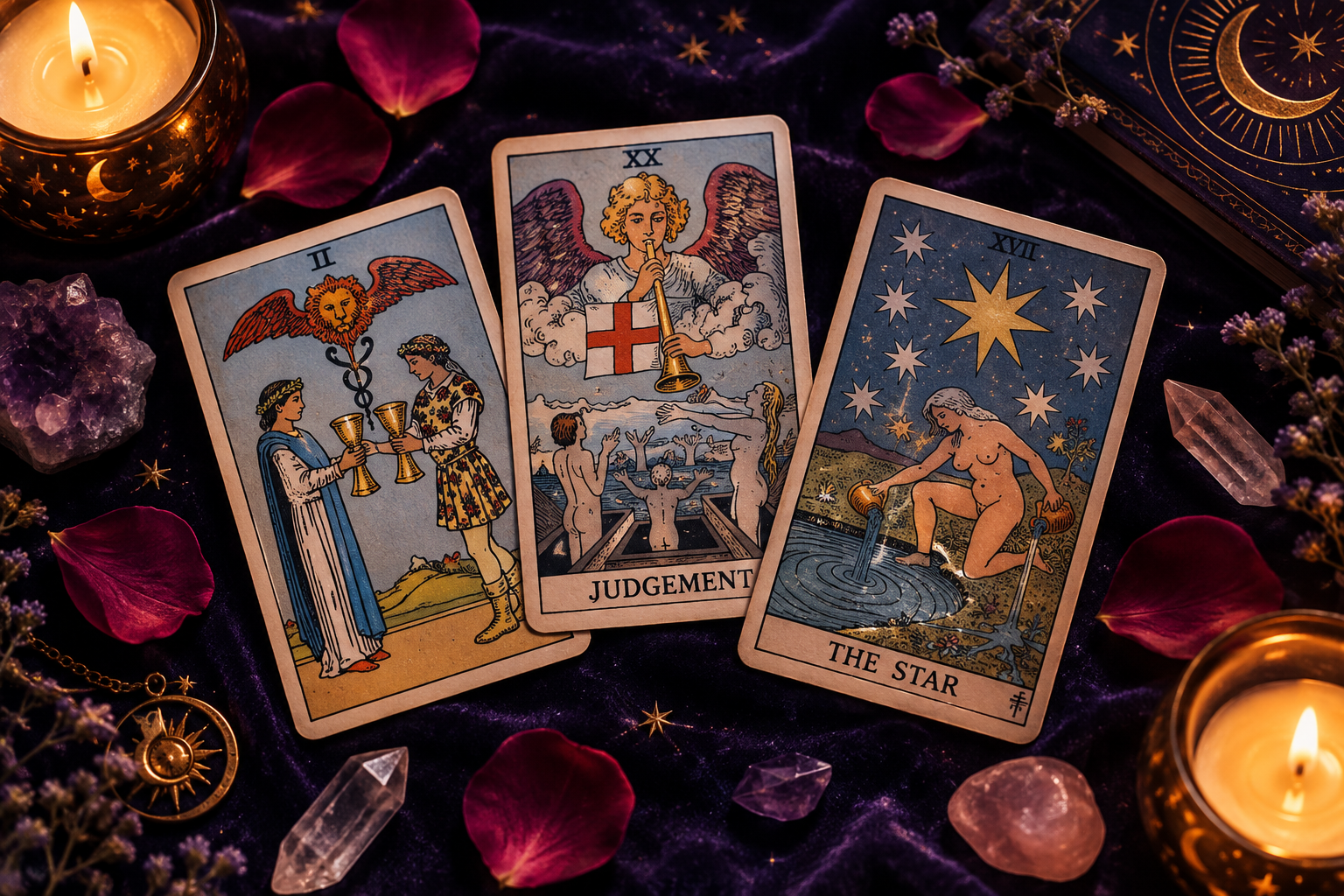
Reading one, the common one: truth comes out. A confession, a discovery, or a sudden attack of conscience ends the concealment. This is uncomfortable but ultimately clearing. Supporting cards: Judgement, the Sun, Ace of Swords, Queen of Swords upright, Six of Swords.
Reading two, the darker one: the deception escalates. The person stops bothering to be careful. Lies become more brazen, and the sneaking turns into open disregard. Supporting cards: Five of Swords, Devil, Seven of Swords next to the Moon or Ten of Swords.
If your spread has no strong indicators either way, read it as truth emerging. That is the dominant tradition and the more statistically useful default.
Singles
Reversed for a single person, the outcome favours honesty paying off. Someone who has been vague becomes direct, or you decide to stop performing and say what you want. The connections that follow are fewer but real. If you have been the one hedging, keeping a rotation going or avoiding exclusivity talks, this card says the strategy is about to collapse, probably because someone calls you on it.
A New Relationship
Early-stage reversed outcomes usually bring a disclosure within weeks. The new partner reveals the thing they were sitting on, or you find it. If the disclosure comes voluntarily, the relationship can deepen quickly, because the fog clears early. If you discover it rather than being told, treat the finding seriously even if the secret itself is small. The reflex to conceal is the issue, not the content.
An Existing Relationship
In a long-term partnership, reversed is the card of the hard conversation finally happening. An affair is admitted, a resentment is spoken, a plan to leave is put on the table. The relationship after this conversation will not look the same, and that is the point. Couples who get this card and then actually talk tend to either rebuild on firmer ground or separate cleanly. The worst result is getting the card, sensing the opening, and letting the moment pass.
Where the escalation reading applies, the outcome is a partner who no longer hides their contempt or their outside interest. That is painful, but it is also unambiguous, and unambiguous is what you need in order to act.
Reconciliation With an Ex
Reversed in a reconciliation question is more hopeful than upright, with a condition. The old pattern of avoidance and half-truths is being dropped. Your ex may come back with an actual accounting of what went wrong and what they have done about it. Or you may finally admit your own part in the breakdown. A reunion on those terms has a real chance.
The condition: the honesty has to be mutual and demonstrated, not announced. If one person is being transparent and the other is still managing the narrative, you are back in the upright card with better lighting.
Yes or No in a Love Outcome
Upright: no, or more precisely, not on the terms you are hoping for. The card says the relationship’s future is being shaped by what is hidden, and you are not currently being given the full picture.
Reversed: a conditional yes. The outcome improves if the truth that surfaces is handled with maturity on both sides. If you are asking “will they be honest with me,” reversed leans yes. If you are asking “will this work out,” reversed means it can, after a reckoning.
What to Do When You Draw This Card
If you are single
- Stop reading signals and ask direct questions early: “Are you seeing other people?” “What are you looking for?” Note how the question is received as much as what is answered.
- Set a personal limit on how long you will accept vagueness. Two or three dates without a straight answer about availability is enough information.
- Audit your own presentation. If you are hiding what you want in order to seem easygoing, you are the figure with the swords.
If the relationship is new
- Have the disclosure conversation on purpose, framed as mutual: “Is there anything I should know about where you are in life right now?” Then share something yourself.
- Pay attention to small inconsistencies. The two swords left behind are usually trivial details that do not line up.
- Slow down financial, housing, or social entanglement until you are confident the picture is complete.
If the relationship is established
- Name the pattern without accusing. “I feel like there is something we are not talking about” opens a door. “I know you are hiding something” slams it.
- Decide in advance what you will do with each possible answer so the conversation is not derailed by panic.
- If you suspect infidelity, gather clarity before confrontation. Pull a clarifying card, but also pay attention to behaviour over a defined period, two to three weeks, rather than one anxious evening.
- If you are the one concealing, understand that this card almost always precedes exposure. Choosing to disclose is the only version of this where you keep any trust.
If you are considering reconciliation
- Require specifics. What exactly changed, when, and how would you be able to see it? Vague remorse is the upright card.
- Watch for the ex who wants contact but resists definition. That is someone keeping the door open, not someone walking through it.
- Be honest about your own motive. If you want them back mainly so the breakup stops hurting, you are also holding a hidden agenda.
FAQ
Is the Seven of Swords a yes or no in love?
Upright it is a no in the sense that the relationship is not what it appears to be and the full truth is being withheld. Reversed it is a qualified yes that depends on how both people handle the honesty that surfaces.
Does the Seven of Swords mean cheating?
It means concealment, and infidelity is one of the most common forms that concealment takes. Confirm with surrounding cards. The Three of Swords, Lovers reversed, or Three of Cups reversed alongside it strongly suggest a third party. The Four of Cups or Two of Swords beside it point instead to emotional unavailability without anyone else involved.
What does the Seven of Swords mean for reconciliation with an ex?
Upright, the reconciliation is unlikely to succeed because at least one person wants something other than the relationship, such as attention, comfort, or a fallback option. Reversed, honesty about what went wrong is possible, and a reunion built on that honesty has a real chance.
Does the Seven of Swords reversed mean the truth will come out?
In most readings yes. The schemer drops the swords and the concealment fails, through confession or discovery. A minority reading, supported by cards like the Five of Swords or the Devil, indicates the deception gets more reckless instead. Default to truth emerging unless the spread clearly argues otherwise.
What does the Seven of Swords mean about my partner’s feelings?
The Moon in Aquarius correspondence describes someone who feels more than they show and manages that gap through distance and rationalisation. Your partner may care but be unwilling to be vulnerable, or may be emotionally elsewhere while physically present. Either way, you are not getting the full picture of what they feel.
Can the Seven of Swords be positive in a love reading?
Yes, when it describes healthy self-protection: guarding your heart after betrayal, keeping private information from a partner who has not earned it, or quietly planning an exit from a relationship where openness would be unsafe. The test is whether the other person would feel betrayed or protected if they knew.