

Page Of Swords As Feelings In Love & Relationships (Upright & Reversed)
You pulled the Page of Swords asking how someone feels about you, and the card handed you a riddle instead of a love letter. That is the point. This card describes a person who is interested, alert and thinking hard, but who has not yet let their guard down, and the rest of this guide breaks down exactly what that means for a crush, a new partner, a long-term relationship, an ex, or a friend.
What the Page of Swords Says About How Someone Feels About You
Read this card as a mental state rather than a heart state. The person you asked about is paying attention to you. They notice what you say, they replay conversations, they probably have opinions about your opinions. What they are not doing yet is feeling safe enough to be soft.
In plain terms, upright, this person likes you but is still gathering information. They are curious, a little wary, and more comfortable sparring with you than confessing to you. If you were hoping for warmth, you will find it, but it arrives disguised as questions, teasing and long text threads that never quite land on the subject of feelings.
Reversed, the picture sours. Curiosity curdles into nosiness, wariness becomes suspicion, and the sharp mind that made them interesting starts being used to keep you off balance. More on that below, because the reversed Page of Swords in a feelings reading has a very specific set of warning signs.
The Imagery, the Air Element, and Why This Card Feels the Way It Does
In the Rider-Waite-Smith deck, the Page of Swords stands on uneven, hilly ground with a sword gripped in both hands and raised toward the sky. Wind whips the clouds and bends the trees behind them. Their body faces one direction while their head turns the other way, scanning the horizon over one shoulder. A small flock of birds cuts across the sky.
Every one of those details shows up in how this card behaves in a love reading:
- The raised sword is a mind that is switched on and ready. Feelings are processed through thought before they are allowed to become emotion.
- The turned head is vigilance. This person is watching for threats, inconsistencies and red flags, often before any exist.
- The wind and ragged clouds are restlessness. The Page cannot sit still with a feeling. They need to talk it out, research it, test it.
- The uneven ground is a footing that is not yet secure. Trust is being built, not assumed.
Swords belong to the element of Air, the element of thought, language and perception. Pages are the youngest court figures, so this is Air in its early, exploratory stage: bright, quick, uncertain, and prone to overthinking. In contemporary tarot practice the Page of Swords is widely paired with Mercury and with Gemini, the planet and sign of communication, curiosity and double-mindedness. That pairing explains the card’s emotional signature almost perfectly. Mercury wants to understand before it commits. Gemini wants to keep options open and keep talking. Put the two together and you get someone whose attraction looks like a debate.
Modern decks keep this character intact while changing the costume. The Wild Unknown Tarot renders the card as the Daughter of Swords, a young owl, which captures the watchful, slightly unnerving intelligence better than many human figures do. Whatever deck you use, look for the same cues: alertness, a raised blade, eyes on the distance rather than on anyone close by.
Page of Swords Upright as Feelings
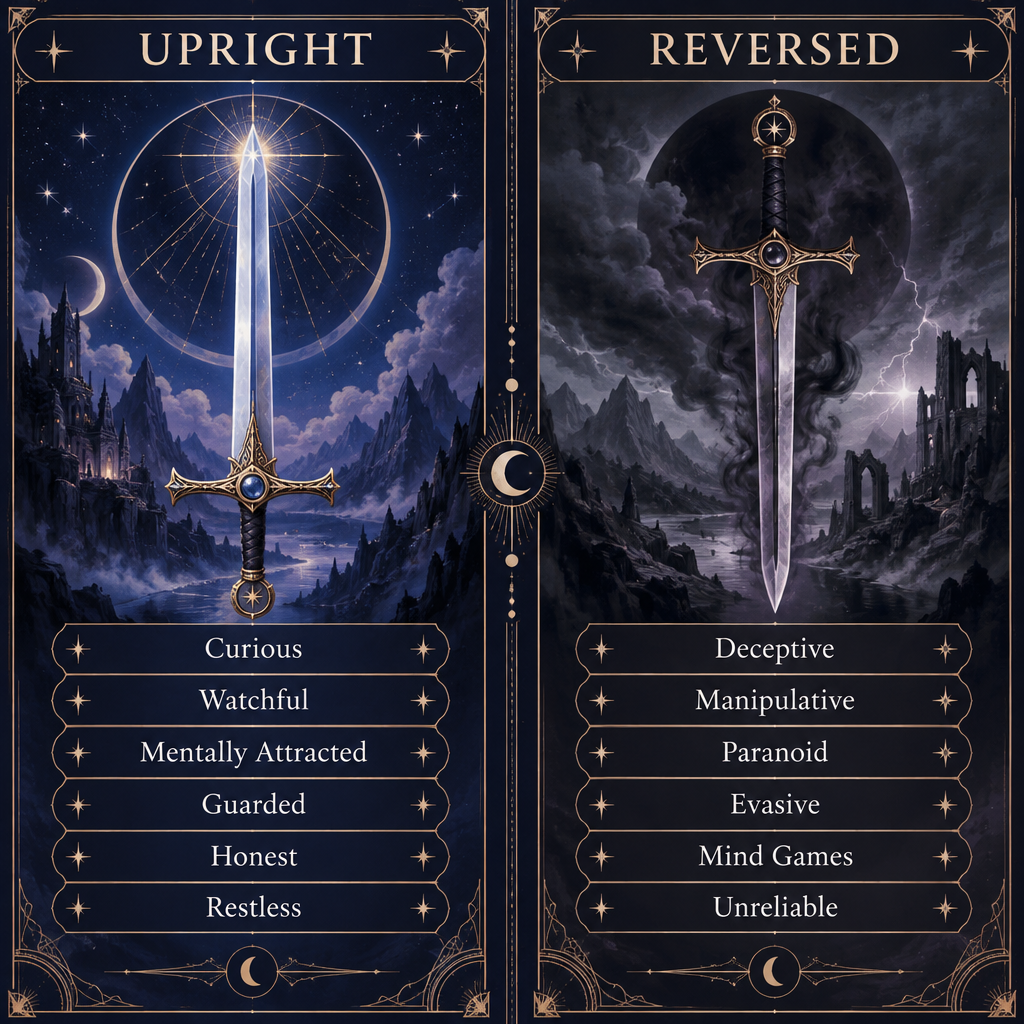
Upright, the Page of Swords is a genuine but guarded interest. The feelings exist. They are simply being chaperoned by the intellect.
Upright keywords for feelings:
- Curiosity about you
- Watchfulness and mild suspicion
- Mental stimulation and attraction to your mind
- Restlessness, difficulty sitting with emotion
- Honesty, sometimes blunt to a fault
- Quick thinking, witty back-and-forth
- Eagerness to learn more before committing
Attraction expressed through debate, not romance
This person flirts by arguing. They will challenge something you said, send you an article to prove a point, ask you a question so pointed it feels like an interview. None of that is coldness. For a Page of Swords type, poking at your ideas is how they get close to you. If they did not care, they would not bother to disagree.
Expect communication that is frequent and lively but light on vulnerability. They will tell you what they think about your taste in films long before they tell you what they feel about you.
Trust is being built, and it is not finished
The slight suspicion in this card is not a sign that the person dislikes you. It means they have not decided you are safe yet. They are checking whether your words match your actions, whether your story stays consistent, whether you can keep up. Pass those quiet tests and the guard comes down. Rush them and the head turns further away.
Page of Swords Reversed as Feelings
Reversed, the Page of Swords stops observing and starts manipulating. The sharp mind is still there, but it is now pointed at you rather than at understanding you. This is one of the clearest “proceed with caution” cards in a feelings reading.
Reversed keywords for feelings:
- Deceptive or evasive
- Manipulative, playing mind games
- Cynical about love
- Paranoid, jealous, controlling
- Scattered, inconsistent, unreliable
- Gossipy, indiscreet
- All talk and no follow-through
Gossip, spying and surveillance
The vigilance of the upright card becomes surveillance when reversed. This looks like checking your location, going through your phone, monitoring who liked your posts, or quietly asking mutual friends about you. It also looks like gossip. A reversed Page of Swords may be talking about you behind your back, sharing private details, or shaping a narrative about you to other people. If you have had a nagging sense that someone knows more about your movements than they should, this card confirms it.
Mixed signals and passive-aggression
Reversed, this person runs hot and cold on purpose or by neurosis. They text constantly for three days and then vanish. They say they are fine while clearly seething. They make a cutting remark and follow it with “I’m just being honest.” Passive-aggression is the natural home of a Page of Swords who cannot admit they feel something, so they express it sideways.
Mind games, gaslighting and withholding information
At its worst, the reversed Page of Swords uses information as a weapon. They remember exactly what you said and twist it. They deny conversations happened. They keep facts from you, not because they forgot, but because knowing more than you gives them the upper hand. Gaslighting fits here precisely because this card is about perception and language, and a reversed Page corrupts both.
All talk, no action
The milder reversed expression is simply unreliability. Big declarations, elaborate plans, promises to call, none of it followed through. This person may enjoy the idea of you, and enjoy talking about the idea of you, without ever doing anything to make it real.
Page of Swords as Feelings for a Crush
This is the most common reason anyone pulls this card, so here is the direct answer.
Upright: they are interested and overthinking it
Your crush has noticed you and is thinking about you more than they let on. They are likely analysing your messages, wondering whether your friendliness means anything, and keeping their own interest hidden behind banter. If they tease you, challenge you, or ask you slightly too many questions, that is their version of flirting. They are not indifferent. They are cautious and mentally busy.
The catch is that a Page of Swords crush rarely makes the first emotional move. They will make plenty of conversational moves. They will not say “I like you” until they have ruled out every way it could go wrong.
What to do: Give them something to think about. A direct, low-pressure signal of interest works better than hints, because a Page of Swords wants clarity. Keep the conversation sharp and fun, and let them reach their own conclusion.
Reversed: interest tangled with suspicion or games
Reversed, the crush may still find you intriguing, but the energy is messy. They might be sending deliberately mixed signals to see how you react, talking about you to friends in a way that is more gossip than admiration, or watching your social media closely while acting aloof in person. Sometimes it simply means they are too scattered and uncertain to pursue anything.
What to do: Do not chase someone who is playing hot and cold. Match their consistency, not their intensity, and see whether they stabilise.
Page of Swords as Feelings in a New Relationship
Upright: excited, curious, still testing
In the first weeks or months of a relationship, the Page of Swords upright shows a partner who is energised by you. They love the talking, the late-night debates, the discovery of how your mind works. They are also quietly auditing you. Small inconsistencies get noticed. Promises get remembered.
This is a healthy phase as long as both of you understand it is a phase. Feelings are present, but they have not settled into trust yet.
What to do: Be consistent. This partner falls deeper every time your actions line up with your words. Avoid making them guess.
Reversed: jealousy and overanalysis move in early
Reversed in a new relationship, the card warns of a partner who is already a little paranoid, perhaps checking your phone or interrogating you about exes, or who is holding back real information about their own life. Early mind games are a bad sign because they only escalate.
What to do: Name the behaviour the first time you see it. A new relationship cannot survive surveillance disguised as interest.
Page of Swords as Feelings in a Long-Term Relationship
Upright: your partner still finds you interesting, but is holding something back
For established couples, the upright Page of Swords is a mixed blessing. The good news is that the intellectual spark is intact. Your partner still enjoys arguing with you, still wants your opinion, still finds you mentally attractive after years together. The caution is that they are processing a feeling rather than sharing it. Something is on their mind, and they are observing you to decide whether to say it.
What to do: Open the door for honest conversation without forcing it. Ask what they have been thinking about lately, and listen for the thing they circle but do not say.
Reversed: suspicion, snooping and cold communication
Reversed, a long-term partner may be withholding information, communicating in sarcasm, or quietly building a case against you. Snooping is common here. So is gossiping about the relationship to friends rather than talking to you directly.
What to do: This card calls for a frank conversation about trust, and possibly a neutral third party if the pattern is entrenched. Passive-aggression does not resolve itself.
Page of Swords as Feelings for an Ex
A surprisingly large share of people pulling this card are asking about someone they used to be with. The Page of Swords has a lot to say here, almost none of it simple.
Upright: they are thinking about you, but intellectualising it
Your ex has not stopped thinking about you. They are, however, treating the breakup like a case study. They analyse what went wrong, mentally rehearse arguments, and may have a very articulate theory about why it ended. What they are not doing is sitting with the grief or the longing. The feelings are being processed as thoughts, which keeps them at a safe distance.
They may also be watching you from afar, checking your profiles and asking mutual friends how you are, while telling themselves it is just curiosity.
Reversed: denial, bitterness, or a smear campaign
Reversed, the ex is either in denial about feeling anything, or actively hostile. Gossip is a real risk here: a reversed Page of Swords ex may be telling their version of the story to anyone who will listen, and that version may not be flattering or accurate. Expect cynicism about the relationship, sharp comments if you cross paths, and possibly obsessive monitoring of your life that they would deny if asked.
Is reconciliation likely?
Not in the card’s current state. The Page of Swords describes someone still in their head, and reconciliation requires someone willing to move into their heart. That does not mean the door is closed. It means the door will only open if:
- Communication becomes honest rather than clever. No scoring points, no rehashing old arguments as evidence.
- The watching stops. An ex who monitors you from a distance is not ready to be close to you.
- The intellectualising gives way to accountability. They need to say “I was wrong” instead of “here is my analysis of why we failed.”
If those three shifts happen, the Page of Swords can mature into something steadier. If they do not, this card describes an ex who will keep thinking about you indefinitely without ever doing anything about it.
What to do: Do not reopen contact hoping their curiosity will turn into commitment. Let them come to you with clarity, and if they come with arguments instead, you have your answer.
Page of Swords as Feelings for a Specific Person or a Friend
Not every feelings reading is romantic. Asked about a friend, colleague, sibling or any specific person, the Page of Swords describes someone who is interested in you, observant of you, and quick to communicate, but not yet fully trusting.
In a friendship, upright, this is the friend who texts you articles, remembers everything you said and loves a good debate. They genuinely like you. They might not be the one you cry to, because emotional softness is not their native language, but they will defend you with facts and show up with ideas. Reversed, it points to a friend who gossips about you, keeps score, or is quietly competitive while pretending to be supportive.
For a colleague or acquaintance, upright suggests professional respect mixed with curiosity. Reversed warns of someone collecting information about you, which in a workplace usually means office politics.
For a family member, upright often shows someone who shows love by asking questions and giving unsolicited advice. Reversed suggests criticism masked as concern.
What to do: With any specific person, treat upright as an invitation to be open and reversed as a reason to share less until trust is proven.
How the Page of Swords Differs From Nearby Cards
Readers often confuse this card’s emotional tone with its neighbours. The differences matter.
| Card | How the feelings show up | Core difference from Page of Swords |
|---|---|---|
| Page of Swords | Curious, watchful, flirts through debate, guarded | The baseline: interest filtered through thought |
| Page of Cups | Dreamy, openly affectionate, sends a tentative love note | Leads with heart, not head; little suspicion |
| Knight of Swords | Charging in, declarations, fast pursuit, impatient | Has decided already; no hesitation, less listening |
| Page of Wands | Playful, enthusiastic, wants adventure together | Warm and impulsive rather than analytical |
| Queen of Swords | Clear boundaries, honest, emotionally self-contained | Mature version: has finished analysing and knows what she wants |
The simplest distinction: a Page of Cups feels first and thinks later, a Page of Swords thinks first and feels later, and a Knight of Swords acts before doing either.
What to Do When the Page of Swords Appears in a Feelings Reading
Whatever the context, a few rules hold.
- Match clarity with clarity. This person responds to direct, honest communication. Hints get analysed to death; plain statements get answered.
- Prove consistency over time. Their guard drops when your actions line up with your words repeatedly, not when you make one grand gesture.
- Enjoy the mental connection without demanding emotional declarations. Push a Page of Swords for feelings before they are ready and they retreat into logic.
- Treat reversed warning signs seriously. Snooping, gossip, mixed signals and withheld information are not quirks. They are patterns, and they rarely improve without being confronted.
- Check surrounding cards. The Page of Swords alone describes a mind in motion. Cards like the Two of Cups or the Lovers nearby suggest the feelings will land; cards like the Seven of Swords or the Moon nearby confirm the reversed meanings even if the Page is upright.
FAQ
Does the Page of Swords mean someone likes you?
Upright, yes, with a caveat. The person is interested and thinks about you often, but they express it through curiosity, questions and banter rather than open affection. Trust is still being established, so do not expect a confession yet. Reversed, interest may still exist but is tangled with suspicion, games or gossip.
Is the Page of Swords a yes or no for love?
It is a cautious yes upright and a no reversed. Upright, the connection has real potential but needs honest communication and time before it becomes emotional commitment. Reversed, the card points to manipulation, mixed signals or unreliability, and the answer leans firmly toward no, or at least not now.
What does the Page of Swords reversed mean for feelings?
Reversed, it describes someone who is deceptive, paranoid or playing mind games. Common expressions include spying on you, gossiping about you, sending deliberate mixed signals, passive-aggressive comments, gaslighting, withholding information for leverage, and making promises they do not keep. Treat it as a caution to protect yourself and demand consistency.
What does the Page of Swords mean as feelings for an ex?
Your ex is still thinking about you, but they are analysing the relationship rather than feeling their way through it. Upright, they may watch you from a distance while rationalising their emotions. Reversed, they may be bitter, in denial, or telling an unflattering version of the breakup to others. Reconciliation is unlikely until the overthinking turns into honest accountability.
What does the Page of Swords mean for a crush?
Your crush has noticed you and is interested, but they are overthinking it. They flirt by challenging you and asking questions, and they will not make the first emotional move until they feel sure. A direct, low-pressure signal from you helps more than hints.
Is the Page of Swords a good card for relationships?
For intellectual compatibility and lively communication, it is excellent. For emotional depth, it is a work in progress. Upright, it describes a relationship where the mind is engaged and the heart is catching up. Reversed, it flags trust issues that need addressing before the relationship can be called healthy.