Page Of Cups As Feelings In Love & Relationships (Upright & Reversed)
When the Page of Cups shows up as someone’s feelings for you, it means they have a crush on you and have not fully decided what to do about it. The emotion is real, tender, and a little nervous, but it is young, and this article walks through what that looks like at every relationship stage, from a first flirtation to an ex who still thinks about you to a partner you have shared a bed with for a decade.
The short answer
Upright, the Page of Cups as feelings says: this person is smitten, sentimental, and slightly shy. They daydream about you, replay your conversations, and are working up the courage to say something. The feeling is sincere but untested.
Reversed, the Page of Cups says: this person has feelings they are not handling well. They may be retreating into fantasy, sending mixed signals, or avoiding anything that would make the connection real. The attraction often still exists; the willingness to be vulnerable does not.
As a yes or no card for love, it leans yes for romance and emotional openness, and no for anything requiring a firm commitment right now.
What the Rider-Waite-Smith imagery tells you about these feelings
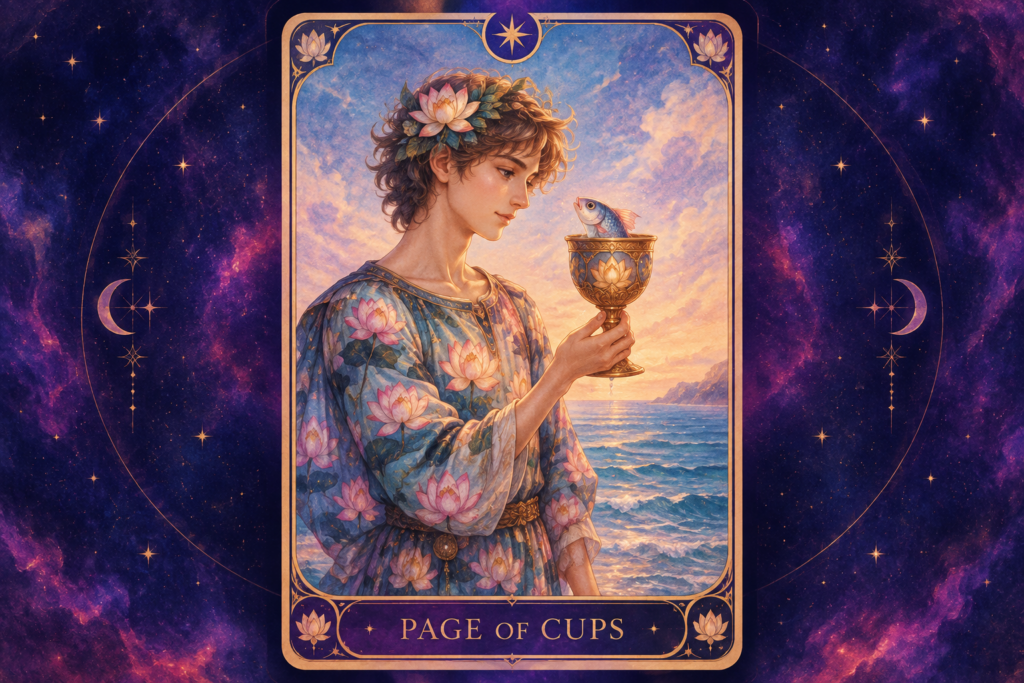
The reference point for nearly all modern tarot interpretation is Pamela Colman Smith’s 1909 artwork for the Rider-Waite deck. Every element on the Page of Cups card translates directly into how this person feels.
The Page. Pages are the youngest court rank. In a feelings reading, that youth is about emotional experience, not age. A 45-year-old can give off pure Page of Cups energy when he catches feelings for the first time since his divorce. The posture matters too: the figure stands relaxed, one hand on hip, gazing at the cup rather than at any destination. The person is absorbed in the feeling itself.
The Cup. The Cup is the heart, offered rather than guarded. The Page holds it out in front of the body, which is the opposite of the clutched, defensive posture you see in the Four of Cups. Whoever this card represents is open to you. They have not learned to hide their heart yet, and that is both the charm and the risk.
The Fish. A fish pokes its head out of the cup and looks the Page in the eye. It is the surprise element: an unexpected feeling, an intuitive flash, a message that arrives out of nowhere. For feelings, the fish is the moment someone realises “oh no, I like them.” It also connects to the idea of a message from the subconscious, which is why this card so often precedes a text, a confession, or an awkward compliment.
The sea and the floral tunic. Water laps behind the Page, calm rather than stormy. The tunic is patterned with lotus blossoms, a flower that grows out of water. Emotion is the whole environment here. This person is not calculating; they are feeling their way forward, and their intuition is doing more work than their logic.
The water element. Every card in the Suit of Cups speaks the language of emotion, intuition, and relationship. The Page is where that language is first being learned. Expect feelings expressed clumsily, sweetly, and sometimes with more intensity than the situation warrants.
Page of Cups upright as how someone feels about you
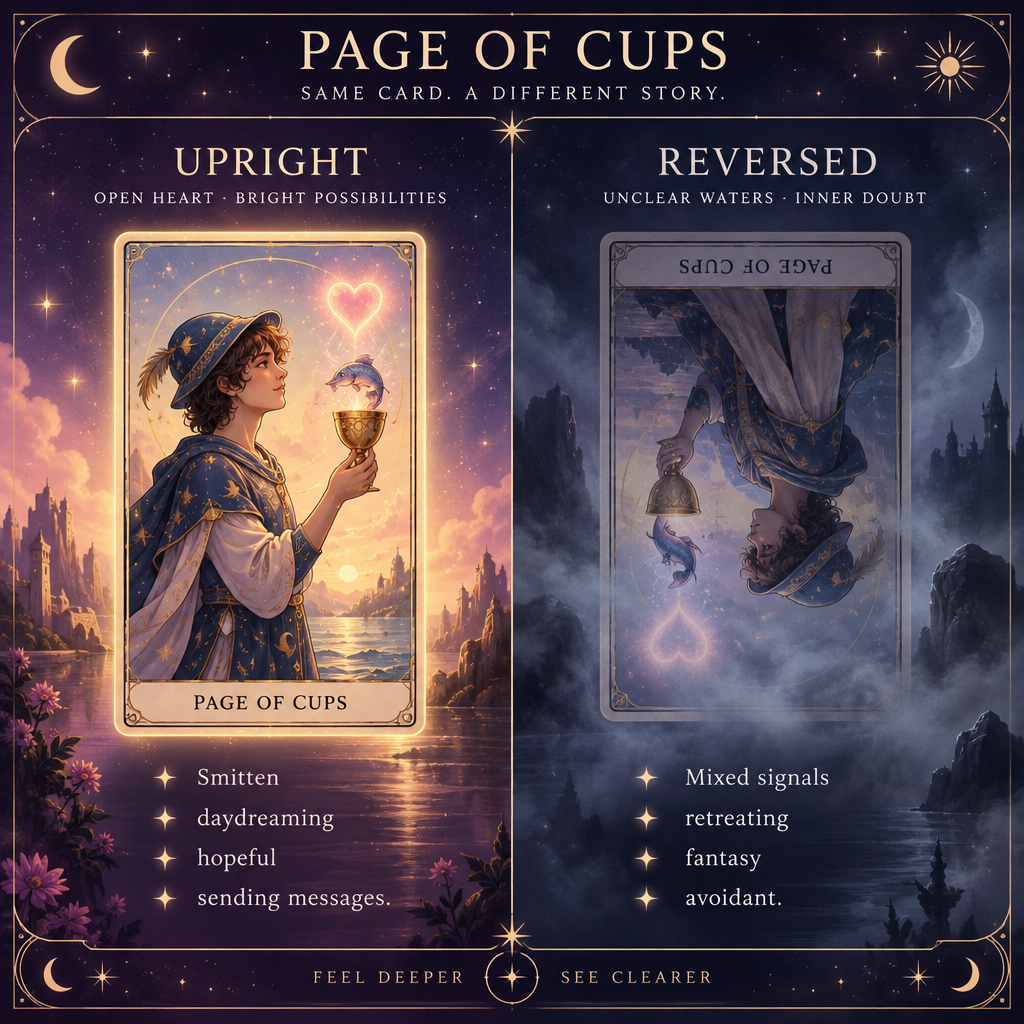
Here is the full range of what the upright card signals, because “infatuation” alone undersells it.
They want to tell you something
The Page of Cups is the court card most associated with romantic messages. In practice this looks like a long text they drafted three times, a handwritten note, a song they send you with “this reminded me of you,” or a tentative “can we talk?” If you asked how someone feels and this card appears, a confession or at least a clear signal of interest is likely within the near term. Pages carry news; the Page of Cups carries news of the heart.
They are experiencing limerence
Psychologist Dorothy Tennov coined the term limerence in her 1979 book Love and Limerence to describe the involuntary, obsessive early stage of romantic attraction: intrusive thoughts, acute sensitivity to any sign of reciprocation, and mood swings tied to the other person’s behaviour. That is the Page of Cups upright almost exactly. The person feels a lot, notices every detail of how you respond, and reads significance into small gestures. It is flattering. It is also not yet love in the mature sense, because it has not been tested against reality.
“Fish love” and the question of what they actually love
There is a well-known teaching, popularised by Rabbi Abraham Twerski, about a young man who says he loves fish. The response: you don’t love the fish, you love how it tastes to you; if you loved the fish you wouldn’t pull it from the water and cook it. Much romantic feeling is “fish love,” a love of what the other person provides. The fish rising from the Page’s cup is a useful reminder to ask which kind of love this is. Upright, the card usually points to a genuine, tender fascination with you specifically, but it also carries the possibility that the person is in love with the feeling of being in love. You cannot tell which from a single card. You can tell from whether they stay curious about you once the novelty fades.
They feel safe enough to be vulnerable
The inner-child quality of the Page is often misread as immaturity. Upright, it is closer to emotional openness. This person is willing to look a little foolish for you, to blurt out something awkward, to show excitement without playing it cool. In attachment theory terms, this is a person leaning toward a secure or at least hopeful stance: they want closeness and they are not pretending otherwise.
They express affection creatively
Page of Cups people write poems, make playlists, cook something you mentioned once, or draw you a bad cartoon. If you receive a gift that is more thoughtful than expensive, that is this card at work.
Page of Cups reversed as how someone feels about you
The old reading of the reversed Page as “temper tantrums” is too narrow. The modern consensus among readers is that the reversal describes emotional energy that has turned inward, stalled, or distorted. These are the main patterns.
Escapism: daydreaming as a substitute for action
Reversed, the Page keeps staring into the cup and never leaves the shore. The person likes you, possibly a great deal, but they are satisfied with the fantasy version of the relationship. Daydreaming about you is safer than asking you out. If you have been waiting weeks for someone to make a move and this card appears, they probably will not without a nudge.
Mixed signals
Hot one day, distant the next. Enthusiastic in private, cool in public. The reversed Page has feelings they have not reconciled with their fears, and the result is inconsistency. This is not necessarily manipulation; often it is a person who panics after showing too much and overcorrects.
Fantasy versus reality
Sometimes the reversed card means the person has fallen for an idealised image of you rather than the actual you. They may be disappointed by ordinary things: that you are tired after work, that you have opinions they disagree with, that you are a person rather than a muse. When this is the dynamic, the relationship struggles the moment it moves from text messages to Tuesday nights.
Emotional manipulation and guilt
In its most negative expression, the reversed Page of Cups is someone who uses emotional displays to get their way: sulking, playing the victim, sudden tears when challenged. The feelings may be real but they are deployed as leverage. Pair this with cards like the Seven of Swords or the Moon and treat it as a warning.
Blocked intuition
The person senses something about the connection and refuses to look at it. They avoid honest conversation because they already half know what it would reveal. Reversed, the fish has slipped back under the water.
Insecurity and anxious attachment
The classic reading still applies. The person may want reassurance constantly, read rejection into neutral replies, and struggle to say what they need. In attachment terms this maps closely onto an anxious-preoccupied pattern. They care about you; they just do not yet trust that you care back.
How someone sees you versus how they feel
These are different questions and the card answers them differently.
Asked how someone sees you, the Page of Cups says they perceive you as sweet, sensitive, creative, a little dreamy, and emotionally open. They may also see you as young in some way: less experienced than them, naive about relationships, or simply charmingly unguarded. Whether that perception is flattering or patronising depends on surrounding cards.
Asked how someone feels, the card describes their internal state, as covered above. A person can see you as a Page of Cups type and feel nothing romantic, or feel full Page of Cups infatuation while seeing you as the more mature one. Keep the two questions separate in your spread.
Page of Cups feelings by relationship stage
Singles, crushes, and unrequited love
Upright: Your crush likes you back, or at least is curious. The feeling is probably at the stage where they notice you more than they have admitted to themselves. If you are asking about a stranger or someone you have barely spoken to, the card can also describe your feelings being projected forward, so check whether the other person has actually shown interest.
Reversed: They may be aware of your interest and unsure how to respond, or they are nursing a fantasy about someone else. For unrequited love specifically, the reversed Page is a kind nudge: you may be in love with a story rather than a person.
What to do: Upright, make a low-stakes move. The Page responds to directness far better than to games. Reversed, stop reading tea leaves in their Instagram likes and ask a straightforward question, or redirect your energy.
New and early relationships
Upright: This is the card’s natural home. Both of you are in the honeymoon phase, exchanging long messages and discovering shared tastes. Using Robert Sternberg’s Triangular Theory of Love, which breaks love into intimacy, passion, and commitment, the Page of Cups is high on early intimacy and budding passion but near zero on commitment. That is appropriate for the stage. Enjoy it, and do not mistake it for the finished product.
Reversed: One of you is pulling back, idealising, or keeping things vague to avoid defining the relationship. Expect inconsistent communication and a sense that the other person is “not quite there” even when they are physically present.
What to do: Upright, let the relationship move at its own pace and introduce small doses of reality: meet their friends, have a boring errand day together. Reversed, name what you are noticing. “I feel like we are great in texts and awkward in person” is exactly the conversation this card is asking for.
Existing and long-term relationships
Upright: A welcome card. It signals renewed tenderness, a partner rediscovering why they fell for you, or a sweet gesture arriving unexpectedly. Sometimes it literally points to a child: pregnancy news, a desire to start a family, or a partner reconnecting with their playful side. Your partner feels affection that is softer and more romantic than usual.
Reversed: Your partner may be emotionally checked out, retreating into their own head, or avoiding a conversation about something that is bothering them. It can also flag emotional immaturity showing up under stress: sulking instead of talking, passive aggression, or escapism through screens, hobbies, or drink.
What to do: Upright, meet the gesture with one of your own; the Page thrives on reciprocity. Reversed, create a safe opening rather than an interrogation. Ask what they have been daydreaming about lately. The answer often reveals what they are avoiding.
An ex and the question of reconciliation
Upright: Your ex still has feelings, and they are the wistful, nostalgic kind. They replay the good memories. A message from them is plausible. The card does not, by itself, say they have grown or that the problems that ended things are resolved. It says the heart still flickers.
Reversed: Your ex is stuck in fantasy about what you had, or is sending breadcrumbs without any intention of committing. Mixed signals from an ex, the “hey stranger” text every few months, is textbook reversed Page of Cups. It can also mean they are idealising you from a distance precisely because distance keeps you unreal.
What to do: Upright, if you want reconciliation, respond but ask for a real conversation, not a nostalgic one. Reversed, protect yourself. Decide what you would need to see before re-engaging, and do not accept vague warmth as a substitute.
Marriage, engagement, and commitment
Upright: Here the card is encouraging but incomplete. Your partner feels deeply and romantically about you and may be dreaming about a shared future. For a proposal question, the Page of Cups can indicate the idea is forming, and occasionally it foreshadows the announcement itself. Pair it with the Four of Wands, the Ten of Cups, or the Hierophant for a strong signal; alone, it describes the feeling more than the decision.
Reversed: Your partner is not emotionally ready to commit, even if they say they want to. They may love the idea of marriage more than its reality, or they may be avoiding the subject altogether. Fear of growing up, in the emotional sense, is a common thread.
What to do: Upright, talk about the future in concrete terms and see whether the dreaminess holds up against logistics. Reversed, resist pressuring; you cannot rush a Page into becoming a King. Decide instead how long you are willing to wait for emotional maturity to catch up with affection.
Page of Cups yes or no in love
Does this person like me? Yes.
Are they in love with me? Not yet in the mature sense, but they are heading there.
Will they contact me? Upright, yes, likely soon. Reversed, maybe, but inconsistently.
Should I pursue this? Yes, gently, with realistic expectations.
Will this become a committed relationship? Unclear from this card alone. It describes a beginning, not an outcome.
Is my ex coming back? Upright leans yes for contact, neutral for lasting reconciliation. Reversed leans no.
Page of Cups as a person
When the card represents someone’s character rather than their passing feelings, you are looking at a sensitive, imaginative, artistic type who leads with emotion. Readers who like personality frameworks often match this card to the ISFP profile: gentle, aesthetically driven, conflict-averse, intensely private about deep feelings while being outwardly warm. They cry at films, remember what you said six months ago, and struggle to initiate hard conversations.
As a partner, this person is loyal and attentive once secure, and prone to retreat or sulk when they feel criticised. They need reassurance delivered softly. They will not respond well to ultimatums, and they will flourish with a partner who takes their creativity seriously.
Page, Knight, and Queen of Cups: where this feeling sits on the maturity scale
Court cards in the same suit describe the same emotional language at different levels of development. Placing the Page against its neighbours makes its meaning sharper.
| Card | Emotional stage | As feelings for you | Typical behaviour |
|---|---|---|---|
| Page of Cups | Discovering feelings | A crush, infatuation, tentative openness | Sends thoughtful messages, hesitates to act |
| Knight of Cups | Acting on feelings | Active romantic pursuit, idealised courtship | Grand gestures, flattery, sometimes unreliable follow-through |
| Queen of Cups | Mastering feelings | Deep empathetic love, emotional security | Listens, nurtures, holds space without needing to be asked |
If you draw the Page and hoped for the Queen, the gap is not about how much the person cares. It is about how practised they are at carrying what they feel. A Page can grow into a Queen. The question is whether they are willing to, and whether you are willing to wait.
FAQ
What does the Page of Cups mean as feelings for a crush?
Your crush has noticed you and feels a nervous, sincere attraction. They probably think about you more than they let on and are deciding whether to say something. A small, direct gesture from you will usually tip the balance.
What does the Page of Cups reversed mean as feelings from an ex?
Your ex still has emotions tied to you but is handling them immaturely: nostalgia without action, breadcrumb messages, or idealising the past without addressing why it ended. Treat warmth from a reversed Page of Cups ex as a mood, not a plan.
Is the Page of Cups a yes or no in love?
Yes for attraction, affection, and the chance of a romantic message. Not yet for commitment. The card describes the opening chapter of a feeling, so it confirms interest while leaving the ending open.
Does the Page of Cups mean someone is going to confess their feelings?
Upright, it is one of the strongest indicators in the deck that a romantic message or confession is coming. Reversed, the feeling exists but the person is likely to hold back or express it indirectly.
Can the Page of Cups mean the person is immature?
It can, especially reversed, but upright it more often describes emotional openness and wonder rather than immaturity. The difference lies in whether the person acts on their feelings honestly or hides inside them.
What does the Page of Cups mean for a long-term relationship?
Upright, a renewal of tenderness, playfulness, or sometimes news about children. Reversed, a partner who has emotionally withdrawn or is avoiding a conversation. Either way, the card is asking the couple to reconnect with the softer, less guarded version of their love.