
Pulled the Page of Cups as the outcome card in a love reading? Upright, it points to a tender new beginning: a confession, a message, a first date that feels unexpectedly sweet, or a long-term relationship rediscovering its softness. Reversed, the outcome is a connection that stays in the daydream stage, stalls, or asks you to grow up emotionally before it can go anywhere.
The Short Answer
The Page of Cups is a gentle yes for love when upright. It is not the thunderclap of The Lovers or the settled commitment of the Ten of Cups. It is the beginning of feelings, honestly expressed. Expect a message, an admission, an invitation, or a fresh wave of affection, and expect it to arrive in a slightly awkward, earnest, unpolished way.
Reversed, the answer shifts to “not yet.” The feelings may exist, but one of you is hiding them, idealising the other person, or too bruised from the past to act. The outcome is not a hard no. It is a delay with conditions attached, and the conditions are emotional honesty and maturity.
Card Symbolism and What It Says About Love
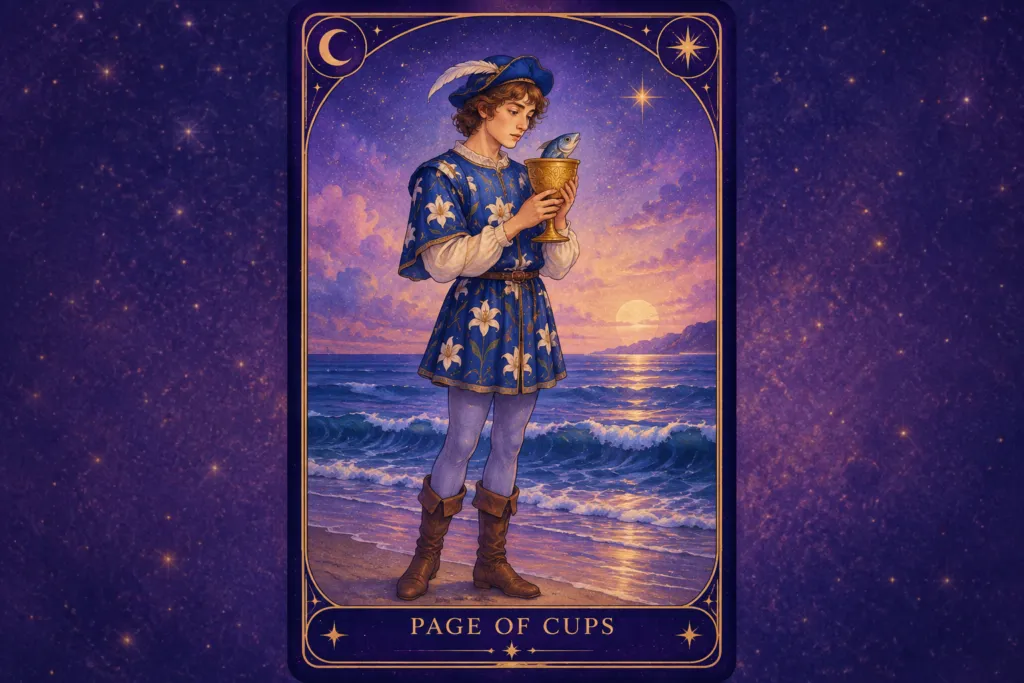
In the Rider-Waite-Smith deck, a young figure in a blue tunic patterned with lilies stands on a shoreline, holding a golden cup. A fish pokes its head out of the cup and the two seem to be looking at each other. Behind the Page, calm waves roll in under a soft sky. Every detail on this card translates directly into a love outcome.
The fish in the cup
The fish is the surprise. It represents a feeling or an idea surfacing from the unconscious when you least expect it. In a love reading this is the crush you did not plan, the ex who suddenly texts, or the realisation that the friend you have known for years makes your chest tight. The Page is not alarmed by the fish. The Page is curious. That is the attitude the card asks of you: meet the unexpected feeling with openness rather than suspicion.
The cup
Cups hold emotion. The Page’s cup is offered forward, held at chest height, as if about to be shared. This is why the card so often predicts an offer of some kind: a confession, an invitation, a proposal in a long relationship, or a sincere apology from someone who hurt you. The cup is also small and single. One feeling, one message, one beginning. Do not read it as a flood.
The water and the shoreline
The Page stands on land, with the sea behind. The emotional depths are present but the Page has not waded in yet. In outcome position this is precise: the relationship is at the edge of something deeper, not in the middle of it. The waves are gentle, which tells you the emotional weather is calm. There is no storm in this outcome, no drama. Whatever develops will develop quietly.
The youthful figure
Pages are students. They have talent but no track record. In love, the youthful figure means the connection (or the person) is sincere but inexperienced, sometimes naive, occasionally clumsy. Someone who overshares on the first date. Someone who writes you a poem. Someone who has never been in a serious relationship, or who has been single so long they feel like a beginner again. The lilies on the tunic reinforce purity of intention. The Page’s hat, with its flowing scarf, suggests imagination and a head full of romantic ideas.
The pose
Look at the Page’s weight. It rests on one leg, hand on hip, relaxed and slightly theatrical. This is someone comfortable being seen feeling something. That body language is the single biggest clue to the card’s love meaning: emotional vulnerability without embarrassment.
Page of Cups Keywords at a Glance
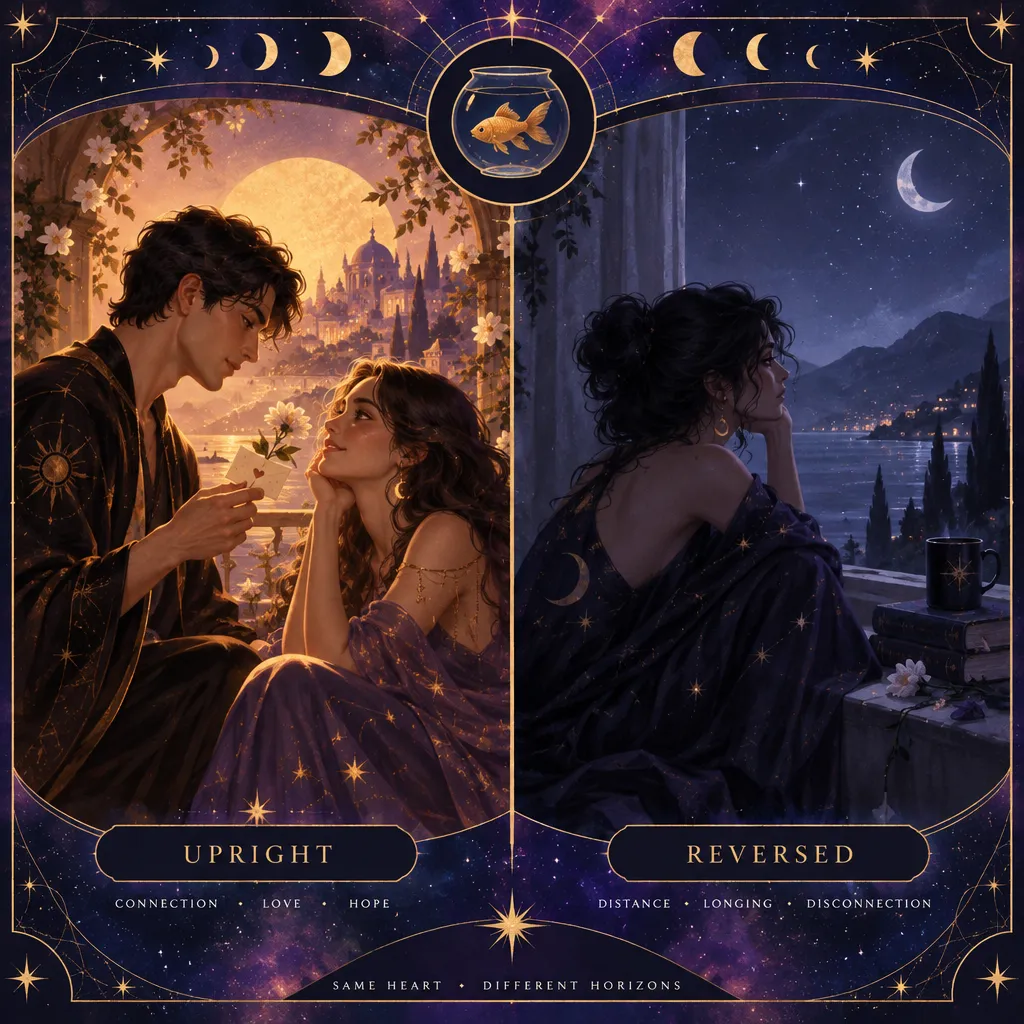
| Upright | Reversed |
|---|---|
| Open-hearted | Emotionally guarded |
| New feelings surfacing | Suppressed or unspoken feelings |
| Sweet messages, confessions | Silence, ghosting, withdrawal |
| Playful, dreamy, romantic | Escapist, living in fantasy |
| Creative expressions of love | Dramatic or passive-aggressive behaviour |
| Intuitive emotional read | Misreading signals, projection |
| Fresh start, healing | Stagnation, repeating old wounds |
| Sincere but inexperienced | Immature, unrealistic expectations |
| Gentle yes | Not yet, conditional |
Page of Cups Upright as a Love Outcome
For singles
Upright, this card tells a single person that someone is about to show interest, and that the interest will be sincere rather than strategic. It is the classic “admirer” card. Often the person is younger than you, younger in spirit, or simply new to romance. Sometimes it is a secret crush finally working up the nerve. Sometimes it is you developing feelings you had not noticed.
The message frequently arrives as literal communication. A DM from someone you had written off. A reply on a dating app that is oddly thoughtful. A friend confessing. Pages are messengers, and the Page of Cups carries emotional news.
The deeper outcome for singles is about your own heart rather than another person’s. The card predicts that you will feel something again. If you have been numb, cynical, or protecting yourself after a bad relationship, the Page of Cups says the ice is cracking. That matters more than any specific suitor.
What to do:
- Answer the message, even if it comes from an unexpected source. The fish in the cup is rarely the person you had in mind.
- Say yes to low-stakes dates. The Page’s energy is playful, not serious. A walk, a coffee, a gallery. Not a three-hour dinner with an agenda.
- Stop pre-screening people for marriage potential. This outcome rewards curiosity and punishes checklists.
For existing relationships
For a couple, the upright Page of Cups predicts a return of tenderness. Partners who have slipped into logistics mode (bills, kids, whose turn it is to cook) start doing small, slightly silly romantic things again. Notes in lunch boxes. A song sent at 2pm for no reason. A compliment that lands like it did in the first month.
The card is strongly associated with announcements inside a relationship, and three come up repeatedly in practice:
- A proposal or talk of engagement. The cup offered forward is an offer. If you have been wondering whether your partner is thinking about it, this outcome says the conversation is coming, and it will be heartfelt rather than performative.
- Pregnancy or news about children. The Page is the “child” of the Cups court, and the fish is a very old fertility symbol. The card does not guarantee a pregnancy, but it appears often enough in that context that readers treat it as a genuine indicator, especially alongside the Empress, the Ace of Cups, or the Sun.
- A reconciliation after a rough patch. If you asked about a relationship under strain, the Page of Cups outcome is an apology, a softening, one partner finally saying “I miss how we used to be.”
What to do:
- Initiate the small gesture rather than waiting for it. The card responds to whoever moves first.
- If you have been holding back a hope (marriage, a baby, moving in together), voice it. The Page gets to say vulnerable things out loud.
- Rebuild play. Couples who have stopped teasing each other, stopped being silly, are the ones this card most wants to shake loose.
For potential relationships
This is the most common context for the card, because people pull outcome cards about people they are not yet dating. Upright, the Page of Cups says the potential is real and the other person’s interest is genuine. It also says the connection is at an early, fragile stage. Nobody has committed to anything, and nobody should pretend otherwise.
The feelings the card describes are a crush rather than a plan. The person you asked about thinks about you more than they have admitted. They might have rehearsed a text. They are drawn to you emotionally, possibly artistically, and they are a little intimidated. If you asked “how do they feel about me,” the answer is: warmly, nervously, and with a lot of imagination filling in the gaps.
The caution hidden in the upright card is exactly that imagination. Pages idealise. The person may be in love with a version of you built from three conversations and a social media profile. For the potential to become something real, the two of you need actual time together so the fantasy can meet the person.
What to do:
- Make the first move if you have been waiting. The Page’s cup is offered, not demanded. A clear, light-touch invitation works.
- Keep expectations at Page level. You are at the beginning. Judge the connection on how it feels in person, not how it feels in your head at midnight.
- Watch for whether vulnerability is returned. If you share something honest and they share something back, the card is delivering. If they deflect with charm, you may be dealing with the Knight of Cups instead, who flirts beautifully and commits rarely.
For an ex and reconciliation
Page of Cups reconciliation readings are where this card does its most interesting work. Upright, in the outcome position, it predicts contact from the ex or a meaningful softening on your side. The contact will be emotional, not tactical. An apology, an “I’ve been thinking about you,” an acknowledgement of what went wrong. Pages are sincere even when they are clumsy.
The card also says the ex has done some growing. The fish surfacing from the cup is new insight, a feeling they did not have access to before. This is why the Page of Cups is one of the more hopeful cards for reconciliation, more hopeful than the Six of Cups, which can be pure nostalgia.
But the youthful figure sets a condition. A Page-level reconciliation is a fresh start, not a resumption. You cannot pick up at the point where things fell apart. If you get back together under this card, you are starting at date one, with new rules, and with both people treating each other as slightly unknown. If either of you tries to skip that stage, the old patterns return within weeks.
There is a second reading for exes that readers sometimes miss. The Page of Cups outcome can mean your own heart healing enough that the ex stops mattering. The new feeling in the cup might be for someone else, or for yourself. If you have been asking the same question about the same person for months, consider that the card is answering a question you did not ask.
What to do:
- If they reach out, respond honestly rather than coolly. Playing hard to get wastes the window this card opens.
- Set the terms of a fresh start explicitly. Name the one or two things that ended it and agree on how they will be handled differently.
- Pull a clarifier. Paired with the Two of Cups or the Ace of Cups, reconciliation is well supported. Paired with the Five of Cups or the Three of Swords, the Page’s sweetness is a temporary reprieve and you should protect yourself.
Page of Cups Feelings in Love
When you specifically ask “what does this person feel for me” and receive the Page of Cups, the feelings are:
- Infatuated. They have a crush and are at the stage where everything about you seems charming.
- Shy about it. They have not said it, or said it badly.
- Idealising. They project a lot. You are partly a fantasy to them right now.
- Emotionally open. They would respond well to a sincere approach from you.
- Slightly intimidated. They see you as somehow more experienced, more established, or out of their league.
What the feelings are not: calculated, lustful without warmth, or indifferent. If someone’s feelings come up as the Page of Cups, they care. Whether they will act on it depends on the surrounding cards and, frankly, on whether you give them an opening.
Page of Cups as a Person in Love
Sometimes the outcome card describes who you will end up with, or who your partner fundamentally is. The Page of Cups as a person is:
- Sensitive and easily moved. Cries at films, remembers what you said in passing, notices your moods before you do.
- Creative or drawn to creative people. Musicians, writers, illustrators, and people who make elaborate playlists are classic Page of Cups types.
- Romantic in an old-fashioned, slightly impractical way. Handwritten letters. Surprise flowers that arrive on the wrong day.
- Young, or young at heart. Age on paper matters less than the quality of wide-eyed sincerity.
- Prone to daydreaming and to taking things personally. The same sensitivity that makes them a wonderful partner means offhand remarks sting for days.
- Loyal once attached, but slow to assert boundaries. They would rather feel hurt quietly than start a conflict.
Astrologically this personality maps to the water signs. Cancer gives the nurturing and the moodiness, Pisces the dreaminess and the artistic streak, Scorpio the depth of attachment and the tendency to brood. A partner with strong placements in these signs, especially a Pisces or Cancer Moon, is textbook Page of Cups.
Loving a Page of Cups person is easy at the start and requires patience later. They need reassurance more than most. In return you get a partner who is emotionally present in a way that is rare.
Page of Cups Reversed as a Love Outcome
Reversed, the fish slips back into the water. The feeling that was about to surface stays hidden, or surfaces in a distorted form. Here is how the reversal plays out in each scenario.
Reversed for singles
The reversed Page of Cups tells a single person that the block is internal. You are not meeting people because, on some level, you are not letting yourself feel anything. Past wounds have taught you that openness costs too much. You may be swiping and dating but keeping every conversation at surface level, or falling for people who are unavailable precisely because unavailability is safe.
A second reversed pattern is the opposite: feeling far too much, far too fast, for people who barely know you exist. The daydream relationship. The crush on the barista built into a full future in your head. Reversed, the Page’s imagination runs without a connection to reality, and the outcome is disappointment when reality fails to match.
A third reading is an admirer who is emotionally immature. Someone interested in you who sulks when you are busy, sends dramatic messages, disappears and reappears, or cannot handle a direct conversation. The feelings are real but the person cannot carry them responsibly.
What to do:
- Do the honest audit. Are you single because of circumstance or because you have made yourself unreachable? The reversed card almost always answers “unreachable.”
- Separate fantasy from data. Before investing emotionally, ask what you actually know about this person from direct experience.
- If someone’s interest comes with drama, step back early. Reversed Page patterns do not improve under pressure.
Reversed for existing relationships
In a couple, the reversed Page of Cups is stagnation. Not conflict, which would show up as Swords, but a slow draining of enthusiasm. The relationship has become comfortable and flat. Nobody is doing the small sweet things. Affection has become routine or disappeared. Partners talk about schedules and not about feelings.
Underneath the flatness there is usually suppression. One partner has feelings they are not voicing: resentment, loneliness, a longing for how things used to be, sometimes attraction to someone else. The reversed Page holds the cup upside down. Whatever was in it has been poured out quietly, out of sight.
Escapism is the other major theme. One or both of you are checking out through screens, work, drink, hobbies, or a rich inner fantasy life that substitutes for actual connection. The relationship survives on autopilot while the real emotional energy goes elsewhere.
In its sharpest form, the reversal describes emotional immaturity inside a long relationship: tantrums instead of conversations, the silent treatment, guilt trips, one partner making the other responsible for all their feelings. The codependency reading belongs here too. Boundaries have dissolved and one person’s moods dictate the household.
What to do:
- Name the flatness out loud. “I feel like we’ve stopped being tender with each other” is a Page of Cups sentence, and it breaks the spell.
- Ask the suppressed question directly. If you suspect your partner is holding something back, give them a safe opening and then genuinely listen.
- Reintroduce one deliberate act of play or affection per week, and track whether it is reciprocated. If it is met with indifference repeatedly, the relationship has a deeper problem than the Page can describe and you should look at the cards around it.
Reversed for potential relationships
This is the unrequited love position. Reversed, the Page of Cups says one person feels considerably more than the other, and the imbalance is not going to correct itself on its own. If you asked about someone you are interested in, the most likely reading is that they are not as invested as you hope, or that they are interested but too immature or guarded to do anything about it.
The daydream-versus-reality gap is at its widest here. You may be in a relationship with your idea of this person. The signals you are reading as interest are being inflated by hope. Reversed Pages misread emotional cues in both directions, so it is also possible they are interested and you have talked yourself out of believing it. Either way, the outcome is that nothing happens unless someone forces clarity.
Sometimes the reversed card describes the person themselves: someone emotionally unavailable, recently out of a relationship and not healed, or prone to intense beginnings that fizzle within weeks. The feelings they express will be sincere in the moment and gone by the following month.
What to do:
- Get real information. Ask them something that requires an honest answer about where they stand. Vagueness in reply is your answer.
- Set a time limit on the uncertainty. Decide how long you will wait for clarity, then hold yourself to it.
- Re-evaluate your emotional investment honestly. If you are giving far more than you are getting back, the reversed Page says that pattern continues.
Reversed for an ex and reconciliation
Reversed, the ex is not ready, and quite possibly neither are you. Contact may come, but it will be inconsistent, emotionally messy, or driven by loneliness rather than genuine change. Late-night messages. Nostalgia without accountability. The reversed Page of Cups reconciliation is one where the same conversation happens again and nobody has learned anything.
The card also warns about your own idealising. Time has edited the memory of the relationship. You remember the sweet beginning (the upright Page) and have blurred the reasons it ended. If you are pulling cards about this person repeatedly, the reversal says the attachment has become a fantasy you are using to avoid the present.
Emotional immaturity on the ex’s side is a common reading. They want the comfort of you without the work of changing. They may be hoovering: reaching out just enough to keep you attached, then withdrawing.
What to do:
- Do not initiate. If reconciliation is meant to happen under this card, it needs to come from demonstrated change on their side, not from your effort.
- Write down the concrete reasons the relationship ended and reread them before responding to any contact.
- Redirect the emotional energy. The reversed Page often appears for people who have stopped meeting anyone new because they are still half-waiting. Stop waiting.
Water, Astrology and Timing
The Page of Cups belongs to the Water element, which governs emotion, intuition, memory, and receptivity. Water does not force. It finds the lowest point and fills it. In love outcomes this translates to connections that develop by feel rather than by plan, and to timing that is slow and organic.
The card is associated with the three water signs. Cancer brings the nurturing, home-building side and the hope of family. Scorpio brings emotional intensity and the capacity for both deep bonding and deep hurt. Pisces brings romance, imagination, and the risk of illusion. If your question involves a person born under one of these signs, or with a water-sign Moon or Venus, the Page of Cups is doubly significant.
For timing questions, Pages traditionally indicate the early stage of a cycle. Some readers associate the Cups court with autumn, others with the water-sign seasons (late June to late July for Cancer, late October to late November for Scorpio, late February to late March for Pisces). Treat timing from a single court card loosely. The more reliable timing message is “soon, but small.”
How the Page of Cups Develops: Related Cards
Tarot courts tell a story, and the Page is chapter one. Knowing what comes next helps you read the outcome in context.
Page of Cups to Knight of Cups. The crush becomes pursuit. The Knight arrives with flowers and grand gestures, which is more exciting and less reliable. If the Knight appears alongside the Page, the romance is about to escalate. If the Knight appears instead of the Page in a follow-up reading, be careful: Knights of Cups are famously better at the chase than at staying.
Page of Cups to Two of Cups. This is the ideal progression. The tentative offer becomes a mutual exchange. The Two of Cups is the card of genuine partnership, the moment two people meet each other halfway. If you pull the Page as outcome and the Two of Cups as a clarifier, the beginning is going somewhere real.
Page of Cups to Ace of Cups. The Ace is the overflow, the full emotional opening. Page then Ace suggests a feeling that starts small and becomes overwhelming in the best sense. Often linked to falling properly in love, or to pregnancy.
Page of Cups and Four of Cups. The Four is apathy, the refusal of the cup being offered. Upright Page next to the Four of Cups says the offer will be made but not accepted. Reversed Page with the Four of Cups is the stagnant long-term relationship described above, in its most entrenched form.
Page of Cups and Six of Cups. Together these point strongly to the past: an ex, a childhood friend, a return to innocence. For reconciliation questions, this pair is the most direct “they are coming back” signal in the Cups suit.
Page of Cups and the Queen or King of Cups. The Page is learning what the Queen and King have mastered. If a mature Cups court appears with the Page, the outcome involves someone emotionally wiser guiding or balancing the Page’s inexperience. In a relationship between a Page-type and a Queen-type, the dynamic is tender but can slide into parent-child patterns.
Page of Cups and the Tower or the Three of Swords. The sweet beginning is followed by a hard lesson. The Page’s naivety meets reality. Not a reason to refuse the connection, but a reason to keep your eyes open.
Reading the Card by Spread Position
Most people pulling this card are using one of three formats, and the position matters.
In a single-card daily pull (the default on most tarot apps), the Page of Cups is a mood forecast: expect a moment of emotional openness or a sweet message today. Do not build a relationship prediction from it.
In a three-card past, present, future spread, the Page in the future position is the classic love outcome: a new feeling or offer arriving. In the past position, it describes how things began and asks whether that innocence can be recovered.
In the Celtic Cross outcome position (card ten), the Page of Cups is a solid, gentle prediction that the situation resolves emotionally rather than dramatically. Check card nine (hopes and fears) to see whether you are hoping for this or afraid of it, and card seven (your attitude) to see whether you are the Page in the story.
In relationship spreads with “their feelings” and “your feelings” positions, pay attention to which side the Page lands on. If it is on their side, they are the one with the unspoken crush. If it is on yours, the reading is asking you to act.
FAQ
Is the Page of Cups a yes or no in love?
Upright, yes. It predicts a positive, sincere emotional development: a confession, a message, a fresh start, or renewed affection in an existing relationship. Reversed, the answer is “not yet.” Feelings exist but are blocked by immaturity, fear, idealisation, or unresolved past hurt, and the outcome depends on whether those blocks are addressed.
What does the Page of Cups mean for singles in love?
An admirer is close, often someone unexpected, younger, or new to romance, and their interest is genuine. Just as importantly, your own heart is opening again. The card asks singles to respond to messages, accept low-pressure dates, and stop filtering every prospect through a marriage checklist.
What does the Page of Cups reversed mean as a love outcome?
Reversed, the card points to emotional withdrawal, unrequited or imbalanced feelings, fantasy replacing reality, stagnation in long-term relationships, escapism, and immature behaviour such as sulking or inconsistency. The practical message is to speak the feeling that is being suppressed, test your assumptions against real evidence, and stop investing in anyone who cannot meet you with the same openness.
Does the Page of Cups mean an ex is coming back?
Upright, it often means contact from an ex, and the contact will be emotionally sincere. Reconciliation is possible but only as a genuine fresh start with new terms. Reversed, the ex is not ready, the contact is likely to be inconsistent, and you are probably idealising a relationship that ended for real reasons.
Can the Page of Cups indicate pregnancy or a proposal?
Yes to both, with support from surrounding cards. The Page is the child of the Cups court and the fish is a traditional fertility symbol, so it is one of the cards readers watch for in pregnancy questions, especially next to the Empress, the Ace of Cups, or the Sun. For proposals, the offered cup points to an engagement conversation that is heartfelt and a little nervous rather than grand.
What kind of partner does the Page of Cups represent?
A sensitive, creative, romantic person who is emotionally open and somewhat inexperienced. They notice your moods, make small thoughtful gestures, and take things to heart easily. Think strong Cancer, Pisces, or Scorpio placements, especially a water-sign Moon. They need reassurance and dislike conflict, and in return offer an unusual degree of emotional presence.
Add Yes No Tarot as a preferred source on Google, and the sites you pick are more likely to appear in your Top Stories.