
The Knight of Swords as a love outcome means things are about to move fast, be said plainly, and be decided quickly. Whether that is good news depends on where you stand: single, newly dating, long committed, separated, or hoping an ex returns. This guide breaks the card down by each situation, upright and reversed, plus what it says about feelings, personality, and your next move.
Quick Answer: Is the Knight of Swords a Yes or No in Love?
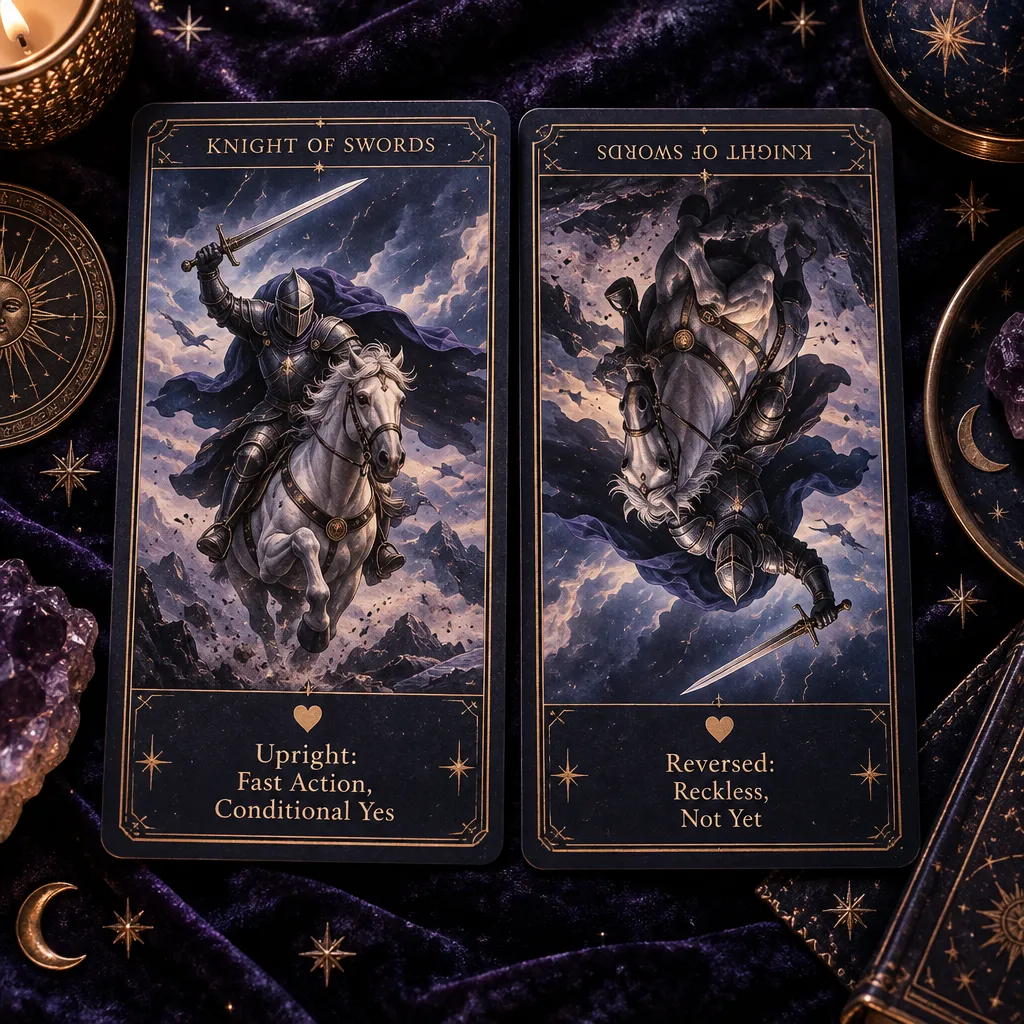
Upright: a conditional yes. Expect speed, directness, and decisive action from the other person or from events themselves. Something that has been stalled will move. The condition is that this card promises momentum, not tenderness, and not necessarily permanence.
Reversed: a no, or at least “not now.” The same energy turns reckless, argumentative, or controlling. If the question is about reconciliation or whether a new romance will last, the reversed Knight tells you the foundation is not there yet.
If you want a one-line verdict for an outcome position: the Knight of Swords delivers a fast, honest result, and you need to be ready for how blunt that result might be.
What the Card Shows: Rider-Waite-Smith Imagery
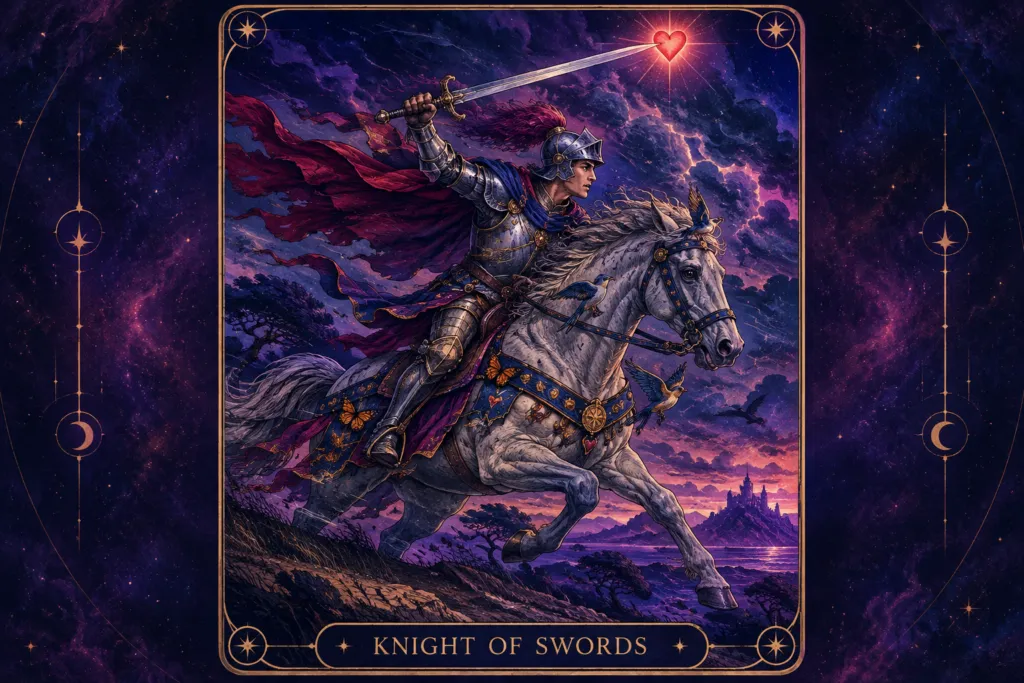
In the Rider-Waite-Smith deck, illustrated by Pamela Colman Smith and first published in 1909, the Knight of Swords is the most kinetic of the four Knights. Every detail on the card feeds into its love meaning.
- The raised sword. Held high and forward, it stands for truth, mental clarity, and a willingness to cut straight to the point. In love, this is the partner who says “I like you, let’s do this” on the second date, or the ex who finally admits what went wrong.
- The charging horse. The grey horse is at full gallop, legs extended, head low. Movement is the whole story. Relationships under this card do not simmer; they sprint.
- The stormy sky. Clouds streak across the background and the trees bend hard in the wind. Turbulence and urgency surround the Knight. He is riding into the weather, not away from it, which tells you this person meets conflict head on rather than avoiding it.
- The armor. Full plate, visor up. He is protected but not hidden. Read this as emotional guarding: he can see you and speak to you, yet getting past the metal to the heart underneath takes effort.
- Birds and butterflies on the harness. Smith decorated the horse’s bridle and the Knight’s cape with butterflies and birds, both traditional Air symbols. These tie the card to thought, speech, and ideas rather than feeling.
Compare him to the Knight of Cups, whose horse walks slowly beside a calm river, and the difference in romantic pace is obvious before you read a single keyword.
Element and Astrology: Why This Knight Loves the Way He Does
Swords belong to the element of Air, which governs thought, language, logic, and communication. Knights carry the active, outward-moving quality of their rank, which is why many readers describe this card as Fire of Air: ideas in motion, words turned into action.
The Golden Dawn system, which Waite drew on, places the Knight of Swords across the final degrees of Taurus and the first two decans of Gemini. Most modern readers simplify this to Gemini, and some extend it to the whole Air triplicity of Gemini, Libra, and Aquarius. All three framings point the same direction for romance:
- Mind before heart. Attraction starts with conversation. This person falls for how you think and how you argue, not how you look at them across a room.
- Direct communication. No hinting, no sulking. If something is wrong, you will hear about it, often more bluntly than you would like.
- Restlessness. Air moves. Routine, emotional processing, and long silences all feel like stagnation to this archetype, which is why commitment can be a sticking point.
- Debate as intimacy. Disagreement is not a threat to this person; it is engagement. A partner who needs harmony at all times will find this exhausting.
Understanding the Air signature stops you from misreading the card. A Knight of Swords partner who skips the flowers and sends you a 400-word text about a documentary is not being cold. That is the love language.
Knight of Swords Upright as a Love Outcome
If You Are Single
Someone is coming in fast. The upright Knight as an outcome for a single querent usually describes a new person who is confident, talkative, and clear about their interest. You will not be left guessing whether they like you. They will ask you out directly, message first, and want to see you again within days rather than weeks.
The sweep-you-off-your-feet quality is real, and so is the risk of mistaking intensity for depth. This card does not tell you the person is your long-term match. It tells you the approach will be bold and the pace quick. Enjoy it, but keep your own judgment switched on.
It can also point to you as the one charging ahead: finally messaging the person you have been watching, saying yes to the date you kept postponing, moving to a new city and dating with intention. Either way, passivity is over.
In a New Relationship
Expect the relationship to accelerate. Labels arrive early, plans get made for months ahead, and the two of you can talk for hours without running out of material. Intellectual compatibility is the strongest asset here. If you share worldviews and enjoy sparring over ideas, this will feel electric.
The caution is foundation. A romance that goes from first date to weekend trips in three weeks has not yet been tested by boredom, illness, or a bad month at work. The Knight does not build; he conquers. Ask yourself whether you have seen this person handle a disappointment, not just a good time.
Watch also for one-sided momentum. If one partner is the Knight and the other is a slower, more emotional type, the faster one can leave the other feeling steamrolled. Naming the pace out loud (“I love this, and I also want to make sure we are not skipping steps”) is exactly the kind of direct conversation this card rewards.
In an Existing or Long-Term Relationship
The card points to clearing the air. Something unspoken is about to get spoken, and the outcome is honest, if occasionally uncomfortable. Think of the couple who finally has the money conversation, or the partner who admits they have been unhappy with how holidays get divided between families.
This is a genuinely good outcome for couples who have been avoiding a topic. Resentment loses its power once it is said out loud. The Knight also favors problem-solving as a team: tackling a move, a renovation, a career change, or a parenting disagreement with energy and shared logic.
The weak spot is tone. Honesty delivered at full gallop can wound. If this card comes up for a long relationship, the work is not whether to speak but how. The content of the message will land; make sure the delivery does not undo it.
During a Separation
Impatience dominates. One or both of you wants resolution now, and the Knight of Swords indicates that decisions will be made quickly: paperwork filed, belongings collected, a definitive conversation held. The limbo ends.
That speed cuts two ways. If you have been waiting months for clarity, this is relief. If you were hoping for a slow, gentle untangling, brace yourself. Words during this period will be sharp. Keep important communication in writing, stick to logistics, and resist the urge to win every exchange.
For a separation that is not yet a decided breakup, the upright Knight suggests the gap closes or widens fast. It rarely means drifting on indefinitely.
Reconciliation and Getting an Ex Back
Upright, the Knight of Swords is one of the more encouraging cards for reconciliation, with a specific flavor. The return, if it happens, will be swift and decisive. Your ex is not going to spend six months liking old photos before making contact. They will reach out directly, say what they want, and expect a clear answer.
A few things to weigh:
- The reason behind the return matters. Air energy can mean they have genuinely thought the situation through and reached a conclusion. It can also mean they are acting on a sudden impulse that will fade just as fast.
- Impatience runs both directions. If you are the one wanting them back, this card can reflect your own urgency, and urgency makes people accept terms they should not.
- Honest conversation is the mechanism. Reconciliation under this card works when both people can name what broke without flinching. If either of you cannot do that, the second attempt repeats the first.
A practical test: when contact comes, does the conversation include specifics about what will be different? If it is all declaration and no detail, the Knight is charging without a map.
Knight of Swords Reversed as a Love Outcome
Reversed, the Knight’s momentum does not disappear. It loses direction. The sword is still swinging, but now it hits things it should not.
If You Are Single
Two common readings. First, you are moving too fast or in the wrong direction: texting someone who has been lukewarm, chasing a connection that only exists in your head, or saying yes to a date you already know is a bad idea because you are tired of waiting. Second, a person arrives whose confidence tips into arrogance. They talk over you, argue for sport, and treat your boundaries as a debate topic.
The reversed Knight for a single person is a signal to slow down and observe. Let the other person show you three consistent weeks before you decide what they are.
In a New Relationship
The classic reversed meaning here is a relationship moving far too fast with nothing underneath it. Moving in after a month, meeting the entire family before you know each other’s middle names, declarations of forever that outrun actual knowledge of the person. One or both of you may feel out of your depth and unwilling to admit it.
Recklessness is the second theme: careless words in arguments, decisions made in anger, plans canceled on a whim. And a third-party element sometimes appears, such as a friend or relative who inserts their opinions aggressively, or an ex who keeps “just checking in.” Someone outside the relationship is stirring the air.
The honest take: a new relationship under the reversed Knight has poor odds unless the pace changes. It is not doomed, but it needs a deliberate slowdown and a frank conversation about why you are rushing.
In an Existing or Long-Term Relationship
Communication has turned into combat. Arguments escalate quickly, old grievances get weaponized, and one partner may use intelligence or verbal skill to dominate rather than resolve. Sarcasm, cutting remarks, and “I was just being honest” used as cover for cruelty all belong here.
This is also where the card’s most serious warning lives. Persistent verbal or psychological control, demands disguised as logic, manipulation, and a cruel streak that comes out whenever you push back are not personality quirks. If that describes your relationship, the reversed Knight is telling you to take it seriously. Talk to someone you trust and consider whether staying is safe.
Not every reversed Knight in a long relationship means abuse, though. More often it describes a couple who have forgotten how to disagree without wounding each other and who need to rebuild basic rules of engagement.
During a Separation
Chaos and spite. One party is acting impulsively, firing off angry messages, involving friends and family in every grievance, or making threats about custody or finances in the heat of the moment. Nothing productive happens because every exchange becomes a fight.
If this is your situation, the advice is almost mechanical: limit direct contact, communicate through written channels or a mediator, and do not respond to provocation in real time. Give every message a twelve-hour delay before replying. The reversed Knight loses most of its power when you refuse to match its speed.
Reconciliation and an Ex Reversed
This is a clear “not now.” If you are asking whether an ex is coming back, the reversed Knight says either they will not, or they will return carrying the same anger and control issues that ended things. A reconciliation attempted under this card tends to be short, volatile, and worse the second time.
Specific patterns to watch for:
- They reappear only to argue, relitigate the breakup, or make you feel responsible for their unhappiness.
- Contact is sudden and intense, then drops to silence for weeks.
- They want you back but refuse to discuss what will change.
- Someone else (a new partner, a friend, a family member) is actively meddling in whether you two speak.
It can also reflect your own state. If you are the one lying awake drafting messages, the reversed Knight asks whether you are pursuing them or pursuing an end to your own discomfort.
Knight of Swords as Feelings: How This Person Feels About You
Asked how someone feels about you, the upright Knight of Swords describes a person who is mentally hooked. You occupy their thoughts. They replay conversations, want to debate you, and feel driven to pursue. The attraction is active and forward-leaning. They are not lying around daydreaming; they are planning how to see you.
What they may not be doing is sitting with their emotions. This person feels through thinking. If you ask “do they love me,” the honest reading is that they are fascinated and motivated, and the deeper emotional layer is either developing or not yet examined. Give it time and watch whether action stays consistent.
Reversed, the feelings turn sour or controlling. They may feel frustrated that you are not responding the way they want, possessive about your attention, or angry over a perceived slight. Sometimes the reversed Knight as feelings simply means they are conflicted and acting erratically because they do not know what they want.
A useful distinction when reading feelings with this card: are they moving toward you, or moving around you? Toward is the upright Knight. Around, in circles, with noise but no landing, is reversed.
Knight of Swords as a Person: The Partner Archetype
When the card represents an actual person in your love life, the profile is consistent across most reading traditions.
Age and sign. Court Knights are usually read as young adults, roughly 20 to 39, or anyone whose energy is youthful and restless regardless of birth date. Air sign placements (Gemini, Libra, Aquarius, especially Gemini) are common markers, though the archetype matters more than the chart.
Traits in love:
- Bold and direct. They tell you what they want and ask what you want.
- Intellectually driven. They fall for your mind and lose interest in people who cannot keep up conversationally.
- Fast-moving. Quick to pursue, quick to commit on paper, sometimes quick to leave.
- Argumentative. Debate is how they connect. They will challenge your opinions and expect you to challenge theirs.
- Emotionally armored. Feelings are discussed as concepts more often than they are expressed.
- Commitment-wary by default. Not because they are dishonest, but because routine feels like a cage. They can commit, and do, when the relationship keeps their mind engaged.
There is a “charming troublemaker” quality to this archetype, the person who is thrilling to date and hard to pin down. Readers sometimes shorthand it as bad-boy or bad-girl energy, which is fair as long as you remember the upright version is honest. The reversed version is the one who uses charm as cover.
How to date one. Match their directness. Hints and silent treatments will not work and will frustrate them. Keep your own life and interests, because they respect independence and lose respect for clinginess. And ask for the emotional expression you need in plain terms. They are far more likely to deliver it when asked clearly than to intuit it.
Lust vs. Love: Reading the Card Honestly
The Knight of Swords can indicate strong physical and intellectual attraction without a matching emotional commitment. The pull is real. The conversation is electric. The chemistry may be excellent. None of that guarantees the person wants a relationship.
Signs you are looking at attraction rather than deepening love under this card:
- Plans are always about the next exciting thing, never about ordinary life together.
- Vulnerability is deflected with humor or a change of subject.
- They are generous with words and stingy with time when things are not fun.
- Surrounding cards are other Swords, Wands, or the Devil, rather than Cups or the Hierophant.
Signs the Knight’s energy is maturing into something steadier:
- They follow through on small, boring promises.
- Conflict leads to resolution instead of a dramatic exit.
- Cards like the Two of Cups, Ten of Pentacles, or the King or Queen of Swords appear nearby, suggesting the Knight is growing up.
Neither reading is a moral judgment. Some of the best relationships start with a Knight of Swords spark. The card simply asks you to know which stage you are in.
Knight of Swords Compared to Related Cards
| Card | Pace in love | Emotional style | What it adds to an outcome reading |
|---|---|---|---|
| Knight of Swords | Very fast | Direct, intellectual, guarded | Honest, rapid movement; truth spoken quickly |
| Knight of Wands | Very fast | Passionate, physical, flirtatious | Adventure and chemistry; even less patience for commitment |
| Knight of Cups | Slow, romantic | Dreamy, expressive, idealistic | Courtship, poetry, emotional offers; risk of fantasy |
| Knight of Pentacles | Slow, steady | Practical, loyal, reserved | Reliability and long-term building; little drama |
| Queen of Swords | Measured | Clear-eyed, independent, honest | Boundaries, discernment, often a single or divorced figure |
| King of Swords | Deliberate | Rational, authoritative, fair | Mature commitment through logic; the Knight grown up |
The most useful contrast is Knight of Swords versus Knight of Wands, because both read as fast and bold. The Wands Knight is driven by desire and excitement and tends to burn out when the thrill fades. The Swords Knight is driven by ideas and conviction and tends to leave when the conversation goes stale. If you are trying to figure out what will hold a particular person, that difference tells you.
Against the King of Swords, the Knight looks like a draft version. The King has learned to pause before speaking and to weigh consequences. When both appear in a love reading, the message is often that the relationship, or the person, is on a path from impulsive honesty to considered honesty.
Love Advice When the Knight of Swords Is Your Outcome
Do:
- Say the thing you have been avoiding. This card rewards directness more than almost any other.
- Match energy with action. If someone is pursuing you clearly and you are interested, respond clearly. Playing hard to get backfires here.
- Set the pace out loud. “I want this to work, so I want us to go at a speed where we actually get to know each other” is a Knight of Swords sentence done well.
- Keep your reasoning sharp. Notice what someone does, not just what they say, and compare the two.
Avoid:
- Confusing speed with certainty. Fast does not mean right.
- Winning arguments at the cost of the relationship. Being correct and being alone is a real outcome under this card.
- Reacting instantly during conflict. Especially reversed, every hour you wait before replying improves the result.
- Ignoring patterns of verbal control because the person is intelligent or charming. Intelligence makes manipulation more effective, not less likely.
If reversed: slow everything down. Pause major decisions for two weeks. Have one honest conversation about pace and tone instead of ten heated ones. If the honest conversation is impossible because it keeps turning into an attack, you have your answer.
FAQ
Is the Knight of Swords a good card for love?
It is a good card for honesty, momentum, and clarity, and a mixed card for romance and emotional depth. Upright, it means things move forward and truth gets spoken. It does not promise tenderness or permanence on its own, so look at surrounding cards for the emotional texture.
Is the Knight of Swords a yes or no in a love reading?
Upright is a conditional yes: expect fast, decisive action. Reversed is a no or “not yet,” pointing to recklessness, conflict, or a shaky foundation.
What does the Knight of Swords mean for a crush?
Your crush is likely to act directly if interested, or the card is telling you to make the first move yourself. Either way, the waiting phase is ending. Reversed, it suggests you are overanalyzing or the person is sending mixed, impulsive signals.
Does the Knight of Swords mean someone is coming back?
Upright, it frequently does, and the return will be quick and clearly stated rather than slow and ambiguous. Reversed, it means they are not coming back in a healthy way, or any return would carry the same anger and control that ended things.
What does the Knight of Swords mean as how someone feels about me?
They are mentally engaged, driven to pursue, and thinking about you constantly. The emotional layer is less developed than the intellectual one, so consistency over time matters. Reversed, they may feel frustrated, possessive, or conflicted.
Is the Knight of Swords a commitment card?
Not by default. It describes a person or phase that favors movement over settling. Commitment is possible when the relationship stays mentally stimulating and the Knight’s directness is met with equal honesty. Paired with the Four of Wands, Ten of Cups, or King of Swords, it reads far more committed.
Which zodiac sign is the Knight of Swords?
Most commonly Gemini. The Golden Dawn system assigns it the span from late Taurus into Gemini, and many readers broaden it to all Air signs: Gemini, Libra, and Aquarius. The elemental quality, Air in motion, matters more than any single sign.
What does the Knight of Swords reversed mean in love beyond red flags?
Recklessness, a relationship moving too fast without foundation, one partner feeling out of their depth, careless or cruel words in arguments, and interference from a third party such as an ex or an opinionated relative. Serious verbal or psychological control is one possible reading, not the only one.
Add Yes No Tarot as a preferred source on Google, and the sites you pick are more likely to appear in your Top Stories.