King Of Swords As Love Outcome (Upright & Reversed) Tarot Card Meaning
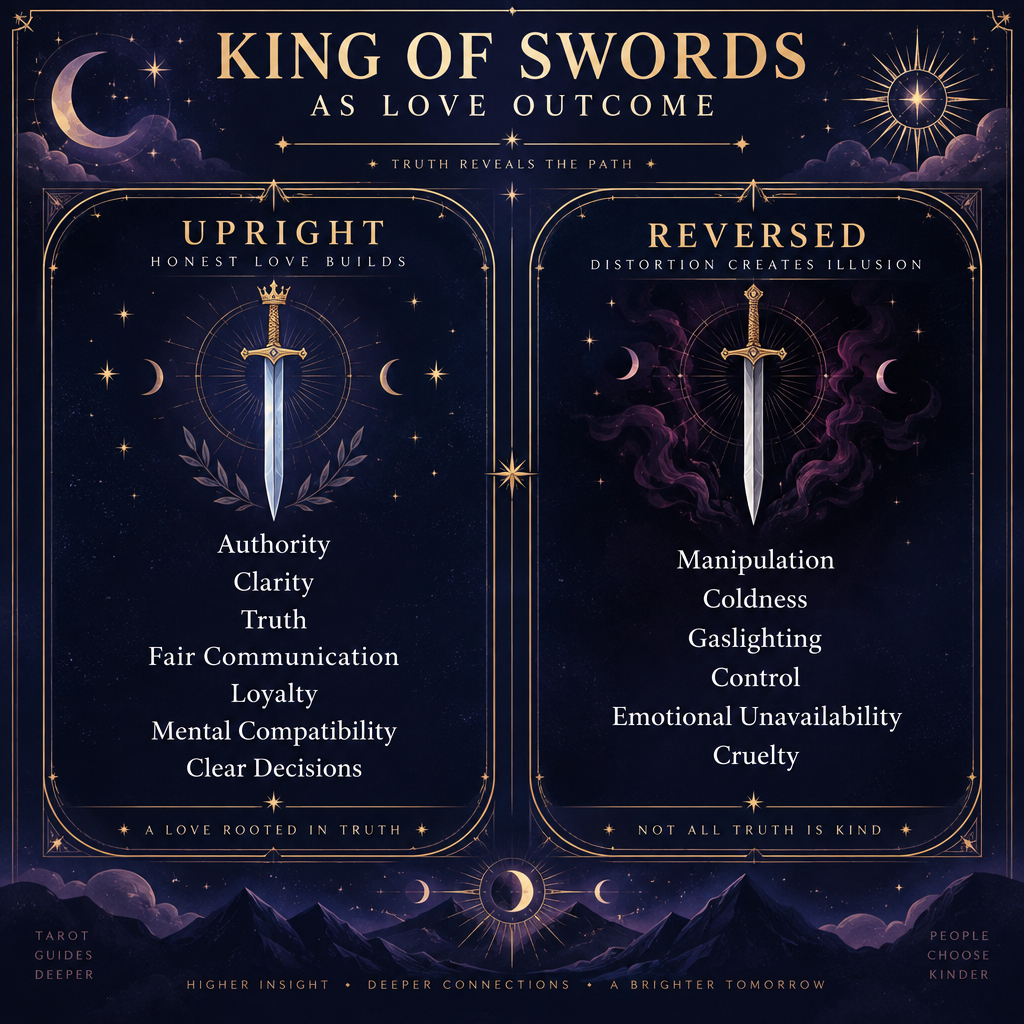
The King of Swords as a love outcome points to a relationship built on truth, clear communication and fair dealing, with a partner who thinks before he feels. Upright it is a favourable card with one real caveat about emotional warmth; reversed it warns of a cold, controlling or verbally cutting dynamic. This guide covers both positions across single, new, committed, separation and reconciliation readings, plus a direct yes-or-no verdict.
Upright and Reversed Keywords at a Glance
| Upright | Reversed |
|---|---|
| Authority, clarity, truth | Manipulation, tyranny, coldness |
| Justice and fairness | Distortion of facts, gaslighting |
| Direct communication | Words used as weapons |
| Loyalty expressed through action | Emotional unavailability dressed as logic |
| Mental compatibility | Arguing to win rather than to resolve |
| Boundaries and self-discipline | Control, rigidity, cruelty |
| Decisions made with a clear head | Indecision masked by intellectual posturing |
Card Symbolism Decoded for Love
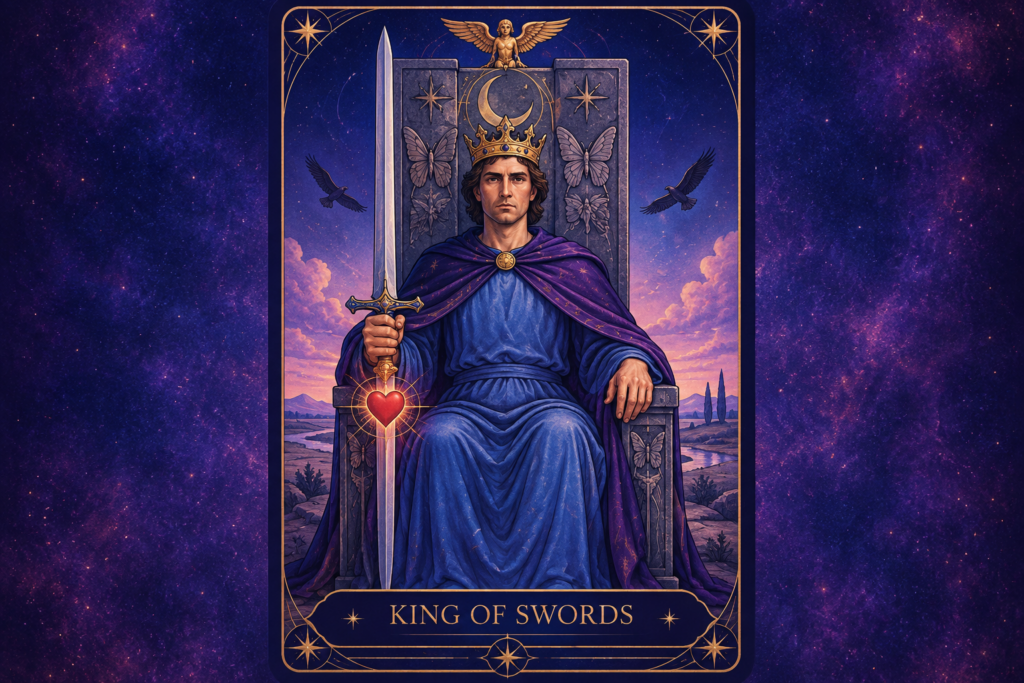
In the Rider-Waite-Smith deck the King sits facing you on a plain stone throne, sword raised in his right hand and tilted slightly to the right. Every detail on the card carries a message when the question is about love.
The upright sword. Swords are the suit of the mind, and the King holds his blade point-up rather than resting across his lap. In a love outcome this is honesty held in plain view. Nothing is hidden, and the relationship’s problems will be named rather than tiptoed around. The slight tilt is often read as a willingness to bend toward mercy, so this is truth with judgement, not truth as a blunt instrument.
The throne and its carvings. Butterflies and a crescent moon are carved into the back of the throne. Butterflies are the traditional symbol of transformation and of the Air element, and in a relationship reading they suggest a connection that has matured out of a messier earlier phase. The crescent moon hints that intuition still exists underneath all that logic, even if the King rarely leads with it.
The crown. A gold crown topped with an angel or winged figure signals that the King’s authority is legitimate and his judgement is informed by a higher standard. For love, this is a partner whose word you can take at face value.
Blue robe and purple cape. Blue is the colour of the intellect and of calm, and the purple cape layered over it points to maturity and a certain regal detachment. Together they describe someone who stays composed under pressure. In an argument this person does not shout, and in a crisis this person is who everyone else calls.
Clouds and birds. The sky behind the King is clearer than on most Swords cards, with only a few low clouds and two birds in flight. Compared to the stormy Queen of Swords or the choppy Page, this is a settled mind. The birds represent ideas and communication travelling freely, which is exactly what the card promises for a couple.
The sparse landscape. Behind the throne a few trees stand in flat, open country. There is nothing lush here. That restraint is the card’s honest warning: this is a relationship of substance rather than romance for its own sake.
Element and Zodiac: Why This King Leads With His Head
The King of Swords belongs to Air, the element of thought, speech and judgement. Most modern systems associate him with Aquarius, the fixed Air sign, though some older correspondence tables place him across Capricorn and Aquarius or assign him to Gemini. Either way, the Aquarian flavour is the useful one for love readings.
Aquarius energy prizes fairness, independence and ideas over displays of feeling. The card’s partner will show love by being reliable, by remembering what you said three weeks ago and acting on it, and by treating you as an equal in every decision. What this partner will not do is gush. If your own love language is verbal affirmation or constant physical affection, you will need to ask for it directly, and the good news is that this King responds well to direct requests.
Is the King of Swords You, Your Partner, or the Situation?
Court cards can represent a person or an energy, and the distinction changes the reading.
As a person: This is a man, or someone of any gender who embodies the archetype, who is typically older or more experienced than the querent, works in a field requiring judgement (law, medicine, finance, engineering, management, academia), speaks precisely, dislikes drama and keeps promises. In a love outcome position with no other court cards nearby, he almost always represents the partner or the person you are asking about.
As the querent: If you drew the card in a position labelled “you” or “your approach,” it describes how you are handling the relationship: with your head, with firm boundaries and possibly with a little too much distance.
As a situation or advice: In an outcome position when the relationship question is about a dynamic rather than a specific person, the King describes the resolution itself. The outcome will be decided by facts and honest conversation rather than by passion or by waiting to see what happens.
A practical rule: if a second court card of similar rank appears in the spread, the King is more likely to be a literal third party. If he appears alone in the outcome slot, read him as the character of the result.
King of Swords Upright as a Love Outcome
The upright King promises a relationship where you will always know where you stand. Partners under this card do not play games, do not ghost and do not say one thing while meaning another. Conflicts get handled through conversation, and decisions about moving in, marriage or children get made deliberately rather than drifted into.
If You Are Single
Expect to meet someone who is established, articulate and a few steps ahead of you in life experience. He will probably not sweep you off your feet in week one. Instead you will notice that he listens closely, follows through on plans and asks sharp questions about who you actually are. Attraction here builds through conversation, and often through a shared professional or intellectual interest.
The card also tells you something about yourself as a single person: you are done with chaotic connections and are selecting for integrity. Trust that filter.
What to do: Let conversations go deep early rather than keeping dates light. Pay attention to whether someone’s actions match his statements across the first month, because consistency is the signature of this King.
In a New Relationship
Things may feel measured compared to past romances. The King of Swords partner is evaluating as well as enjoying, and will not say “I love you” until he means it. Do not mistake this for lack of interest. He is probably more committed than someone who moves fast, because he does not enter anything he has not thought through.
In a situationship or a connection that has stayed undefined, this card is a push toward definition. Ambiguity cannot survive the King’s presence for long. One of you is about to ask what this is.
What to do: Be the one who initiates the “what are we” conversation. Lay out what you want plainly. This partner respects clarity and loses respect for hints.
In an Established Relationship
For couples, the King of Swords as an outcome means the relationship will be stable, loyal and fair, and that whatever issue prompted the reading will be resolved by addressing it head-on. If you have been circling a disagreement about money, in-laws, division of labour or future plans, the card is telling you the circling ends now and the direct conversation goes well.
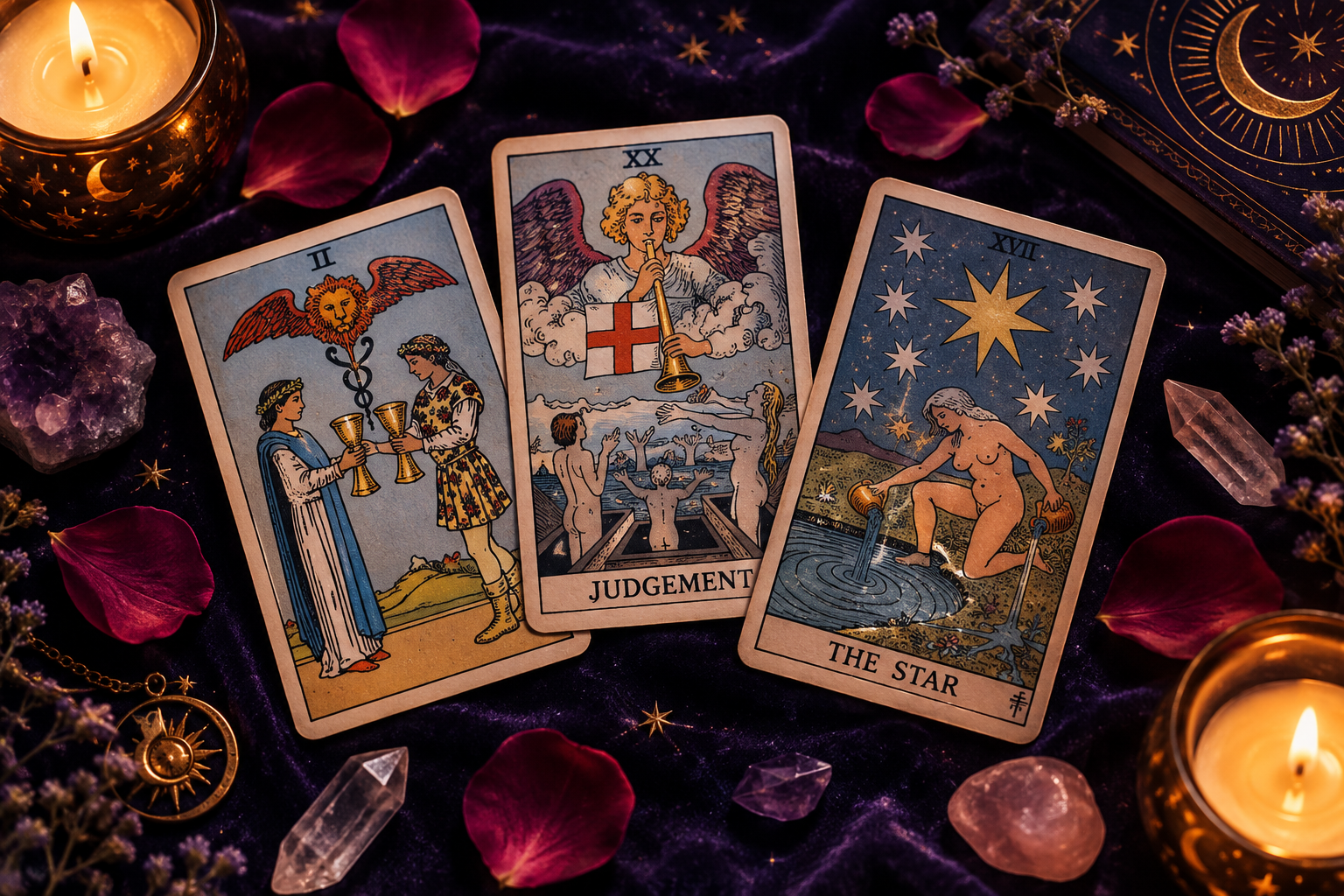
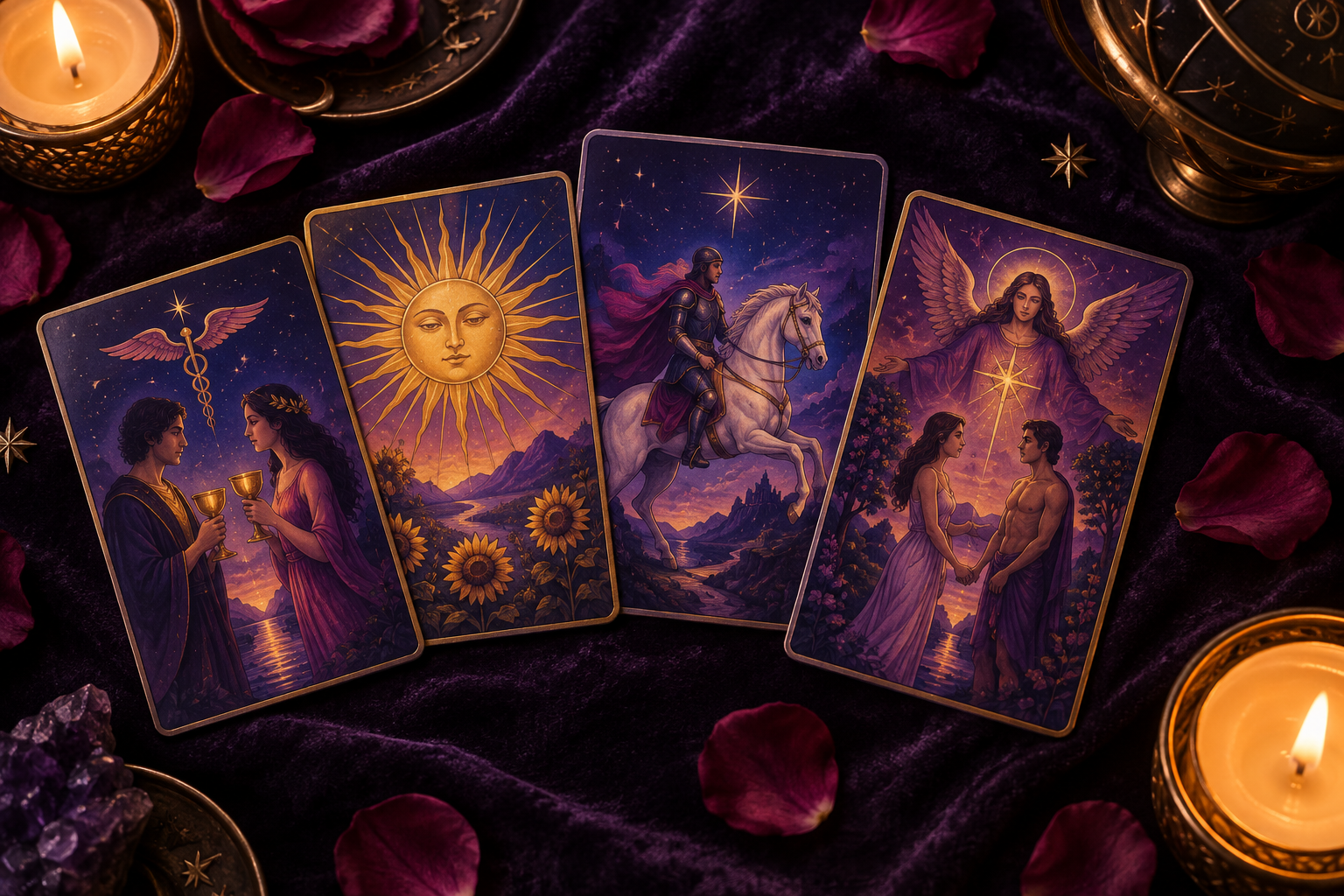
It is also a strong marker of commitment. Partnerships under this King move toward formal structures: engagement, marriage, joint finances, legal arrangements. The card does not promise a wedding on its own, but paired with the Hierophant, the Four of Wands, the Ten of Cups or the Two of Cups it is one of the clearer marriage signals in the deck.
What to do: Schedule the conversation you have been avoiding and come to it with specifics rather than feelings alone. Written notes are not unromantic for this card; they are respected.
Reconciliation and Getting Back Together
Asked whether an ex will return, the upright King of Swords gives a qualified yes. Reconciliation happens, but only through an honest accounting of what went wrong. There is no sliding back together after a late-night text. The returning partner, or you, will want to talk through the breakup rationally, name the problems and agree on what changes.
The card also describes the ex: if he embodies the King, he left for a reason he could articulate and will only come back if that reason has been addressed. Appeals to sentiment will not move him. Evidence of genuine change will.
What to do: Before reaching out, write down the three concrete issues that ended things and what is different now about each. Lead with that, not with how much you miss him.
The Detachment Caveat Even When Upright
Here is the nuance most readings skip. The upright King is a positive card, and it can still describe a relationship that is intellectually rich but emotionally thin. Partners under this energy sometimes treat feelings as problems to be solved. You may find yourself with someone who gives excellent advice when you are upset and never simply holds you.
Watch for two specific patterns: a partner who redirects every emotional conversation toward practical solutions, and a partner who is generous with time and effort but almost never says how he feels. Neither pattern is a dealbreaker. Both need to be named out loud, because this King will not notice the gap on his own. Ask for the warmth directly and most upright Kings will adjust, since fairness matters to them and they will see the request as reasonable.
King of Swords Reversed as a Love Outcome
Reversed, the sword drops and the clear sky turns. The intellect that made the upright King trustworthy becomes a tool for control. The outcome under this card is a relationship marked by coldness, verbal cruelty, manipulation or rigid authoritarianism, and the advice is almost always to protect yourself first and ask questions second.
If You Are Single
Someone who looks impressive on paper is about to show up, and the card is asking you to look past the credentials. The reversed King is charming in a clipped, confident way, often quick to judge others and quick to tell you how things are. Early red flags to track: he corrects you in front of people, he dismisses your feelings as irrational, he rewrites the facts of a conversation you both remember differently, and he keeps score.
Modern dating gives this type extra cover. Breadcrumbing (occasional messages with no follow-through), love-bombing followed by withdrawal, and arguments conducted entirely over text where tone can be denied are all reversed-King tactics.
What to do: Give it three dates and one disagreement. How he handles being told he is wrong tells you everything. If he cannot concede a small point gracefully, stop there.
In a New Relationship
Dishonesty surfaces. The reversed King in this position suggests the person you are seeing is withholding information about his past, his current entanglements or his intentions, and is using logic to make your suspicions feel unreasonable. “You’re overthinking this” is the phrase to listen for.
In long-distance relationships, where so much depends on taking someone’s word, this card is a particular caution. Inconsistencies in stories, unexplained gaps in availability and a refusal to video call at normal times all matter more than they would in person.
What to do: Verify rather than trust. That does not mean hiring an investigator; it means confirming the basics (where he lives, what he does, whether he is actually single) through normal means and noting any resistance when you do.
In an Established Relationship
The outcome here is an emotionally unavailable or controlling dynamic. The reversed King partner may be the one who decides everything, who treats you as less intelligent, who delivers criticism as “just being honest” and who argues to win rather than to resolve. Over time this erodes self-confidence, and many querents who draw this card describe feeling like they are constantly on trial.
Emotional detachment is the subtler version. A partner who was never cruel but has simply stopped engaging, who answers questions with one word and treats affection as an interruption, is also the reversed King.
What to do: Name the pattern once, specifically and calmly, and watch the response. A partner who hears it and adjusts is salvageable. A partner who turns the complaint back on you is showing you the outcome. Couples counselling is the appropriate next step if there is any willingness on both sides; individual therapy for you is the step if there is not.
In a Separation or Divorce
The reversed King describes an ex who will fight dirty. Expect disputes over facts, money and custody to be conducted through intimidation, legal threats and selective truth-telling. The card is also a warning that this person has an agenda and is not interested in a fair outcome.
What to do: Move every important communication to writing, keep copies and get a lawyer earlier than you think you need one. Do not negotiate directly if you can avoid it. The reversed King is skilled at talking people out of what they are owed.
Reversed Reconciliation
Asked about getting back together, the reversed King is a no, or at minimum a “not like this.” Either the ex is returning with the same controlling patterns intact, or the reconciliation is being driven by someone’s need to win the breakup rather than by love. If an ex who embodies this card reaches out, the motive is usually to reassert control, not to repair.
King of Swords Yes or No for Love
Upright: yes. The relationship or the person is trustworthy, committed and worth pursuing. The caveat is that the yes comes with homework: you will need to ask for emotional warmth rather than assume it will arrive on its own, and you will need to meet this partner’s directness with your own.
Reversed: no. Proceed only with firm boundaries and outside support, and treat any pattern of manipulation, gaslighting or coldness as the answer rather than as a phase to wait out.
For questions about marriage specifically, the upright King is a yes when supported by other commitment cards and a “yes, eventually, after deliberate discussion” on its own. For “will he come back,” it is a yes conditional on honest conversation upright and a no reversed.
How the King of Swords Compares to Related Cards in Love
King of Cups. The King of Cups is the emotional counterpart: warm, intuitive, nurturing and sometimes evasive. Where the King of Swords tells you the truth, the King of Cups makes you feel safe. Many readers consider the Cups King the warmer love outcome, but the Swords King is the more reliable one. A reading that pairs them is close to ideal.
Queen of Swords. She shares his intellect and honesty but carries more visible pain. The Queen has usually been through loss and guards herself accordingly. As a love outcome she suggests independence and clear boundaries, while the King suggests commitment within those boundaries. Together they can indicate a couple who respect each other deeply and struggle to be vulnerable.
Knight of Swords. The Knight is the King before he learned patience: fast, blunt, exciting and prone to charging in and out. As a love outcome the Knight means a whirlwind that may not last. The King means the whirlwind has settled into something that will.
Justice. When Justice sits beside the King of Swords in a love spread, legal matters are in play: marriage contracts, divorce proceedings or prenuptial agreements. The combination is neutral in itself and takes its tone from the King’s orientation.
FAQ
What does the King of Swords mean in love?
It represents a partner, or a relationship, defined by honesty, intellectual connection, fair treatment and loyalty shown through action rather than words. The relationship is stable and headed toward commitment. The one weakness is emotional reserve, which needs to be addressed openly rather than left to resolve itself.
Is the King of Swords a yes or no card?
Upright it is a yes, particularly for questions about trust, commitment and whether a person is genuine. Reversed it is a no, pointing to manipulation, coldness or control.
What does the King of Swords reversed mean in a relationship?
A dynamic where logic is used to dominate rather than to understand. Typical signs include a partner who dismisses your feelings as irrational, rewrites shared history, criticises under the banner of honesty and must win every argument. It can also indicate a partner who has withdrawn emotionally and engages only on his own terms. Professional support, either couples counselling or individual therapy, is the card’s standard advice.
Does the King of Swords indicate marriage?
It indicates readiness for formal commitment and a partner who takes vows seriously. On its own it is a strong “moving toward” signal rather than a guarantee. Alongside the Hierophant, the Four of Wands, the Ten of Cups or the Two of Cups, it is one of the clearer marriage combinations in the deck.
Does the King of Swords mean an ex will come back?
Upright, yes, but only after an honest conversation about what went wrong and what has changed. This King does not return on sentiment. Reversed, no, or the return will carry the same controlling behaviour that ended things the first time.
What kind of person is the King of Swords in a love reading?
Mature, articulate, principled and composed, often working in a field that demands judgement such as law, medicine, finance or management. He values fairness, dislikes drama, keeps his word and expresses care through reliability. He is not naturally demonstrative and responds best to direct requests for affection.
Is the King of Swords a good card for a new relationship?
Yes. It suggests the connection will develop deliberately and honestly, and that ambiguity will not last long. The pace may feel slower than past romances, which is a sign of seriousness rather than disinterest.