
Hierophant As Love Outcome (Upright & Reversed) Tarot Card Meaning
You pulled the Hierophant as the outcome card in a love reading and want a straight answer. Here it is: upright, this card points toward commitment, formal recognition, and a relationship built to last, while reversed it warns of obligation, rigid rules, or a bond that cannot be made official. Below you will find the reading broken down by your situation, from a brand-new crush to an ex who might come back.
The Hierophant in Love at a Glance
| Upright | Reversed | |
|---|---|---|
| Core message | Commitment, tradition, formal recognition | Obligation, rule-breaking, blocked commitment |
| Love keywords | Marriage, shared values, stability, approval, loyalty | Rebellion, hypocrisy, secrecy, mismatched values, unconventional love |
| Element | Earth | Earth (blocked or misused) |
| Zodiac | Taurus | Taurus |
| Yes or no for love | Yes, especially for commitment questions | No, or not in the form you expect |
| Timing | Slow and steady, often tied to a formal milestone | Delayed or derailed by outside pressure |
Use this table as your anchor. Everything that follows explains why these keywords apply and how they shift depending on who you are asking about.
What the Card Itself Tells You About Love
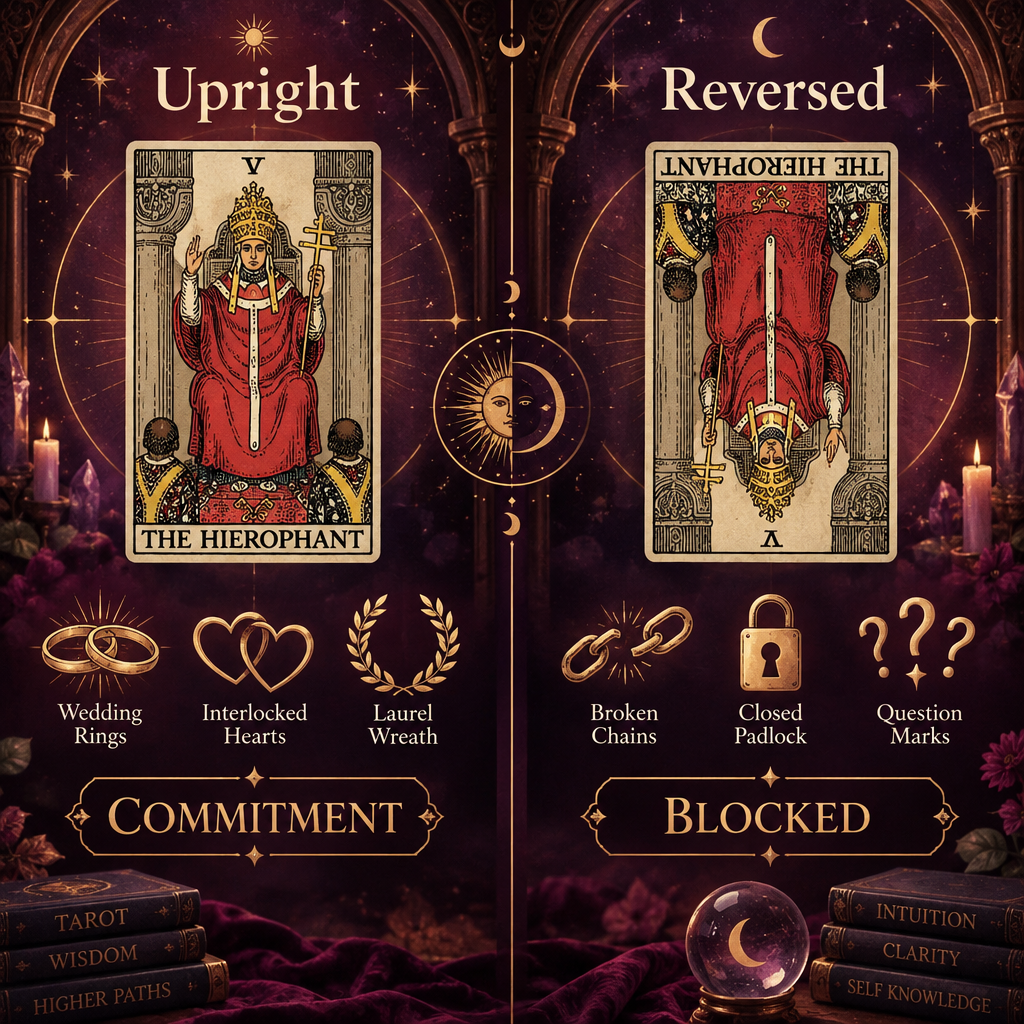
The Hierophant is card five of the Major Arcana. In the Rider-Waite-Smith deck he sits on a throne between two pillars, wearing a three-tiered crown, right hand raised in blessing, left hand holding a triple-barred cross. Two tonsured followers kneel before him and a pair of crossed keys rests at his feet. Each of these details carries a specific meaning in a love outcome reading.
The Pope figure
The central figure is a religious authority, the one who officiates ceremonies and declares a union valid in the eyes of a community. As a love outcome this is the clearest marriage signal in the deck apart from the Four of Wands and the Ten of Cups. It says the relationship is heading toward something that other people will witness and recognise, not something that stays private.
The triple crown
The three tiers traditionally stand for the three levels of existence (body, mind, spirit), or for the past, present and future. For love, the message is that this relationship touches every layer. It is not only physical attraction, and not only an intellectual match. A partnership under the Hierophant tends to feel like it has a history and a future already built into it.
The crossed keys
The keys represent access to knowledge that is otherwise locked away. In a love reading they describe a partner who holds the key to your growth, or a relationship that teaches you something about yourself that you could not have learned alone. They also hint at exclusivity: a locked door that only one person is meant to open. Monogamy is implied.
The two pillars
Pillars appear on the High Priestess card too, but here they are plain grey stone rather than black and white. They stand for structure, tradition and the institutions that frame a relationship: marriage law, religious vows, family expectations. A relationship ending in the Hierophant is one that fits, or chooses to fit, inside a recognised framework.
The two disciples
The kneeling followers show two people submitting to the same teaching. In love terms, this is a couple who agree on the rules. They may have very different personalities, but they share a definition of what commitment means, what loyalty looks like, and how they expect to be treated. That shared rulebook is what makes Hierophant relationships durable.
Taurus, Earth, and Why This Card Is Both Wholesome and Indulgent
The Hierophant is assigned to Taurus, a fixed Earth sign ruled by Venus. This association is the reason tarot readers describe the Hierophant love outcome as wholesome and indulgent at the same time, a pairing that sounds contradictory until you look at how Taurus actually operates.
Earth gives the card its stability. A Hierophant relationship is slow to start, slow to change, and extremely hard to break. Promises are kept because keeping promises is the whole point.
Venus, Taurus’s ruler, brings the sensual and material side. Taurus wants good food, soft fabric, a comfortable home and a partner who pays attention to physical pleasure. So the Hierophant does not predict a dry, duty-bound marriage. It predicts a partner who spoils you, remembers your preferences, invests in shared comfort, and treats the body as part of the sacred, not opposed to it.
Taurus also governs self-worth and personal finances. When this card is your outcome, expect money and values to be discussed openly and early. The relationship works because both people know what they are worth and refuse to settle for less. If you have been undervaluing yourself, the Hierophant outcome often arrives alongside a partner who insists on treating you better than you have been treating yourself.
The Hierophant Upright as a Love Outcome
The general message is commitment and legitimacy. A relationship that ends in the upright Hierophant becomes real in a public, structured way. How that plays out depends heavily on where you currently stand.
For singles and new connections
If you are single, the Hierophant as your outcome says the next significant relationship will be a serious one. This is not a fling card. The person you meet is likely to be traditional in some sense: they want to introduce you to family, they prefer defined labels, and they move at a measured pace rather than rushing into intimacy.
Where you meet them matters. The Hierophant favours structured environments: a class, a place of worship, a professional association, a wedding, or an introduction through family. Dating apps are not excluded, but the connection tends to progress through conventional steps rather than a late-night hookup that turns into something more.
One outcome that catches people off guard: the Hierophant can describe a connection that stays platonic or chaste for a long time. The card has a priestly quality, and in some readings the attraction is spiritual or intellectual before it becomes physical. If you are asking about someone specific and get the Hierophant, be prepared for a slow build and respect for boundaries. Pushing for speed will backfire.
For an existing long-term relationship
Here the Hierophant is one of the best outcome cards you can draw. It confirms the relationship is on solid ground and heading toward a formal milestone. For couples who are dating, that usually means engagement or moving in together with a clear plan. For couples who are already married, it signals renewed commitment, often around a shared decision such as buying a home, starting a family, or taking on a joint spiritual or community role.
The card also describes the texture of the relationship: predictable in a good way. You know what each other believes, you have agreed rituals (Sunday dinners, annual trips, how holidays are split between families), and those routines hold you together when individual moods wobble.
If the relationship has been rocky, the upright Hierophant as an outcome says it survives, but through the traditional route. Think couples counselling, a conversation with a trusted elder, or a deliberate recommitment to the vows you originally made rather than a dramatic reinvention.
For reconciliation or an ex returning
This is the question people ask most often, and the Hierophant gives a nuanced answer. Upright, it leans toward yes, the ex comes back, but with a condition: the reunion has to be structured and sincere. The Hierophant does not endorse sliding back into old patterns through late-night texts. It describes a return that involves a proper conversation, acknowledged mistakes, and an explicit agreement about how things will be different.
Often the reconciliation is motivated by shared values that both of you lost sight of during the breakup. Family may play a role, either encouraging the reunion or reminding one of you what you walked away from. If the original split was caused by one partner refusing commitment, the Hierophant says that resistance has softened and the returning partner is now ready for the labels they previously avoided.
If the ex was unfaithful or disrespectful, read the card more cautiously. The Hierophant can mean they return out of a sense of duty rather than love, which sets up a reversed-Hierophant situation later. Check the surrounding cards for warmth (Cups suit) before treating this as a happy ending.
Marriage and engagement
Ask a direct question about marriage and receive the upright Hierophant, and the answer is yes. The card literally depicts the person who performs the ceremony. It is especially strong when it appears alongside the Lovers, the Four of Wands, the Ten of Cups, or the Ten of Pentacles. On its own it still points to engagement, a wedding, or a legal formalisation such as a civil partnership.
A note on modern context: the Hierophant’s “recognised union” no longer means only a church wedding. In many countries the legal institutions themselves have widened to include same-sex marriage, civil partnerships for mixed-sex couples, and cohabitation agreements that carry legal weight. The card follows the institution. If the structure that recognises your relationship exists, the Hierophant says you will use it. If you are in a place where your relationship type is still not legally recognised, the card can indicate frustration around that gap, and the outcome may involve finding community recognition instead.
Family, religion and social expectations
The Hierophant always raises the question of approval. As an outcome it usually means the relationship earns it: parents warm to your partner, the religious community accepts the match, or two families with different backgrounds find common ground.
It can also mean these expectations shape the outcome more than you would like. A couple may marry sooner than they planned because of family pressure, or one partner may convert, change habits, or adopt traditions to make the union acceptable. The upright card frames these as workable compromises. The reversed card, covered next, frames them as a cage.
The Hierophant Reversed as a Love Outcome
Reversed, the structure the Hierophant represents is either rejected, abused, or absent. Two broad readings exist. The negative one: a relationship held together by obligation, hypocrisy, or fear. The positive one: a relationship that deliberately breaks from convention and is healthier for it. Which applies depends on your question and the supporting cards, but here is how each situation tends to play out.
New or potential relationship reversed
If you are asking about someone new, the reversed Hierophant says this connection will not fit the mould, and the two of you may not even agree on what mould you are trying to fit. Common scenarios: one person wants exclusivity and the other refuses labels; cultural or religious backgrounds clash and neither side is willing to bend; or the person you are interested in talks about commitment but their behaviour shows none.
The card also warns about hypocrisy. Someone who presents as a traditional, values-driven partner may privately behave very differently. Watch for mismatch between stated principles and actions in the first few months.
Existing relationship reversed: staying out of obligation
This is the heaviest reading. The reversed Hierophant as an outcome for a long-term relationship often describes a couple staying together because leaving feels unacceptable: the mortgage, the children, the religious prohibition on divorce, the fear of what the family will say. The relationship persists but the spiritual connection has gone. Partners perform the roles without feeling them.
If this resonates, the card is not telling you to leave. It is telling you that the current arrangement runs on fear of judgment rather than love, and that the two of you need to either rebuild the connection honestly or confront the structure that is trapping you.
Partner already married or committed elsewhere
The reversed Hierophant has a well-known darker meaning: the person you are asking about is bound by vows to someone else. The card shows the institution of marriage, and inverted it shows that institution being violated. If you are asking about a new interest and pull this card as the outcome, especially next to the Seven of Swords or the Three of Swords, take it as a serious signal that there is a prior commitment you do not fully know about. The affair rarely converts into the legitimate relationship you want.
Singles reversed
For singles, the reversed card often turns the lens inward. You may be rejecting traditional relationships altogether, perhaps after a marriage that failed or a religious upbringing you have left behind. The outcome is a period where you refuse to follow anyone’s script, which can be liberating, but it can also leave you avoiding commitment entirely while telling yourself you are being free.
A second reading: you want a conventional partner but keep attracting people who are unavailable, non-committal, or already taken. The pattern itself is the message. Ask what rule you are following that leads you there.
Reconciliation or ex returning reversed
Reversed, the ex is unlikely to return in a lasting way. If they do come back, it is on terms that lack the structure a real reconciliation needs: vague promises, no accountability, the same refusal to define the relationship that caused the split. The card can also describe an ex who returns because they feel guilty or because family pressured them, not because anything has changed inside them. Closing the door is often the healthier outcome here.
Breaking free from outdated structures
Not every reversed Hierophant is bad news. For couples in non-traditional arrangements, the reversed card as an outcome can mean a relationship that works precisely because it refuses inherited rules. Long-distance couples who never cohabit, partners who choose not to marry for financial or philosophical reasons, interfaith couples who build their own rituals, polyamorous arrangements with explicit agreements: all of these fall under the reversed Hierophant in its constructive mode.
The test for whether you are in the constructive version or the destructive one is simple. Are both partners choosing the unconventional structure openly and honestly? If yes, the card supports you. If one partner is pretending to agree while secretly wanting the traditional path, the hypocrisy meaning applies.
Practical Next Steps When the Hierophant Appears
The Hierophant is the card of teachers and institutions, so its advice is almost always to seek guidance from someone qualified rather than figuring it out alone.
- Couples counselling. Upright or reversed, if the reading concerns an existing relationship under strain, this card endorses structured therapy. The Hierophant likes method and expertise.
- A spiritual advisor or faith leader. If religion is part of the relationship’s friction or glue, talk to someone inside that tradition who can speak honestly about what it does and does not require.
- A mentor couple. Find a pair who have been together for decades and whose relationship you admire. Ask them direct questions about how they handled the stage you are in.
- Premarital counselling. If the card points to engagement, many officiants and therapists offer a short course covering money, children, faith and conflict. The Hierophant approves of doing this before, not after, the vows.
- For the reversed card specifically, individual therapy focused on obligation, guilt and fear of judgment often does more than couples work, because the block is usually inside one person’s belief system.
Reflection and Journaling Prompts
Write your answers down. The Hierophant rewards deliberate, recorded thinking over impulsive reaction.
If the card is upright:
- What does commitment actually look like to me, in concrete behaviours? Does the person I am asking about already do those things?
- Whose approval am I seeking for this relationship, and would I still want it without that approval?
- Which shared values would I refuse to compromise on, and have I said them out loud to my partner?
If the card is reversed:
- Am I staying, or pursuing, out of love or out of fear of what ending it would mean?
- Where do my stated beliefs about relationships and my actual behaviour disagree?
- If no one I know would ever find out, what would I choose?
For either position:
- What rule about love did I inherit from my family that I have never questioned?
- What would a wise elder who genuinely cared about me say about this situation?
FAQ
Does the Hierophant as a love outcome mean marriage?
Upright, yes, more reliably than almost any other card. It depicts the officiant of a ceremony and represents formal, recognised union. Confirm with supporting cards: the Four of Wands, Ten of Cups, Ten of Pentacles or the Lovers alongside it make the marriage reading very strong. Reversed, the card points away from marriage, or toward a marriage that happens for the wrong reasons.
Is the Hierophant a yes or no for love?
Upright is a yes, particularly for questions about commitment, exclusivity, engagement and whether a relationship will last. Reversed is a no for conventional commitment questions, though it can be a qualified yes if you are asking whether an unconventional relationship will work on its own terms.
What does the reversed Hierophant mean for commitment?
It means commitment is blocked, resisted or faked. Either one partner refuses to define the relationship, the couple stays together out of duty rather than desire, or there is a hidden prior commitment to someone else. Occasionally it means the two of you are redefining commitment outside traditional marriage, which is healthy only if both of you are honest about it.
What does the Hierophant mean for singles?
A serious, slow-building relationship is coming, likely with someone who values tradition, family and defined labels. You may meet them through a structured setting such as a class, community or family introduction. Expect the connection to develop through conventional stages, and do not be surprised if the early phase is more spiritual or intellectual than physical.
Will my ex come back if I pull the Hierophant?
Upright, the odds favour a return, but one that involves a proper conversation and renewed, explicit commitment rather than casual drifting back together. Reversed, a return is unlikely to last, and if it happens it tends to be driven by guilt or family pressure rather than genuine change.
Is the Hierophant a bad card in a love reading?
No. Upright it is one of the most stable, commitment-friendly cards available. The reversed card is uncomfortable because it exposes obligation, hypocrisy or secrecy, but that exposure is useful information. It tells you exactly where the relationship’s structure is failing so you can address it or walk away with clarity.