
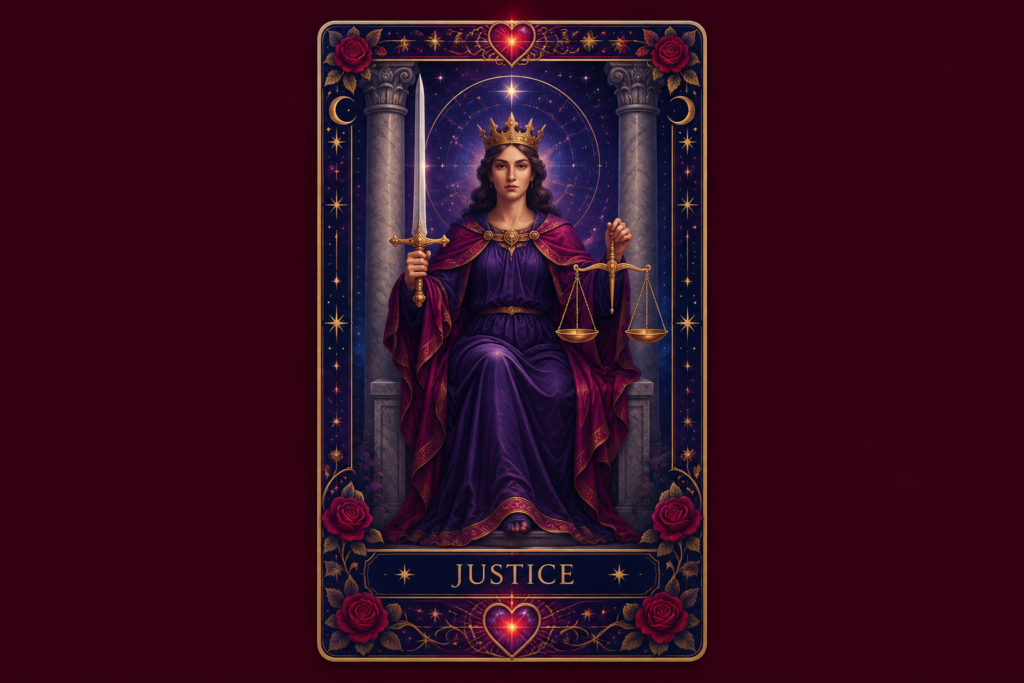
Justice As Love Outcome (Upright & Reversed) Tarot Card Meaning
Justice in the outcome position of a love spread tells you the relationship will settle exactly where the actions inside it have earned it to settle. Upright, that is good news for a fair, honest connection and uncomfortable news for an unequal one. Reversed, it points to a bill coming due: deception surfacing, blame being dodged, or a partnership tangled in legal or financial loose ends.
The Short Answer Before the Detail
Justice is not a card of romance or passion. It is a card of consequence. As a love outcome it says: whatever has been put into this relationship, in honesty, effort, loyalty or their opposites, is about to be measured and returned in kind. If you have been straight with your partner and they with you, expect a stable, mutually respectful result, and quite possibly a formal commitment. If something has been hidden, lopsided or unresolved, expect it to be dragged into the light and corrected, whether or not anyone wants that.
Readers who want a flat yes or no will not get one from this card. It answers a different question: has this relationship been conducted fairly? The outcome follows from that.
What the Imagery Says About Love
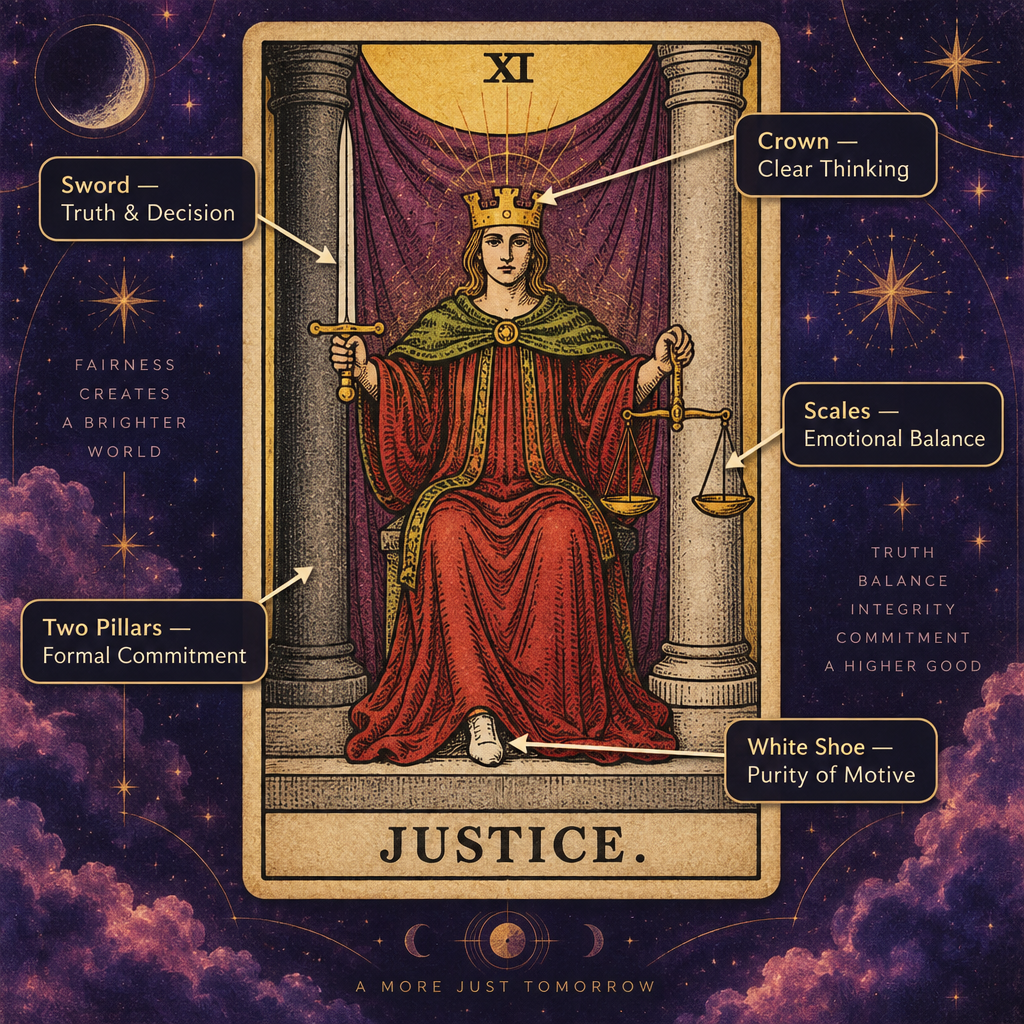
Most people pull Justice from the Rider-Waite-Smith deck or one of its many descendants, such as the Modern Witch Tarot, which keeps Pamela Colman Smith’s composition almost line for line. Every element on that card translates directly into relationship language.
The scales sit in the figure’s left hand, held level. In a love reading this is emotional balance: who initiates, who apologises, who compromises, who pays. When the scales are even, both partners carry comparable weight. When they tip, one person is subsidising the relationship with time, money or forgiveness, and Justice says that subsidy is about to be audited.
The sword is upright, double-edged, and held in the right hand. It represents truth spoken plainly and a decision that cuts cleanly. A double edge cuts both ways, which matters here: the truth that frees you from a bad dynamic can also expose your own part in it. Justice never lets one person be entirely the victim.
The crown carries a square jewel at its centre. Square means well-ordered thought rather than emotional impulse. For love, read this as mutual respect built on clear thinking: partners who see each other accurately instead of through projection.
The two pillars and the purple veil behind the figure frame a formal space. This is the courtroom element of the card, and it is why Justice so often shows up around engagements, marriage licences, cohabitation agreements, prenups and divorce proceedings. The veil hints that something is still hidden behind the formal front. In a relationship, it is the thing that has not yet been said.
The white shoe peeking from under the red robe is the detail most readers miss. White is purity of motive. The shoe is barely visible, which is the point: the moral quality of someone’s actions in love is small, easy to overlook, and ultimately the thing that decides the verdict. Red robe, green mantle: passion governed by growth and reason, not the other way round.
Where Justice Sits: Number XI, Libra, Air
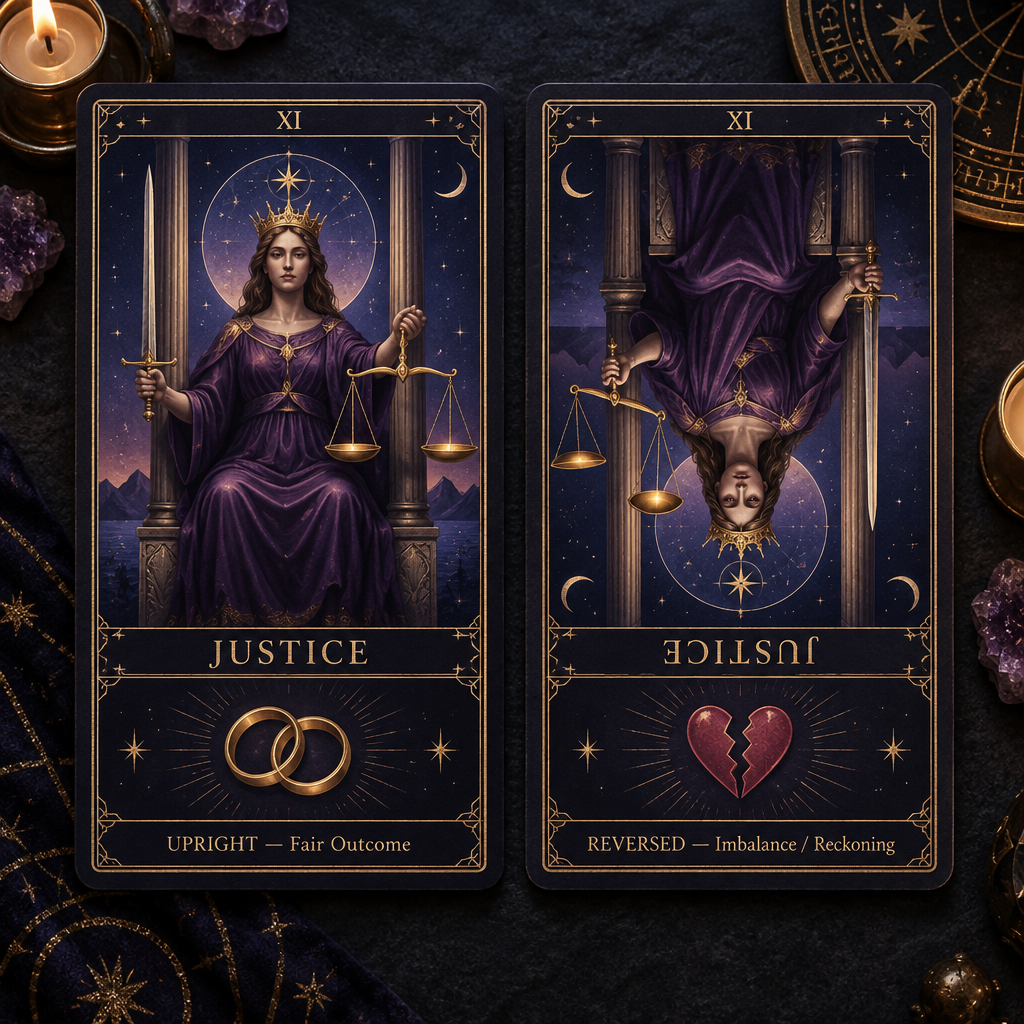
In the Rider-Waite-Smith tradition Justice is Major Arcana card XI. Arthur Edward Waite swapped it with Strength, which was card XI in the older Tarot de Marseille, so in Marseille-style decks and in Aleister Crowley’s Thoth deck (where it is called Adjustment) Justice is VIII. The meaning does not change with the number. What changes is the story position: as XI, Justice falls right after the Wheel of Fortune and directly before the Hanged Man. The Wheel sets events in motion; Justice weighs them; the Hanged Man is the surrender that follows the verdict. In love terms, the fling or the crisis has already happened (Wheel), the reckoning is now (Justice), and acceptance comes next.
Justice is assigned to Libra, the sign of partnership, ruled by Venus. That gives this card a natural home in relationship readings. Libra wants harmony, mutual regard and aesthetic balance, and dislikes confrontation. The card’s lesson is that balance cannot be preserved by avoiding the hard conversation; it is restored by having it.
The element is Air, which places Justice alongside the Swords suit. Air governs thought, communication and judgement. This is why Justice as a love outcome often arrives as a conversation, a decision or a document rather than a feeling. The heart is involved, but the mind signs off.
Justice Upright as a Love Outcome
If You Are Single
Upright Justice for a single querent is a karmic reward card, but it rewards specific behaviour: honesty with yourself about what you actually want, and consistent fairness in how you have treated past partners. If you have done that work, the card indicates the next connection will match your values rather than just your type. Expect to meet someone through a setting that rewards straight talk, often work, study or a legal or professional context, and expect the attraction to be mental first.
If you have not done that work, Justice is still neutral rather than punishing. It simply says the next relationship will reflect your current standards. Raise them and the match changes.
Do this: write down the three things you tolerated in your last relationship that you promised yourself you would not tolerate again. Those are the scales you are carrying into the next one.
Ask yourself: Am I asking for a level of honesty I am prepared to offer?
In a New Relationship
For a connection under about six months old, upright Justice says the foundation is sound because values line up. Both people are being reasonably transparent about intentions, exclusivity and pace. The card also indicates a decision point: Justice rarely lets a situationship drift. Someone defines the relationship, and the definition will be fair to both.
Watch for one thing. Justice measures what is actually there, not what is promised. If your new partner’s words and calendar do not match, the card says the gap will become visible soon.
Do this: have the exclusivity and expectations conversation before the three-month mark, while the stakes are still manageable.
Ask yourself: Would I be comfortable if this person saw exactly how I describe this relationship to my friends?
In an Established Relationship
This is where upright Justice does its most useful work. In a long-term partnership it signals that an imbalance everyone has been working around is about to be named. Common forms: one partner carrying the household mental load, uneven financial contribution, one person’s career always taking priority, or a pattern where only one of you ever apologises.
The outcome is a correction, and the correction holds. Upright Justice does not describe a blow-up followed by relapse. It describes the conversation finally happening, both people being heard, and the terms being renegotiated with some permanence. If the relationship is fundamentally fair, this strengthens it considerably. If it is fundamentally unfair and one person refuses to adjust, Justice upright can still mean a fair ending: a separation where assets, time with children and responsibilities are divided equitably.
Do this: bring one specific imbalance to your partner with a concrete proposal attached, not just a complaint.
Ask yourself: If my partner tallied what each of us gives and receives, would their ledger match mine?
Marriage and Legal Commitment
Along with the Hierophant, Justice is one of the two Major Arcana cards most readers associate with marriage. The Hierophant points to the ceremony, the tradition, the public vows. Justice points to the contract: the licence, the shared mortgage, the joint account, the prenuptial agreement, the civil partnership registration. If you asked about the future of a serious relationship and Justice landed in the outcome position, a legally recognised commitment is on the table, and the card suggests it will be entered into with eyes open.
Supporting cards matter. Justice with the Hierophant, the Four of Wands, the Ten of Cups or the Two of Cups makes the marriage reading strong. Justice alone, surrounded by Swords, is more likely describing a decision about commitment than the commitment itself.
When You Suspect Infidelity
Asked directly about faithfulness, upright Justice indicates the truth will be established. It does not by itself confirm cheating; it confirms clarity. If there has been betrayal, evidence surfaces and consequences follow in proportion. If there has not, the suspicion gets resolved and the fairness of the accused partner is confirmed. Either way the uncertainty ends, which is often what the querent actually needs.
Justice Reversed as a Love Outcome
If You Are Single
Reversed Justice for a single person almost always points to the past. Specifically, to a relationship that ended without resolution: no clear closure, an unfair split, a grievance still being carried. The card says you are not single and available so much as single and still litigating something that is over. New prospects sense the unfinished case and step back.
A second reading applies when the querent has been the unfair one: ghosting, stringing people along, or lying about availability. Reversed Justice says the pattern is now shaping who approaches you. The people you attract will mirror the standard you have set.
Do this: identify the one person from your past you still argue with in your head, and decide what closure you can give yourself without their participation.
Ask yourself: Am I open to someone new, or am I waiting for a verdict from someone old?
In a New Relationship
Early on, reversed Justice is a red flag about asymmetry. One person is far more invested, far more transparent, or far more generous than the other, and the imbalance is being excused as “early days”. The card also commonly flags a partner who is not fully honest about their circumstances: a relationship not quite ended, a financial situation misrepresented, an intention stated that does not match behaviour.
The outcome is that the imbalance does not self-correct. Left alone, it becomes the template for the relationship.
Do this: compare what this person has told you about their life with what you have actually observed. Note every gap.
Ask yourself: If I stopped initiating completely for two weeks, what would happen?
In an Established Relationship
This is the harshest placement. Reversed Justice in a long-term outcome position points to one of three things, and sometimes all three.
First, deception coming to light. Affairs, hidden debt, a secret second phone, financial decisions made without the other partner. The reversal means the exposure is messy and the consequences are not yet proportionate; someone may initially get away with it, or be punished out of all proportion.
Second, the ledger that never closes. One partner keeps a running tally of every slight and uses it in every argument. Nothing is ever forgiven, so nothing is ever resolved. Blame shifts constantly and neither person takes real accountability.
Third, avoidance. Both people know the relationship is unfair and both refuse to address it, because addressing it would mean ending it or changing it substantially.
The outcome of reversed Justice here is not neutral. The reckoning still comes; it just arrives later, more expensively, and often through an outside agent such as a lawyer, a mediator or a discovered message.
Do this: if you suspect deception, gather facts before confrontation. If you recognise the ledger pattern in yourself, name one grievance you are willing to retire permanently.
Ask yourself: What am I refusing to look at because looking would force a decision?
Divorce and Legal Complications
Reversed Justice as a love outcome frequently describes a partnership entangled in legal or financial dispute: a contested divorce, a custody disagreement, a property split that drags on, a partner hiding assets, a cohabitation with no agreement and plenty of shared liabilities. The card warns that the process will feel unfair to at least one party and that outcomes may not match merit in the short term. The practical advice is blunt: document everything, get independent legal advice, and do not sign anything to make the discomfort stop faster.
Justice and Reconciliation With an Ex
Asked whether you will get back together, Justice reframes the question. Rather than will you, it asks: did this relationship end fairly, and have the terms changed?
Upright, Justice supports reconciliation only when both people acknowledge their share of what went wrong and the specific problem has been addressed, not just apologised for. Some readers describe this as a soul contract that was interrupted and has clauses left to fulfil. Whether or not you accept that language, the practical meaning is the same: the relationship can resume only on renegotiated terms, and it will resume on honest ones or not at all.
Reversed, Justice says the ending was unfair in a way that has not been corrected, and going back would restore the old imbalance. It can also indicate that one person wants reconciliation mainly to win the argument rather than to rebuild.
Do this: before contacting an ex, write down what specifically would need to be different this time. If you cannot name it, the card has answered you.
Justice as Feelings
When Justice appears in a position describing how someone feels about you, the feeling is considered rather than hot. They see you clearly, including your flaws, and have weighed you fairly. They respect you. They are likely thinking about the relationship in terms of commitment, compatibility and long-term viability rather than longing. Upright, this is someone whose intentions toward you are honourable and whose decision, once made, will hold. Reversed, they feel wronged by you, are keeping score, or are judging you by a standard they do not apply to themselves.
The Karmic Ledger: Cause and Effect in Love
Justice is the Major Arcana’s clearest statement of cause and effect, and nowhere does that play out more visibly than in relationships.
Consider two concrete patterns. A person who cheated to exit their last relationship rather than ending it honestly draws Justice as the outcome for a new relationship. The card indicates the new partner will eventually learn how the previous one ended, and will judge the querent’s trustworthiness by it. Nothing supernatural is required; people talk, and patterns repeat.
Now the other direction. A person who stayed loyal through a partner’s long illness, and was then left once the partner recovered, draws Justice about their future. The card indicates the fairness they showed becomes the standard they now expect and attract. They will not settle for less than they gave, and that filter changes who stays.
The Wheel of Fortune describes luck. Justice describes earnings. If both appear in a love spread, the reading is unusually karmic: circumstance has brought the situation, but conduct will decide it.
Is Justice a Yes or No Card in Love?
Neutral, leaning toward “yes, if fair”. Justice does not grant wishes; it ratifies conduct. Use this guide:
| Question | Upright Justice | Reversed Justice |
|---|---|---|
| Will we get married or commit legally? | Yes, likely | Delays, disputes, or a commitment entered on unequal terms |
| Will this relationship last? | Yes if balanced; a fair ending if not | Not in its current form |
| Is my partner faithful? | The truth will be confirmed either way | Deception is likely and being concealed |
| Will my ex come back? | Only on renegotiated terms | No, or a return that restores the old imbalance |
| Will I find love soon? | Yes, matched to your current honesty | Not until the past is closed |
Reading Justice by Spread Position
Position changes the card’s job. In a basic three-card past, present, future love spread, Justice in the past usually marks a previous fair decision or legal event (a divorce, a breakup handled well). In the present it signals a decision being weighed right now. In the future or outcome slot it is the verdict, as described throughout this article.
In the Celtic Cross, Justice in the crossing position means fairness itself is the obstacle: someone is insisting on being right rather than being reconciled. In the hopes and fears position it often means the querent fears being judged, or hopes a partner will finally be held accountable.
In relationship-specific spreads with a dedicated feelings card, apply the “Justice as feelings” reading above; do not confuse it with the outcome.
Justice Alongside Other Cards
- With the Hierophant: the strongest marriage pairing in the deck. Commitment that is both legal and traditional.
- With the Lovers: a choice between two paths or two people, where the right choice is the honest one rather than the exciting one.
- With the Wheel of Fortune: a strongly karmic reading. What arrives is what was earned.
- With the Three of Swords: painful truth exposed, usually infidelity or a damaging lie.
- With the Seven of Swords: deception that Justice is about to catch.
- With the Two of Cups: an equal partnership, one of the healthiest combinations possible.
- With the Five of Pentacles reversed: financial fairness restored after a period of one-sided support.
- With the Tower: a sudden exposure of unfairness, often through a discovery or a legal filing.
What to Do When Justice Appears as Your Love Outcome
- Audit, don’t accuse. List what each person contributes across time, money, emotional labour and initiative. Do it on paper. The card responds to evidence.
- Say the unsaid thing. Justice’s Air element means the outcome moves through speech. The conversation you are avoiding is the one that decides the result.
- Settle your own debts first. If you owe an apology, a disclosure or a decision, make it before expecting fairness from the other side.
- Get formal where it matters. If commitment, cohabitation or separation is on the table, put terms in writing. Justice favours agreements that can be pointed to.
- Accept the proportionate consequence. If the verdict goes against you, the card’s lesson is to take it cleanly rather than relitigate.
Reflection Questions
- Where in this relationship do I expect more than I give?
- What have I forgiven out loud but still hold against my partner privately?
- If a neutral observer watched us for a week, what would they say is unfair?
- What did I do in my last relationship that I would not want done to me?
- Am I waiting for the other person to be fair first?
FAQ
What does the Justice card mean in a love reading?
Justice means the relationship will be assessed on its actual fairness. Upright, it indicates balance, honesty and often a formal commitment. Reversed, it indicates imbalance, deception being exposed, or unresolved disputes. It is a card of consequence rather than romance.
Is Justice a yes or no card in love?
Neutral. It answers “yes” when the situation has been handled honestly and both people contribute equally, and “no” or “not yet” when it has not. For questions about legal commitment it leans yes upright.
What does Justice reversed mean for relationships?
Reversed Justice points to unfairness that has not been addressed: cheating or lies about to surface, one partner keeping a permanent grudge ledger, blame-shifting, or legal and financial complications such as a contested divorce. The reckoning still comes, but later and messier.
Does Justice mean marriage in tarot?
It can. Justice is one of the two main marriage cards alongside the Hierophant, and specifically signals the legal side of commitment: licences, contracts, shared property. With the Hierophant, Four of Wands or Ten of Cups nearby, the marriage reading is strong.
What does Justice mean for reconciliation with an ex?
Upright, reconciliation is possible only if both people own their share of the breakup and the original problem is actually fixed. Reversed, the split was unfair in a way that has not been corrected, and reuniting would restore the old imbalance.
What does Justice mean as someone’s feelings toward you?
They view you clearly and fairly, respect you, and are thinking about long-term compatibility rather than passion. Reversed, they feel wronged by you or are judging you harshly by a standard they do not meet themselves.
Is Justice number VIII or XI?
Both, depending on the deck. Rider-Waite-Smith and its descendants number it XI, having swapped it with Strength. Tarot de Marseille decks and the Thoth deck (where it is called Adjustment) keep it at VIII. The love meaning is identical in each.