

Emperor As A Person (Upright & Reversed) Tarot Card Meaning
When the Emperor shows up to describe a person, you are dealing with someone who runs their life like a well-ordered kingdom: rules, routines, responsibilities and a very clear sense of who is in charge. This guide profiles the Emperor as a person in both orientations, covering how they love, how they work, how they see you, what they feel, and what to do when this personality lands in your life.
Quick Profile: The Emperor as a Person at a Glance
| Attribute | Upright | Reversed |
|---|---|---|
| Core drive | Order, protection, legacy | Control, ego, avoidance of responsibility |
| Communication style | Direct, brief, decisive | Dismissive, contradictory, or absent |
| In love | Loyal provider, slow to open up | Domineering, cold, or unreliable |
| At work | Structured boss or mentor | Micromanager or checked-out figurehead |
| Emotional access | Guarded but steady | Shut down or volatile |
| Yes or no | Yes, especially for commitment and career | No, or not yet |
Everything below expands on this table.
Who the Emperor Is as a Person (Upright)
The upright Emperor is the person everyone turns to when something breaks. They do not panic, they do not gossip, and they rarely raise their voice because they do not need to. Authority comes from consistency: they said they would do it, and it got done, every time, for years.
This person builds systems. They have a budget spreadsheet, a maintenance schedule for the car, and an opinion about how the dishwasher should be loaded. That can look rigid from the outside, but the structure exists to protect the people inside it. The Emperor’s love language is a paid-off mortgage and a full tank of petrol in your car before a long drive.
Upright personality traits
- Decisive and comfortable making the final call
- Protective of family, employees and anyone under their care
- Disciplined, with routines they rarely break
- Rational, prefers facts and plans over feelings and hunches
- Reliable to the point of predictability
- Ambitious, oriented toward long-term security and legacy
- Traditional in values, often respectful of hierarchy and institutions
- Reserved emotionally, shows care through action rather than words
- Fair but firm; expects rules to apply to everyone, including themselves
- Natural mentor who gives tough love and practical advice
Professions that fit this archetype include military officers, police, judges, surgeons, CEOs, headteachers, engineers and anyone whose job involves keeping order under pressure. Even without a title, the Emperor is often the de facto boss in a room.
Who the Emperor Is as a Person (Reversed)
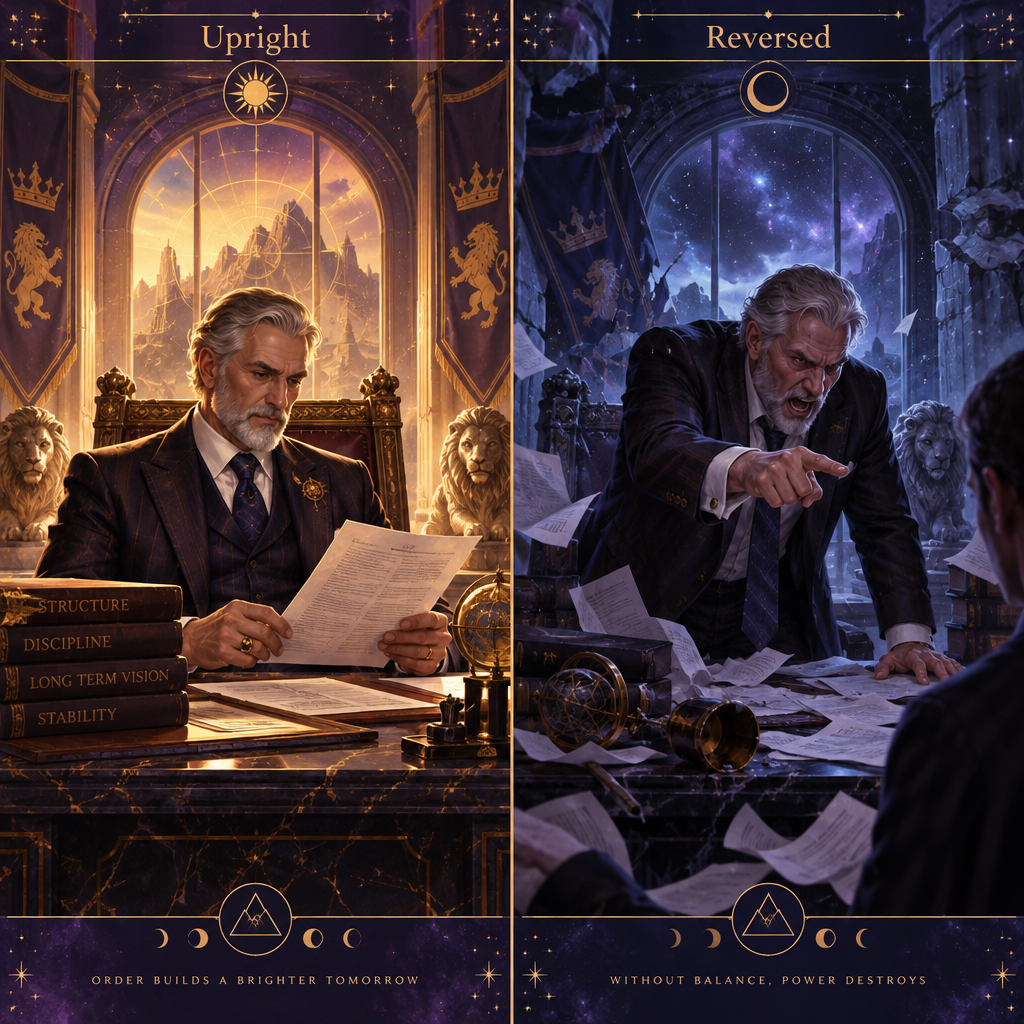
The reversed Emperor has the same appetite for authority without the maturity to carry it. Two very different people can appear here, and it pays to work out which one you are dealing with.
The first version is the tyrant: someone who mistakes control for leadership. They micromanage, belittle, keep score, and treat disagreement as disloyalty. In its most extreme form this personality is coercive or abusive, and the card is a genuine warning to protect yourself.
The second version is the abdicator: a person who should be providing structure and simply does not. The absent father, the boss who never makes a decision, the partner who leaves every bill and plan to you. This Emperor has no self-discipline and resents anyone who asks for it.
Both versions often share a father wound. They either had a domineering parent they now imitate, or an absent one they never learned to replace with inner authority.
Reversed personality traits
- Controlling, needs to approve every decision
- Quick to anger, especially when challenged
- Inflexible and threatened by change
- Belittling or condescending toward those with less power
- Bureaucratic, hides behind rules to avoid accountability
- Emotionally shut down, or explosive with no middle ground
- Lacks self-discipline while demanding it from others
- Abuses position, money or seniority to get their way
- Weak or absent when leadership is actually needed
- Insecure underneath the bravado, often masking a fear of irrelevance
The Emperor as a Person in Love and Relationships
Upright: the steady provider
An upright Emperor partner commits slowly and then stays. They are not the type to send a stream of romantic texts, but they will remember your car needs its MOT and quietly book it. Expect a partner who wants a plan: when you move in, when you marry, how the finances are split.
The friction points are emotional. This person can treat feelings as problems to be solved rather than experiences to be shared. If you cry, they will offer a solution before a hug. They also like being right and can slide into lecturing. A relationship works when their partner appreciates stability and is willing to say plainly, “I don’t need you to fix this, I need you to listen.”
As a parent, the upright Emperor is strict but fair. Children of this person tend to grow up with firm bedtimes, clear consequences and a deep, if unspoken, certainty that they are protected. The risk is that warmth gets outsourced to the other parent.
Reversed: the domineering or absent partner
A reversed Emperor in love shows up in two ways. The controlling version monitors your phone, comments on your spending, decides who you can see and frames it all as concern. Arguments end when they say they end. Over time you notice you have stopped making decisions without checking first.
The absent version is the partner who never steps up. They want the respect of being head of the household without any of the work. Bills are late, plans fall through, and any request for reliability is met with defensiveness.
For children, the reversed Emperor creates either fear or a vacuum. Kids of the controlling type learn to hide things; kids of the absent type learn to parent themselves. If this card describes your partner and you recognise the controlling pattern alongside intimidation or isolation, treat it as a safety issue, not a personality quirk.
The Emperor as a Person in Career and Work
Upright: the boss who rewards results
Working for an upright Emperor is refreshingly simple. Expectations are stated once, deadlines are real, and good work gets noticed. They dislike drama, excuses and meetings without agendas. They will back you publicly if you have done the work, and correct you privately if you have not.
As a mentor, this person gives honest feedback that stings and then proves useful. They value loyalty and tend to promote people who have shown up consistently over people who talk well. Flashy pitches bore them; a tidy spreadsheet and a realistic timeline win them over.
As a colleague, the Emperor becomes the unofficial team lead within weeks. They are the one who writes the process document nobody asked for and then everyone uses.
Reversed: the micromanager or bureaucratic blocker
The reversed Emperor at work is exhausting. The micromanager version rewrites your emails, sits in on your calls and takes credit in front of leadership. The bureaucratic version blocks every initiative with policy, not because policy demands it but because saying no feels like power.
Watch for a boss who punishes honesty, plays favourites, or changes the rules after the fact. This person rarely mentors anyone because a competent junior feels like a threat. If you cannot change teams, document everything and keep your wins visible to people above them.
Emperor as a Person: How Someone Sees You
Emperor as a person how someone sees you, upright: they see you as capable, grounded and in control. You come across as someone who has their life together, who can be relied on in a crisis, and who does not need rescuing. In a romantic context this reads as “marriage material” or “the responsible one.” They may also find you a little intimidating or hard to read.
Reversed: they see you as controlling, stubborn or bossy. They may feel you shut down emotionally, dominate conversations, or refuse to compromise. Alternatively, they see you as someone who is not living up to your responsibilities, all talk and no follow-through. Either way, respect has slipped.
Emperor as a Person: Feelings
Emperor as a person feelings, upright: this person feels protective toward you and views you seriously. They are considering a future, not a fling. Their feelings run deeper than they show, and they express them through practical acts: fixing things, paying for things, making sure you are safe. They want to be your rock and may feel frustrated if you do not let them.
Reversed: their feelings are tangled up with control or pride. They might feel possessive rather than affectionate, or they may want the status of having you without doing the emotional work. In some cases the reversed Emperor feels insecure and covers it with coldness. Do not mistake their distance for indifference; it is often fear of losing authority.
Emperor as a Person: Yes or No
Upright, the Emperor is a yes. It is one of the strongest yes cards for questions about commitment, stability, marriage, job offers and whether someone is dependable. The one caveat is questions about spontaneity or emotional openness, where the answer is more like “yes, but slowly.”
Reversed, the Emperor is a no. Something about the person or situation lacks the structure, maturity or good faith needed for a yes. If the question is “should I trust this person with control over my life or money,” reversed is a firm no.
Emotional Characteristics and Emotional Availability
The upright Emperor is emotionally available in the way a well-built house is available: the door opens, but you have to knock. They process feelings privately and share conclusions rather than the messy middle. They are loyal, slow to anger and slow to forgive. Once trust is broken, rebuilding it takes years, if it happens at all.
The reversed Emperor swings between two poles. Some are frozen, with feelings so buried that intimacy feels like a performance. Others are volatile, with anger as the only emotion they can access. Neither can sit comfortably with vulnerability, their own or yours.
Physical Appearance of the Emperor as a Person
Tarot is not a photo ID, but readers use the Emperor to describe certain physical impressions. This person typically holds themselves upright and takes up space. Posture is straight, handshake firm, eye contact steady. Clothing is practical and often conservative: a well-cut suit, a uniform, work boots that have actually been worked in.
Traditionally the card points to someone older or older-seeming, with grey or white in the hair and beard, a strong jaw and a weathered face. In practice the Emperor can describe a 30-year-old who simply carries themselves with gravity. Colour associations lean red and rust. If you are trying to identify someone from a spread, look for the person others instinctively quiet down for.
Symbolism on the Card
The Rider-Waite-Smith Emperor, drawn by Pamela Colman Smith in 1909, packs the whole personality into a single image.
- The stone throne: authority that does not move. This person’s position is built, not borrowed, and the coldness of stone hints at emotional reserve.
- Four ram heads: Aries, the sign that rules the card. Rams charge forward and defend territory. Four of them reinforces the number of the card.
- Red robes: passion, blood, vitality and Mars. The Emperor is not a passive administrator; there is fire underneath the order.
- Armour beneath the robes: always prepared for conflict, even while seated in peace. Hard to get close to.
- The ankh sceptre: the Egyptian symbol of life. Power exists to protect and sustain, not to dominate.
- The orb: the world held in the left hand, signifying responsibility for a domain and the people in it.
- White beard: age and earned wisdom, the elder who has seen enough to stay calm.
- Barren mountains: a landscape with no softness. Discipline can tip into rigidity when nothing green is allowed to grow.
Other decks reinterpret this. Aleister Crowley’s Thoth deck (painted by Lady Frieda Harris) shows the Emperor with a lamb at his feet and bees and fleurs-de-lis on his robe, emphasising sovereignty tempered by sacrifice. Lisa Sterle’s Modern Witch Tarot places a woman on the ram-headed throne in a sharp suit, making the point that this energy has never been about biology.
Astrological and Elemental Profile
| Correspondence | Detail |
|---|---|
| Major Arcana number | IV (4) |
| Zodiac sign | Aries |
| Ruling planet | Mars |
| Element | Fire |
| Numerology | 4: stability, foundations, four walls, four seasons |
| Season | Spring (Aries season, roughly 21 March to 19 April) |
| Complementary card | The Empress (III) |
Aries explains the drive, the temper and the willingness to go first. Mars explains the protectiveness and the capacity for aggression when reversed. The number four is why this card is about structure rather than pure force: four legs on a table, four corners on a foundation.
The Emperor Compared With The Empress
The Empress (card III) and the Emperor (card IV) are a matched pair, and reading them side by side sharpens both.
| The Empress as a person | The Emperor as a person |
|---|---|
| Nurtures through warmth and abundance | Protects through boundaries and rules |
| Venus, Earth, sensual and receptive | Mars, Fire, active and assertive |
| Comfortable with feelings and mess | Prefers logic and order |
| Lets things grow organically | Plans, builds and maintains |
| Reversed: smothering or neglectful | Reversed: tyrannical or absent |
A healthy person carries both. Someone who is all Emperor becomes a fortress; someone who is all Empress becomes a garden with no fence. If both cards appear for one person, you are looking at a genuinely balanced authority figure, or at a couple who complete each other.
The Emperor as a Father Figure
Ask most readers what the Emperor means and “the father” comes up within seconds. Upright, this is the dad who taught you to change a tyre, showed up to every match, and never once said “I love you” out loud but made it obvious in everything else. His children tend to be self-reliant and respectful of rules, sometimes with a lifelong habit of seeking his approval.
Reversed, the Emperor is the father who ruled by fear or the father who was not there. Adults raised by this version often either recreate his control in their own relationships or overcorrect into chaos. When this card appears for a client’s parent, the useful question is not “was he good or bad” but “what did you learn about authority from him, and does it still serve you?”
Common Misconceptions
The Emperor is only a man. No. The card describes an energy, not a gender. Women, non-binary people and men all embody the Emperor when they lead through structure and protection. Plenty of readers pull this card for their mothers.
Upright Emperor means a perfect partner. Not automatically. Upright, this person is dependable, but they can be emotionally distant and stubborn. Stability is not the same as intimacy.
Reversed Emperor always means abuse. It can, and you should take that possibility seriously, but reversed also describes weak leadership, laziness, immaturity or someone in the middle of losing the authority they once had.
The Emperor is cold. Reserved is not cold. The red robes are there for a reason. This person feels intensely and simply does not broadcast it.
What to Do When the Emperor Appears in Your Life
If the person is upright:
- Communicate directly. Say what you want in one sentence. Hints do not land.
- Show reliability. This person judges by track record, not promises.
- Ask for emotional presence explicitly. “I need you to listen, not solve” works far better than sulking.
- Respect their systems, then negotiate. Attack the routine and you attack them.
- Learn from them. Emperors make excellent mentors if you can take blunt feedback.
If the person is reversed:
- Name the pattern to yourself first. Controlling or absent? The response differs.
- Set one boundary and hold it. Reversed Emperors test limits early and often.
- Keep your own resources: money, friendships, records. Independence is your protection.
- Do not try to fix them. Father wounds are theirs to heal.
- If control comes with fear, isolation or threats, leave and get support. The card is telling you something you already know.
FAQ
What does the Emperor reversed mean as a person?
Reversed, the Emperor describes someone who either abuses authority (controlling, belittling, rigid, quick to anger) or fails to hold it at all (absent, undisciplined, unreliable). Both versions crave respect without earning it. In relationships this can range from stubbornness to coercive control, so read the surrounding cards and your own gut.
Is the Emperor a yes or no card?
Upright, yes, particularly for questions about commitment, stability, career and whether a person is trustworthy. Reversed, no. The structure or maturity needed for a positive outcome is missing.
Is the Emperor card a good sign for a relationship?
Upright, it signals a loyal, protective partner who is serious about the future and likely to propose or commit. It is a good sign if you value security. It is a less good sign if you need constant emotional expression, because this partner shows love through action rather than words.
What zodiac sign is the Emperor tarot card?
Aries, ruled by Mars, with the Fire element. The four ram heads on the throne in the Rider-Waite-Smith deck make this explicit.
Can the Emperor as a person represent a woman?
Yes. The Emperor is an archetype of structured authority and protection, and it appears for people of any gender. Decks like the Modern Witch Tarot illustrate the Emperor as a woman for exactly this reason.
What is the difference between the Emperor and the King of Pentacles as a person?
Both are stable providers, but the King of Pentacles is a court card focused on material comfort, money and enjoying the fruits of work. The Emperor is a Major Arcana card about authority, rules and legacy. The King wants a comfortable home; the Emperor wants a well-run one.
How does the Emperor as a person feel about me?
Upright, they feel protective and are thinking long-term about you, even if they have not said so. Reversed, their feelings are mixed with possessiveness, pride or fear of losing control, and their distance is usually defensiveness rather than a lack of interest.