Hanged Man As A Person (Upright & Reversed) Tarot Card Meaning
When the Hanged Man shows up to describe a person, you are looking at someone who has stopped moving on purpose. They are patient, contrarian in a quiet way, drawn to the spiritual side of life, and willing to give things up that most people cling to. This guide covers how that archetype behaves in relationships, at work, in their feelings toward you, and what happens to the personality when the card falls reversed.
Quick Reference: Upright vs. Reversed Keywords
| Position | Core traits as a person |
|---|---|
| Upright | Patient, surrendered, reflective, self-sacrificing, unconventional, spiritually curious, sees from a new angle, comfortable with waiting |
| Reversed | Stalling, martyrdom, resistance, indecision, victim mindset, needless sacrifice, refusing to let go, avoiding inner work |
What the Hanged Man Represents as a Person
The Hanged Man person is the one in the group who has not rushed to a decision while everyone else has. They are not indecisive in the anxious sense. They have simply chosen to hang in the uncertainty a little longer because they suspect the obvious answer is wrong.
Three things define this personality.
First, suspension. They tolerate limbo far better than most. A job offer they have not answered, a relationship with no label, a move they keep postponing. Where others feel panic, they feel something closer to curiosity.
Second, sacrifice. They give things up willingly. Time, comfort, status, being right. In the Norse myth that underpins the card, Odin hangs himself from the world tree for nine nights to gain the runes. The Hanged Man person operates on the same logic: lose something now, gain something you could not have reached otherwise.
Third, inversion. They see situations from a flipped angle. When a friend complains about being passed over for promotion, the Hanged Man person asks whether the promotion was ever worth having. This habit makes them useful and occasionally infuriating.
How the Card’s Imagery Maps to the Personality
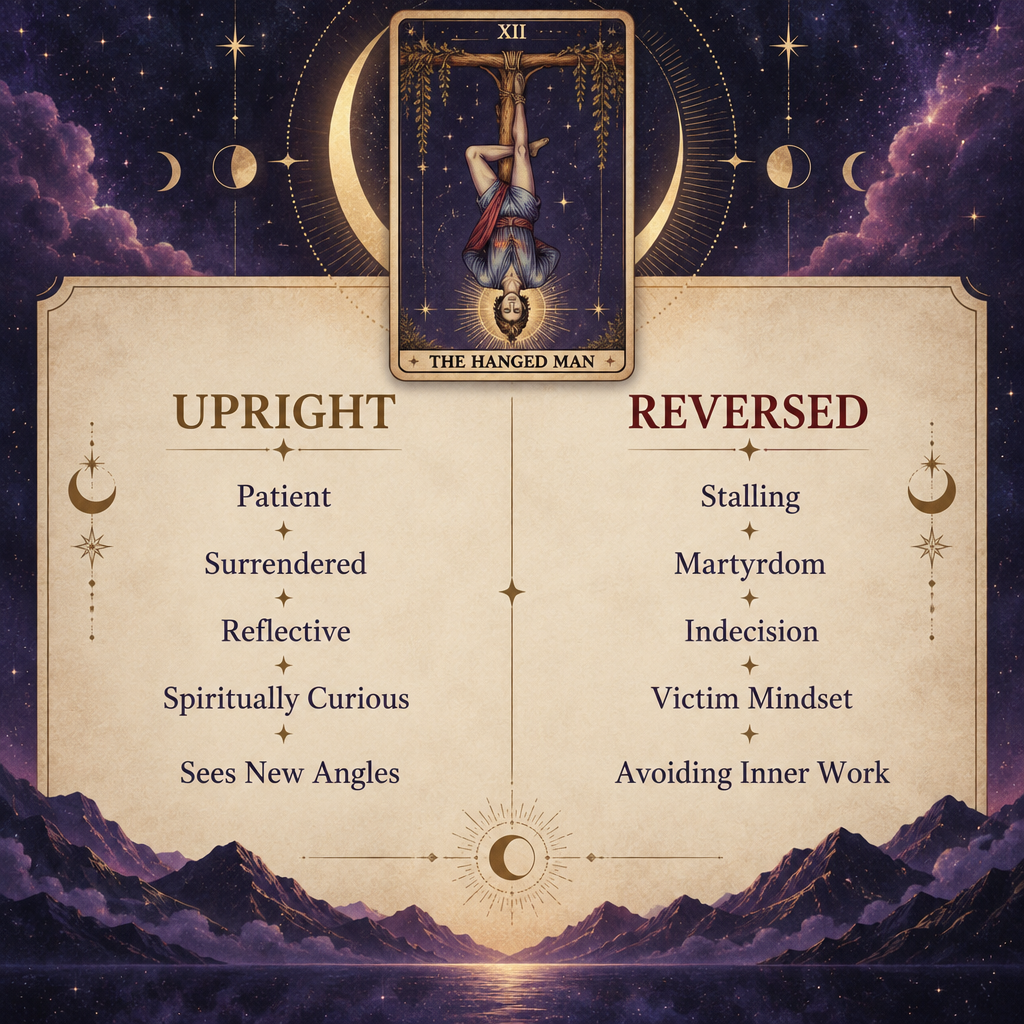
Pamela Colman Smith’s 1909 illustration for the Rider-Waite-Smith deck packs the personality into a few visual choices, and reading them explains why the archetype behaves the way it does.
The living tree. He hangs from a T-shaped cross that still sprouts leaves. This is not a dead gallows. The pause in this person’s life is fertile, not barren, which is why they can stay stuck for months and emerge with something new.
The halo. The yellow nimbus around his head is the signature of a mind that has reached clarity through stillness. The Hanged Man person often has insights that arrive only after they have stopped trying to force an answer.
Red hose (legs). Red stands for passion and physical vitality. The lower body, the part of him pointing at the sky, holds his drive. His energy has been redirected upward rather than switched off. This person is not lazy. Their motivation simply points somewhere unusual.
Blue tunic. Blue is the color of knowledge and calm. It covers his torso and heart. Emotional steadiness and a taste for learning sit at the center of who they are.
The crossed legs and bound arms. His right leg is tied; the left bends behind it to form a figure four. His arms, hidden behind his back, create an inverted triangle. Alchemically the downward triangle is water. Combined with the cross of the legs, you get the symbol of spirit descending into matter. In plain terms: this is someone who brings the intangible, intuition, faith, meaning, into practical daily life, often clumsily.
Serene face. Nothing about his expression suggests distress. The Hanged Man person is calm in circumstances that would rattle others, and sometimes that calm reads as detachment.
Spiritual and Mystical Traits: Neptune, Pisces, and Water
Modern tarot assigns the Hanged Man to Neptune, and through Neptune to Pisces and the Water element. The older Golden Dawn system gives the card the Hebrew letter Mem, which also means water. Either way, the person this card describes is soaked in Neptunian qualities.
Expect a rich inner life. They daydream, they remember their dreams, they are drawn to meditation, tarot, astrology, prayer, or any practice that involves sitting still and listening. Many Hanged Man people describe moments of dissolving self, during music, in nature, in long baths, in the middle of a tedious commute, and they treat these experiences as data rather than oddities.
Their intuition is good and they trust it. If a Hanged Man person tells you they have a bad feeling about a plan, they usually cannot explain why, and they are usually right.
The Neptune shadow is also present. Boundaries blur. They absorb other people’s moods, lose track of time, and sometimes confuse what they imagine with what is happening. Escapism is a real risk, whether through fiction, sleep, substances, or spiritual bypassing (using “it will all work out” to avoid dealing with something concrete).
Numerology of XII
The Hanged Man is card 12. Twelve is a number of completed cycles: twelve months, twelve zodiac signs, twelve hours on a clock face. A Hanged Man person often appears at the end of a cycle in your life, or is themselves finishing one.
Reduce 12 to a single digit and you get 3, the Empress. Underneath the stillness, this person is generative. The pause produces something. They tend to emerge from their suspended periods with a project, a new belief system, a book half written.
Flip 12 and you get 21, the World, the final card of the Major Arcana. The Hanged Man is the World inverted: completion seen from the inside before it arrives. This is why the Hanged Man person so often seems to be living a life that is “almost” something. Almost settled, almost finished, almost ready. They are closer than they look.
The Hanged Man as a Person in Love and Relationships
Upright
As a partner, the Hanged Man person is loyal, undramatic, and slow. They will not chase you. They will wait, and if you interpret waiting as disinterest, you will misread them badly.
They give generously and ask for little. Expect them to rearrange their schedule, their diet, their weekend, and sometimes their career around what you need. They see this as love, and it is, though it can tip into something less healthy (covered below).
Conflict with a Hanged Man partner is strange. They rarely raise their voice. Instead they go quiet, think for a day or two, and come back with a perspective you did not consider. Arguments resolve slowly but thoroughly.
In dating, they are often in a holding pattern. Someone described by this card may be between relationships, processing an ex, or in a situationship they have not pushed to define. If you want a decision from them, you will need to ask directly, and even then they may ask for more time.
Reversed
The reversed Hanged Man partner is stuck rather than patient. They stay in a relationship that ended emotionally years ago because leaving feels like admitting failure. Or they keep sacrificing for a partner who never reciprocates, then quietly keep score.
Martyrdom is the tell. “After everything I have done for you” is this person’s signature line. They cannot see that the giving was a choice, not a debt the other person owes.
They also resist the perspective shift that would free them. Friends point out the obvious. Therapists point out the obvious. The reversed Hanged Man nods and changes nothing, because changing would mean the years of waiting were wasted.
The Hanged Man as Feelings
If you ask how someone feels about you and the Hanged Man appears, the honest answer is: they are undecided, and they are not rushing to decide.
Upright, this is not rejection. They feel something real and are letting it settle before acting. They may be weighing what they would have to give up to be with you. A move, a lifestyle, a different relationship, their independence. Often they are more invested than their behavior suggests, and they are waiting for a sign that you are too.
Reversed, the feelings are murkier. They may feel trapped by the situation, resentful of sacrifices they imagine they have made for you, or paralyzed by a choice between you and something else. Reversed Hanged Man feelings frequently belong to someone who wants to leave but cannot bring themselves to say so.
In either position, do not expect a grand gesture. Expect a long pause followed by a quiet, considered answer.
The Hanged Man as a Person in Career and Work
This is the colleague who has been in the same role for six years and seems fine with it. Promotions pass them by, partly because they do not campaign for them and partly because managers mistake their calm for lack of ambition.
They are excellent in roles that reward patience and perspective: research, counseling, editing, strategy, hospice work, anything spiritual or therapeutic, and any job where the right answer only shows up after you stop forcing it. They are poor fits for sales floors, startups that worship speed, and anywhere that measures people by how fast they respond.
A Hanged Man person at work often sacrifices for the job in ways that go unnoticed. They cover shifts, take the unglamorous project, stay late without mentioning it. They do this partly out of principle and partly because self-promotion feels vulgar to them.
Reversed, the professional picture darkens. They are stagnant, not steady. They complain about the same manager for years and never apply elsewhere. They turn down opportunities because leaving would mean the time already invested was wasted. Colleagues start to see them as the office martyr, the one who does everything and resents everyone.
Physical Appearance and Style
Readers often describe the Hanged Man person through posture before anything else. They hold still. They do not fidget. In a room full of people checking phones, they are the one looking out of the window.
Their style is unconventional but not loud. Think thrifted layers, mismatched textures, a piece of jewelry with a story behind it, a haircut that is either slightly outgrown or deliberately unusual. They are not trying to shock anyone. They simply dress for an audience of one, and that audience is themselves. Blue and red appear more often than you would expect, echoing the card.
Faces tend toward the dreamy. Heavy-lidded eyes, a slow smile, a gaze that lingers a half-second longer than is comfortable. They can look tired even when rested, and they often look younger than their age, as if time has been moving more slowly for them.
Shadow Side of the Upright Hanged Man Person
Even upright, this archetype has costs, and an honest reading should name them.
Passivity can slide into inaction. There is a difference between waiting for clarity and waiting because deciding is scary, and the Hanged Man person does not always know which one they are doing.
Self-sacrifice can become enabling. Covering for a partner’s addiction, bankrolling an adult child, absorbing a friend’s chaos. The Hanged Man person frames all of this as generosity. From the outside it often looks like avoidance of a necessary confrontation.
Their perspective-flipping can become reflexive contrarianism. Not every conventional view is wrong, and a person who argues the opposite of whatever was just said is exhausting to be around.
Detachment is the last risk. The serene face on the card can hide someone who has checked out of their own life and is calling it acceptance.
The Reversed Hanged Man as a Person
The reversed card describes someone who has all the stillness of the upright figure and none of the growth.
They are stalling, not pausing. Ask what they are waiting for and they cannot tell you.
They practice martyrdom. Sacrifices are made loudly and remembered permanently. They are the friend who reminds you they drove you to the airport in 2019.
They use victimhood to resist change. If the situation is someone else’s fault, there is nothing they need to do about it. This logic keeps them in bad jobs, bad relationships, and bad habits for years.
They make needless sacrifices. Giving up things that no one asked them to give up, then expecting credit. Declining the promotion “for the family” when the family wanted them to take it.
They refuse the inner work. The upright Hanged Man goes inward during the pause. The reversed one distracts, numbs, blames, and emerges from the pause exactly as they entered it.
They cannot release. A grudge, a dead relationship, a version of themselves that stopped existing a decade ago. Letting go would mean admitting the holding on was pointless.
This person is not a bad person. They are a Hanged Man who has been hanging so long they forgot the point was to come down with something.
How to Relate to a Hanged Man Person
Do not rush them. Pressure makes them retreat further into stillness. State what you need, give a deadline if one genuinely exists, then leave them alone with it.
Ask for their perspective when you are stuck. Their inverted view is most valuable on problems you have been staring at for too long.
Watch the sacrifice ledger. If they keep giving, make sure it is actually wanted, and say thank you specifically. Unacknowledged sacrifice is what turns an upright Hanged Man into a reversed one.
Name stalling when you see it. Gently. “You have been thinking about this for eight months. What would it take to decide?” They often need an outside voice to tell them the pause has served its purpose.
If you are the Hanged Man person, the single most useful question is: what am I gaining by staying here? If you have an answer, stay. If you do not, the tree has given you what it had.
Yes or No: The Hanged Man as a Person
For yes-or-no questions about a person, the Hanged Man upright is a “not yet.” Will they commit? Will they call? Will they take the job? Not until they have finished suspending. The card is not negative, but it will not give you the fast yes you want.
Reversed, lean toward no, with a note. The no is not because the person is wrong for you. It is because they are stuck, and stuck people do not move on your timeline or anyone’s.
How the Hanged Man Differs From Adjacent Archetypes
The Hermit (IX). Both withdraw. The Hermit withdraws deliberately, walks away with a lantern, and knows what they are looking for. The Hanged Man is held in place by circumstance or choice and does not fully know what will come of it. The Hermit is a sage; the Hanged Man is a student mid-lesson.
The Moon (XVIII). Both are Water-heavy and intuitive. The Moon person is lost in illusion and anxiety, unsure what is real. The Hanged Man person sees clearly; the clarity just arrived upside down. The Moon is fog; the Hanged Man is a lens.
Pisces energy generally. Pisces is Neptune’s sign and shares the dreaminess, empathy, and escapist risk. The difference is that a Hanged Man person has added a vow to the Pisces temperament. They are not just drifting. They have agreed to stay in a hard place for a reason, even if they cannot articulate the reason yet.
The Four of Swords. Minor Arcana rest versus Major Arcana suspension. The Four of Swords person is recovering and will return to normal life. The Hanged Man person will not return to normal. Normal is what they are leaving behind.
FAQ
What does the Hanged Man represent as a person?
A patient, unconventional, spiritually inclined person who is willing to pause and sacrifice in order to gain a new perspective. They tolerate uncertainty well, give generously, and see problems from unusual angles. The risk is that patience becomes passivity and generosity becomes enabling.
Is the Hanged Man a positive person to have in your life?
Upright, yes, provided you can handle their pace. They are loyal, calming, and insightful, and they will show you angles you missed. Reversed, they are draining, because their stuckness and martyrdom pull you into a holding pattern alongside them.
What does the reversed Hanged Man mean as a person?
Someone stalled rather than paused. They resist change, cast themselves as a victim or martyr, make sacrifices nobody asked for, and avoid the inner work that would move them forward. They often stay in situations that ended emotionally long ago.
How does a Hanged Man person behave in relationships?
Slowly and loyally. They do not chase, they give more than they ask for, and they resolve conflict through quiet reflection rather than argument. They may linger in undefined situations for a long time and need a direct question before they will commit.
What does the Hanged Man mean as feelings for someone?
They feel something real but have not decided what to do about it. Upright, they are weighing the cost of acting. Reversed, they may feel trapped or resentful and want to leave without saying so.
Which zodiac sign is the Hanged Man?
The card is linked to Neptune and, through Neptune, to Pisces and the Water element. In the older Golden Dawn system it corresponds to the Hebrew letter Mem, which also means water. Both traditions point to the same personality: intuitive, dreamy, empathetic, and prone to dissolving boundaries.