

Drawn upright as a love outcome, the Eight of Pentacles means yes: the relationship lasts because both people keep putting in steady, practical effort. Expect slow progress, not fireworks. Reversed, it means not yet. The effort has stopped, become one-sided or gone into the wrong things, and the outcome only turns positive if that changes.
The rest of this page shows how that plays out for a crush, a new partner, a long-term relationship, an ex or a decision you have to make. It also covers how nearby cards shift the reading and what Pamela Colman Smith, A. E. Waite and the Golden Dawn actually said about the card.
Yes or No: The Quick Verdict
Upright: yes, with conditions. The relationship has a durable future as long as both people keep doing the ordinary daily work. Think of it as a sign you will still be together in ten years, not a whirlwind card.
Reversed: no as things stand, but you can change it. It rarely predicts a dramatic breakup. It predicts a slow fade through neglect, burnout or uneven effort. If that imbalance is fixed, the answer can turn back to yes. That is why the reversed Eight works better as a warning than as a final verdict.
| Question you asked | Upright answer | Reversed answer |
|---|---|---|
| Will this relationship last? | Yes, if the effort continues | Not on its current course |
| Will my crush become something? | Slowly, through familiarity | Unlikely while one of you is elsewhere |
| Will my ex come back? | Possibly, after real change | Unlikely; the repair work isn’t happening |
| Is this person serious about me? | Yes, shown through actions | Distracted, tired or going through the motions |
| Should I commit? | Yes, to the steady option | Not until the effort is mutual |
What the Card Shows: Smith’s Image and Waite’s Words

The card shows an apprentice at a workbench, carving coins one at a time. Every love meaning of the Eight of Pentacles comes from that picture of patient, repeated work.
Pamela Colman Smith’s drawing
In the Rider-Waite-Smith deck, published by William Rider & Son in 1909 and illustrated by Pamela Colman Smith, a young craftsman sits on a bench with a hammer and chisel, cutting a pentacle. Six finished coins hang in a column on the post beside him. A seventh rests on the ground at his feet, and the eighth is the one in his hands. Behind him a road leads to a small, distant town. He has his back to it.
In a love reading, each detail means something:
- The apprentice, not a master. The card doesn’t say you have reached perfect love. It says you are learning how to love this specific person and getting better with each attempt. Compare the Three of Pentacles, where the craftsman is skilled enough that others consult him about the work. The Eight is earlier, humbler and built on repetition.
- The six coins on the post. These are what the relationship has already finished: arguments resolved, trust earned, habits built.
- The coin on the ground. Something has been set aside. Usually it’s a conversation or a need that keeps getting put off.
- The coin in progress. This is the issue being worked on right now.
- The town behind him. It stands for distractions: other options, outside approval, the fantasy of a partner who takes no effort. He chose the bench instead.
What A. E. Waite wrote in The Pictorial Key to the Tarot
Waite’s 1910 guide to the deck describes the card as “an artist in stone at his work, which he exhibits in the form of trophies.” He gives these upright meanings: “work, employment, commission, craftsmanship, skill in craft and business, perhaps in the preparatory stage.” His additional meanings add “a young man in business who has relations with the Querent; a dark girl.”
His reversed meanings are much harsher: “voided ambition, vanity, cupidity, exaction, usury.” He adds that the reversed card may signal skill turned toward cunning and intrigue, and his secondary reversed note warns that the querent “will be compromised in a matter of money-lending.”
None of Waite’s text is about romance, but you can still use it. “Perhaps in the preparatory stage” is why the upright card describes a relationship still under construction. “Exaction” and “usury” describe love run like a ledger: keeping score, charging interest on favours, demanding repayment for every kindness. That’s a sharper reversed meaning than “lack of effort,” and most modern guides skip it.
Golden Dawn attribution: Lord of Prudence, Sun in Virgo
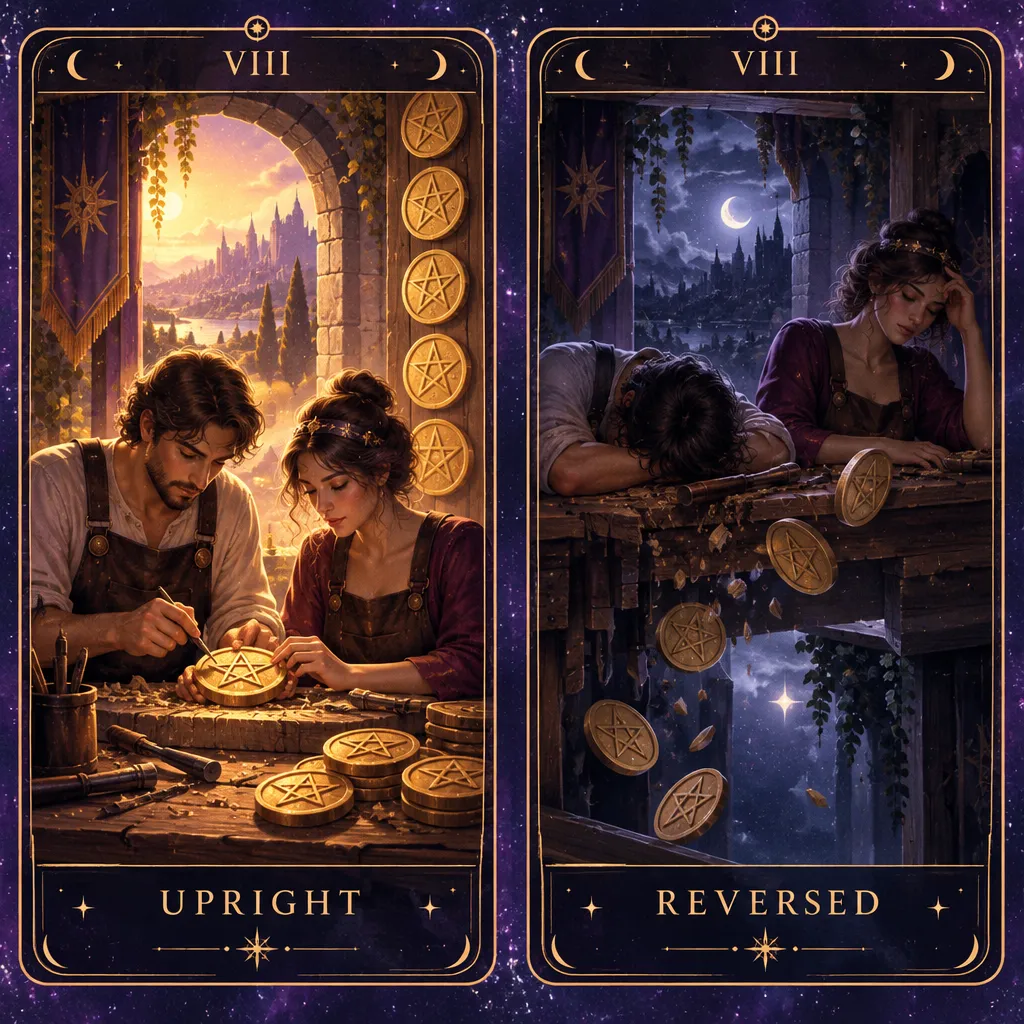
The Hermetic Order of the Golden Dawn titled the card the Lord of Prudence. They assigned it to the Sun in the first decan of Virgo (0° to 10°) and placed it in Hod on the Tree of Life. Aleister Crowley kept the title “Prudence” for the Eight of Disks in his Thoth deck.
Virgo is the sign of service, health and daily routine. In love, this placement says affection shows up as competence: picking up the prescription you forgot, remembering how you take your coffee, fixing the wobbly chair without being asked. If you need big declarations to feel loved, this card asks you to learn a quieter language. The love is real, but it shows up in errands and habits.
Prudence also means caution. Under this card, someone is choosing carefully and won’t be rushed. That suits a long-term partner and frustrates someone who wants an answer by Friday.
Why the number eight matters
In the Minor Arcana, eights mark the point where the suit’s lesson has mostly been learned and now has to be practised until it becomes habit. For love, that means the relationship has passed its fragile stage. It isn’t at the finish line yet (that’s the Ten), but it has enough momentum that consistent effort will carry it forward.
Upright Eight of Pentacles: Love Outcome by Situation

Upright, the card is good news in every situation, but the timing is always slow and the outcome always depends on effort. Here’s what that means in each case.
A crush
The interest is real, but it builds through familiarity, not a big reveal. The outcome favours slow exposure: the same class, the same shift, the same weekly event. Your crush may be absorbed in work or study right now, which can look like indifference when it isn’t.
Next step: Show up consistently where they already are. A shared routine does more here than a bold confession.
Someone new or a recent relationship
This is one of the best outcome cards for the first few months. It says the connection has substance beyond chemistry. You’re getting past performing for each other and finding out how the other person handles a bad week or a dishwasher that needs emptying.
Expect the relationship to get more serious at a measured pace. One or both of you is deliberately taking your time, and that’s a strength.
Next step: Start one small, repeatable ritual together, like Sunday walks or Wednesday cooking. Have the dull conversations early: money habits, how you each handle conflict, what your schedules look like.
A partner or long-term relationship
The outcome is longevity. The card doesn’t turn up for relationships about to collapse. It turns up for ones that last because both people keep maintaining them.
It can also point to something literal: building a business together, renovating a home, saving toward a shared goal or co-parenting as a team. Psychologist Robert Sternberg’s Triangular Theory of Love, published in Psychological Review in 1986, splits love into intimacy, passion and commitment. Intimacy plus commitment without passion is what he calls companionate love, and that’s where the upright Eight naturally sits. Sternberg’s “consummate” love needs all three, so this card asks you to schedule passion on purpose instead of waiting for it.
Next step: Pick the issue that has been “on the ground” and work on it this month. Then tell your partner what the six coins on the post are: the things they already do well.
An ex or reconciliation
Reconciliation is possible, but only after work, and the work has to happen before you get back together. The real question is what each of you has actually changed. If nothing has, a reunion replays the original ending.
Your ex is probably head-down in their own life right now, focused on career or self-improvement. They aren’t actively pursuing you, and the card doesn’t suggest they’re chasing anyone else either.
Next step: Do your own repairs first. If you reach out, lead with what you’ve specifically changed, not with how much you miss them. Plan in months.
Single and asking about future love
Your current focus on work, health, home or your own patterns is the right preparation, even if it doesn’t feel romantic. Love tends to come through your routine: a coworker, someone at the gym, a classmate, a fellow volunteer. Expect a partner who is diligent, practical and a little reserved, the kind who texts back reliably but doesn’t write poetry.
Next step: Say yes to recurring things (the weekly class, the standing dinner) over one-off events. Notice who is consistent rather than who is exciting.
A decision: stay, go, or choose between two people
Upright, the card favours the option where effort is already mutual and the coins are already on the post. It rarely backs the more thrilling choice. If you’re torn between someone steady and someone intoxicating, the Eight is voting for steady.
Next step: List what each option has actually built, not what it promises. The card trusts finished coins over plans.
Reversed Eight of Pentacles: Love Outcome by Situation
Reversed, the card describes effort that has failed in one of several specific ways. Working out which one applies to you tells you what to fix.
The seven ways effort goes wrong
| Pattern | What it looks like | Likely outcome if unchanged |
|---|---|---|
| Lack of effort | No plans, perfunctory texts, running on inertia | A fade, not a breakup |
| Burnout | One person over-functioned for too long and ran out | Looks like indifference; is closer to grief |
| Perfectionism | Partner treated as a flawed draft; constant correction | The criticised partner eventually walks away |
| Ledger love (Waite’s “exaction, usury”) | Scorekeeping, favours with strings attached | Resentment on both sides |
| Misdirected effort | Lavish trips or gifts while the real problem goes undiscussed | Same result as no effort |
| One-sided effort | One partner initiates, plans, apologises and repairs alone | The carrier puts the load down |
| Work crowding out love | Career, study or a side hustle eats the relationship | Partner feels outranked by a spreadsheet |
The work-crowding version is often the easiest to fix because the problem is scheduling rather than feeling. That only holds if the busy partner actually changes the calendar, not just the promises. Burnout is the exception to every “try harder” rule. It responds to rest and a fairer split of the load, not a lecture.
A crush, reversed
Either your crush’s attention is elsewhere or you’re polishing yourself to win them instead of simply showing up. Both stall the outcome. Reversed, the card can also flag a crush you keep at a safe distance so you never have to risk anything.
Next step: Make one real, low-stakes move, or let it go and put the energy back into your own life.
A new relationship, reversed
The early effort is misaligned. One person treats it as serious while the other treats it as a hobby, or the focus is all on how it looks and nobody has had a real conversation. Unchanged, these relationships often fizzle around the three-to-six-month mark.
Next step: Have the “what is this” talk sooner than feels comfortable. Drop the performance for one date and see who is still there.
A partner, reversed
This means stagnation and the quiet resentment of feeling unappreciated. Both of you are ignoring the six coins on the post and staring at what’s missing. Unchanged, the separation starts emotionally and may later become literal.
Next step: For one week, name out loud every contribution your partner makes as you notice it. Then sit down for an honest conversation about who carries what.
An ex, reversed
This is a clearer no than the upright card. The work that would make reconciliation viable hasn’t been done, and the energy is going into nostalgia rather than change. Getting back together now recreates the relationship you already left.
Next step: Put that effort into your own life. If your ex comes back with evidence of real change, look at it again then. Don’t go searching for it.
Single, reversed
Dating frustration is pointing back at you. Maybe you swipe without meeting people, ghost when things get mildly inconvenient, or hide in work to avoid feeling vulnerable.
Next step: Change one dating habit for six weeks. Meet the people you match with, and ask a trusted friend what pattern they see in your exes.
A decision, reversed
You may be staying because of what you’ve already put in rather than what you get back. Sunk effort isn’t a reason to keep going. The reversed card asks whether the work is building anything or just keeping you busy.
Upright vs. Reversed at a Glance
| Upright | Reversed | |
|---|---|---|
| Core energy | Steady, intentional effort; love as craft | Effort stopped, misdirected, one-sided or transactional |
| Yes or no | Yes, conditional on continued effort | No as things stand |
| Crush | Grows through shared routine | Stalled by distraction or self-polishing |
| New relationship | Substance beyond chemistry; slow, serious progress | Superficial or misaligned; likely to fizzle |
| Long-term relationship | Longevity; building something concrete | Stagnation, burnout, feeling unappreciated |
| Ex / reconciliation | Possible after visible personal change | Unlikely; the repair work is not happening |
| Single | Love arrives through routine | Avoidance disguised as busyness |
| Timing | Months, not weeks | Slow fade rather than sudden break |
| Next step | Add one shared ritual; acknowledge progress | Identify the failure pattern; rebalance or rest |
How Neighbouring Cards Change the Outcome
The cards around the Eight decide whether the effort leads somewhere or keeps going in circles.
| Neighbouring card | With upright Eight | With reversed Eight |
|---|---|---|
| Two of Cups | Mutual effort, genuine bond; one of the strongest pairings for lasting love | Affection is there, but one person has stopped contributing |
| Ten of Pentacles | Work leads to shared home, marriage, family security | Building a life together has stalled over money or logistics |
| The Lovers | Commitment plus real attraction; passion survives | A choice is being avoided through busyness |
| Four of Wands | Moving in, engagement or a celebration of a milestone | Plans for a milestone keep getting postponed |
| The Hierophant | Traditional commitment, possibly marriage | Going through the motions of a conventional relationship |
| Knight of Pentacles | Very secure, possibly dull; add deliberate novelty | Stubborn routine, neither person willing to change |
| Four of Cups | One partner is emotionally checked out despite the effort | Mutual apathy |
| Five of Pentacles | Loyal through hard times, but strained | Money stress is crushing the effort |
| The Devil | Effort has become compulsion or control | Obsessive fixing or a toxic loop |
| The Hermit | Self-work before love; common for singles | Isolation used to avoid intimacy |
| Three of Swords | Repairing a wounded relationship; possible but painful | The hurt is not being worked through |
| The Star or Six of Cups | Hopeful, gentle rebuilding | Neglect is repairable; affection remains underneath |
| The Tower or Ten of Swords | Upheaval interrupts the work | The warning becomes an ending |
For marriage questions, the Eight on its own describes the kind of relationship marriages are built on. Next to a Ten of Pentacles, the Four of Wands or the Hierophant, it leans strongly toward a formal commitment.
Outcome, Feelings or Advice: Why the Position Matters
The same card means something different depending on where it falls in the spread.
- As the outcome: where things are heading if the current path continues. Upright, a lasting bond built by effort. Reversed, a fade unless something changes.
- As feelings: how someone sees you. Upright, they’re dedicated and show it through actions, though they may say less than you’d like. Reversed, they feel tired, taken for granted or pulled toward other priorities.
- As advice: what to do. Upright, keep going and focus on the work in front of you. Reversed, stop and check where your effort is actually going before adding more.
Reading the feelings position as a verdict is the most common mistake. A quiet, hardworking partner shown by this card often feels more than they express.
Timing: How Long Until You See Results
The Eight of Pentacles points to months, not days or weeks. Pentacles are the slowest suit, and this card shows a process of repeated effort, not a single event. A reasonable expectation is gradual change over one to several months, with the clearest shifts showing up in behaviour before words.
If you asked a short-range question (“this week?”), the card’s answer is that you’re measuring the wrong unit of time.
What to Do After Drawing This Card
The Eight of Pentacles responds to action, upright or reversed. Work through it in order:
- Name the coin in your hands. Pick one specific issue in your love life you can work on now, not the whole relationship.
- Count the six on the post. Write down what has already been built, resolved or earned. For singles, that includes patterns already broken.
- Pick up the coin on the ground. Restart the postponed conversation or the dropped habit this week.
- Check where your effort goes. For seven days, notice what you actually spend relationship energy on. If it doesn’t touch the real problem, redirect it.
- Turn your back on the town. Stop comparing your relationship to strangers’ highlight reels and drop the mental backup list.
- If reversed, rest before you rebuild. Burnout doesn’t respond to more effort. It responds to rest, honesty and a fairer split of the load.
There’s an honest counter-argument too. Some relationships don’t deserve more work. If you’re the only one who has carried the load for a long time, the Eight’s lesson about effort can mean investing in yourself instead.
FAQ
Is the Eight of Pentacles a good love outcome?
Upright, yes. It predicts a stable, lasting relationship built on consistent effort and everyday acts of care. It isn’t a passion card, so people hoping for a whirlwind sometimes underrate it, but it’s one of the more dependable signs that a relationship will last.
Is the Eight of Pentacles a yes or no in love?
Upright, it’s a yes that depends on effort continuing on both sides. Reversed, it’s a no on the current path, because neglect or imbalance is wearing the relationship down. Fixing that imbalance can turn the answer back to yes.
Does the Eight of Pentacles mean someone is too busy for love?
Sometimes. When the card points to work crowding out romance, it’s usually reversed or next to cards like the Hermit or Four of Cups. Upright, busyness more often means someone is building a life they plan to share, not avoiding you.
What does the Eight of Pentacles mean as feelings?
They feel dedicated and want to prove it through actions rather than words. They see the relationship as something worth working on, even if they’re reserved about saying so. Reversed, they feel drained, unappreciated or distracted.
Does the Eight of Pentacles mean marriage?
Not on its own. It describes the committed, practical kind of partnership that marriages are built on. Paired with a Ten of Pentacles, the Four of Wands or the Hierophant, it leans strongly toward marriage or another formal commitment.
Will my ex come back if I draw the Eight of Pentacles?
Upright, it’s possible but slow, and only after real change on both sides. Your ex is likely focused on their own life for now. Reversed, a reunion is unlikely because the work a healthy reconciliation needs isn’t being done.
What did A. E. Waite say the Eight of Pentacles means?
In The Pictorial Key to the Tarot, Waite described “an artist in stone at his work” and gave the meanings work, employment, craftsmanship and skill in craft and business, “perhaps in the preparatory stage.” His reversed meanings were voided ambition, vanity, cupidity, exaction and usury. Love readings of the card build on these work-focused meanings.
Add Yes No Tarot as a preferred source on Google, and the sites you pick are more likely to appear in your Top Stories.