
Chariot As A Person (Upright & Reversed) Tarot Card Meaning
When the Chariot represents a person in a reading, you are looking at someone who moves through life by force of will. Upright, that will is directed, disciplined, and remarkably hard to knock off course. Reversed, the same drive turns into control anxiety, aggression, or a stalled engine that never leaves the driveway.
Chariot Keywords at a Glance
| Upright Chariot person | Reversed Chariot person | |
|---|---|---|
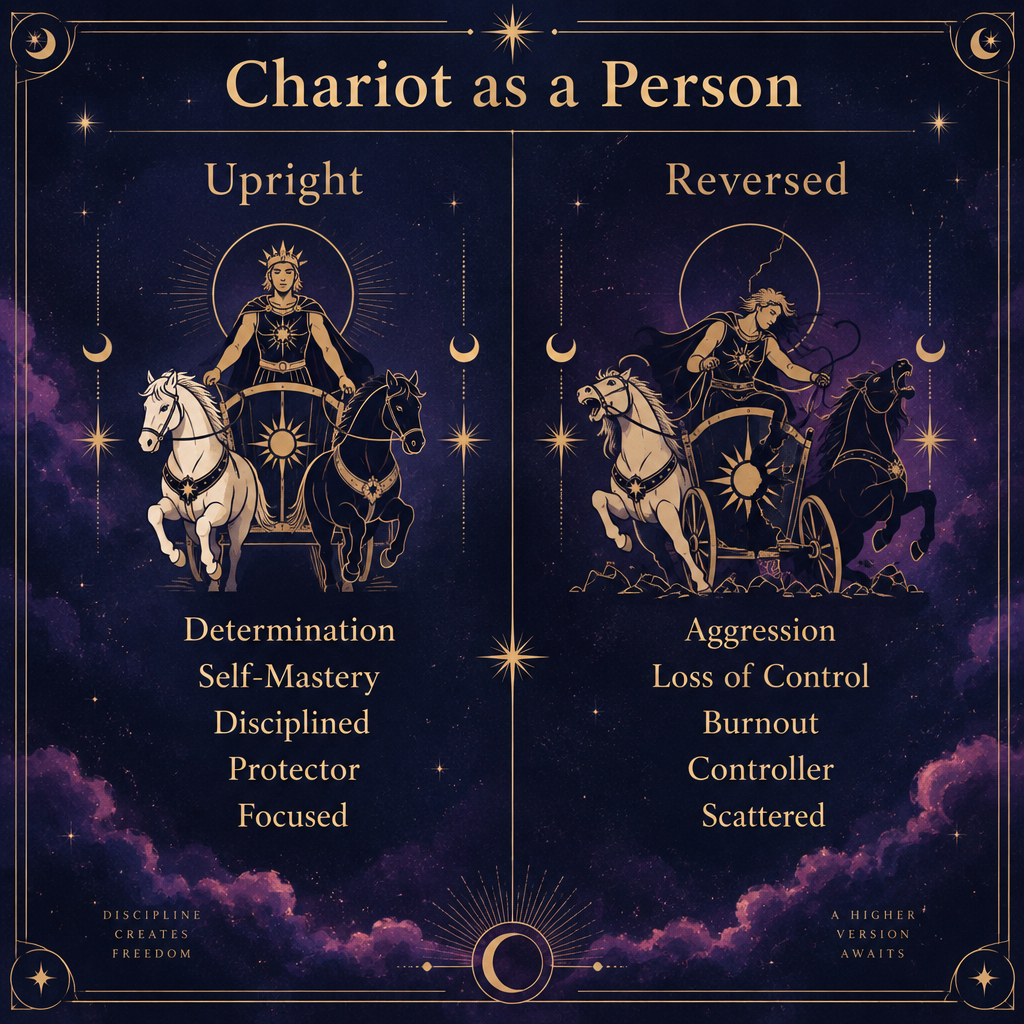
| Core traits | Determination, willpower, self-mastery, discipline, ambition, focus | Aggression, loss of control, burnout, power struggles, scattered energy |
| Emotional style | Contained, steady under pressure, decisive | Volatile, defensive, prone to overcorrecting |
| Behaviour | Sets a goal and drives at it in a straight line | Either pushes too hard or refuses to move at all |
| Relationship role | Protector, provider, initiator | Controller, or the partner who checks out |
| Work role | Closer, competitor, self-starter | Micromanager, or the burnt-out high achiever |
| Astrology | Cancer, ruled by the Moon | Cancer’s shadow: moodiness, defensiveness |
| Number | 7 (the first test after the Lovers) | 7 blocked: the test failed or avoided |
What the Card’s Imagery Says About This Person
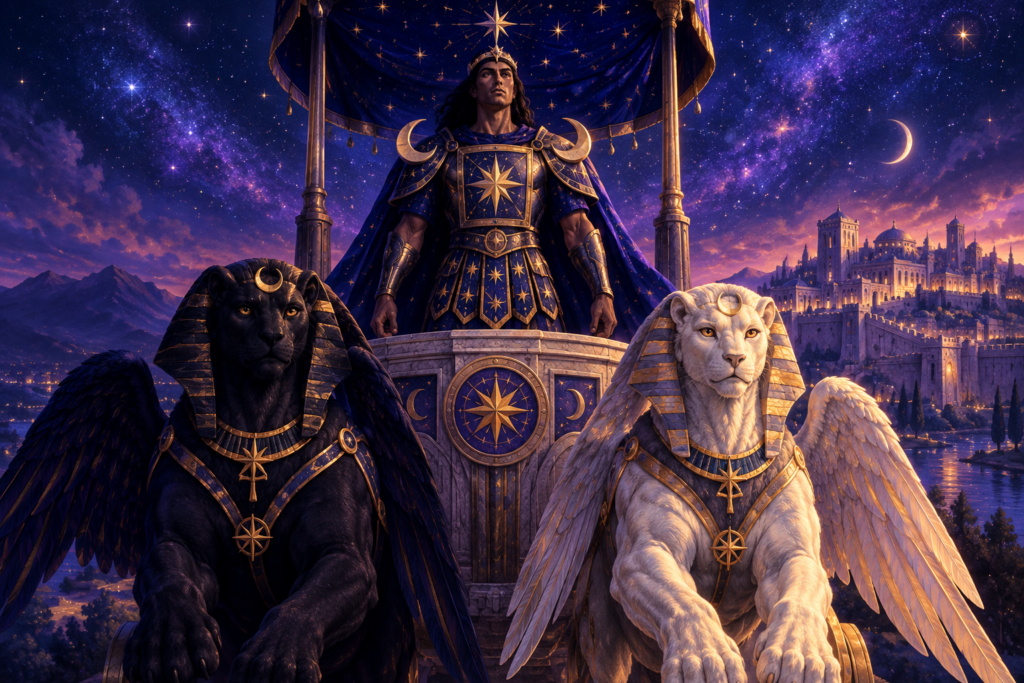
The Rider-Waite-Smith Chariot is packed with details that translate directly into personality traits, which is why the card produces such a consistent character portrait.
The charioteer holds no reins. Two sphinxes, one black and one white, pull the vehicle, and they face slightly different directions. The figure controls them anyway, purely through will. That is the central fact about a Chariot person: they contain contradictory impulses (ambition and caution, ego and duty, aggression and tenderness) and they keep those impulses harnessed without visible strain. When you meet someone who seems to have their temper, their appetites, and their fears on a leash, you are probably meeting this card.
The armor is covered in stars and the canopy above is a field of them, which points to a person who feels answerable to something larger than short-term comfort. The crescent moons on the shoulders and the square on the breastplate combine lunar emotion with earthly solidity. Cancer, the Chariot’s sign, is a cardinal water sign: it initiates, but from feeling rather than logic. So the Chariot person is not the cold tactician people sometimes assume. Their drive comes from something they care about deeply, often family, home, a person they have decided to protect, or a wound they refuse to let define them. The walled city behind the chariot is the home they left in order to prove something to themselves.
Notice, too, that the chariot itself is stone, and the figure stands rather than sits. This is not a comfortable ride. The Chariot person has accepted that success costs effort and does not complain about paying.
Upright Chariot as a Person
Personality
The upright Chariot person is defined by active, directed willpower. They decide what they want, build a route to it, and then execute with a consistency that other people find either inspiring or exhausting. They are not adaptable in the way the Magician is adaptable; they are persistent. Obstacles get pushed through rather than talked around.
They tend to be early risers, list makers, and finishers. A Chariot person who says they will call you at nine calls at nine. They keep promises to themselves with the same seriousness, which is why they often have a visible physical discipline (training routines, sport, a diet they actually follow) that has lasted years.
They also have a competitive streak that is easy to underestimate because it is quiet. They rarely boast. They would rather win and let the result speak. In arguments they are firm but fair, willing to hear the other side, and they will change position if presented with evidence. What they will not do is change position to keep the peace.
Emotional Life
Cancer’s rulership matters here. Beneath the armor, the upright Chariot person feels a great deal. The difference between them and a more openly emotional card is that they have trained themselves to act on feeling rather than be swept by it. Fear gets converted into preparation. Anger gets converted into effort. Grief gets channeled into a project or a cause.
This makes them very steadying in a crisis. When everyone else is panicking, the Chariot person is already moving furniture, making phone calls, and assigning tasks. People feel safe around them for exactly that reason.
The trade-off is that they can be slow to show vulnerability. They process alone, often through physical exertion, and only share once they have a plan. Partners and close friends sometimes learn about a Chariot person’s struggle only after it has been solved.
Physical Presence and Body Language
The Chariot person is usually noticed before they speak. Posture is the giveaway: shoulders back, spine long, weight evenly distributed, chin level. They stand still without fidgeting and sit without slouching. When they move, they move with purpose, taking direct routes across a room rather than drifting.
Physical stamina is characteristic. Many Chariot people are athletes or former athletes, or they have jobs that reward endurance. They can outwork most people in a room and rarely look tired doing it. Handshakes are firm. Eye contact is sustained but not aggressive.
Their appearance tends toward the functional and well kept rather than the flashy. Clothes fit properly and suit the setting, hair is deliberate, and there is often a single strong detail (a watch, a particular jacket, a signature colour) that they wear like a uniform. The overall impression is of someone who decided long ago how they wanted to present and has not needed to revise it.
The Upright Chariot in Love and Relationships
As a partner, the upright Chariot person is a protector and an initiator. They pursue clearly and do not play games. If they are interested, you will know, and they will make concrete plans rather than send vague texts. Once committed, they are loyal to the point of stubbornness and take the practical side of a relationship seriously: bills, repairs, showing up.
Because of the Cancer influence, they want a home base and a partner who feels like home. They express love through action and reliability more than through words. Expect them to remember what you said you needed three weeks ago and to have quietly handled it.
The friction point is control. The Chariot person is used to steering, and a partner who wants equal input on direction will need to insist on it, calmly and early. They respect strength and will meet it with respect. They lose interest in partners who make them do all the driving.
If you have asked how a specific person feels about you and drawn the upright Chariot, the answer is that they are moving toward you with intent. They may not have said much yet, but the decision has been made.
The Upright Chariot at Work and With Money
Professionally, the upright Chariot person is a self-starter and a closer. They do well in sales, athletics, the military, emergency services, entrepreneurship, law, logistics, and any field that rewards drive and delivers measurable wins. They set targets, hit them, and immediately set the next one.
As a colleague they are dependable and demanding in equal measure. They do their share and notice when others do not. As a manager they lead from the front, take responsibility for outcomes, and expect the team to keep pace. They are not natural delegators and have to learn that skill deliberately.
With finances, they are disciplined savers who spend on things that serve a goal: equipment, training, a vehicle, a home. Impulse purchases are rare. They are comfortable with calculated risk, particularly on their own abilities, and are the type to leave a secure job to build something once the plan is ready.
Reversed Chariot as a Person
Personality
The reversed Chariot person still has the engine. What is missing is the steering. The two sphinxes have pulled in opposite directions and the charioteer, lacking reins, has either lost the vehicle or climbed down in frustration.
This shows up in one of two forms. The first is the aggressive overcorrector: someone who forces every situation, bulldozes disagreement, drives too fast in every sense, and treats any obstacle as a personal insult. The second is the stalled Chariot: someone with real talent and ambition who cannot get started, who talks about the plan endlessly but never launches, or who has burnt out completely after years of pushing.
Both versions share a core problem. They cannot tolerate the sensation of not being in control, and their behaviour is an attempt to escape that sensation rather than to reach a goal.
The Shadow Side: What Is Really Going On
The controlling behaviour of a reversed Chariot person is almost always rooted in fear of failure. Somewhere along the way they learned that their worth depended on winning, and that losing would mean being unprotected. Cancer’s shadow is a crab retreating into its shell, pincers out. The reversed Chariot person is defending something soft.
That is why criticism produces such disproportionate reactions. A small piece of feedback feels like an attack on their right to exist, so they escalate. It is also why the stalled version procrastinates: if you never leave the city walls, you can never be defeated on the road.
Control anxiety also explains the micromanaging, the jealousy in relationships, the refusal to ask for help, and the exhaustion. They are trying to hold both sphinxes with their bare hands. It does not work, and the harder they grip, the more the animals fight.
Emotional Life
Emotionally, the reversed Chariot person is volatile in a way the upright person is not. Moods swing between grandiosity and collapse. They may be charming and energetic on Monday and unreachable by Thursday. Anger is close to the surface, and it is often directed at whoever is nearest rather than at the actual source.
Underneath the anger sits a chronic sense of being behind, of not measuring up, of other people having it easier. They compare constantly and rarely win the comparison in their own head, regardless of external evidence.
Physical Presence and Body Language
The body tells the story. The aggressive reversed Chariot person leans in too far, talks too loudly, grips too hard, and cannot stay still. Jaw tension, clenched fists, pacing, and interrupting are common. They often carry injuries from overtraining or from accidents caused by rushing.
The stalled version shows the opposite: slumped posture, low energy, avoidance of eye contact, and a heaviness of movement that suggests someone carrying more than they can lift. Both versions tend to neglect sleep and to run on stimulants, adrenaline, or both.
The Reversed Chariot in Love and Relationships
As a partner, the reversed Chariot person struggles to share the wheel. The aggressive type becomes controlling: monitoring, dictating, sulking or exploding when plans change, treating the relationship as a possession to be defended. The stalled type checks out, becoming passive, avoidant, and unwilling to make any decision, leaving the partner to carry everything.
If you asked about a specific person’s feelings and drew the reversed Chariot, the honest reading is that they want you but cannot commit to a direction. They may be pulling toward you and away from you at the same time, sending mixed signals not out of cruelty but because they genuinely have not resolved their own conflict. Waiting for them to sort it out without any input from you is a poor strategy.
The Reversed Chariot at Work and With Money
Professionally, the reversed Chariot person is either the manager everyone dreads or the brilliant employee who never delivers. The controlling type micromanages, takes credit, refuses to delegate, and burns through staff. The stalled type misses deadlines, changes course repeatedly, and is often on the edge of burnout after a long period of overwork.
Financially, watch for reckless risk taken in a state of frustration, or for money problems caused by paralysis: bills unopened, decisions deferred, opportunities missed because the perfect plan never arrived.
How Someone Sees You as the Chariot
If you asked how another person perceives you and the Chariot appeared upright, they see you as strong, capable, and self-possessed. They may find you slightly intimidating. They likely admire your discipline and believe you can handle anything, which can mean they lean on you more than is fair and rarely think to ask how you are doing. In a romantic context, they see you as a catch: someone who has their life together and knows what they want.
Reversed, they see you as someone who is either too forceful or who is stuck. They may feel steamrolled by you, or frustrated that you have so much potential and are not using it. Either way, they perceive a lack of balance and are probably keeping some distance until they understand which way you are going to move.
Chariot as a Person: Yes or No?
Upright, the Chariot person is a yes. This is someone who follows through, who will show up for you, and whose presence in your life moves things forward.
Reversed, the answer is not yet. The person is not a bad person, but they are not in a state to be relied on. Whether the question is dating them, hiring them, or partnering with them, wait until you see evidence that they have regained control of their own direction.
The Chariot Person in Friendship
The upright Chariot friend is the one who helps you move house, drives across town at midnight when your car dies, and tells you the truth when you ask for it. They are loyal, protective, and a little bossy. They organise the group trip and expect people to be on time. They are not the friend you call for a long emotional unpacking; they are the friend you call when something needs to be done.
The reversed Chariot friend is competitive in ways that sour the relationship, or is the person who always cancels because they are overwhelmed. Friendships with them can feel like a struggle for control of the plans, the conversation, or the narrative.
The Chariot Compared With Other Major Arcana Personalities
The Magician person is a strategist who succeeds through skill, timing, and adaptability. The Chariot person succeeds through persistence and will. Put them on the same problem and the Magician finds a clever route around; the Chariot goes straight through.
The Emperor person is a builder of structures who rules a domain and wants order. The Chariot person is a conqueror on the road, still proving something, still in motion. The Emperor has already arrived.
Strength, the card immediately after the Chariot, achieves control through gentleness and patience, taming the lion by hand. The Chariot controls through force of will. Strength is the lesson the Chariot person still has to learn: that some things cannot be harnessed, only befriended.
The Lovers, the card before the Chariot, is the choice. The Chariot is the person who has made it and is now living with the consequences.
How to Deal With a Chariot Person
Give them a goal and get out of the way. Chariot people respond to clear objectives and hate being managed closely. Be direct with them; they respect candour and distrust flattery. Do not take their competitiveness personally, and do not try to win an argument through emotional pressure, because they read it as manipulation.
If you love an upright Chariot person, ask how they are doing and then wait through the silence. They will not volunteer the answer. Insist on equal say in shared decisions from the start, because habits set early are hard to shift with this card.
If you are dealing with a reversed Chariot person, refuse to play the control game. Do not match their aggression, do not rescue their paralysis, and do not accept mixed signals as a permanent arrangement. Name what you see, calmly, and set clear limits. Their fear of failure is not yours to fix, but you can decline to be steamrolled by it.
Reversed Chariot: The Road Back Upright
For anyone recognising themselves in the reversed profile, the way back is not more effort. It is less gripping.
Start by naming the fear. Most reversed Chariot people have never said out loud what they think will happen if they fail. Saying it, ideally to another person, shrinks it.
Pick one direction and drop the others for now. The sphinxes cannot be forced to agree; the charioteer chooses which pull to follow. A single clear goal, even a modest one, restores the feeling of movement.
Rebuild the body. Sleep, steady exercise that is not punishment, and a reduction in stimulants do more for a reversed Chariot than any amount of motivational thinking. The card is physical. Its recovery is physical too.
Finally, let someone else hold something. Delegate a task, accept help, share a decision. The upright charioteer controls without reins, and that only works when you stop trying to hold everything with your hands.
FAQ
What does the Chariot mean as a person?
The Chariot as a person describes someone driven by directed willpower: disciplined, determined, protective, and hard to deter. They set clear goals, keep their emotions harnessed rather than suppressed, and tend to have a strong physical presence. Beneath the armour they are deeply feeling people, reflecting the card’s Cancer rulership.
What does the Chariot reversed mean as a person?
Reversed, the Chariot describes someone who has lost control of their own drive. They are either aggressive and controlling, forcing every situation, or stalled and burnt out, unable to commit to a direction. The root cause is usually fear of failure, which makes them grip harder or refuse to move at all.
Is the Chariot a yes or no card?
Upright, the Chariot is a clear yes, especially for questions about whether a person will follow through or whether an effort will succeed. Reversed, it is a no or a not yet, signalling that control and direction need to be restored first.
What zodiac sign is the Chariot?
The Chariot is associated with Cancer, a cardinal water sign ruled by the Moon. This is why the card’s crescent moons appear on the charioteer’s shoulders, and why the Chariot person’s drive comes from emotional loyalty rather than cold ambition.
Is the Chariot a good card for love?
Upright, yes. It points to a committed, loyal, action-oriented partner who pursues clearly and protects what they have. Reversed, it warns of a partner who is controlling, sending mixed signals, or too depleted to show up in the relationship.