
Pulling the Five of Swords in the outcome position of a love reading points to a relationship where someone is winning arguments and losing intimacy. Upright, it signals conflict, ego, deception, or a separation that leaves nobody satisfied. Reversed, it flips into one of the more hopeful cards in the Swords suit, pointing to apologies, de-escalation, and the chance to repair what was broken.
What the card actually shows
In the Rider-Waite-Smith deck, a young man stands in the foreground gathering up swords. He holds three and has left two more stuck in the ground, which tells you he has taken more than he can carry. His expression is a smirk, not relief. Behind him, two figures walk away toward a choppy sea. One has his head bowed in his hands. The other is further off, shoulders slumped, already halfway gone.
The sky is torn with jagged, wind-pushed clouds. Nothing about the scene is settled.
Three details matter most for love readings:
- The winner holds swords he cannot use. Five blades are useless to one person. He has won the fight and gained nothing he can keep.
- The two retreating figures have left their weapons behind. They have stopped fighting, but they have not forgiven. They are leaving.
- The water in the background is rough. Swords govern the mind, but the sea represents emotion. The emotional aftermath of this argument is not calm.
When this card lands as an outcome, ask which figure you are. The one standing with the swords, or one of the two walking off.
Venus in Aquarius: why this card runs hot and cold
The Golden Dawn system assigns the Five of Swords to the first decan of Aquarius, ruled by Venus. That pairing explains a lot about the card’s romantic temperature.
Venus wants closeness and pleasure. Aquarius wants distance, principle, and the freedom to be right. Put them together and you get a love energy that debates instead of embraces. Someone under this influence will argue a point about the relationship with perfect logic while completely missing that their partner is in tears across the table.
In practice, Venus in Aquarius as a love outcome tends to show up as:
- A partner who intellectualizes feelings rather than expressing them
- Affection that switches off the moment a disagreement starts
- A need to be independent that reads as emotional unavailability
- Unconventional relationship structures that cause friction with family or friends
This is also why the card so often describes a relationship where both people are technically communicating but neither feels heard. The words are correct. The warmth is absent.
Quick yes or no verdict
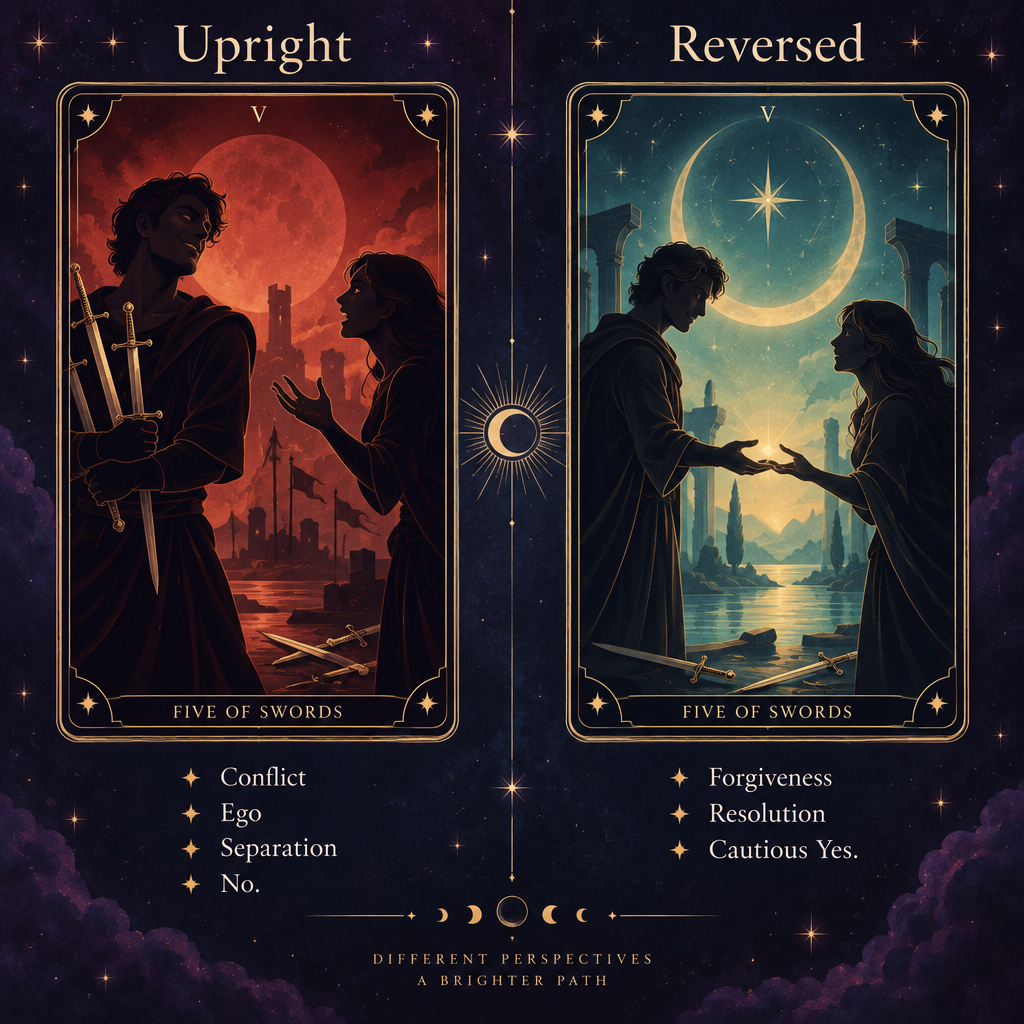
Upright: No. As a love outcome, the Five of Swords upright says this connection is heading toward conflict, deception, or separation. If you asked “will this work out,” the honest reading is that it will not in its current form.
Reversed: A cautious yes. The reversed card points to resolution, forgiveness, and a willingness to put weapons down. It is not a guarantee, but it is the card saying the fight can end if both people want it to.
Five of Swords upright as a love outcome
If you are single
The upright Five of Swords for a single person usually describes a wound that is still running the show. You may be carrying the sharpness of a past breakup into every new encounter, treating first dates like cross-examinations or shutting down the moment someone gets close.
It can also point to the dating environment itself. Game-playing, mixed signals, people who disappear after a disagreement, or a specific person who is pursuing you partly to win against someone else. If you are attracted to someone who already has a partner, this card is a direct warning that the situation will produce a loser, and it may be you.
The deeper message is about inner child wounds. Many people who repeatedly pull Swords cards in love readings learned early that being right was safer than being vulnerable. The Five of Swords asks you to notice when you are defending yourself against someone who has not attacked.
In a new relationship
Early-stage relationships that produce this card tend to have one of two problems. Either the fights started unusually fast, or one person is hiding something.
Look for these patterns:
- Disagreements about small things (texting frequency, who pays, how often you see each other) escalate into character attacks
- One person keeps score and brings up past slights
- Apologies come with a “but” attached
- You feel the need to document conversations or re-read messages to prove you were right
A new relationship should not need a referee. If you are three months in and already keeping a mental ledger, the Five of Swords is telling you the dynamic is set and will not improve on its own.
In an existing or long-term relationship
For an established couple, this is the “winning the argument, losing the marriage” card. One or both partners have become more invested in being right than in being close. Fights end with a victor and a silent house.
Common forms this takes:
- Power struggles over money, in-laws, parenting, or sex, where every disagreement is really about who gets to decide
- Weaponized honesty, saying cruel things and calling it “just being truthful”
- The cold war, where open fighting has stopped but one partner has mentally checked out (the retreating figures)
- Scorekeeping, where past mistakes are stored and deployed strategically
The card does not automatically mean the relationship ends. It means the current way of handling conflict will end it if nothing changes. The person holding the swords needs to recognize that there is nobody left to fight once the other two figures reach the shore.
Reconciliation with an ex
This is one of the most searched questions for this card, and the upright answer is blunt: getting back together now means re-fighting the same battles. The issues that split you have not been resolved, only paused.
Specific warnings for ex reconciliation upright:
- One of you wants to reunite partly to prove the breakup was the other person’s fault
- Old arguments resurface within weeks, often word for word
- There may be a third party involved, either currently or during the gap, that has not been disclosed
- Pride is preventing the genuine apology that would be required
If your ex has reached out and this card comes up as the outcome, expect that they want to resume the relationship on their terms. Ask yourself whether you want a partner or a rematch.
Infidelity, deception, and self-sabotage
The Five of Swords is one of the Minor Arcana’s clearest deception cards, alongside the Seven of Swords and the Three of Swords. It does not always mean cheating, but when a querent asks specifically about fidelity and this card appears, the reading should not soften it.
The deception can take several forms:
- Active infidelity, often justified by the cheating partner as something the other person “deserved” after a fight
- Lying to win, where a partner misrepresents events to come out ahead in an argument
- Emotional affairs framed as “just friendship” with someone who takes their side
- Hidden resentment, where one partner has secretly decided the relationship is over but is still showing up
Self-sabotage belongs here too. Sometimes the person being deceived is you, by you. Picking fights to create an exit, testing a partner until they fail, or holding them to standards you have not communicated are all ways of winning a battle you secretly started.
A note on sensitivity: a single card should never be the basis for accusing a partner of cheating. Use it as a prompt to pay attention and to ask direct questions, not as evidence.
The hollow victory at the heart of this card
Every interpretation of the Five of Swords comes back to the same idea. You can be completely correct and still lose everything that mattered.
The man on the card did win. Nobody is disputing that. He also now has five swords, no friends, and a storm coming in. Translated to a relationship: you can prove your partner was wrong about the holiday plans, their mother, the money, the text they sent, and you can win every one of those exchanges. What you cannot do is win someone back into loving you.
In an outcome position, this card is asking a single question: what are you trying to get out of this relationship, and does winning actually deliver it?
Divorce and separation as an upright outcome
For married or long-term couples, the upright Five of Swords can indicate separation, and specifically a contested one. This is not the mutual, respectful parting of the Six of Swords. It is the kind where lawyers get involved over furniture, where friends are asked to pick sides, and where one person is determined to come out “ahead.”
If you pull this card asking about a divorce or separation that is already underway, the message is to stop trying to win it. The swords you take will not be worth what you spend to get them. Settlements reached under this energy tend to leave both parties bitter for years.
Five of Swords reversed as a love outcome
Reversed, the swords come out of the ground and the retreating figures turn around. This is the card of the apology that finally lands, the fight that ends with both people exhausted enough to be honest, and the slow release of a grudge that has been held too long.
It is a positive outcome card, with one condition: the peace has to be chosen. Nothing about the reversed Five of Swords happens automatically.
If you are single (reversed)
Reversed for a single person is about putting down the swords you have been carrying from past relationships. The bitterness, the defensive humor, the assumption that the next person will hurt you too. All of it is ready to go.
This card frequently appears right before someone meets a partner who does not trigger their old patterns, precisely because they have stopped scanning for threats. Your task is to notice when you reach for a weapon that the situation does not require.
In a new relationship (reversed)
A new relationship with this card in the outcome has survived its first real test. There was a conflict, and instead of one person winning, both people learned something. Expect the apology to be genuine and the resolution to hold.
One caution: make sure the peace is real and not just one person caving to avoid a fight. Reversed Five of Swords can occasionally describe someone who surrenders too quickly, swallowing their position to keep the relationship calm. That is a postponed war, not a resolved one.
In an existing relationship (reversed)
For long-term couples, this is the “we finally stopped fighting the same fight” card. One or both partners have realized that the scoreboard was destroying them. The long-held grievance gets named, acknowledged, and set down.
Couples therapy often shows up under this card, as does the specific moment when a partner says “you were right, and I’m sorry” without a qualifier. If you have been waiting for a sign that your relationship can recover from a bad stretch, this is it.
Reconciliation with an ex (reversed)
The reversed Five of Swords is one of the more favorable cards for ex reconciliation, but it demands that you proceed with your eyes open.
What it supports:
- The anger from the breakup has cooled on both sides
- At least one of you has done real work on the issue that split you
- A conversation can now happen without descending into blame
What it still requires:
- A direct discussion of what went wrong, not a quiet resumption
- Both people admitting their part, not one person absorbing all the fault
- Agreement on what will be different, with specifics
If you reconcile under this card and skip the hard conversation, you will be back in the upright position within a few months.
When reversed turns negative
Occasionally the reversed card describes someone who has lost a conflict and is quietly plotting a return. Watch for excessive deference, a refusal to discuss what happened, or an eagerness to “just move on” that feels evasive. The surrounding cards will tell you which version you have. Paired with the Seven of Swords or the Moon, read it carefully. Paired with the Six of Cups, Two of Cups, or Temperance, trust the healing.
What you should do when this card appears
Single, upright
Stop dating as if you are preparing for a trial. Identify the specific past relationship that taught you to keep your guard up and name what actually happened there. If you are involved with someone who is unavailable or attached, exit now, before you become the figure walking away in defeat.
Single, reversed
Say yes to the next invitation you would normally decline out of caution. Practice receiving a compliment without deflecting. The old defenses have done their job and can be retired.
New relationship, upright
Have one conversation about how the two of you fight. Not about any specific fight, but about the pattern. If your partner cannot have that conversation without turning it into another fight, you have your answer.
New relationship, reversed
Mark the resolution. Acknowledge out loud that the two of you handled a conflict well. Couples who notice their own repair successes build on them.
Existing relationship, upright
Pick one recurring argument and deliberately lose it. Concede the point and watch what happens to the room. If the relationship improves when you stop fighting to win, you have learned something essential. If your partner uses the concession as a weapon, you have learned something else.
Existing relationship, reversed
Name the grievance that has been sitting under every fight and address it directly, ideally with a therapist present. The card says the opening is there. Do not waste it by being vague.
Reconciliation with an ex, upright
Do not reach out, and do not respond with anything beyond politeness if they do. Write down the three issues that ended the relationship and ask honestly whether either of you has changed on any of them. The answer under this card is almost always no.
Reconciliation with an ex, reversed
Agree to one in-person conversation with a clear agenda: what happened, what each of you owns, and what would be different. If that conversation goes well, proceed slowly. If either person refuses to own anything, close the door with gratitude for the clarity.
How it compares to neighboring Swords cards
| Card | Love outcome theme | How it differs from the Five |
|---|---|---|
| Four of Swords | A pause, time apart to recover | Rest instead of fight. The conflict is on hold, not lost or won. |
| Five of Swords | Conflict with a winner and a loser | Active ego, deception, or hollow victory |
| Six of Swords | Leaving a relationship or situation calmly | The retreating figures have reached the boat. Grief without blame. |
| Seven of Swords | Sneaking, secrets, infidelity | The deception is hidden. In the Five it is out in the open. |
| Three of Swords | Heartbreak, betrayal, painful truth | The Three is the wound. The Five is the argument about whose fault it was. |
If the Five of Swords appears alongside the Four, the relationship needs distance before any resolution is possible. Next to the Six, the separation is already decided and the fight is over how to leave. Beside the Seven, assume something is being concealed and ask about it directly.
FAQ
Is the Five of Swords a yes or no for love?
Upright, it is a no. The relationship or connection is headed toward conflict, dishonesty, or separation. Reversed, it is a cautious yes, with resolution and forgiveness available if both people actively choose them.
Does the Five of Swords mean my partner is cheating?
It can indicate infidelity or deception, but one card is never proof. Treat it as a reason to pay attention and ask direct questions. Look at surrounding cards: the Seven of Swords, the Moon, or the Three of Swords strengthen the deception reading, while Cups cards soften it.
What does the Five of Swords mean for getting back with an ex?
Upright, reconciliation would mean re-fighting old battles that were never resolved, often with pride and blame still in the way. Reversed, there is a real opening for repair, provided you have a direct conversation about what went wrong rather than quietly picking up where you left off.
What does Venus in Aquarius have to do with this card?
The Five of Swords is assigned to the first decan of Aquarius, ruled by Venus. The combination produces love that is intellectual, detached, and prone to arguing principles over feelings, which is why the card so often describes partners who communicate fluently yet never feel close.
Is the Five of Swords reversed a good card in a love reading?
Yes, in most cases. It signals that a conflict is ending, apologies are being offered, and old resentment is being released. The only caution is to make sure the peace is mutual and not one person silently surrendering to avoid another fight.
Can the Five of Swords mean divorce?
For married couples it can indicate separation, especially a contested or bitter one where each party is trying to come out ahead. The card’s advice in that situation is to stop fighting to win, because the cost of victory under this energy outweighs anything gained.