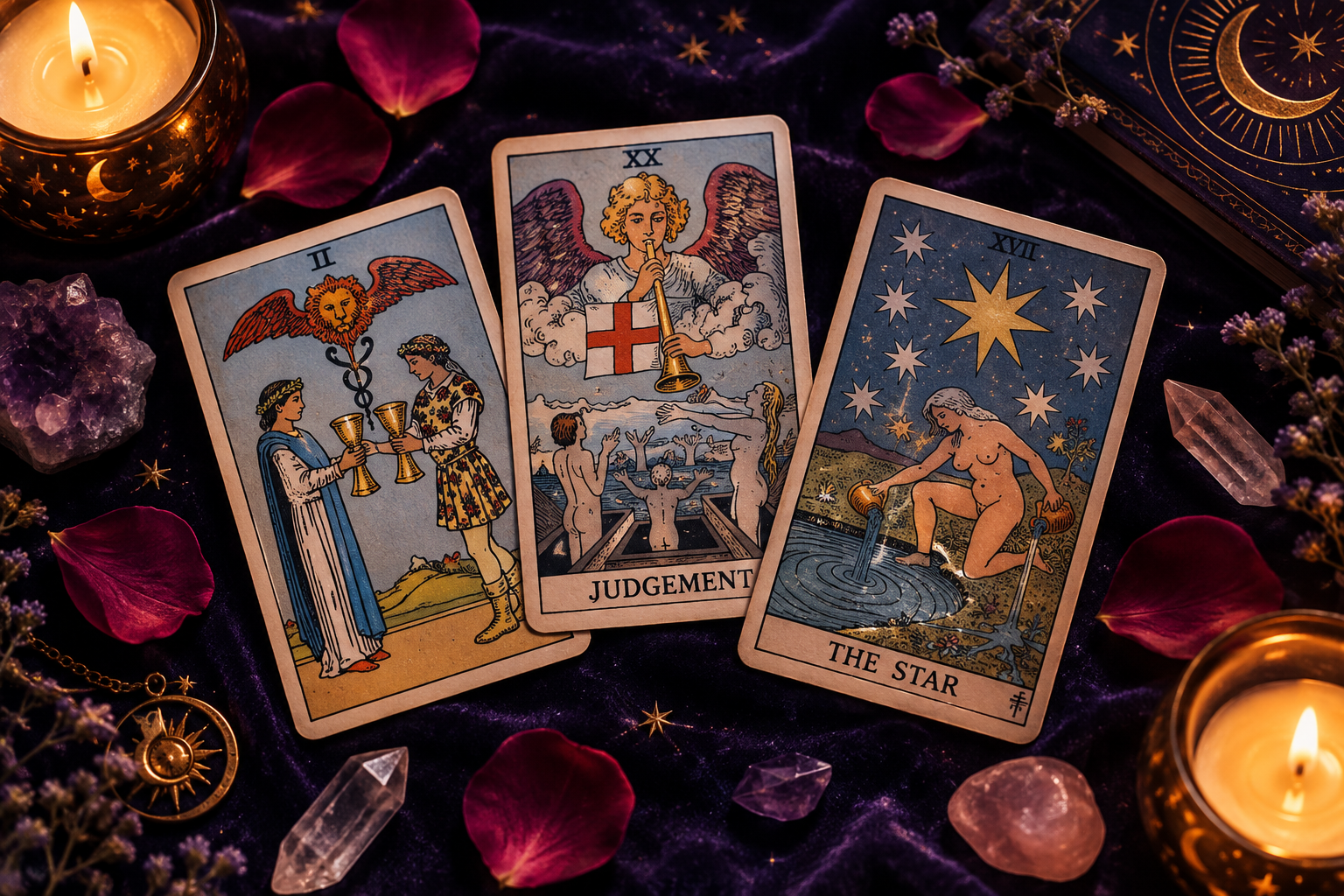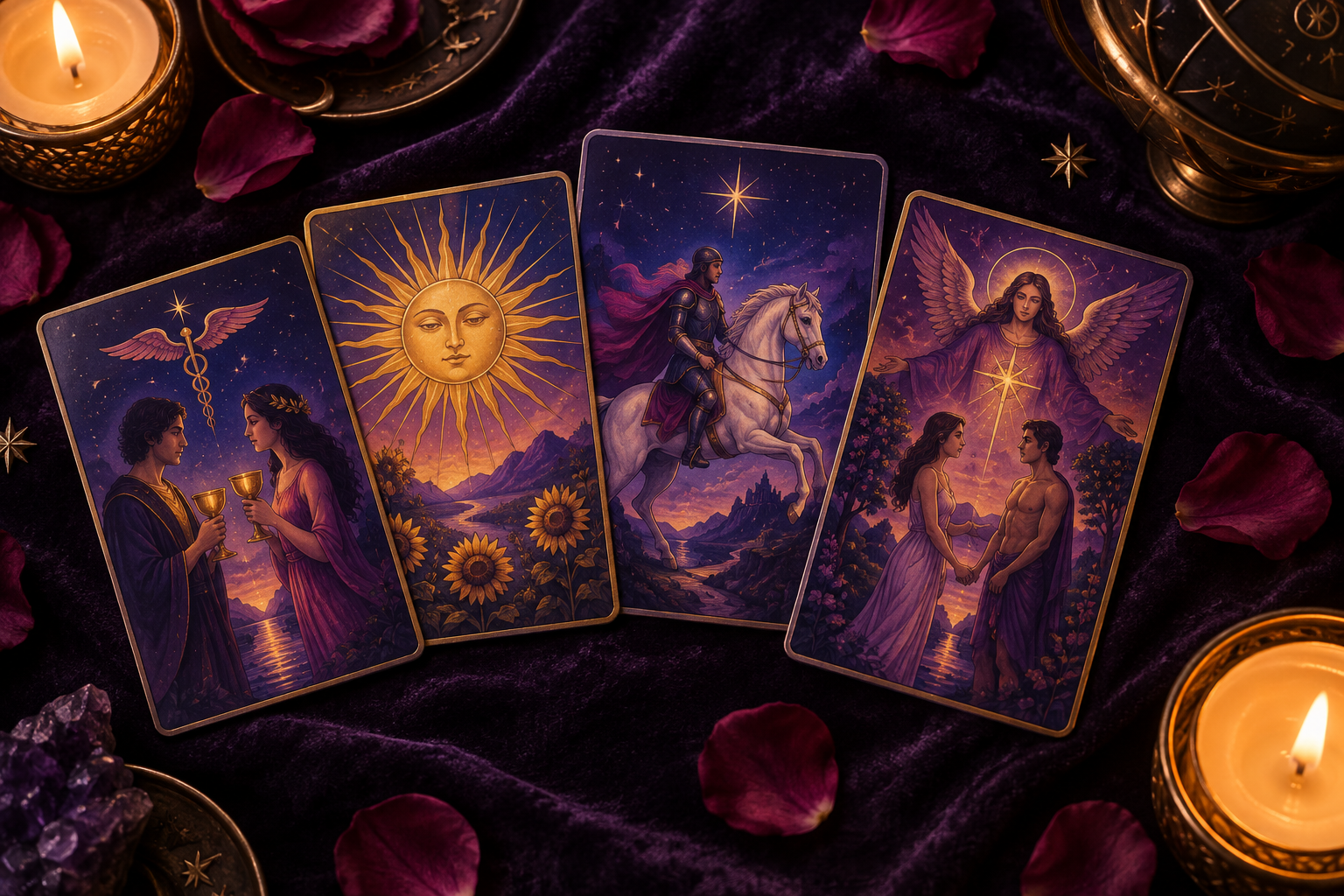
Six Of Swords As Love Outcome (Upright & Reversed) Tarot Card Meaning
The Six of Swords as a love outcome says the relationship is leaving rough water, but it has not reached the far shore yet. It is a card of quiet transition rather than celebration, and what it predicts depends heavily on whether you are single, newly dating, in a long-term partnership, or asking about an ex. Here is how to read it in each situation, upright and reversed, with the combinations and spread positions that sharpen the answer.
The Imagery, and Why It Matters for Love Readings
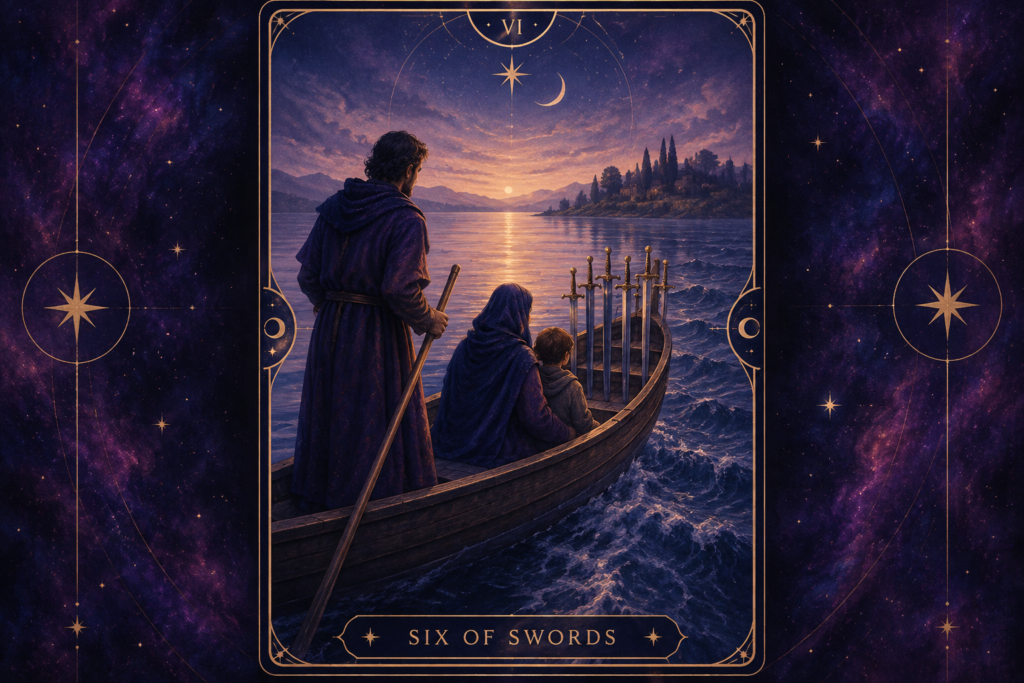
In the Rider-Waite-Smith deck, a ferryman pushes a small boat across a body of water. A cloaked woman sits hunched in the middle of the boat with a child beside her. Six swords stand upright in the bow, planted in the hull. The water on the right side of the boat is choppy; on the left, where the boat is heading, it is smooth. The far shore shows trees and land, but it is still a distance away.
Every element of that scene changes how you interpret the card in a relationship spread.
The boat and the ferryman. Movement is being assisted. The passengers are not rowing. In love, this often means circumstances, time, or a third party (a therapist, a friend, distance itself) is carrying the situation forward rather than either partner forcing it. The ferryman’s face is turned away: progress here is unemotional and methodical.
The cloaked woman. She is grieving or protecting herself, and she does not look back. Read this as someone who has decided to leave a painful chapter but has not yet felt the relief of arriving. For a love outcome, this is the emotional tone: resigned, careful, hopeful in a muted way.
The child. Something innocent or new is being carried into the next phase. In a relationship reading this can be a literal child, but more often it points to the part of a person that still trusts, or to a fresh connection that needs shelter during a transition.
The six swords. Swords are thoughts. Six of them travel with the passengers, meaning the mental baggage comes along for the ride. Nobody leaves a breakup or a rough patch with an empty head. The question is whether those thoughts are stowed neatly in the bow or whether they threaten to sink the boat (which is the reversed card’s problem).
Rough water behind, calm water ahead. This is the heart of the love outcome. The worst is behind you. The future is calmer. But notice that the boat is still in the middle. The card promises direction, not arrival.
Modern decks keep the message while shifting the mood. The Modern Witch Tarot shows the same ferry scene with contemporary figures, keeping the hunched passenger. The Light Seer’s Tarot reframes it as a figure moving through a fogged, transitional landscape, leaning into the idea of a personal passage. The Wild Unknown Tarot removes the people entirely and shows six swords with birds in flight above water, emphasizing release. If you are reading with one of these, the core outcome is unchanged: a necessary departure toward something steadier.
Mercury in Aquarius and the Air Element
The Golden Dawn system assigns the Six of Swords to Mercury in Aquarius, the second decan of Aquarius (roughly January 30 to February 8). Mercury governs communication and analysis. Aquarius is detached, idealistic, and forward-looking. Together they describe a mind that solves emotional problems by thinking about them clearly rather than feeling them intensely.
For a love outcome this has three practical consequences:
- Resolution comes through talking, not through drama. When this card predicts reconciliation or improvement, it almost always involves honest, fairly unemotional conversations. Grand gestures are not the mechanism.
- Distance is often part of the story. Aquarius is the sign of the wider world and of friendship networks. The Six of Swords frequently appears for long-distance couples, relationships that began online, or partners who need physical space to think.
- Objectivity can read as coldness. Someone embodying this energy may seem to be handling a breakup or a conflict “too well.” They are processing it intellectually. It does not mean they feel nothing.
Air cards as love outcomes are never as warm as Cups cards. The Six of Swords is the gentlest of the Swords suit, but it still predicts a relationship or healing process governed by reason. If you want to know whether someone loves you, this card is telling you how they are thinking about the situation, which is often more useful.
Six of Swords as a Yes or No in Love
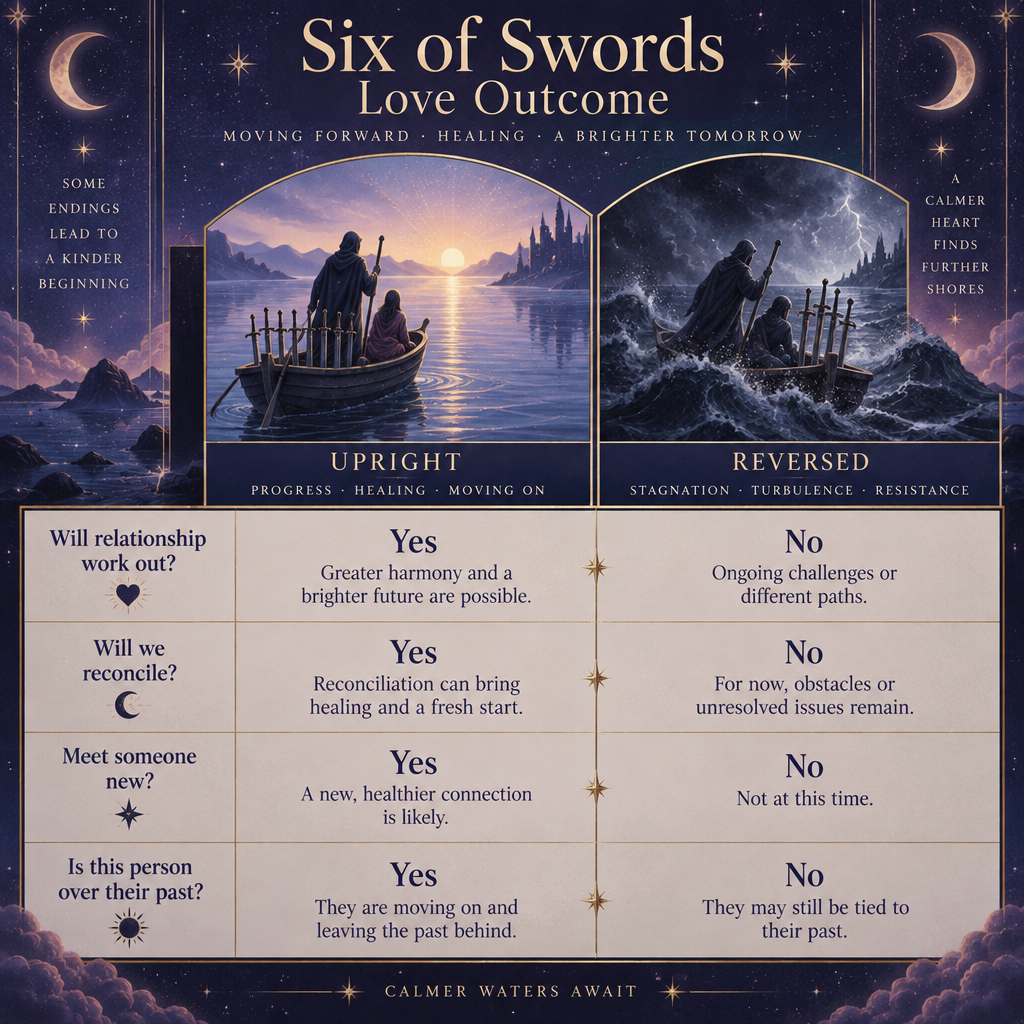
| Question type | Upright | Reversed |
|---|---|---|
| Will this relationship work out? | Leaning yes, after a period of adjustment | Leaning no, until unresolved issues are faced |
| Will we get back together? | Possible, only if both have changed; not a flat yes | Unlikely in a healthy form right now |
| Will I meet someone new? | Yes, once you have finished processing the last chapter | Not yet; old wounds are blocking it |
| Is this person over their past? | Mostly, and actively moving forward | No, they are stuck or circling back |
The upright card is a soft yes. It confirms movement in a positive direction but attaches a timeline and a condition: the calm shore arrives after the crossing, not instead of it. The reversed card is a soft no. It rarely means “never,” but it does mean that the thing blocking your outcome has not been dealt with, and asking the cards again next week will not change that.
Upright Six of Swords Love Outcome by Relationship Status
Singles
Upright, this card tells a single person that the heartbreak or disappointment they carried is genuinely receding. You are not fully healed, but you are no longer in the storm. The typical pattern is someone who, a few months after a breakup, notices they went a whole day without thinking about their ex.
The outcome for new love is positive but delayed. The card does not predict meeting someone this week. It predicts becoming someone who is ready to meet them. Readers who force dating during a Six of Swords phase tend to attract people who mirror the unfinished business they are carrying, because those six swords are still in the boat.
Travel and relocation are literal possibilities here. A single person who draws this card often meets a partner after moving cities, changing jobs, or taking a trip. Aquarius energy favors meeting through friends of friends and online communities rather than through chance encounters.
New Relationships
For a connection that is only weeks or a few months old, the upright Six of Swords is a quietly good outcome. It shows two people who are each leaving something behind, often a previous relationship or an old pattern, and consciously building something different.
The relationship will feel calmer than what either of you had before. That can be disorienting if you are used to intensity. Several readers mistake this calm for lack of chemistry. The card is saying the opposite: the absence of chaos is the point.
Expect the early phase to involve a lot of talking about the past. Mercury in Aquarius makes this a relationship where comparing notes on former partners, discussing what went wrong before, and setting explicit expectations is normal and healthy. The outcome is a partnership built on shared understanding rather than shared adrenaline.
Existing Relationships
In a committed relationship, this card as the outcome means a recurring conflict is finally being left behind. The couple has been having the same argument, about money, about in-laws, about one partner’s job, and the Six of Swords shows them moving past it rather than resolving it in one dramatic conversation.
What tends to happen in practice is a change of circumstance that removes the trigger. A move to a new home, a job change, children starting school, or simply the passage of enough time that both partners stop reacting to the old wound. The relationship survives and improves, but it changes shape. Couples who draw this card often describe their relationship a year later as “quieter, more like a team.”
The card can also predict literal relocation together. If one of you has been offered work elsewhere, this is a yes, and the move will be good for the relationship even if the transition is uncomfortable.
Reconciliation With an Ex
This is the most searched question for this card, and the honest answer is that the upright Six of Swords is not a clear yes.
What the card actually shows is that your ex has done the work of leaving the relationship as it was. They are in the boat, facing forward, and they are not looking back at the shore where the two of you broke up. The old relationship is over for them. That is the hard part of the message.
The hopeful part is the far shore. Because the Six of Swords is about arriving somewhere new, it leaves room for a reinvented relationship between two people who have both grown. Reconciliation under this card does not look like picking up where you left off. It looks like two changed people meeting again on different terms, often after a period of no contact, often after one or both have had other experiences, and usually initiated through calm, direct communication rather than an emotional plea.
If your ex has not changed, or you have not, the card is telling you they have simply moved on. If both of you have, it leaves the door ajar. Look at surrounding cards to decide which: Two of Cups or The Lovers nearby tips it toward reunion; Eight of Cups or The Hermit tips it toward a clean departure.
Hopes and Fears Position
When the Six of Swords lands in the hopes and fears position of a Celtic Cross or similar spread, it almost always reflects a split wish. You hope the painful period is ending and that you can finally stop fighting or grieving. You fear that “moving on” means losing the person or the version of the relationship you still love.
In love readings this frequently appears for someone who wants their partner to agree to a big change (moving, marriage, children) and is afraid the change will reveal that they are not compatible. It also appears for people who hope their ex will reach out and simultaneously fear that they will, because they know a reunion would mean going back into rough water.
The guidance here is to separate the two. Name the hope and the fear out loud. The card in this position is not a prediction; it is a mirror showing you that your anxiety about leaving is as strong as your desire to leave.
Reversed Six of Swords Love Outcome by Relationship Status
Reversed, the boat has turned back toward the rough water, or it is drifting without a ferryman. The swords that were neatly stowed are now a threat. The reversed card never means the relationship is fine. It means someone is refusing to make a crossing that needs to be made.
Singles
Reversed for a single person, this is emotional limbo. You know the past relationship is over and you may even say you are over it, but your behavior says otherwise. The typical signs: still checking an ex’s social media, comparing every new date to one specific person, or avoiding dating entirely with reasons that sound practical but are really about fear.
The outcome for new love is blocked, not by circumstance but by unprocessed material. People in this state do meet potential partners, and then sabotage the connection or choose someone unavailable. The card is clear that no new relationship will take hold until the old one has been properly grieved.
This can also indicate someone who has been in a transitional state for too long. Months of “figuring myself out” that have become a way of hiding. The crossing was supposed to take a season, not years.
New Relationships
In an early relationship, the reversed Six of Swords shows unresolved history creating friction. One or both partners are reacting to the present person as if they were a past one. A new partner’s normal request for reassurance is heard as the controlling behavior of an ex. A pause in texting triggers the abandonment panic that belongs to a different relationship.
Communication, which should be this card’s strength, breaks down. Mercury reversed produces misunderstandings, assumptions, and conversations that never quite land. The outcome is a relationship that keeps almost working, with recurring small ruptures that neither person can fully explain.
This does not always mean the relationship fails. It means it will fail if the baggage stays unexamined. Couples who draw this reversed card early on and actually discuss what each of them is carrying can turn it around. Those who do not tend to end things within a few months without really knowing why.
Existing Relationships
For a long-term couple, the reversed Six of Swords is stagnation through avoidance. There is a conversation that needs to happen, about the state of the relationship, about intimacy, about a decision one partner has been putting off, and neither person is having it.
The relationship is not in open crisis. It is becalmed. Both people are polite, both are distracted, and both know something is wrong. Over time this produces the “roommates” dynamic that so many long-term couples describe.
The outcome, if nothing changes, is a slow drift rather than a dramatic ending. The card can also warn about a relocation that is being resisted: one partner wants to move or change the life structure, the other is digging in, and the disagreement is being left to fester rather than resolved.
Reconciliation With an Ex
Reversed, the answer about an ex is a caution, and it cuts both ways.
If you are asking whether your ex wants to come back, the reversed card suggests they have not moved on, but not in the way you might hope. They are stuck. They may reach out, they may hover, they may send mixed signals. What they are feeling is attachment and unfinished business, which is not the same as wanting to build something new with you.
If you are the one who cannot let go, the card is saying the same about you. The distinction between attachment and love is the whole lesson here. Love wants the other person’s well-being and is willing to make the crossing. Attachment wants relief from the discomfort of separation and will row back into the storm to get it.
A reconciliation attempted under the reversed Six of Swords usually reproduces the original breakup within a few months, because nobody actually left the old relationship. The outcome improves only if both people take genuine time apart and return, if at all, with the card upright.
Long-Distance Relationships and Relocation
The Six of Swords is one of the most literal travel cards in the deck, and it appears constantly in readings about long-distance love.
Upright, it is a positive outcome for distance relationships. It shows the separation as a transitional phase with an end point, and it favors the kind of steady, communicative connection that Mercury in Aquarius supports: regular calls, honest updates, plans that involve actual dates and logistics. It often predicts that one partner will relocate to close the gap, and that the move will go smoothly.
Reversed, distance becomes an excuse rather than a circumstance. Calls become shorter and less frequent. Plans to visit keep slipping. One partner may be using the distance to avoid a decision about commitment. If you are asking about a relocation and the card is reversed, expect disagreement about who moves, delays, or a move that one person resents.
Six of Swords Combinations in Love Readings
Surrounding cards decide whether the crossing lands in reunion, release, or something in between.
| Combination | Love outcome |
|---|---|
| Six of Swords + Two of Cups | Reconciliation on healthier terms. Two people who separated return to each other as changed partners. One of the strongest reunion signals in the deck. |
| Six of Swords + Three of Swords | Healing after a specific heartbreak. The betrayal or loss is real, but recovery has begun. Reunion is unlikely; personal recovery is the outcome. |
| Six of Swords + The High Priestess | A transition guided by intuition. You already know what the relationship needs. The answer is to trust what you sense rather than what you are being told. |
| Six of Swords + Ten of Cups | The journey leads to lasting domestic happiness. Often a relocation together, a blended family, or a couple who weathered a hard year and came out committed. |
| Six of Swords + The Lovers | A conscious choice to move forward together. Strong for new relationships that began after both partners ended something else. |
| Six of Swords + Eight of Cups | A definitive departure. Someone is walking away from the relationship for good, usually with sadness but without doubt. |
| Six of Swords + The Tower | A sudden event forces the transition. The relationship changes shape abruptly, often through a move, a job loss, or a revelation. |
| Six of Swords + Four of Cups | Moving on from a relationship you have grown bored or disillusioned with. Emotional withdrawal precedes the physical exit. |
| Six of Swords + The Star | Hope restored after loss. The relationship, or your readiness for a new one, recovers more fully than expected. |
| Six of Swords + Five of Pentacles | Leaving a relationship that was financially or emotionally impoverishing. The transition is hard but necessary. |
Read combinations by asking what the second card says about the destination. Cups cards describe where the boat lands emotionally. Swords cards describe the thoughts that travel with you. Major Arcana describe the forces steering the ferry.
What to Do When You Draw This Card
If you are single
Stop measuring your readiness by how much time has passed and start measuring it by how you react to reminders of your ex. If a song or a place still ruins your afternoon, you are mid-crossing. Use the time to build a life that does not depend on a partner, and let introductions come through your wider network rather than forcing dating apps.
If you are in a new relationship
Have the conversation about past relationships early and deliberately. Tell your partner what you are sensitive to and why. Ask them the same. This card rewards couples who treat their histories as information rather than secrets. Then stop talking about the past and build something new.
If you are in an existing relationship
Identify the argument you keep having and ask what circumstance would make it irrelevant. Sometimes the answer is a practical change: a move, a budget, a boundary with a relative. Sometimes it is simply agreeing to stop reopening the wound. If the card is reversed, schedule the conversation you have been avoiding and name the date out loud.
If you are hoping to reconcile
Give it time, and make the time real: no contact, no checking, no mutual friends relaying messages. Use the separation to ask honestly whether you have changed in the ways that caused the breakup. If after that period you both want to reconnect, do it through a direct, calm conversation about what would be different. If the card was reversed, assume the pull you feel is attachment until proven otherwise.
If you are in a long-distance relationship
Set a date for closing the distance, even a provisional one. The Six of Swords needs a far shore. Relationships that drift without a destination under this card tend to fade quietly.
FAQ
Is the Six of Swords a good card for love?
Upright, it is a cautiously good card. It confirms that a difficult period is ending and that the relationship or your love life is heading somewhere calmer. It lacks the warmth of the Cups cards, so it rarely predicts passion or instant romance, but it reliably predicts improvement.
Does the Six of Swords mean my ex will come back?
Not on its own. Upright, it shows your ex has moved past the relationship as it was, with room for a reinvented connection only if both of you have changed. Reversed, it suggests they have not moved on but are stuck in attachment rather than love, and a reunion now would likely repeat the breakup.
What does the Six of Swords mean as someone’s feelings toward me?
They feel they are in transition. They may be processing a past relationship, deciding whether to move toward you, or quietly letting go. Their feelings are measured and rational rather than intense. Mercury in Aquarius energy means they are thinking carefully, not swept away.
Does the Six of Swords always mean a breakup?
No. In existing relationships it more often means leaving a cycle of conflict behind, or relocating together. It predicts a breakup mainly when paired with Eight of Cups, Three of Swords, or The Tower, or when the relationship question itself is about whether to leave.
Why does this card keep appearing in my love readings?
Because you have not finished the crossing. Repeated appearances usually mean you are intellectually aware that a chapter is over but have not emotionally arrived at the new one. The card will keep showing up until the swords are stowed and the boat reaches shore.