
Upright, the Five of Cups is a no. Reversed, it is a conditional yes that depends on whether you have actually done the grieving the card asks of you. Below you’ll find the verdict for every common question type, the symbolism that explains it, and what to do once the card lands on your table.
The Short Answer
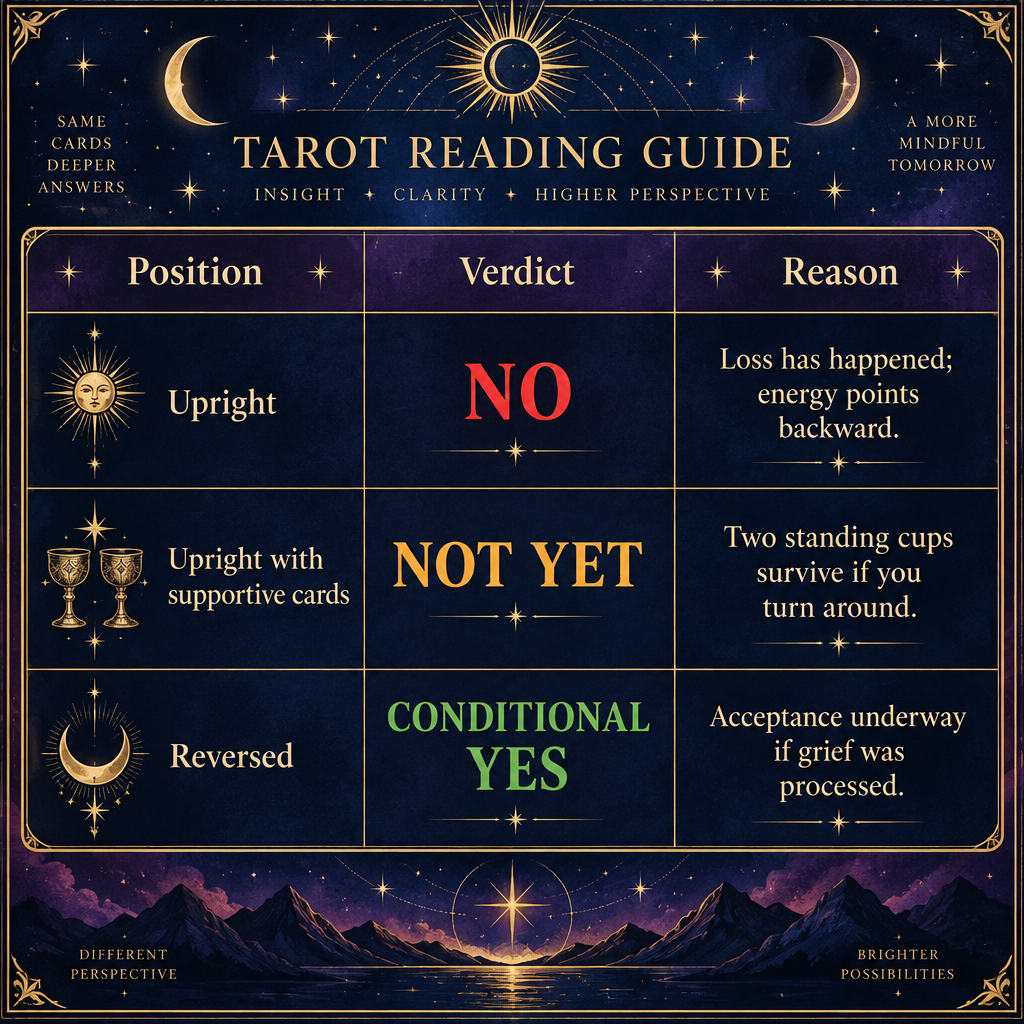
| Position | Verdict | One-line reason |
|---|---|---|
| Upright | No | Loss has already happened; the energy is pointed backwards, not toward your goal |
| Upright, with supportive cards | Not yet | The two standing cups mean something survives, but only if you turn around |
| Reversed | Conditional yes | Acceptance and recovery are underway, provided the grief was processed rather than buried |
If you only came for the verdict, that table is it. The rest of this page explains why the answer falls that way and how it shifts depending on what you asked.
Card Description and Symbolism
The standard image comes from the Rider-Waite-Smith deck, drawn by Pamela Colman Smith and first published in 1909. It remains the reference design that most modern decks adapt, so the symbolism below applies to the majority of cards you’ll encounter.
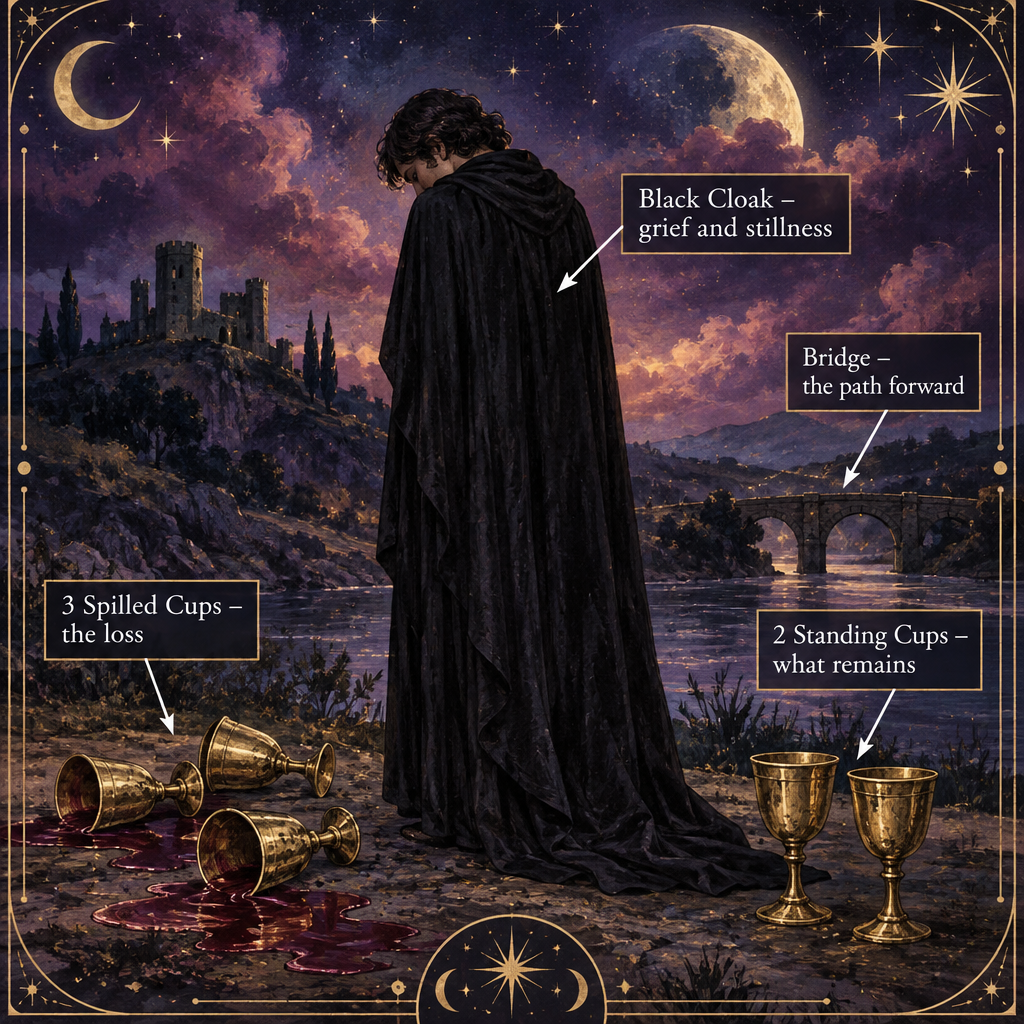
Arthur Edward Waite described the scene in his companion book as a dark, cloaked figure looking sideways at three prone cups, with two others standing upright behind him, and a bridge in the background leading to a small keep. Every element in that sentence carries weight in a yes or no reading.
The three spilled cups
Three cups lie on their sides with their contents soaked into the ground. This is the loss itself. In a yes or no context, it tells you the thing being asked about has already been damaged in some way, whether that is a relationship, an investment, a job prospect or a plan. You are not being warned about a future loss. You are being shown one that has happened.
The two standing cups
Behind the figure, two cups remain full and upright. The figure cannot see them because of where he is looking. This is the single most important detail for softening the card’s no. Not everything has been lost. Roughly 40 percent of what the figure holds dear is still intact, and he is ignoring it. When the Five of Cups appears upright, the no is partly a no because of the loss and partly a no because the querent’s attention is in the wrong place.
The black cloak
The figure wears a heavy black cloak with the head bowed. This is mourning dress. The posture reads as someone who has stopped moving. In a yes or no reading, that stillness matters: nothing is going to progress while the person asking is frozen in grief.
The river and the bridge
A river separates the figure from a castle or keep on the far bank, and a bridge crosses it. The castle represents stability, home, or the next chapter. The bridge is the route there. It is passable. The figure simply has not stepped onto it. This is why the reversed card can become a yes: in reversal, the figure is imagined as having turned toward the bridge.
At a Glance
| Attribute | Detail |
|---|---|
| Suit | Cups |
| Element | Water (emotions, memory, intuition) |
| Planet | Mars |
| Zodiac | Scorpio (first decan, roughly October 23 to November 1) |
| Numerology | 5, the number of disruption, conflict and forced change |
| Upright keywords | Grief, regret, loss, disappointment, dwelling on the past, pessimism |
| Reversed keywords | Acceptance, moving on, forgiveness, recovery, or suppressed grief |
| Yes or no, upright | No |
| Yes or no, reversed | Conditional yes |
Why Mars in Scorpio and the Number 5 Make This a No
The Golden Dawn system, which the Rider-Waite-Smith deck follows, assigns the Five of Cups to Mars in Scorpio. Mars brings heat, friction and conflict. Scorpio is the sign of deep emotional attachment and difficulty letting go. Put the two together and you get a card about an emotional wound that is felt intensely and held onto for too long. Scorpio also rules the first decan of its sign, which is the rawest and most unprocessed phase of that energy. This is not grief that has mellowed. It is grief that still stings.
The Water element reinforces this. Water in tarot governs feelings, relationships and the subconscious. When a Water card goes wrong, the problem is emotional rather than practical, which is why the Five of Cups rarely signals a logistical obstacle and almost always signals an emotional one.
Then there is the number itself. Fives across all four suits represent instability. The Five of Swords is a hollow victory, the Five of Pentacles is hardship, the Five of Wands is competition. In Cups, the suit of emotion, the five becomes loss. Fives sit at the midpoint of the pip cards, where the comfortable structure of the four has broken and the recovery of the six has not yet arrived. A midpoint of disruption is not where yes answers live.
Five of Cups Upright: No
Drawn upright in response to a direct question, the Five of Cups says no. The thing you are asking about is tied up with a loss you have not finished processing, and the outcome you want is not available from where you currently stand.
Hedging this into a “probably not” does the querent a disservice. The card is specific. Something was lost, and the person asking is still looking at the spilled cups. Until that changes, the answer does not change.
That said, the two standing cups are not decorative. The no is a no to the question as asked. It is not a no to everything. If you reframe the question around what remains rather than what was lost, the picture can look very different.
Love when you are single
Asked “Will I meet someone soon?” or “Is a new relationship coming?”, the upright Five of Cups answers no. The card indicates you are still carrying a previous relationship, often more than you realise. New partners pick up on that, and the ones who don’t tend to be people who want to fill a gap rather than build something.
Asked “Should I date right now?”, the card still leans no, but for a different reason: readiness, not opportunity.
Love when you are in a relationship
Asked “Will we get back together?” after a breakup, the answer is no. The spilled cups are the relationship. Asked “Will this relationship survive?” while still together, the card points to a disappointment or betrayal that one of you is dwelling on. The relationship is not necessarily over, but the honest answer to “will it be fine on its current path” is no. Something has to be grieved properly before it can be repaired.
Asked “Does my partner still love me?”, the Five of Cups is one of the few cards where the yes or no frame breaks down. It more often reflects the querent’s own fear of loss than the partner’s feelings.
Career
For “Will I get the job?”, upright is a no. For “Should I stay in this role?”, it reads as no as well, but with a twist: the card frequently appears when someone is mourning what a job used to be rather than evaluating what it is. For “Will my project succeed?”, expect a setback that has either already occurred or is already baked in.
The useful career reading of this card is about failure as information. The three spilled cups are a lesson, not a verdict on your competence.
Finances
Money questions get a firm no upright. The Five of Cups in a financial reading often marks a loss that has already landed: a bad investment, money lent and not returned, a purchase regretted, a business venture that failed. Asked “Will I recover this money?”, the answer is no. Asked “Should I put more in to try to fix it?”, the answer is a louder no. Chasing a loss is the behaviour of someone staring at spilled cups.
Asked “Will my finances improve?”, the card says not until you stop measuring yourself against the position you were in before the loss.
What to do if you draw it upright
- Name the loss out loud or in writing. The card is about unacknowledged grief, and acknowledging it is step one.
- Take inventory of the two standing cups. What is still intact in this area of your life? Write down at least two things.
- Stop asking “will I get back what I lost” and start asking “what can I build with what remains.”
- Give yourself a time limit for the mourning phase. Open-ended grief becomes identity.
- Do not make irreversible decisions about the question you asked for at least a few weeks.
Five of Cups Reversed: Conditional Yes
Reversed, the figure has turned around. He can see the two full cups. He is facing the bridge. The energy of the card moves from loss toward recovery, and the yes or no answer shifts to a yes.
The condition is that the grieving has actually been done. The reversed Five of Cups has two faces, and older yes or no guides tend to mention only the flattering one.
The acceptance reading
In its positive expression, reversed means you have processed the disappointment, forgiven whoever needed forgiving (often yourself), and are ready to engage with life again. Here the answer to most questions is yes, with the usual caveat that Cups cards describe emotional readiness rather than guaranteed external events.
The suppressed grief reading
In its shadow expression, reversed means the grief was skipped rather than resolved. The figure has turned away from the spilled cups, but not because he has made peace with them. He simply refuses to look. People in this state say they are “over it” while making decisions clearly driven by the old wound. If the reversed Five of Cups appears alongside cards like the Seven of Swords, the Moon, or the Four of Cups, read it this way and downgrade the yes to a not yet.
Love when you are single
Reversed is a yes for new love, with a timing note: the card describes the moment the door reopens, not the moment someone walks through it. Expect readiness first, then opportunity. If you are asking whether you should accept a date or say yes to someone’s interest, go ahead.
Love when you are in a relationship
For “Can we move past this?”, reversed is a yes. For “Will we reconcile?”, it is also a yes, with the condition that both people have actually let go of the grievance rather than agreed to stop mentioning it. The reversed Five of Cups in a relationship spread is often the first card that shows up when forgiveness has become possible.
Career
Reversed answers yes to “Should I apply again?”, “Can I recover from this setback?” and “Is it time to move on from this job?” It describes the point where a professional failure stops being a wound and becomes a credential. People who have been through a layoff or a failed venture and can talk about it calmly in interviews are drawing on reversed Five of Cups energy.
Finances
Money questions get a yes reversed, in the sense of recovery being possible. Asked “Will I bounce back financially?”, the card says yes, gradually. Asked “Should I take a new financial risk?”, the card says yes only if the decision comes from a clear head rather than a need to prove the earlier loss did not matter. That distinction is where the suppressed grief reading becomes practically important.
What to do if you draw it reversed
- Check your own honesty. Ask whether you have accepted the loss or simply stopped talking about it.
- Make one concrete move toward the thing you asked about within the week. Reversed energy fades if not used.
- Revisit the relationship, job or financial plan you wrote off and see whether any of it is salvageable.
- Practise active forgiveness. The Hawaiian practice of Ho’oponopono, with its four phrases of apology, forgiveness, gratitude and love, suits this card well because it is directed inward as much as outward.
The Spiritual Reading: Grief as a Teacher
Beyond love and money, the Five of Cups carries a spiritual lesson that affects every yes or no answer it gives. The card does not punish grief. It shows a person doing exactly what grief requires, which is stopping and feeling. The problem it identifies is duration and direction.
Self-forgiveness is the hidden theme. Many people who pull this card are not mourning something done to them. They are mourning something they did, or failed to do, and the black cloak is self-blame. Emotional resilience, in this card’s terms, is not the ability to avoid spilling cups. It is the ability to turn around and see the two that are still standing.
A practical ritual: pour three small glasses of water and deliberately pour them out. Then pour two more and drink them. It sounds simple. It works because it makes the card’s lesson physical.
Reading the Five of Cups with Other Cards
The yes or no answer tightens or loosens depending on neighbours.
- With the Six of Cups: the loss is tied to nostalgia or someone from your past. Upright no becomes a “not by going backwards.”
- With the Three of Swords: a sharper no. The loss involved a betrayal or heartbreak, and the wound is fresh.
- With the Four of Cups: the person asking is both grieving and apathetic. Strong no, and the advice is to re-engage before asking again.
- With the Star or the Sun: the no softens considerably. Hope and clarity are arriving.
- With the Ten of Cups: recovery leads to something better than what was lost. Read as “no to this, yes to what comes after.”
- With Death or the Tower: the loss was necessary. Accept it quickly.
If you want a clarifier, pull one card and ask “what will help me turn around?” rather than repeating the yes or no question. Repeating the question to the same deck tends to produce more Cups cards and more confusion.
FAQ
Is the Five of Cups a yes or no card?
Yes, it gives a usable yes or no answer. Upright it is a no. Reversed it is a conditional yes. It is one of the more consistent Minor Arcana cards in this respect.
Does the Five of Cups always mean no?
Upright, it means no to the question as asked. The two standing cups in the image mean the overall situation is not hopeless, so a reframed question about what remains can get a different answer. Reversed, the card is a yes with conditions.
What does the Five of Cups mean in love, yes or no?
Upright: no, you are still carrying a previous loss and it is affecting your current or prospective relationship. Reversed: yes, reconciliation or new love is possible because the emotional groundwork has been done.
Is the Five of Cups reversed a yes?
Mostly yes. The exception is when surrounding cards suggest the grief was suppressed rather than processed. In that case, read it as “not yet” and address the unfinished emotional work first.
What does the Five of Cups mean for career and money?
Upright it signals a setback that has already happened and warns against chasing losses. Reversed it indicates recovery and the ability to turn a failure into experience. For a direct question like “Will I get the job?”, upright is no and reversed is yes.