
10 Common Yes or No Tarot Mistakes (And How to Fix Them)
The most common yes or no tarot mistakes are re-asking until you get the answer you want, asking vague or double-barrelled questions, having no plan for reversed cards, and forcing “maybe” cards into a clean yes or no. Each one has a simple fix, and most come down to setting your rules before you shuffle. Below are the 10 errors that skew readings most often, why they happen, and what to do instead.
Why Yes or No Readings Go Wrong So Easily
A yes or no reading asks a 78-card system to collapse into one of two answers. That is a lot of compression. The Rider-Waite-Smith deck, created by Arthur Edward Waite with artist Pamela Colman Smith and published by William Rider & Son in 1909, was built for storytelling and nuance. Most of its cards were never designed to say “yes” or “no.”
So the mistakes below are rarely about memorising the wrong meaning. They are about process: how you phrase the question, how often you ask, and how you handle cards that don’t fit the binary.
Here is what you’re working with in a standard deck:
| Section | Cards | Traditional element | Typical yes/no lean |
|---|---|---|---|
| Major Arcana | 22 | Varies by card | Read card by card; strongest signals |
| Wands | 14 | Fire | Leans yes (action, momentum) |
| Cups | 14 | Water | Leans yes for emotional or relationship questions |
| Swords | 14 | Air | Leans no (conflict, worry, hard truths) |
| Pentacles | 14 | Earth | Slow, steady yes for material questions |
| Total | 78 |
The suit leans are conventions, not laws. Plenty of Swords cards read as yes, and some Cups cards (the Five, the Eight) usually read as no. Still, the table shows why a single draw carries so much weight: you are relying on one card out of 78 to carry the full answer.
Mistake 1: Re-Asking the Same Question Until You Get a Yes
This is the big one. You ask, you pull the Ten of Swords, you don’t like it, and you shuffle again “just to be sure.” Then again.
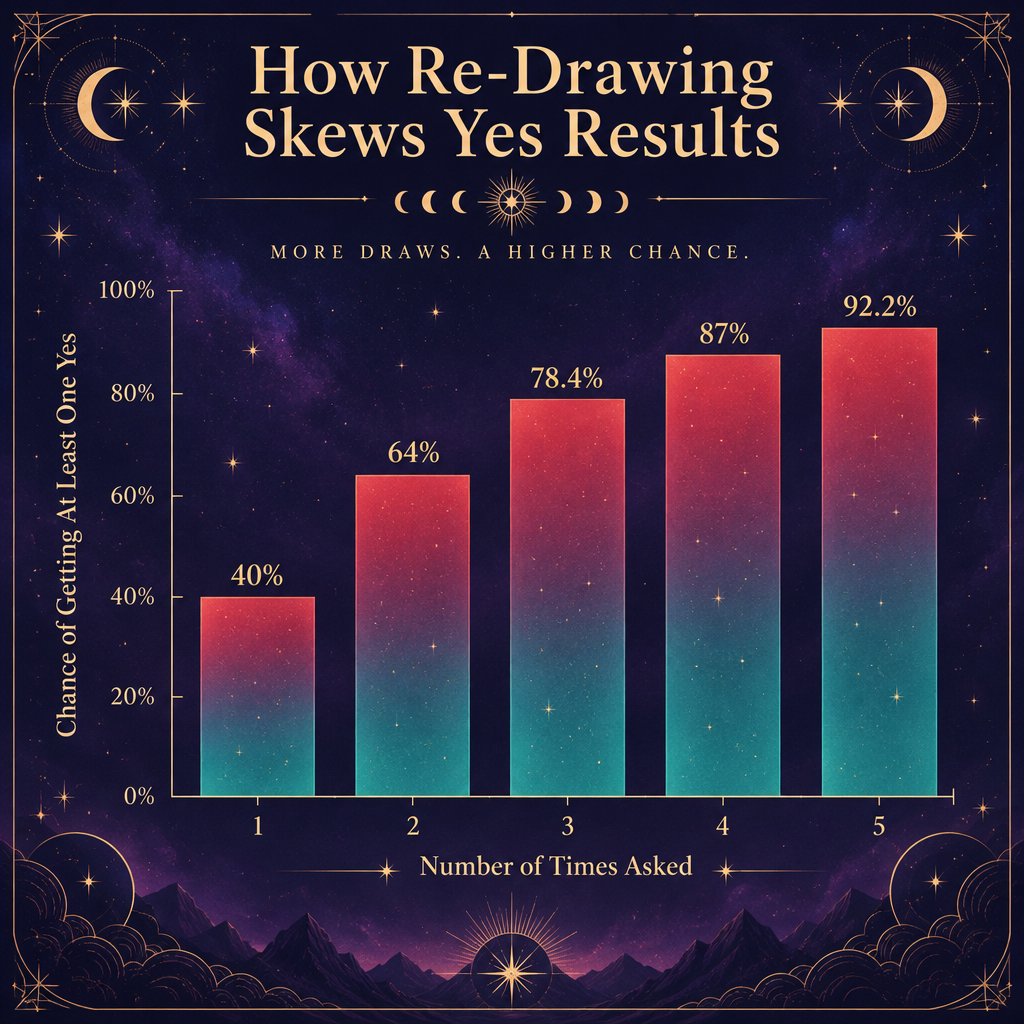
The problem is basic probability. Standard yes/no charts usually treat well over 40% of cards as a yes, but even a conservative 40% shows the problem. Every redraw gives you another roll of the dice, and the odds of eventually seeing a yes climb fast.
| Number of times you ask | Chance at least one draw says yes (if ~40% of cards read yes) |
|---|---|
| 1 | 40.0% |
| 2 | 64.0% |
| 3 | 78.4% |
| 4 | 87.0% |
| 5 | 92.2% |
By the fifth try, you are almost guaranteed the answer you were fishing for. At that point the deck isn’t telling you anything. You are.
The fix: Commit to the first draw. If you want more depth, don’t repeat the question. Ask a different follow-up, such as “What do I need to understand about this no?” Then give the topic a break. Many readers wait at least a few days, or until something in the situation actually changes, before revisiting it.
Mistake 2: Asking Vague or Compound Questions
“Will things work out?” What things? Work out how? By when?
Vague questions produce answers you can’t act on, because any card can be stretched to fit. Compound questions are worse. “Will I get the job and will I like it?” contains two questions. A single card can’t answer both, and you’ll end up reading whichever half matches your mood.
The fix: One subject, one outcome, ideally a time frame. Compare these:
| Weak question | Stronger question |
|---|---|
| Will things work out with Sam? | Will Sam and I still be together in six months? |
| Is this a good idea? | Will accepting this job offer improve my finances this year? |
| Should I move and change careers? | Is moving to Leeds the right step for me this year? (career goes in a separate reading) |
| Will I be happy? | Will taking this course make me feel more confident at work? |
| What’s going to happen? | Will the house sale complete before the end of the month? |
If phrasing is where you struggle most, it is worth studying a set of yes no tarot questions that already follow this structure. Seeing 20 or 30 well-built examples trains your instinct faster than any rule.
Mistake 3: Having No Plan for Reversed Cards
A lot of readers ignore reversals until one shows up, then decide on the spot what it means. Unsurprisingly, the decision tends to favour what they want to hear.
If you shuffle in a way that turns cards around, roughly half your draws can come out upside down over time. That is far too common to improvise.
There are three widely used approaches:
- Reversal flips the answer. Upright yes becomes no, upright no becomes yes.
- Reversal weakens or delays. An upright yes becomes “yes, but not yet” or “yes, with obstacles.”
- No reversals. You turn every card upright and read only the face meaning.
All three are legitimate. What isn’t legitimate is switching between them depending on the result.
The fix: Pick one method and write it down. Some cards make this choice matter more than others. Look up Eight of Swords yes or no meanings and you’ll see why: upright, it usually reads as no (you feel trapped), but reversed it often reads as release, closer to yes. If you haven’t decided your reversal rule in advance, a card like that can be bent either way.
Mistake 4: Forcing “Maybe” Cards Into Yes or No
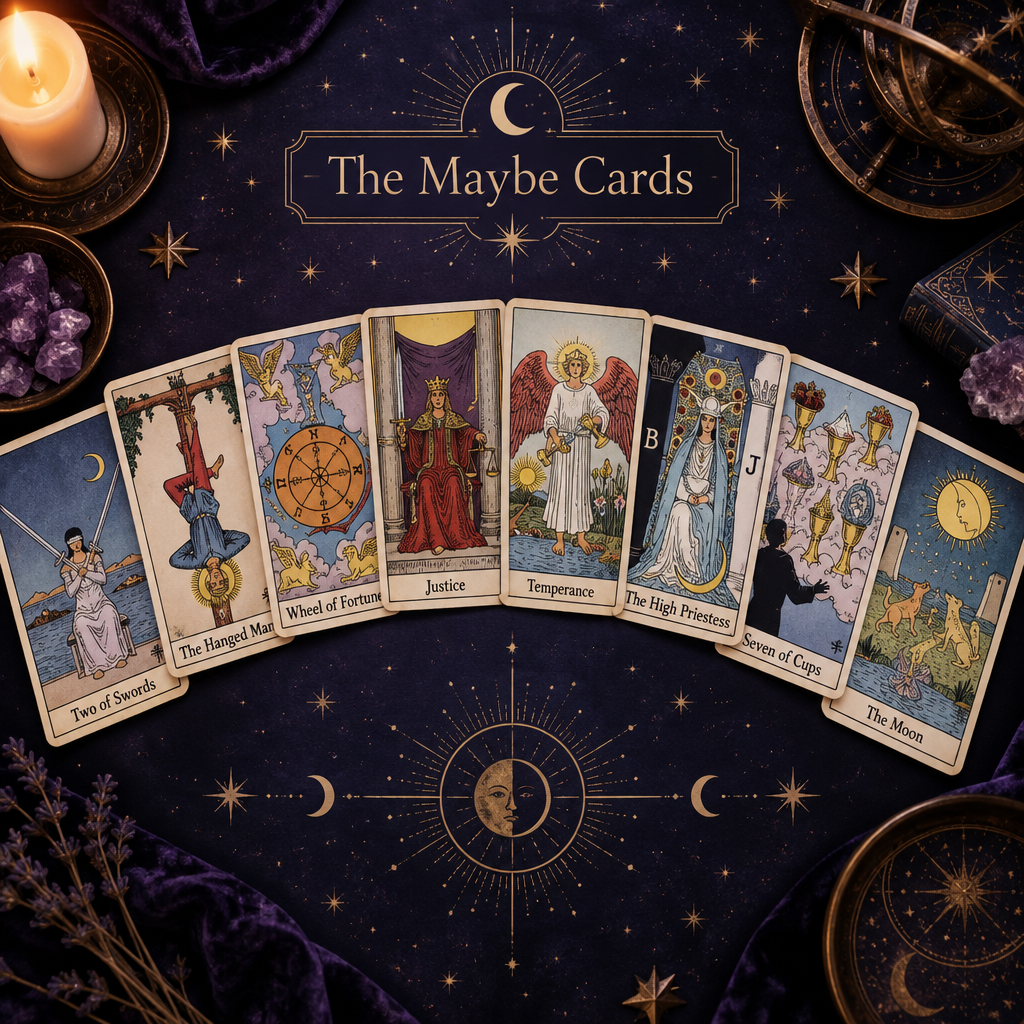
Some cards simply refuse to give a binary answer. Experienced readers treat them as a distinct third category, and so should you. Forcing a hedging card into a yes or no strips out the most useful information it carries.
| Card | Why it hedges | How to read it in a yes/no draw |
|---|---|---|
| Two of Swords | Stalemate, an avoided decision | “Not until you decide something you’re avoiding” |
| The Hanged Man | Suspension, a pause | “Not yet; waiting is part of the answer” |
| Wheel of Fortune | Cycles, luck, forces outside you | “Possibly, but timing isn’t in your control” |
| Justice | Fairness, cause and effect | “Yes, if you’ve acted fairly; no if you haven’t” |
| Temperance | Patience, moderation | “A slow yes that needs balance” |
| The High Priestess | Hidden information | “You don’t have the full picture yet” |
| Seven of Cups | Illusion, too many options | “Narrow your options and ask again” |
| The Moon | Confusion, unclear facts | “Unclear; check the facts first” |
| Four of Swords | Rest, recovery | “Not now; rest before acting” |
The fix: Accept “maybe” as a real answer. A maybe card is usually pointing at a condition: something you need to do, learn or wait for. Treat that condition as your next question rather than as a reason to redraw.
Mistake 5: Leaning on a Borrowed Chart Without Knowing Why
Yes/no charts are everywhere, and they disagree with each other. One site lists Death as a flat no. Another calls it a yes, because endings make room for new starts. If you memorise a chart without understanding the logic, you’ll be confused the moment two sources conflict.
The fix: Learn the reasoning behind each assignment. A good tarot yes no guide explains why a card leans one way, so you can adapt when the context changes. Judgement is a useful test case. Check judgment tarot yes or no interpretations and most lean yes, because the card is about a wake-up call and answering it. A question about reviving a project fits that energy. A question about avoiding a reckoning does not.
Once you know the “why,” you can read cards you haven’t memorised yet.
Mistake 6: Treating Your Deck Like a Search Engine
Tarot is poor at hard facts. Asking “Will I win the lottery on Saturday?” or “Is my partner lying about where he was on the 14th?” treats the cards like a database. Specific numbers, dates and verifiable events are exactly where the tool is weakest.
Readers fall into this because yes/no feels like it should work for factual questions. It’s a binary, after all. But the cards speak in themes: conflict, abundance, endings, patience. They don’t speak in dates or lottery numbers.
The fix: Ask about things that involve your choices, your feelings or your direction. “Is now a good time to have an honest conversation with my partner?” gives the card something to respond to. “Did he do it?” mostly invites anxiety.
Mistake 7: Glancing at the Card and Moving On
You pull the Eight of Cups, think “no,” and put the deck away. Thirty seconds, done.
That speed skips most of what the card offers. Eight of Cups yes or no readings usually land on no, because the figure is walking away from something that no longer fulfils them. But why is the answer no? Because you’ve already outgrown the thing you’re asking about? That’s a very different message from “it won’t happen.”
The same goes for the Five of Swords. Most Five of Swords yes or no interpretations say no, or a hollow yes: you might get what you want, but the win costs more than it’s worth. Rush past that and you miss the warning.
The fix: After you note the yes or no, spend a minute with the image. What is happening in the picture? Which detail catches your eye first? Write one sentence about why the card might be giving that answer. The binary is the headline. The image is the story.
Mistake 8: Reading When You’re Emotionally Flooded
The worst time to pull a yes/no card is ten minutes after a fight, a rejection, or a 2 a.m. spiral. When you’re flooded, you’ll read any card through the lens of your fear or your hope. The Tower becomes catastrophe. The Lovers becomes destiny.
Readers on forums such as Reddit’s r/tarot describe this pattern regularly: seeing several readers in a row about a breakup, or pulling card after card during a crisis. It rarely helps, and it often makes the anxiety worse.
The fix: Set a simple rule. If you’d be devastated by a “no,” you’re not ready to ask yet. Wait until you can sit with either answer calmly. Some readers find it helps to breathe deeply, write the question on paper, and come back an hour later. If the question still feels urgent, it’s probably better suited to a longer spread than to a single card anyway.
Mistake 9: Using a One-Card Draw for a Complex Decision
A single card works for simple questions. “Should I go to the party tonight?” is fine. “Should I leave my marriage?” is not a one-card question, and treating it like one is unfair to you and to the situation.
Big decisions have moving parts: your feelings, the other person’s position, practical obstacles, likely outcomes. One card can’t hold all that.
The fix: Scale the spread to the stakes. A few options:
- One card: Low-stakes, single-variable questions.
- Three cards (majority rules): Count the yes and no cards. Two of three wins. Good when you want a firmer answer without much interpretation.
- Three cards (situation, obstacle, outcome): The outcome card gives the yes or no; the other two explain it.
- Five cards or more: For relationships, career moves and anything with several people involved.
Relationship questions in particular benefit from structure, which is why so many readers keep a few tarot spreads for love questions on hand rather than relying on a single pull.
Mistake 10: Never Tracking Your Results
Most people have no idea how often their yes/no readings actually turned out right. They remember the striking hits and forget the misses. That’s a normal human bias, and it means you never learn which parts of your process work.
The fix: Keep a simple log. Note the date, the exact question, the card, whether it was reversed, and your interpretation. Then come back in a month or three and record what happened.
Over time you’ll spot patterns. Maybe your readings are sharp on work questions and muddy on love questions. Maybe you consistently misread certain cards. Maybe you’ll find that the cards on most lists of tarot cards for yes answers, like The Sun, The Star and the Ace of Cups, line up with good outcomes for you, while the “maybe” cards tend to mark situations that genuinely hadn’t been decided yet. That kind of self-knowledge is worth more than any chart.
Set Your House Rules Before You Shuffle
Nearly every mistake above shrinks when you decide your rules in advance. Before your next reading, settle these five things:
- How you’ll phrase questions: One subject, one outcome, a time frame.
- Your reversal method: Flip, weaken, or ignore. Pick one.
- Your “maybe” policy: Which cards count as conditional, and how you’ll follow up.
- Your redraw rule: Ideally none. If you allow follow-ups, they must be different questions.
- Your spread size: Matched to how much the decision matters.
Write them on a card and keep it with your deck. It sounds fussy, but it removes the temptation to bend the rules mid-reading.
When Yes or No Tarot Isn’t the Right Tool
Sometimes the honest fix is to skip the yes/no format altogether. If you keep drawing maybe cards, it often means the question is premature or too tangled for a binary. If you’re asking about health, legal trouble or money you can’t afford to lose, you need a doctor, a solicitor or a financial adviser, not a card.
And if you notice you’re consulting the deck several times a day, that pattern is worth paying attention to. The cards work best as a prompt for reflection. They work badly as a substitute for making your own decisions.
FAQ
Are yes or no tarot readings accurate?
There’s no scientific evidence that tarot predicts future events. Where yes/no readings are genuinely useful is as a reflection tool: the card gives you a focused prompt, and your reaction to it often tells you what you already feel. Accuracy, in the practical sense, improves when you avoid the mistakes above, especially re-asking and vague phrasing, and when you track your results honestly.
Should I do a yes or no tarot reading for my decision?
Use one for simple, low-stakes questions or as a quick gut check. For major decisions involving relationships, careers or other people, a larger spread gives you far more to work with. If you’d be crushed by a “no,” wait until you’re calm enough to hear either answer.
Can I get a free, accurate yes or no tarot reading?
Yes. Free online yes/no tools draw a random card, which is functionally the same as shuffling a physical deck, so a free draw isn’t less “accurate” than a paid one. What matters is how well you frame the question and interpret the card. Be wary of free readings that funnel you toward paid psychic calls or urgent warnings that only a paid session can fix.
What not to ask in a tarot reading?
Avoid questions about specific medical diagnoses, legal outcomes, investments, lottery numbers, or when someone will die. Steer clear of questions about other people’s private thoughts or choices that don’t involve you. And don’t repeat a question you’ve just asked. Rephrase it as a different follow-up or let it rest until the situation changes.