10 Signs Your Tarot Reading Is Telling You ‘Not Yet’ (Not Just ‘No’)
You asked a yes/no question, pulled a card, and got something that clearly isn’t a yes but doesn’t feel like a door slammed shut either. That gap is the difference between “no” and “not yet,” and tarot marks it more often than most quick-reference charts admit. Here are the 10 cards and patterns that signal a delay rather than a refusal, how to tell them apart from a true no, and what to do once you’ve got one.
Not Yet vs No: The Short Answer
A “no” card shows something ending, failing, or being refused. A “not yet” card shows something paused, hidden, growing, or still in motion. The images usually give it away: figures resting, waiting, watching, or looking inward rather than collapsing or walking off.
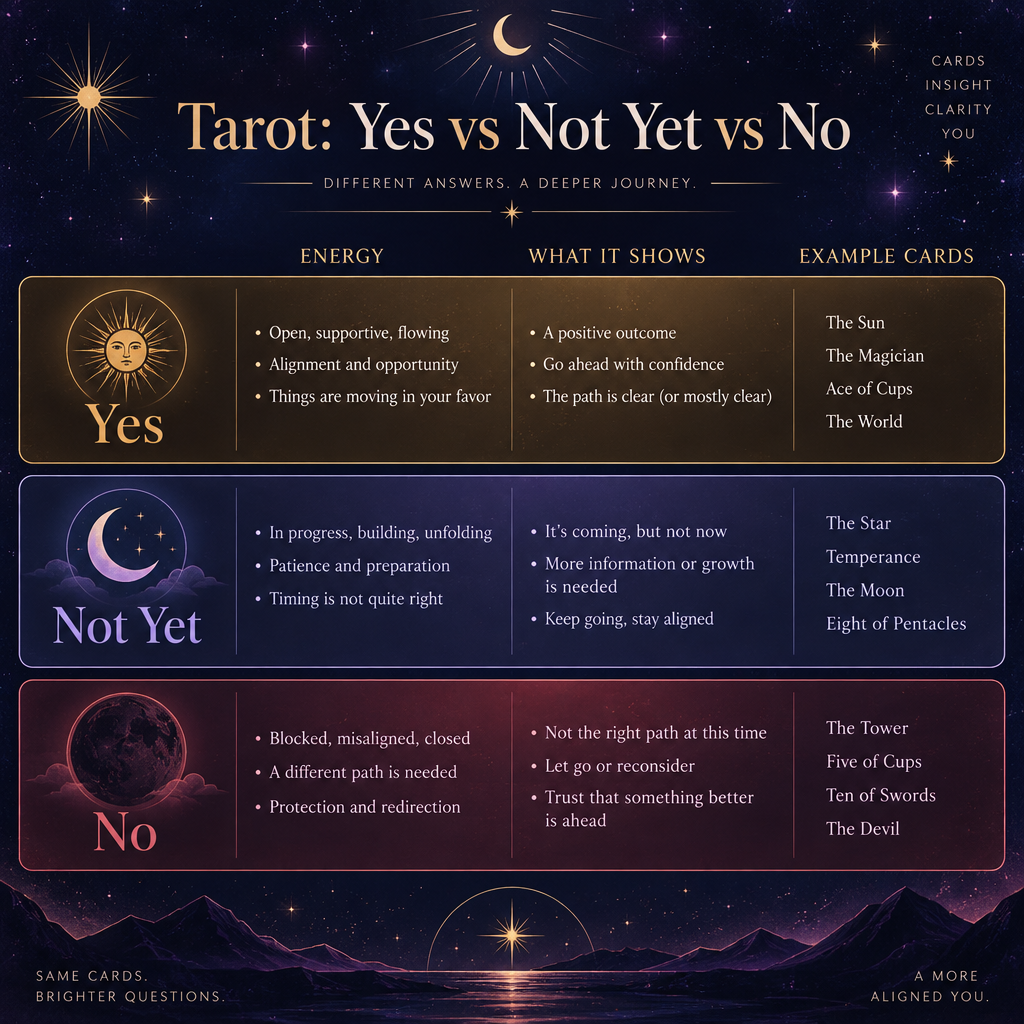
| Signal | What the card usually shows | Energy | What it asks of you | Example cards |
|---|---|---|---|---|
| Yes | Arrival, success, celebration, momentum | Forward, complete | Act now | The Sun, The World, Ten of Cups |
| Not yet | Pause, rest, growth, concealment, slow travel | Suspended, incomplete | Wait, prepare, gather information | The Hanged Man, Four of Swords, Seven of Pentacles |
| No | Loss, ending, defeat, abandonment | Closed, finished | Let go or change course | Ten of Swords, Three of Swords, The Tower |
The middle row is the one people misread. If you treat every “not yet” as a “no,” you might abandon something that only needed time. Treat it as a “yes” and you might push before the situation can hold your weight.
How Yes/No Tarot Handles Timing
A standard tarot deck has 78 cards: 22 Major Arcana and 56 Minor Arcana split across four suits of 14. Most yes/no systems sort those 78 into three buckets: yes, no, and maybe. The trouble is that “maybe” gets used as a junk drawer.
“Maybe” covers two very different situations. One is genuine uncertainty, where the outcome depends on choices nobody has made yet. The other is a timing answer, where the outcome is fairly clear but the moment hasn’t arrived. This article is about the second kind.
If you want a card-by-card tarot yes no guide covering the whole deck, that’s a separate reference. What follows is narrower and more useful when you’re stuck: the specific cards that mean the clock hasn’t run out.
Most of the imagery referenced below comes from the Rider-Waite-Smith deck, illustrated by Pamela Colman Smith under the direction of A.E. Waite and published by William Rider & Son in 1909. Nearly every modern deck borrows its symbolism, so the visual cues should carry over to yours.
The 10 Signs Your Reading Means “Not Yet”
1. The Hanged Man
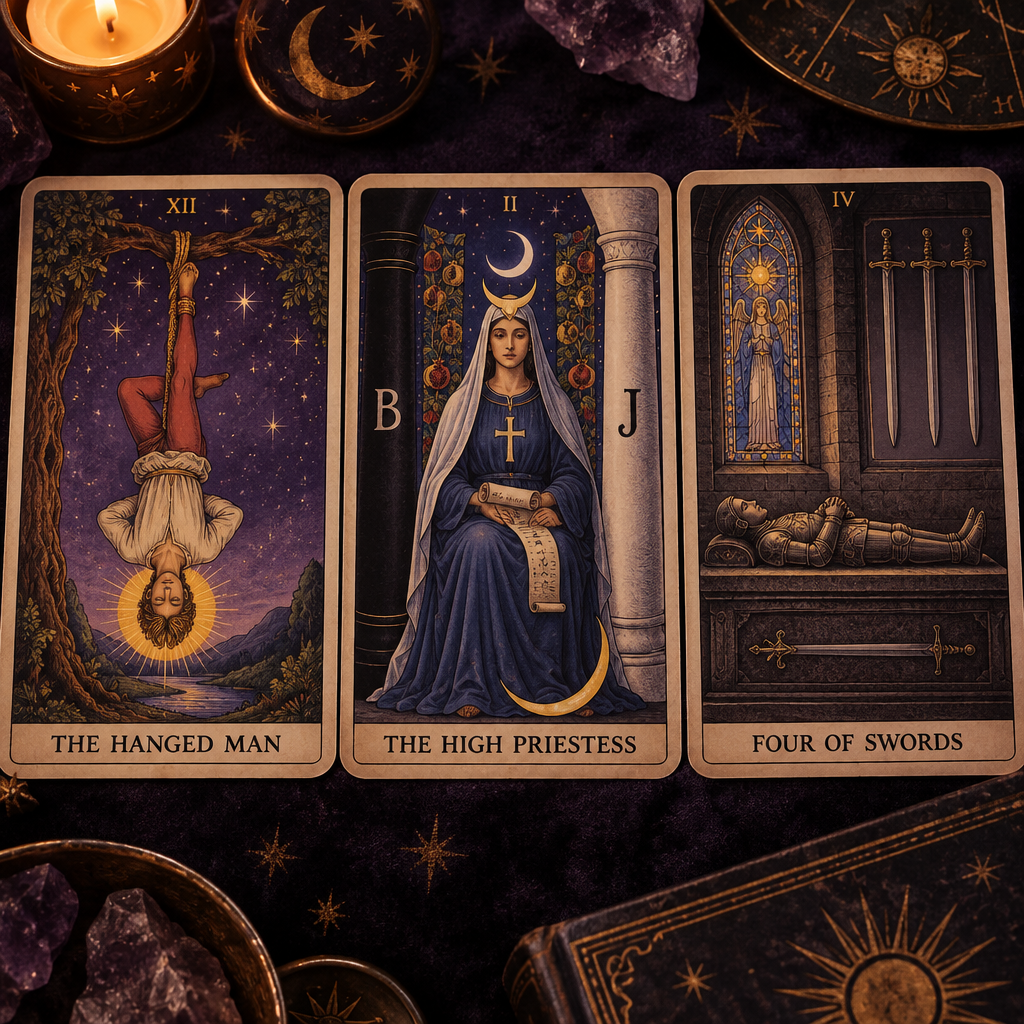
This is the strongest “not yet” in the deck. Card XII shows a man suspended upside down by one foot from a living tree. His face is calm, and a halo glows around his head.
Nothing about him says defeat. He isn’t struggling. He chose this position, and he’s using it to see the world differently.
Why it means wait: The Hanged Man is suspension by definition. The situation is on hold, and forcing it will only tire you out. Something has to shift in your perspective before the answer can move.
What it’s waiting on: Usually you. A change in how you see the problem, a willingness to give up control, or a sacrifice of something small to gain something bigger.
Reversed: The pause turns unproductive. You’re stalling, playing the martyr, or waiting for permission that won’t come. Reversed, it reads less like “be patient” and more like “you are the delay.”
How it differs from a no: Compare it to the Ten of Swords, where a figure lies face down with ten blades in his back. That’s an ending. The Hanged Man is alive, awake, and about to come down.
2. The High Priestess
Card II sits between two pillars marked B and J, with a veil of pomegranates behind her. She holds a scroll marked TORA, partly hidden in her robes. A crescent moon rests at her feet.
Everything about her is about knowledge that exists but isn’t on display yet.
Why it means wait: The answer is real, but you don’t have access to it. Key facts haven’t surfaced, someone is holding back, or your own intuition hasn’t caught up to what you already sense.
What it’s waiting on: Information. A conversation, a test result, an email, a reveal. Sometimes it’s simply waiting for you to trust what you already feel.
Reversed: Secrets, withheld information, or ignoring your gut. Reversed, she can point to someone deliberately keeping things from you, which shifts the “not yet” toward “not until the truth comes out.”
How it differs from a no: She doesn’t block the answer. She guards it. The veil isn’t a wall, and the scroll is half visible, not destroyed.
3. The Moon
Card XVIII shows a dog and a wolf howling at the moon, a crayfish crawling out of a pool, and a winding path running between two towers into the distance.
This is the card of fog, projection, and things that look different in daylight.
Why it means wait: The situation is too murky to answer reliably right now. Fears, assumptions, or missing facts are distorting the picture. Asking again tomorrow won’t help much. Asking again once something has changed will.
What it’s waiting on: Clarity. The Moon often turns up before a reveal, a correction, or a moment where you realise you’d misread the situation.
Reversed: The fog starts lifting. Confusion clears, deception comes to light, or anxiety loosens its grip. Reversed, The Moon often reads as “the answer is about to become obvious.”
How it differs from a no: The path in the image keeps going. It’s long and unclear, but it leads somewhere. A no card doesn’t usually include a road forward.
4. The Four of Swords
A knight’s effigy lies on a tomb inside a church, hands pressed together in prayer. Three swords hang on the wall above him, and a fourth lies along the side of the tomb. A stained-glass window glows behind.
It’s the tarot’s clearest picture of rest.
Why it means wait: You’re not ready yet, usually because you’re depleted. This card shows up when someone wants to jump into a new relationship, job, or project before they’ve recovered from the last one.
What it’s waiting on: Recovery, physical or emotional. The swords are hung up, not lost. You’ll pick them up again.
Reversed: Two common readings. Either you’re refusing to rest and burning out, or the rest period is ending and you’re starting to stir. Look at the surrounding cards to pick which. Active cards nearby (Eight of Wands, Knight of Wands) suggest the wait is wrapping up.
How it differs from a no: The figure is resting, not dead. Waite’s own description frames it as retreat and repose rather than loss. Treat it as a timeout.
5. The Seven of Pentacles
A farmer leans on his hoe and looks at a vine heavy with seven pentacles. He’s done a lot of work. He’s assessing it. He isn’t harvesting yet.
Why it means wait: Your effort is producing results, but they aren’t ripe. This is a patience card for things you’ve invested in: a business, a savings plan, a slow-building relationship, a long application process.
What it’s waiting on: Time and continued work. The farmer can’t speed up the season, but he can keep tending the plant.
Reversed: Impatience, wasted effort, or a warning that you’re putting energy into something that won’t pay back. Reversed, it can push toward a “no” if the investment is genuinely misplaced, so check the cards around it.
How it differs from a no: The pentacles are growing. A “no” in the Pentacles suit looks like the Five of Pentacles: two figures in the snow, shut out of a lit window. The Seven shows abundance in progress.
6. The Hermit
Card IX shows an old man on a snowy peak holding a lantern with a six-pointed star inside. He leans on a staff and looks down at the path.
Why it means wait: The answer comes after a period of inward work, solitude, or study. This card often appears when the question is about another person, and it can mean they aren’t ready either. They’re working something out alone.
What it’s waiting on: Self-understanding. The Hermit’s lantern lights only a few steps at a time, which is the whole point. You don’t get the full map. You get the next move.
Reversed: Isolation that’s gone too far, loneliness, or refusing to look at what needs looking at. Reversed, it can also mean someone is rushing back into the world before they’ve finished their reflection.
How it differs from a no: He’s carrying light. He’s not hiding from the world forever; he’s walking a path, and hermits come down from the mountain eventually.
7. Temperance
Card XIV shows an angel with one foot on land and one in water, pouring liquid between two cups. A path leads off toward a glowing crown on the horizon.
Why it means wait: Things are coming together, but gradually. Temperance is about blending, moderation, and finding the right mix. It’s the card of “slow is smooth, smooth is fast.”
What it’s waiting on: Balance. Two people learning to meet in the middle, a plan finding the right proportions, a habit settling in.
Reversed: Imbalance and excess. Overcommitting, overreacting, or pushing too hard on one side. Reversed, the delay comes from the imbalance itself, so the fix is to ease off.
How it differs from a no: The liquid keeps flowing between the cups. Nothing is spilled. The path to the crown is visible. It’s a steady yes on a slower timeline.
8. The Three of Wands
A figure stands on a cliff with his back to you, holding one wand and watching ships move across the sea. Two more wands are planted beside him.
Why it means wait: You’ve already sent your ships out. The plans are in motion, the application is in, the message has been sent. Now you’re watching the horizon.
What it’s waiting on: Returns. Responses, results, the outcome of something you’ve already set in motion.
Reversed: Delays in plans, disappointing returns, or obstacles abroad or at a distance. Reversed, the ships are held up, not sunk. Expect a slower timeline than you’d hoped.
How it differs from a no: This is the most optimistic “not yet” on the list. The figure is standing tall, looking forward, and the ships are visibly on their way. If you get this card, the answer leans yes with a delay attached.
9. The Knight of Pentacles
Every other knight in the Rider-Waite-Smith deck is on a moving horse. The Knight of Pentacles sits on a heavy horse that’s standing still, holding his coin and studying it.
Why it means wait: It’s coming, slowly and reliably. This is the most methodical card in the court. It won’t be fast, but it won’t fall apart.
What it’s waiting on: Routine, persistence, and the slow accumulation of proof. In love readings, it often describes someone cautious who moves at their own pace.
Reversed: Stagnation, boredom, or stubbornness that’s stopped being steady and started being stuck. Reversed, the wait can drag past the point of usefulness.
How it differs from a no: Compare it with the Knight of Swords charging at full speed. The Knight of Pentacles isn’t refusing to move. He’s checking his footing before he does.
10. A “Yes” Card Shows Up Reversed
This one’s a pattern rather than a single card, and it’s the most common “not yet” people miss.
Some cards are about speed and forward motion. The two clearest are the Eight of Wands (eight wands flying through the air, often read as swift news or rapid movement) and The Chariot (card VII, a figure riding forward behind two sphinxes, about victory through willpower and control). Upright, both are strong yeses.
Reversed, they’re usually still yeses. They’re just delayed.
Why it means wait: The energy is there, but blocked. The Eight of Wands reversed reads as stalled messages and slowed momentum. The Chariot reversed reads as scattered direction, lost control, or two forces pulling against each other.
What it’s waiting on: Whatever is jamming the wheels. Often that’s an external delay (travel, bureaucracy, a slow reply) or an internal one (you haven’t decided which direction you actually want).
Supporting signals: If your spread also includes several Pages or reversed Aces, that’s another nudge toward “early stage.” Pages often signal messages and beginnings that haven’t fully developed. Aces reversed can mean the seed hasn’t sprouted yet.
At a Glance: The 10 Not-Yet Signals
The astrological correspondences below follow the Hermetic Order of the Golden Dawn system, which Waite drew on when designing the Rider-Waite-Smith deck.
| # | Card | Arcana | Golden Dawn correspondence | Core “not yet” message | Strength of the wait |
|---|---|---|---|---|---|
| 1 | The Hanged Man (XII) | Major | Element of Water | Suspended; shift your view first | Strong |
| 2 | The High Priestess (II) | Major | The Moon (planet) | Hidden information hasn’t surfaced | Strong |
| 3 | The Moon (XVIII) | Major | Pisces | Too unclear to answer now | Strong |
| 4 | Four of Swords | Minor | Jupiter in Libra | Rest and recover first | Moderate |
| 5 | Seven of Pentacles | Minor | Saturn in Taurus | Growing, not ripe | Moderate |
| 6 | The Hermit (IX) | Major | Virgo | Inner work comes first | Strong |
| 7 | Temperance (XIV) | Major | Sagittarius | Gradual blending | Moderate |
| 8 | Three of Wands | Minor | Sun in Aries | Plans sent, results pending | Mild (leans yes) |
| 9 | Knight of Pentacles | Court | (varies by system) | Slow and steady | Mild (leans yes) |
| 10 | Eight of Wands / Chariot reversed | Minor / Major | Mercury in Sagittarius / Cancer | Momentum blocked | Mild (leans yes) |
“Strength of the wait” is a practical guide, not a rule. A strong wait means you genuinely can’t get a reliable answer yet. A mild wait means the yes is close and the delay is mostly logistics.
Honourable mentions: The Two of Swords (a blindfolded figure holding crossed swords in front of the sea) signals a stalemate where the answer depends on a decision nobody has made yet. The Wheel of Fortune signals that timing is turning but out of your hands. Both can read as “not yet,” though they lean closer to genuine “maybe.”
False Waits: Cards That Look Like “Not Yet” but Mean “No”
This is where most misreadings happen in the other direction. Some cards feel soft or ambiguous, so people hope they mean “wait.” They usually don’t.
| Card | Why it feels like a wait | What it actually says |
|---|---|---|
| Eight of Cups | The figure is walking away slowly, not fleeing | No. He’s leaving something that no longer fulfils him. It’s a choice to go. |
| Ten of Swords | Dawn breaks on the horizon behind the body | No. The dawn is about what comes after the ending, not a revival of this. |
| The Tower | Chaos feels temporary | No to the current structure. Something will be rebuilt, but not this. |
| Three of Swords | Grief passes, so it feels like a delay | No. The heart is pierced; the hurt is the answer. |
| Eight of Swords | The figure could walk free if she tried | Conditional. Not a wait, but a “no unless you change something.” |
That last row deserves a closer look. If you’re puzzling over an eight of swords yes or no reading, the key is that nothing outside the figure is stopping her. The swords don’t fully enclose her and her feet are free. That makes it different from the Four of Swords, where rest is genuinely needed. The Eight says the block is in your own thinking, and the answer stays “no” until you deal with it.
The Eight of Cups is the other frequent trap. People see a slow, deliberate walk and assume the figure might return. The traditional reading says otherwise: he’s turned his back on a neat stack of cups and is heading for the mountains. That’s a departure, not a pause.
Reversals and the “Delayed” Reading
Reversed cards cause most of the confusion around “not yet” vs “no,” because many readers treat every reversal as an automatic no. That’s too blunt. A reversed card often weakens, delays, or internalises the upright meaning rather than flipping it.
How to Read a Reversed Card in Five Steps
- Start with the upright meaning. Write down what the card would say if it were the right way up.
- Ask whether the energy is blocked, delayed, or reversed. Blocked energy is still there but can’t move. Delayed energy is on its way. Reversed energy has flipped to its opposite. Most reversals fall into the first two categories.
- Check the card’s natural speed. Fast cards (Eight of Wands, Knight of Wands, The Chariot) reversed tend to mean delay. Slow cards (Hanged Man, Four of Swords) reversed tend to mean the pause is going wrong.
- Look at the neighbours. A reversed yes card surrounded by other yes cards is a delayed yes. Surrounded by no cards, it can tip into a real no.
- Ask what would put it upright. If there’s a clear action that would fix it, you’re looking at a “not yet.” If nothing would fix it, it’s a “no.”
Three Reversed Examples
The Chariot reversed, with the Three of Wands and The Star upright. Delayed yes. The momentum is jammed, but the surrounding cards show plans in motion and real hope. Expect it later than you wanted.
The Eight of Wands reversed, with the Five of Cups and Ten of Swords. Leaning no. The message or movement isn’t just slow; the cards around it describe disappointment and endings.
The Four of Swords reversed, with the Knight of Wands upright. The wait is ending. You’re stirring from rest, and the energetic knight suggests you’re nearly ready to move.
Putting a Timeframe on “Not Yet”
“Wait” is more useful when it comes with a rough window. Tarot has two common ways to estimate timing, and neither is precise. Treat them as rough guides and stay consistent with whichever you choose.
Elemental Speed
One widely used convention assigns a speed to each suit based on its element. A common version runs: Wands (fire) mean days, Swords (air) mean weeks, Cups (water) mean months, Pentacles (earth) mean years or long seasons. Some readers swap Swords and Cups. Pick one system and stick to it so your readings stay comparable over time.
Under that convention, a Three of Wands suggests a short wait, while a Seven of Pentacles suggests a long one. That matches their imagery: ships cross oceans faster than crops ripen.
Golden Dawn Decan Dates
In the Golden Dawn system, each numbered Minor Arcana card from 2 to 10 corresponds to a ten-degree slice of the zodiac (a decan), and each Major Arcana card links to a sign, planet, or element. Some readers use those as calendar windows. This is the same structure behind sign-specific tarot readings, so if you already work with astrology it’ll feel familiar.
| Card | Correspondence | Approximate dates |
|---|---|---|
| Three of Wands | Sun in Aries | Late March to around April 10 |
| Seven of Pentacles | Saturn in Taurus | Around May 11 to May 20 |
| The Chariot | Cancer | Around June 21 to July 22 |
| The Hermit | Virgo | Around August 23 to September 22 |
| Two of Swords | Moon in Libra | Around September 23 to October 2 |
| Four of Swords | Jupiter in Libra | Around October 13 to October 22 |
| Eight of Wands | Mercury in Sagittarius | Around November 22 to December 1 |
| Temperance | Sagittarius | Around November 22 to December 21 |
| The Moon | Pisces | Around February 19 to March 20 |
Dates shift by a day or so each year because they follow the Sun’s actual position, not fixed calendar days. Cards tied to a planet or element (The High Priestess, The Hanged Man) don’t map to a date window in this system, which fits their meaning. They’re waiting on a condition, not a calendar.
Which Spread Catches a “Not Yet” Best?
A single card is the fastest way to ask, and the least reliable way to separate “not yet” from “no.” Here’s how the main options compare.
| Method | Cards | Best for | Pros | Cons | Cost |
|---|---|---|---|---|---|
| Single card | 1 | Quick gut checks | Fast, simple, easy to learn | No context; reversals are hard to judge alone | Free with your own deck |
| Three-card tally | 3 | Simple yes/no/not-yet questions | Majority vote smooths out one odd card | Can average away a clear timing signal | Free with your own deck |
| Situation / Block / Outcome | 3 | Separating “wait” from “no” | Names what’s in the way | Takes more interpretation | Free with your own deck |
| Five-card “What’s in the Way” | 5 | Stuck situations | Shows blocks, what to work on, likely timing | Slower; can feel like overkill | Free with your own deck |
| Timeline spread | 3 to 5 | “When will this happen?” | Gives a sequence instead of a verdict | Needs consistent timing rules | Free with your own deck |
| Professional reading | Varies | Emotionally loaded questions | Outside perspective, no bias toward the answer you want | Quality varies widely | Set by the reader; varies widely |
Single Card
Good when you already have context and want a nudge. The weakness is obvious: if you pull The Moon on its own, you know it’s unclear but not why.
Three-Card Tally
Count yes, no, and not-yet cards and go with the majority. It’s a solid upgrade on one card. The catch is that a single Hanged Man in a spread with two mild yes cards can get outvoted, even though it’s the most important card on the table.
Situation / Block / Outcome
This is the one most readers underuse. Card one shows where things stand. Card two shows what’s in the way. Card three shows where it’s heading. If card two is a “not yet” card, you’ve found your delay and its cause in one move.
Five-Card “What’s in the Way”
Lay five cards: the situation, the block, what you can work on, what’s outside your control, and the likely outcome. It’s slower, but it’s the best tool for any question you’ve asked more than twice.
Timeline Spread
Lay three to five cards left to right as now, soon, and later. If the “not yet” card sits in the first position and stronger yes cards follow, the delay is front-loaded and the outcome improves over time.
The Verdict
For most people asking a quick question, use Situation / Block / Outcome. It costs nothing extra, takes one minute longer than a single card, and does the one job a yes/no pull can’t: it tells you why the answer is waiting.
Switch to the five-card spread once you’ve asked the same question repeatedly and keep getting murky answers. Book a professional reading if the question is emotionally heavy enough that you notice yourself reshuffling until you get the card you want. That habit is the single biggest source of misread “not yet” answers.
How to Ask So the Deck Can Say “Wait”
Many timing answers get lost because the question doesn’t leave room for them. “Will he text me?” only has two honest answers. “Will he text me this week?” gives the deck a reason to say “not yet.”
Better Questions Than “Will It Happen?”
- “What needs to happen before this can move forward?” Turns a vague wait into a to-do list.
- “What am I not seeing about this situation?” Useful after The Moon or The High Priestess.
- “Is this a matter of timing or a matter of fit?” Splits “not yet” from “no” directly.
- “What can I work on while I wait?” Turns The Hanged Man or Four of Swords into something actionable.
- “Will this happen within the next month?” Puts a time box on the answer so a delay has somewhere to show up.
Questions to Avoid
Skip double questions (“Will I get the job and will I like it?”). Skip questions phrased as fears (“Am I going to be alone forever?”). Skip asking the same question five times in an hour. The deck isn’t the problem in that last case. You’ve stopped listening to the first answer.
Tarot vs Oracle Cards for Timing Questions
If you’ve used both, you’ll know they handle “wait” very differently. The debate around tarot vs oracle cards usually centres on structure. Tarot has a fixed 78-card system with shared symbolism; oracle decks are designed freely by each creator, with any number of cards and their own meanings.
For “not yet” questions, that structure matters.
Tarot pros: A built-in vocabulary for delay (Hanged Man, Four of Swords, Seven of Pentacles), consistent across decks. Astrological and elemental timing systems you can apply. Reversals add a layer of nuance.
Tarot cons: Steeper learning curve. Some “not yet” cards are easy to confuse with “maybe” until you’ve practised.
Oracle pros: Many oracle decks include cards literally titled “Wait,” “Patience,” or “Not Now,” so the message is unambiguous. Gentle and quick to learn.
Oracle cons: No shared system, so a “wait” card in one deck may not exist in another. Less precise for working out why you’re waiting.
For timing specifically, tarot wins because it explains the delay rather than just announcing it. An oracle deck can make a useful clarifier pulled after your tarot spread.
Love Questions: Where “Not Yet” Shows Up Most
Romance questions produce more “not yet” answers than any other category. That makes sense. Love involves another person with their own timing, their own baggage, and their own readiness.
The cards tend to cluster in recognisable ways:
- The Hermit often means the other person is processing something alone and isn’t ready to let anyone in.
- The Four of Swords often means one of you is still recovering, emotionally, from a past relationship.
- Temperance suggests the connection is real but needs time to find its balance.
- The Knight of Pentacles describes a slow, careful partner who means it but won’t be rushed.
- The High Priestess can mean there’s something about their feelings you don’t know yet.
A “not yet” in a love reading is also a good moment to think about boundaries. If you keep pulling wait cards about someone who hasn’t shown up for months, the cards may be describing their pace accurately while you decide whether that pace works for you. Tarot can tell you the timing; it can’t tell you how long you’re willing to wait. If you want a structure built for these questions, a few tarot spreads for love questions go further than a single yes/no pull.
What to Do After a “Not Yet”
A timing answer isn’t a reason to sit still. Almost every card on this list pairs a pause with a task.
- The Hanged Man: Change your angle. Ask a friend how they see it, or argue the opposite side to yourself.
- The High Priestess: Gather information. Ask the direct question you’ve been avoiding.
- The Moon: Write down your fears and test them against facts. Re-ask once something changes.
- Four of Swords: Rest properly. Sleep, take the leave, step away from the screen.
- Seven of Pentacles: Keep tending the work. Check progress, don’t dig it up.
- The Hermit: Spend time alone with the question. Journal it.
- Temperance: Adjust the mix. Do a little less of whatever you’re overdoing.
- Three of Wands: Wait for responses, but prepare for them. Get ready to say yes.
- Knight of Pentacles: Build a routine around the goal and stick to it.
- Reversed Chariot or Eight of Wands: Identify the block. Decide on one direction and remove what’s pulling you off it.
The common thread is control. “Not yet” cards rarely ask you to do nothing. They ask you to stop forcing the outcome and put your effort into the part you can actually influence.
When to Re-ask
Give a “not yet” room to play out. A sensible rule: wait until something concrete has changed, whether that’s new information, a conversation, or a decision you’ve made. If nothing has changed, the deck has no new answer to give. Readers who re-pull daily on the same question usually end up with a confusing pile of cards that reflects their anxiety more than the situation.
FAQ
Is “not yet” just a polite way of saying no?
No. A “no” card shows endings, loss, or refusal: the Ten of Swords, the Three of Swords, The Tower. A “not yet” card shows rest, concealment, growth, or slow movement. The difference is in the imagery. If the figure is alive, calm, and facing forward, you’re looking at a wait.
Which tarot card is the strongest “not yet”?
The Hanged Man. Its entire meaning is suspension: a deliberate pause where nothing moves until perspective shifts. The High Priestess and The Moon come close, but both lean more toward “you don’t have enough information yet” than pure timing.
Can a reversed card mean “not yet” instead of “no”?
Often, yes. Reversals of fast, positive cards like the Eight of Wands and The Chariot usually mean the yes is delayed or blocked rather than cancelled. Check the surrounding cards. If they’re mostly positive, read the reversal as a delay.
Is the Two of Swords a yes, no, or not yet?
It’s closest to “not yet, pending a decision.” The blindfolded figure is holding a stalemate in place. Once she lowers the swords and removes the blindfold, the situation moves. If the decision is yours, the wait ends when you make it.
How many cards should I pull to tell “not yet” from “no”?
Three, in a Situation / Block / Outcome layout. One card can’t explain why an answer is delayed. Three can name the block, which tells you whether it’s temporary (not yet) or permanent (no).
Should I reshuffle after pulling The Moon?
Reshuffle only after something real has changed. The Moon says the picture is too distorted to answer cleanly. Pulling again five minutes later gives you a different card, but not a clearer situation. Wait for new information, then ask again.