What Tarot Cards Mean Someone Loves You: 8 Signs to Look For
You pulled a card about someone, and now you want to know if what you saw was love or wishful thinking. Some cards in the deck speak about mutual feeling far more directly than others. Here are the eight that matter most, ranked by how clearly each one points to real romantic love from another person.
How these eight cards were chosen
Not every pleasant card in a love reading means someone is in love with you. The Three of Cups is friendship. The Nine of Cups is personal contentment. The Star is hope and healing. All lovely, none of them a declaration.
The cards below made the cut because they meet three tests. First, the imagery itself shows connection between people, or a gift being offered, rather than solo achievement. Second, the traditional meaning set out in Arthur Edward Waite’s companion guides to the Rider-Waite-Smith deck, The Key to the Tarot and The Pictorial Key to the Tarot, ties the card to affection, union or devotion. Third, working readers consistently treat the card as a yes when the question is “does this person have feelings for me.”
Those tests rule out cards like The Empress, which reads more as nurturing abundance than romantic desire, and the Ten of Pentacles, which is about security and family legacy before it is about passion. They stay out of the top eight on purpose.
The ranking considers one more thing: how much the card tells you about the other person specifically. A card that reflects your own feelings or the general vibe of a situation ranks lower than one that points at them and says “this is what they want.”
Quick reference: the 8 love cards at a glance
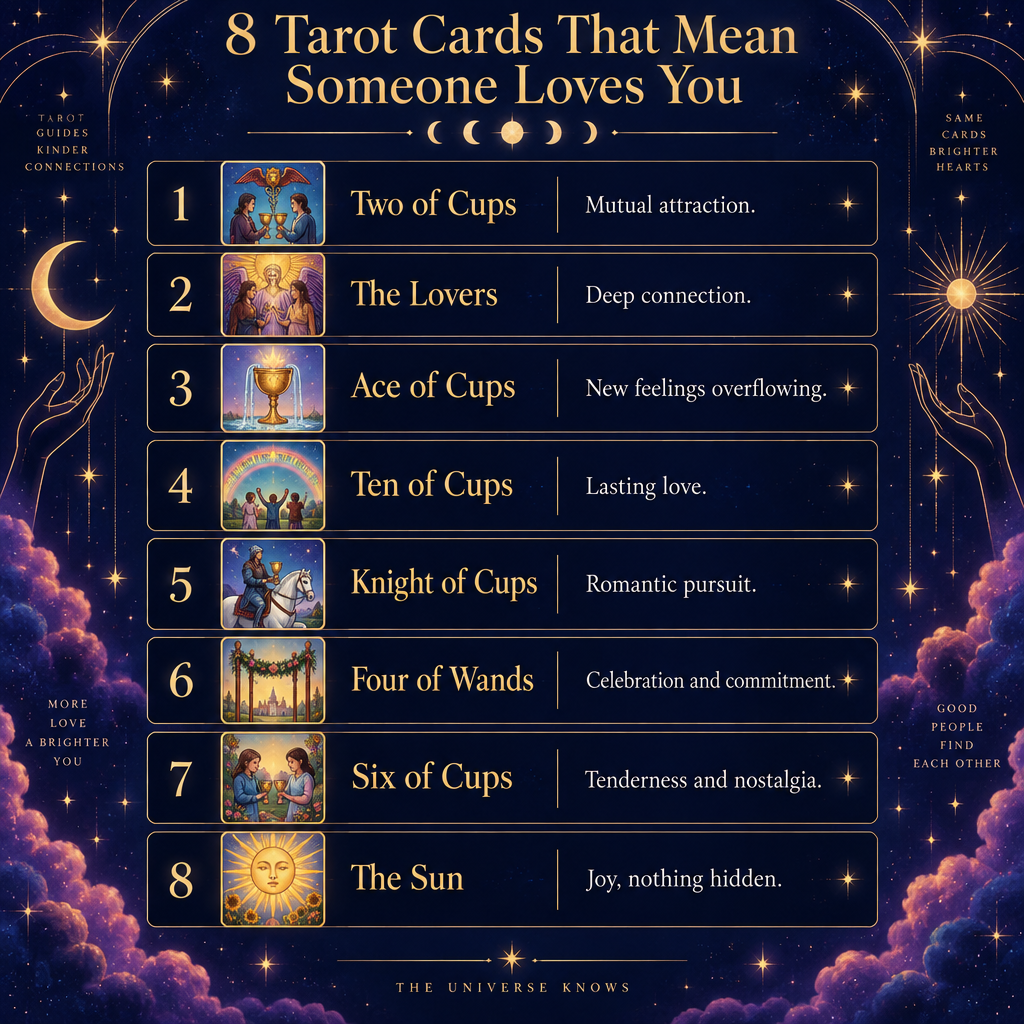
| Rank | Card | Core message | Who it’s about | Reversed meaning |
|---|---|---|---|---|
| 1 | Two of Cups | Mutual attraction, a bond forming | Both of you, equally | Imbalance, one-sided effort |
| 2 | The Lovers | Deep connection, a conscious choice | The relationship as a whole | Misalignment, a choice avoided |
| 3 | Ace of Cups | New feelings overflowing | Often them, sometimes you | Feelings held back or blocked |
| 4 | Ten of Cups | Lasting love, a shared future | What the relationship could become | Family friction, fantasy over reality |
| 5 | Knight of Cups | Romantic pursuit, a declaration coming | Them, as the one approaching you | Moodiness, promises without follow-through |
| 6 | Four of Wands | Celebration, commitment, feeling at home | The two of you together | Instability, a milestone delayed |
| 7 | Six of Cups | Tenderness, nostalgia, innocent affection | Them, especially a past love | Stuck in the past, idealising |
| 8 | The Sun | Joy, warmth, nothing hidden | The whole situation | Dimmed optimism, delayed happiness |
The 8 tarot cards that mean someone loves you
1. Two of Cups: the clearest yes in the deck (top pick)
If you want a single card that answers “do they love me,” this is it. The Two of Cups shows a man and a woman standing face to face, each offering a cup to the other. Above them floats the caduceus of Hermes topped with a lion’s head, a symbol Pamela Colman Smith borrowed to suggest passion held in balance.
Waite’s own notes on the card are short and direct: love, passion, friendship, affinity, union, concord, sympathy. Every word on that list describes something happening between two people, not inside one.
That is why it ranks above The Lovers. The Two of Cups is about reciprocity. When it appears in the “their feelings” position of a spread, it tells you the attraction flows both ways. When it appears as the outcome, it says a bond is forming or strengthening.
Pay attention to the body language in the image. Neither figure is reaching further than the other. Neither is holding back. That equality is the whole point, and it is exactly what people hoping for love want to see confirmed.
Reversed, the Two of Cups is the card you should take seriously as a caution. It points to imbalance. One person is doing the work of the relationship while the other coasts. It can also show a connection that is pleasant but shallow, a good first date that never turns into a second.
2. The Lovers: deep connection and a real decision
The Lovers is the card most people name first when they think about love in tarot, and it absolutely belongs near the top. The Rider-Waite-Smith version shows a naked man and woman beneath the archangel Raphael, with the Tree of Knowledge behind the woman and a tree of flames behind the man. The scene is Eden before the fall, and the feeling is openness with nothing to hide.
In a reading about someone’s feelings, The Lovers signals a connection with real depth. It is not a crush card. It speaks to attraction that touches values, shared vision and the sense that you understand each other without much effort.
So why rank it second rather than first? Because The Lovers carries a second meaning that readers skip too often: choice. Older decks, including the Marseille pattern, show a young man standing between two women while Cupid aims at him. Waite softened this, but the idea of a crossroads never left the card.
That means The Lovers can appear when someone has strong feelings for you and is also weighing whether to act on them. The love is real. The decision is not yet made. Context from the surrounding cards tells you which way they are leaning.
Reversed, The Lovers describes misaligned values or a choice being dodged. It can also show an attraction that is intense but not healthy for either of you. If you keep pulling it reversed about the same person, the question is no longer “do they love me” but “do we want the same things.”
3. Ace of Cups: feelings that cannot stay contained
The Ace of Cups is the seed of every emotional story in the deck. A hand emerges from a cloud holding a cup that overflows in five streams. A dove descends toward it carrying a wafer marked with a cross. Lotus blossoms float on the water below.
As a card about someone else’s feelings, the Ace says something new has started in their heart and it is spilling over. They may not have said anything yet. They may not even fully understand it themselves. But the emotional capacity is there and it is full.
This card ranks third because, unlike the Two of Cups, it does not confirm reciprocity. The Ace is a gift being offered. It does not show the gift being accepted. In a spread, you need another card to tell you whether the offer lands.
It is also one of the cards that can describe you rather than them. If you ask “how does this person feel” and you pull the Ace, it usually means them. If you ask “what is happening in this situation,” the Ace may be reflecting your own openness. Phrasing your question precisely matters more with this card than with almost any other.
Reversed, the Ace of Cups shows feelings that are blocked, repressed or draining away. Someone may want to feel something and cannot. Or they have feelings and have decided not to act on them. Either way, the cup is upside down and nothing is pouring out.
4. Ten of Cups: the long view of lasting love
The Ten of Cups is the picture most people have in their heads when they imagine a happy ending. A couple stands with arms around each other, gazing at a rainbow of ten cups arched over their home. Two children dance beside them. Waite called it the perfection of human love and friendship.
When this card shows up about someone’s feelings, it says they see a future with you. Not just attraction, but something with roots. Home, family, shared life, the kind of love that lasts because both people keep choosing it.
Why only fourth? Because the Ten of Cups is about potential and fulfilment more than present-tense feeling. It tells you what the relationship could become. On its own it does not tell you how far along the other person is right now. Someone can see you as marriage material and still be months away from saying so.
It also appears for people who are deeply in love with the idea of love. A reader will sometimes pull the Ten of Cups for a querent describing a person they have spoken to three times. In that case the card is reflecting hope rather than reporting fact.
Reversed, the Ten of Cups points to a gap between the fantasy and the reality. Family disapproval, mismatched expectations about the future, or a sense that the picture-perfect version of the relationship is covering up something less comfortable.
5. Knight of Cups: the one who is coming to tell you
Of all the court cards, the Knight of Cups is the romantic. He rides a calm white horse at a walking pace, holding a single cup in front of him like an offering. His helmet and boots carry wings, a nod to Hermes again, the messenger.
In a love reading this knight is very often the other person, specifically the version of them that is about to make a move. He represents the approach: the text that finally arrives, the invitation, the confession. He is the card of someone acting on their feelings rather than sitting with them.
He ranks fifth because knights are action cards first and emotion cards second. The Knight of Cups tells you someone is pursuing you. It does not promise the pursuit comes from lasting love. Knights are famously restless. This one is charming, poetic and sincere in the moment, and some of them are only in it for the moment.
Read him alongside the card next to him. Knight of Cups with the Two of Cups is a declaration backed by real feeling. Knight of Cups with the Seven of Cups is someone who loves the chase and has not thought past it.
Reversed, this knight is moody, flaky and full of promises that never quite become plans. He can also describe someone who is emotionally overwhelmed and withdrawing rather than approaching.
6. Four of Wands: feeling at home with you
The Four of Wands is the celebration card. Four wands support a garland of flowers and fruit, and beyond them two figures raise bouquets in welcome while a castle stands in the background. Waite associated it with harmony, prosperity and the “haven of refuge.”
As a feelings card, it tells you someone feels at home with you. Comfortable, settled, happy to be seen with you. It is strongly linked to commitment milestones: engagements, moving in together, meeting the family, the moment a relationship becomes public and real.
It sits sixth because wands are a fire suit, and fire cards speak to energy and action more than to the inner life. The Four of Wands shows you how the relationship looks from the outside and how stable its foundation is. It is less direct about the private contents of someone’s heart.
Still, when you ask “where is this going” and the Four of Wands lands in the outcome position, that is a very good answer.
Reversed, it shows a celebration delayed or a foundation that is less stable than it appears. A couple who look committed from the outside but have not had the conversation that would make it so.
7. Six of Cups: tenderness, memory and a love that was never fully gone
The Six of Cups shows a child handing a cup full of white flowers to a smaller child in a quiet village square. It is the gentlest card in the deck, and its keywords are nostalgia, innocence, kindness and the sweetness of the past.
In readings about someone’s feelings, the Six of Cups most often appears for an ex or a long-standing connection. It says they remember you with warmth. They think about the good times. Sometimes it means a person from your past is about to reach out.
It also appears for new connections that feel instantly familiar, the “I feel like I’ve known you forever” kind of attraction. That comfort is a form of love, even if it is not yet romantic.
The card ranks seventh because its energy is affectionate rather than passionate, and because it is tangled up with the past. Someone can hold deep tenderness for you and still not be ready for a relationship now. The Six of Cups confirms the feeling. It does not confirm the timing.
Reversed, it describes being stuck in the past, idealising a relationship that has already ended, or an inability to let old wounds go.
8. The Sun: nothing hidden, everything warm
The Sun is the happiest card in the Major Arcana. A naked child rides a white horse beneath a huge sun, carrying a red banner, with sunflowers rising behind a garden wall. Its meanings are joy, vitality, success and clarity.
In a love reading The Sun says the connection brings out the best in both people. It is a card of openness: nothing is being concealed, nobody is playing games, and the feeling is simply good. When you ask about someone’s intentions and pull The Sun, you can take them at face value.
It ranks last on this list not because it is weak but because it is general. The Sun blesses the whole situation. It does not single out one person’s romantic feeling the way the Two of Cups or Knight of Cups does. You might pull The Sun about a friend, a colleague or a sibling and it would be equally true.
That said, The Sun next to any of the cards above turns a maybe into a confident yes. It amplifies whatever it touches.
Reversed, The Sun is still a positive card, just dimmed. Happiness is delayed, optimism feels harder to hold onto, or someone is struggling to see what is clearly in front of them.
Cards that look like love but aren’t
Half the mistakes in love readings come from treating warm cards as romantic cards. A few worth knowing before you get your hopes up.
Three of Cups. Three women dance with raised cups. This is friendship, community and celebration. If you pull it about a crush, it very likely means they value you as a friend, or that you are part of a group they enjoy. It is not a love card unless the question was specifically about a social event.
Seven of Cups. Seven cups float in a cloud, each holding something different: a castle, jewels, a wreath, a dragon, a shrouded figure. This is fantasy and indecision. For a love question it usually means someone is daydreaming about options rather than committing to one, and that one may not be you.
The Empress. Abundance, fertility, nurturing. The Empress can appear when someone feels cared for by you. That is affection, and it can live inside a loving relationship, but on its own it does not say “they are in love with you.”
Nine of Cups. The “wish card.” A satisfied man sits in front of nine cups. This is personal contentment. It can mean someone is happy, including happy around you, but it is self-focused by design.
Knowing what the yes cards look like means knowing what they do not look like too.
Tarot card combinations for love
Single cards tell you the headline. Pairs and triples tell you the story. Here are the combinations working readers watch for.
Two of Cups + The Lovers. The strongest pairing possible for mutual love. Attraction plus depth plus a conscious choice to be together. If you pull both in a three-card spread about a person, stop worrying.
Ace of Cups + Knight of Cups. New feelings and the intention to act on them. Someone has caught feelings recently and is working up to telling you. The timing is usually close.
Two of Cups + Four of Wands. A bond moving toward commitment. This combination tends to appear right before a relationship becomes official or a couple takes a visible next step.
Ten of Cups + Six of Cups. A past love with a future. Often an ex who still sees a long-term picture with you, or a childhood friend whose feelings have grown into something more.
The Lovers + Seven of Cups. Real feeling, but the person is torn between you and other options, or between you and their own fear. The love exists; the decision does not.
Knight of Cups + Five of Pentacles or Three of Swords. Someone is pursuing you while carrying their own heartbreak or insecurity. Their feelings may be genuine, but you are partly a comfort against something else.
Any love card + The Tower. Sudden upheaval. Feelings are real, but circumstances are about to shift fast. It is not always bad. Sometimes The Tower is the thing that finally forces an honest conversation.
Any love card + The Hermit. The person has feelings but needs space to process them. Pushing for an answer now tends to backfire.
Get out of your own way
The most common problem in love readings has nothing to do with the cards. It is the reader.
When you are emotionally invested, you start bargaining with the deck. You pull the Five of Cups and decide it must mean they are sad without you. You pull the Eight of Swords and tell yourself they are just scared. Each individual stretch sounds reasonable. Stack six of them and you have built a fantasy with a tarot-shaped frame around it.
A few habits help. Decide before you shuffle what a “no” would look like, so you cannot redefine it afterward. Pull a card for the question and leave it on the table for ten minutes before interpreting. Write your first instinct down before you look anything up.
If you find yourself re-asking the same question about the same person in the same week, that is the reading. The cards already answered. You just did not like it.
And consider having someone else read for you occasionally. A friend with a deck, or a professional reader, will see the Five of Cups and call it grief, without the three paragraphs of explanation you would attach to it.
Asking the right questions for love readings
Yes-or-no questions are the weakest way to use tarot, and “does he love me” is the weakest of the weak. The deck answers in shades. Give it room.
Better questions sound like this:
- What is this person feeling toward me right now?
- What do they want from our connection?
- What is holding them back?
- What am I not seeing about this situation?
- What would I need to know before I invest more?
- What is the most likely outcome if nothing changes?
Notice that only two of those are about them. The rest are about you, or about the dynamic. That balance is deliberate. Readings that only ask about the other person leave you waiting for someone else to decide your life.
Specific framing also fixes the ambiguity problem with cards like the Ace of Cups. “How does Sam feel about me” gives you Sam. “What is going on between me and Sam” gives you a mix. Pick the one you actually want answered.
Relationship expectations vs having standards and boundaries
Tarot gets a bad reputation in love because people use it to lower their standards. Someone treats you poorly, you pull the Two of Cups, and suddenly the poor treatment is a phase you need to wait through.
There is a difference between expectations and standards. Expectations are wishes about how a specific person will behave. Standards are what you require from anyone who wants a place in your life. The cards can tell you about the first. They should never override the second.
If a reading says someone loves you and their behaviour says otherwise, trust the behaviour. Love that exists only in a tarot spread is not love you can live inside. The Knight of Cups who never actually shows up is just a man on a horse.
Use the cards to understand a situation more clearly, not to justify staying in one that already feels wrong. The best readers will tell you this before they tell you anything else.
Lesson in Love tarot spread
This five-card spread is for people who want more than a verdict. It works for a current relationship, a crush or an ex you cannot stop thinking about. Lay the cards in a cross: positions 1 and 2 side by side, 3 above, 4 below, 5 to the right.
Position 1: How you are showing up. Your energy in this connection right now. Honest, guarded, hopeful, resentful. This card sets the context for everything else.
Position 2: How they are showing up. Their energy toward you. This is where you hope to see a Two of Cups or Knight of Cups, and where you need to be honest if you see a Seven of Cups or Eight of Cups instead.
Position 3: What this connection is teaching you. Every relationship, including the ones that fail, carries a lesson. This card names it. Expect Major Arcana here more often than chance would predict.
Position 4: What is holding the connection back. The obstacle, internal or external. Swords cards here usually point to fear or communication. Pentacles point to practical or timing issues.
Position 5: Where this leads if you act on the lesson. Not a fixed outcome. The likely direction if you take position 3 seriously.
A sample reading might run: Page of Cups (you, hopeful and a little naive), Six of Cups (them, fond and nostalgic), The Hanged Man (lesson: patience and a change of perspective), Eight of Swords (block: your own fear of asking directly), Two of Cups (outcome: mutual connection if you do). That reading says they care, you are overthinking, and a direct conversation would get you what you want.
Reading reversals in love readings
Some readers ignore reversed cards entirely. For love readings specifically, that is a mistake, because reversals are often where the honest information lives.
A reversed love card rarely means the opposite of love. It usually means the love is present but obstructed, delayed, unbalanced or unexpressed. The Ace of Cups reversed is still a cup. The feeling exists. It is just not reaching you.
When a reversed card shows up about someone else’s feelings, the question to ask is “what is in the way.” Often the surrounding cards will tell you. Reversed Two of Cups next to the Five of Pentacles might mean financial stress is making someone pull back. Next to The Devil, it might mean the imbalance comes from an unhealthy pattern that needs breaking.
If you are new to tarot, start with reversals on the Cups suit only. Those are the cards that matter most for love, and their reversed meanings are the most intuitive to learn.
FAQ
What is the strongest tarot card for someone being in love with you?
The Two of Cups. It is the only card in the deck whose primary image is two people offering their feelings to each other as equals. The Lovers is deeper but carries the weight of a decision; the Ace of Cups is newer and does not confirm the feeling is returned.
Can tarot really tell me how someone else feels?
Tarot reflects the energy of a situation as you ask about it, filtered through your own intuition. It can give you a strikingly accurate read on a dynamic you are part of. It cannot give you certainty about another person’s inner life, and anyone who promises it can is selling something.
What does it mean if I pull The Lovers reversed about a crush?
Usually a misalignment of values or a choice being avoided. The attraction may be real, but something about what you each want does not line up, or one of you is not ready to decide. It is a card to reflect on rather than panic over.
How many times should I ask the cards about the same person?
Once per question, with a meaningful gap before you revisit. If a situation genuinely changes, read again. If you are re-shuffling because you did not like the answer, the deck already told you what you needed to hear.
Do Pentacles or Swords cards ever mean love?
Rarely on their own, but they add texture. The Ten of Pentacles shows long-term stability and family. The Queen of Pentacles shows someone who expresses care through practical acts. Swords cards are about thought and conflict, so they describe the obstacles to love far more often than love itself.
What card means someone misses you?
The Six of Cups is the clearest answer, especially for an ex or someone from your past. The Five of Cups can also appear when someone regrets a loss and is dwelling on it, though it points to grief rather than longing for a specific reunion.