
Upright, the Knight of Cups gives clear love advice: lead with your heart. Make the romantic offer or accept the one coming to you, and say what you feel. Then let what the person does confirm what they say before you commit. Reversed, the advice is to slow down and test every promise against behaviour. A. E. Waite’s own reversed meanings for this card are “trickery, artifice, subtlety, swindling, duplicity, fraud.”
The sections below cover the card for a crush, a partner, an ex, someone new and a decision you have to make. They show how the reading changes upright, reversed and next to the cards that most often fall beside it, and what to do once you have drawn it.
Knight of Cups Love Advice by Situation
The upright Knight tells you to act on your feelings openly. The reversed Knight tells you to check the facts before you act. This table shows how that plays out in the situations people ask about most.
| Your situation | Upright advice | Reversed advice |
|---|---|---|
| A crush | Tell them, or accept their move. Interest is likely mutual. | They may enjoy your attention more than they want you. Watch whether they act, not what they hint. |
| Someone new | Enjoy the courtship and give it time to prove itself. | Words are running ahead of actions. Slow the pace. |
| A partner | Bring the romance back yourself with a gesture, a note or a plan. | Name the inconsistency calmly and see if behaviour changes. |
| An ex | Contact is likely. Answer honestly and don’t play games. | Contact may be nostalgia or loneliness. Ask for proof of change. |
| A decision | Choose the option your heart is pulling toward, with eyes open. | You may be choosing a fantasy. Write down the facts before deciding. |
| Yes or no | Yes | No, or not yet |
What the Card Shows: Pamela Colman Smith’s Knight

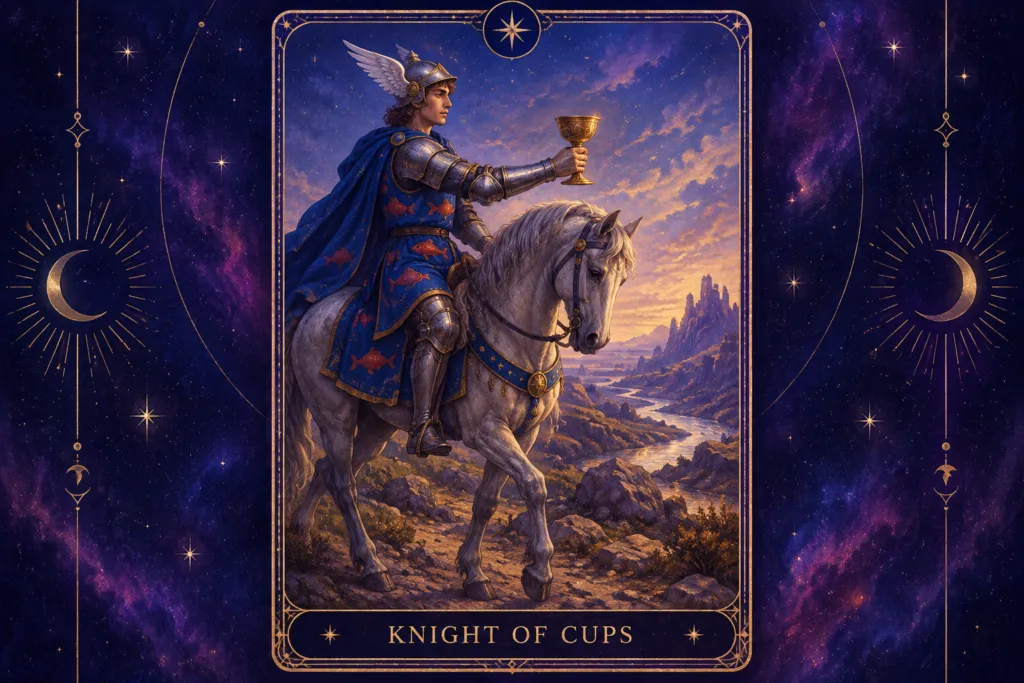
In the Rider-Waite-Smith deck, which William Rider & Son published in 1909 with art by Pamela Colman Smith, the Knight of Cups rides a white horse at a walk. The other three knights are charging, rearing or pausing in tension. This one moves quietly. He holds a single golden cup out in front of him, as if offering it to someone just outside the frame.
The details carry the meaning:
- The wings on his helmet and heels. Modern readers often link these to Hermes, the messenger god, which is why the card so often means a message or offer arriving.
- The fish on his tunic. Fish are the creatures of the Water suit and stand for feelings moving below the surface.
- The landscape. A river runs past dry, rocky ground. The knight carries water (emotion) through country that has little of it. In love readings, he brings feeling into a situation that has gone dry, or he is the only person in the picture feeling anything.
- The pace. He offers the cup politely. He is a suitor, not a conqueror.
What Waite Wrote in The Pictorial Key to the Tarot
Waite described the knight as “graceful, but not warlike; riding quietly, wearing a winged helmet, referring to those higher graces of the imagination which sometimes characterize this card.” He added: “He too is a dreamer, but the images of the side of sense haunt him in his vision.”
That second sentence is the key to the card in love. The Knight of Cups is a dreamer, but his dreams are also about the senses: attraction, desire and the pleasure of being in love.
Waite’s divinatory meanings in The Pictorial Key to the Tarot (1911) are:
- Upright: “Arrival, approach, sometimes that of a messenger; advances, proposition, demeanour, invitation, incitement.”
- Reversed: “Trickery, artifice, subtlety, swindling, duplicity, fraud.”
Two words get skipped in most modern summaries. “Advances” is a plainly romantic word: someone is making a move. “Incitement” means being stirred up or tempted toward something, which is not always toward something wise. Waite’s reversed list is also much harsher than the “moodiness” many modern guides offer. In his reading, the reversed knight is not confused. He is deceptive.
The Golden Dawn View: Fire of Water and Pisces
In the Hermetic Order of the Golden Dawn’s tarot text, Book T, the Knight of Cups is “the Lord of the Waves and the Waters, the King of the Hosts of the Sea.” He is Fire of Water: fiery, pursuing energy applied to feeling. Fire wants to act and Water wants to feel, so the result is someone who acts on emotion quickly. He declares himself, books the trip, says “I love you” early.
Book T rules the card over the last ten degrees of Aquarius and the first twenty of Pisces. That is why it is often called the Pisces knight. Readers who use astrological timing link it to roughly the second week of February through the second week of March.
Book T describes its knight as “graceful, poetic, Venusian, indolent, but enthusiastic if roused.” That word “indolent” is the old source of the modern warning about charm without follow-through. Two system differences are worth knowing:
- In the Golden Dawn, the mounted Knight is the highest-ranking court card.
- Many modern books give Knights the element of Air instead of Fire. If a guide calls this card Air of Water, it is following that later system, not Book T.
Upright and Reversed Keywords
| Upright | Reversed |
|---|---|
| Advances, proposal, invitation | Promises without follow-through |
| Charm, courtship, gentle pursuit | Charm used to manipulate |
| Emotional honesty | Moodiness, sudden withdrawal |
| Idealism, being swept away | Projection, fantasy over reality |
| A message or offer arriving | Cancelled plans, retracted offers |
| Creative expression of love | Jealousy dressed as devotion |
| Following your heart | Duplicity, deception, infidelity |
Upright Knight of Cups as Love Advice
Upright, the Knight of Cups is one of the most encouraging Minor Arcana cards for romance. It says feeling is moving toward you, or it should be moving out of you. The one standing caution: this card describes beginnings and intentions, not how a story ends.
If You Have a Crush
The upright Knight means the attraction is probably mutual and someone is close to saying so. This card fits the person who drafts a message, deletes it four times and finally sends it.
The advice is to send yours, or to say yes when theirs arrives. The Knight rewards emotional honesty and has no patience for strategy. If you have been closed off since a bad experience, the card is a direct instruction to take a small romantic risk again.
If You Are Single or Meeting Someone New
For singles, the upright Knight usually announces an approach: an invitation, a date or a confession, often from someone already in your circle. Knights signal movement, and this one moves in your emotional life.
In the first weeks of something new, the card confirms that the courtship is deliberate. The long voice notes and carefully chosen restaurants are chosen expressions of feeling. The advice is to enjoy it without planning the wedding by the third date.
One useful test: does this person ask about your life, or mainly narrate their feelings about you? Real Knight energy is curious about the other person. Self-absorbed romance looks the same from a distance but wears through quickly.
If You Are in a Long-Term Relationship
For established couples, the upright Knight says romance is still there or about to return. It often marks a partner who is planning something: a proposal, an anniversary trip, or a fresh effort to court you after a flat patch.
If your relationship has gone quiet, the advice is to be the Knight yourself. Plan the evening, write the note or make the gesture. Next to the Lovers, the Four of Wands or the Ten of Cups, the card often comes before an engagement or another formal step.
If You Are Facing a Love Decision
When you ask “should I go for this?”, the upright Knight says yes and asks you to follow your heart. The honest counter-argument is built into the card: he chooses with feeling, not with information.
Use the yes as permission, then check two practical facts before you act on it:
- Is the other person free to be with you?
- Have their actions matched their words for at least a few weeks?
Reversed Knight of Cups as Love Advice
Reversed, the romantic energy is still there, but it has become unreliable, excessive or false. Picture the cup tipped over and empty. The advice is to slow down, check promises against behaviour and protect your own judgment.
The Patterns the Reversed Knight Points To
“Be cautious” is too vague to act on. These are the specific things to look for:
- Charm without follow-through. “We should do something this weekend,” every week, with nothing ever booked.
- Oversized promises. Talk of moving in or travelling the world from someone who hasn’t met your friends yet.
- Sensitivity used as leverage. Tearful apologies that reset the relationship without changing anything, or every disagreement turned into a conversation about their hurt.
- Hot and cold behaviour. Silences that are never explained, until you are tracking their emotional weather instead of living your life.
- Jealousy framed as care. Questions about where you were and who you spoke to, presented as devotion.
- Retracted offers. A proposal withdrawn, a move cancelled, a wedding postponed. The Knight held out the cup and took it back.
- Deception. This is Waite’s meaning at full strength. Next to the Moon or the Seven of Swords, the reversed Knight is one of the deck’s clearer signs of a hidden relationship.
Reversed for Singles and New Relationships
If you are single, the reversed card usually describes someone pursuing you who fits the profile above. If they have just come out of a relationship, read the card as describing their unavailability.
Give a new connection at least a couple of months before you invest emotionally or financially. Have one direct conversation: “You talk about the future a lot, and then plans fall through. What’s going on?” One conversation is enough. If you are having the same one every month, the card has already answered you.
Reversed in a Long-Term Relationship
With an established partner, the reversed Knight most often describes someone who has stopped making romantic effort while still expecting it from you. Infidelity is a less common reading. Look at the surrounding cards before you reach that conclusion.
Don’t open with an accusation. Name what you are experiencing: “I feel like I’m the only one trying.” Then watch the response. Action is the upright Knight coming back. A speech about how hurt they are that you said it is the reversed Knight digging in.
When the Reversed Knight Is You
Sometimes the card describes the person asking the question. Either you have shut down emotionally after a betrayal, or you keep falling for people who cannot commit, which has the same result: no real risk and no real love.
The advice is to practise small acts of honesty. Tell a friend something true. On a date, say what you actually want instead of what sounds easygoing.
Knight of Cups as Feelings, Intentions and How They See You

As feelings, the upright Knight of Cups means romantic attraction, not friendly interest. The person is thinking about you in a dreamy, idealised way and is close to acting on it. Reversed, the feelings are real but tangled with fantasy, mixed motives or someone else.
| Question | Upright | Reversed |
|---|---|---|
| How do they feel about me? | Attracted, romantic, a little idealising | Attracted but conflicted, unavailable or projecting |
| What are their intentions? | To pursue you openly, often with a gesture | To keep you interested without committing |
| How do they see me? | As someone special, almost storybook | As a fantasy they may drop when it cracks |
| What will they do next? | Reach out, invite, declare | Send warm signals, then go quiet |
Even upright, there is one caveat. Waite’s “dreamer” may be in love with an idea of you, or with being in love. That isn’t an insult. It describes where they are. The test is whether the feeling holds up through ordinary life.
Knight of Cups as a Person
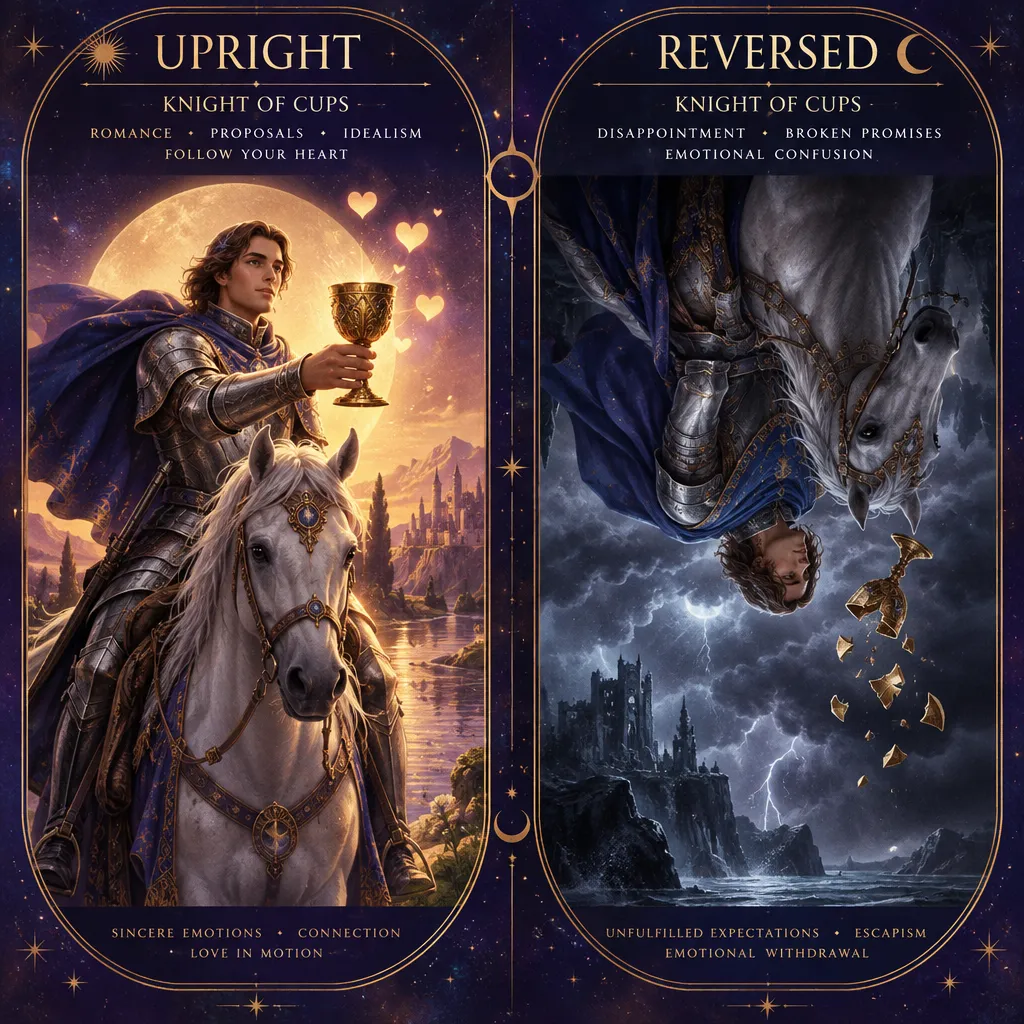
As a person, the Knight of Cups is the charming, emotionally fluent romantic. He remembers details about you, names feelings easily and expresses affection through gestures or creative work. The type is traditionally a younger man, but anyone of any gender or age can carry this energy in a reading.
His shadow, even upright, is a love of the chase and of romantic intensity for its own sake. He can be more invested in romance as an experience than in the partner in front of him, and he may falter when love moves into bills, families and tired evenings.
Court cards show stages of growth. The Knight has not yet become the King of Cups, who holds deep feeling steadily without needing constant drama. In love readings, that gap is often the real question: can this person grow into steadiness?
Reversed, the same person says everything you want to hear and delivers little of it. At worst, he is a seducer who moves on once the pursuit is over.
Knight of Cups and an Ex: Reconciliation Readings
Upright, the Knight of Cups suggests an ex’s romantic feelings are resurfacing and contact is likely. Because he is a messenger, expect a text, a reaction to a post or a mutual friend saying they asked about you. Reversed, contact may still come, but it is usually driven by loneliness or nostalgia rather than a changed heart.
What to do in each case:
- Upright: Let them make the offer, then answer honestly. If you want to try again, say so plainly.
- Reversed: Before you meet, ask what is different now. Expect change to be shown over weeks, not announced in one emotional message.
- Either way: Ask yourself whether you miss the person or the feeling of the beginning. The Knight is the card of beginnings, and nostalgia for a beginning is not a reason to go back.
Neighbouring cards sharpen the answer. With the Six of Cups, the contact is nostalgic. With Judgement, it is a real second chance. With the Eight of Cups, someone has already walked away for good.
Is the Knight of Cups a Yes or No in Love?
Upright, the Knight of Cups is a yes. Do they like me? Yes. Will they ask me out? Likely. Should I tell them? Yes. Reversed, it is a no about someone’s intentions, and a “not yet, verify first” about whether to go ahead.
For reconciliation questions, treat the reversed Knight as a no unless strongly positive cards sit around it.
Knight of Cups With Other Cards in Love
Neighbouring cards decide where the Knight’s offer leads. Cups and positive Major Arcana confirm it. Swords and the Moon question it.
| Card beside it | With the Knight upright | With the Knight reversed |
|---|---|---|
| Ace of Cups | Someone new and significant arriving. For couples, a fresh start or a pregnancy. | Strong feeling offered by someone unready to sustain it |
| Two of Cups | Mutual feeling, an offer accepted and returned | One person far more invested than the other |
| The Lovers | A defining romantic choice. Often comes before an engagement. | Torn between two people, or swayed by temptation |
| Four of Wands | Engagement, moving in, a celebration | Plans announced, then postponed |
| Ten of Cups | The courtship leads to lasting family happiness | Idealising a family life the relationship can’t yet support |
| Temperance | Romance at a healthy pace | A rushed bond that needs slowing down |
| Page of Cups | Flirtation turning serious, sweet early messages | Immature games on both sides |
| Queen of Cups | Two emotionally fluent people meeting | Feelings shared, practical life ignored |
| Six of Cups | An ex or old friend returning with warmth | Nostalgia mistaken for love |
| The Moon | Illusion even in a sincere romance | One of the stronger deception signals |
| Three of Swords | The offer brings heartbreak | A common pairing for infidelity |
| The Devil | Intense attraction with an obsessive edge | Seduction, control, a pattern that is hard to leave |
Where the Card Falls in the Spread
The position in the spread changes what the Knight is telling you. The same card reads as an instruction, a forecast or a warning depending on where it lands.
- Advice position: Make the first move, speak your feelings or plan the gesture. Reversed: stop chasing the fantasy and look at the facts.
- Outcome position: An offer, proposal or declaration is coming. Reversed: a promise that falls through.
- Obstacle position: Idealism is the problem. Someone, possibly you, is in love with an image rather than a person.
- Present position: You are in the courtship phase now. Enjoy it, and keep watching what people actually do.
What to Do After Drawing the Knight of Cups
The card is only useful if it changes your next step. These are concrete actions for each draw:
- Upright, single: Accept the next invitation, even from someone who is not your usual type, and send one honest message you have been holding back.
- Upright, partnered: Plan one romantic gesture this week that costs effort rather than money. If a big step is on your mind, raise it.
- Reversed, single: Write two lists, one of what this person has promised and one of what they have actually done, and compare them.
- Reversed, partnered: Have one calm conversation about consistency, then give it a month before you read on the same question again.
- Reconciliation: Upright, reply warmly and honestly. Reversed, ask for a specific sign of change before you agree to meet.
The deeper lesson in Smith’s image is the walking horse. The Knight of Cups doesn’t rush, and he doesn’t hold back the cup either. Make your offer at his pace: openly, gently, and ready to see what the other person does with it.
FAQ
Is the Knight of Cups a good card for love?
Yes. Upright, it is one of the most positive Minor Arcana cards for romance, pointing to courtship, a heartfelt offer and returned feeling. Its limit is that it describes beginnings and intentions, so look at the surrounding cards to judge where the romance leads.
What is the Knight of Cups’ advice in a love reading?
Upright, the advice is to follow your heart: make or accept the romantic offer and be honest about your feelings. Reversed, it tells you to slow down, compare words with actions, and drop any fantasy you have been protecting.
Does the Knight of Cups mean someone has feelings for you?
Upright, yes. It shows romantic attraction, often from someone close to acting on it. Reversed, the attraction may be real but mixed with unavailability, projection or a liking for attention rather than commitment.
What does the Knight of Cups reversed mean in love?
Waite’s Pictorial Key to the Tarot gives “trickery, artifice, subtlety, swindling, duplicity, fraud.” In modern love readings, that shows up as empty promises, hot and cold behaviour, jealousy, cancelled plans and, next to cards like the Moon, a hidden relationship.
Does the Knight of Cups mean a proposal?
It can. Waite lists “proposition” and “invitation” among its meanings, and the card often appears before engagements alongside the Lovers, the Two of Cups or the Four of Wands. On its own, the offer could be a first date, a declaration or a request to take the next step.
Does the Knight of Cups mean an ex is coming back?
Upright, it suggests your ex’s romantic feelings are returning and contact is likely. Reversed, they may still reach out, but more from nostalgia or loneliness than real change, so ask for proof over time.
What zodiac sign is the Knight of Cups?
In the Golden Dawn system, the Knight of Cups is Fire of Water and rules from the last ten degrees of Aquarius through the first twenty of Pisces, so it is usually called the Pisces knight. That Pisces link fits the card’s idealism, sensitivity and tendency to fall for an ideal.
Add Yes No Tarot as a preferred source on Google, and the sites you pick are more likely to appear in your Top Stories.