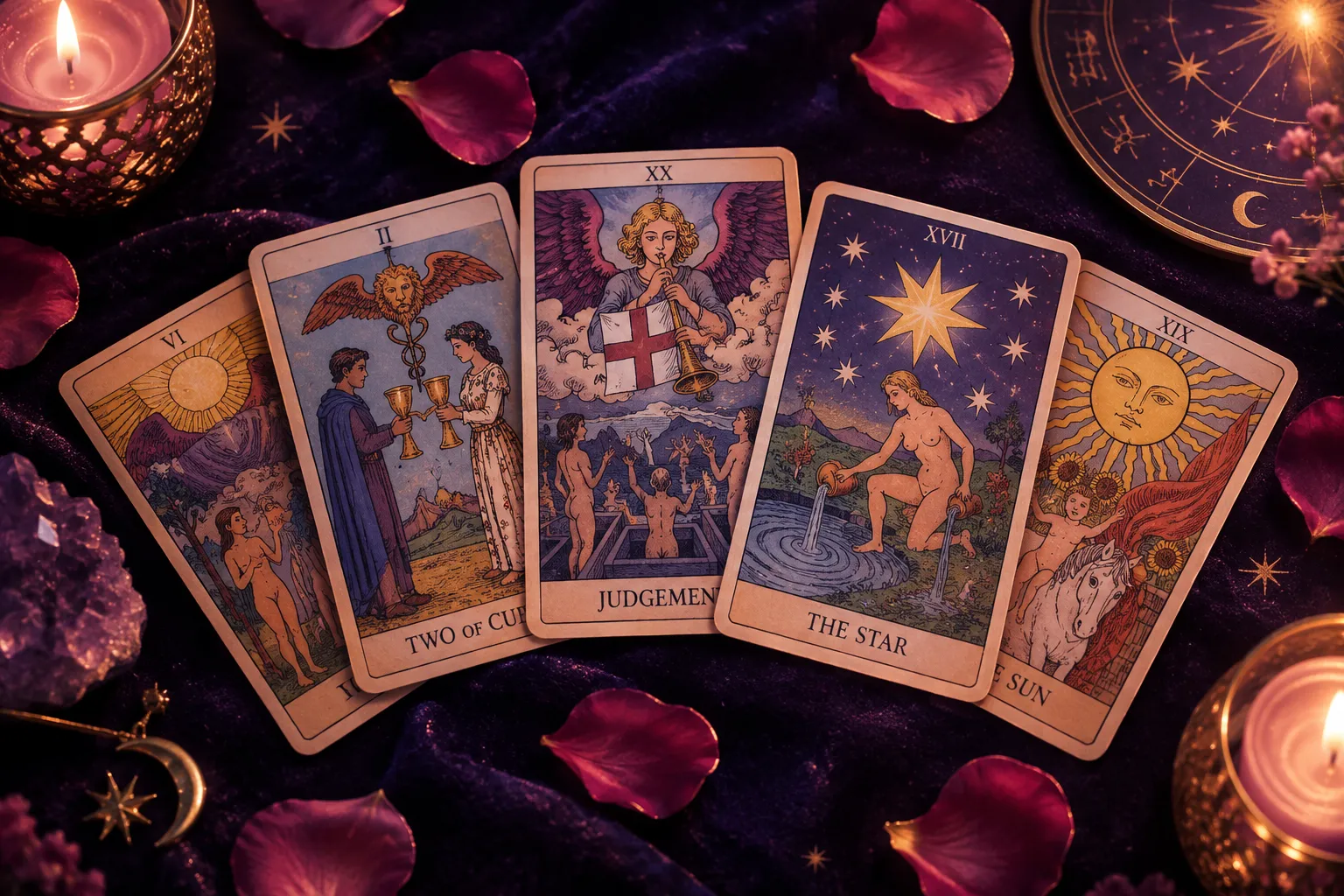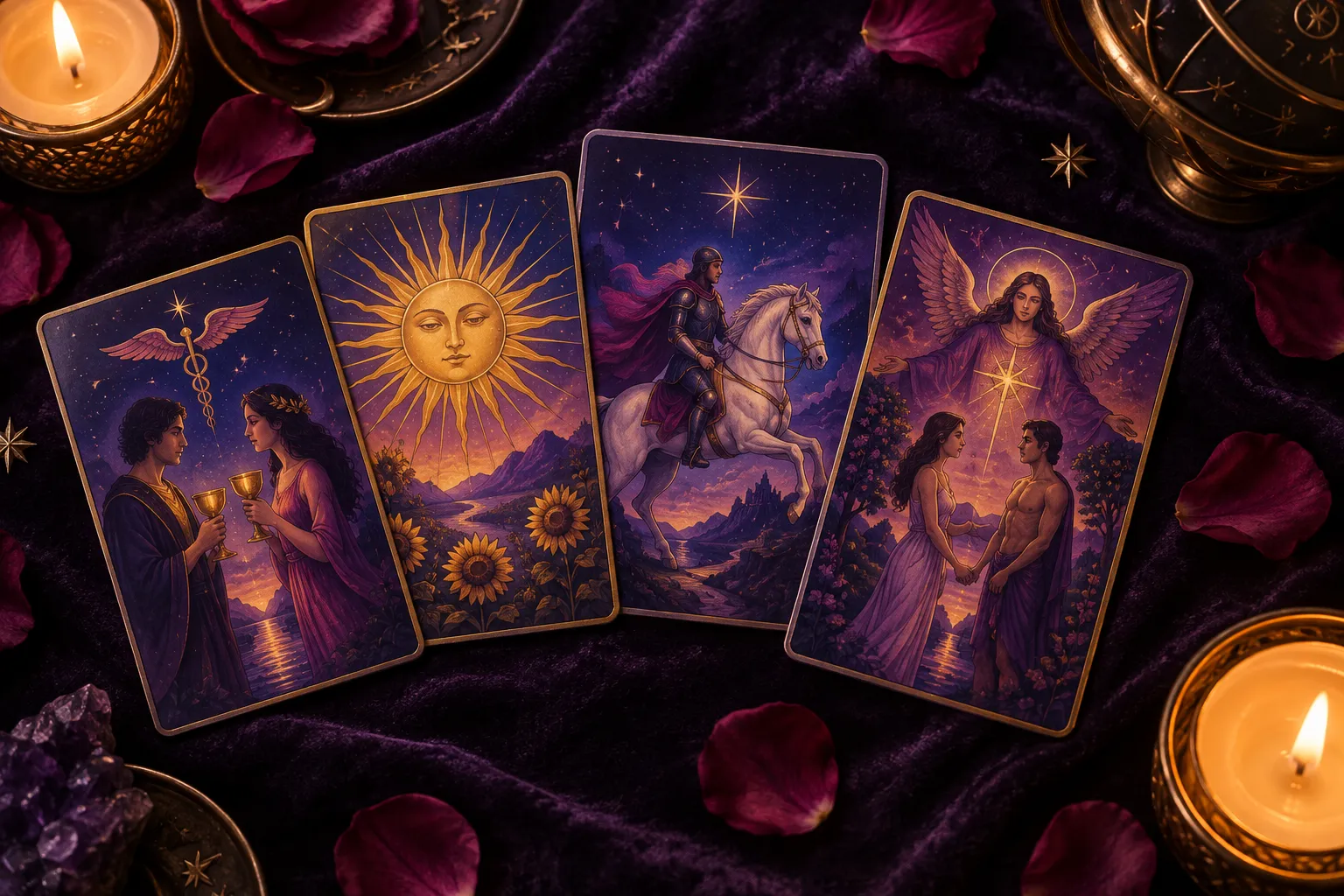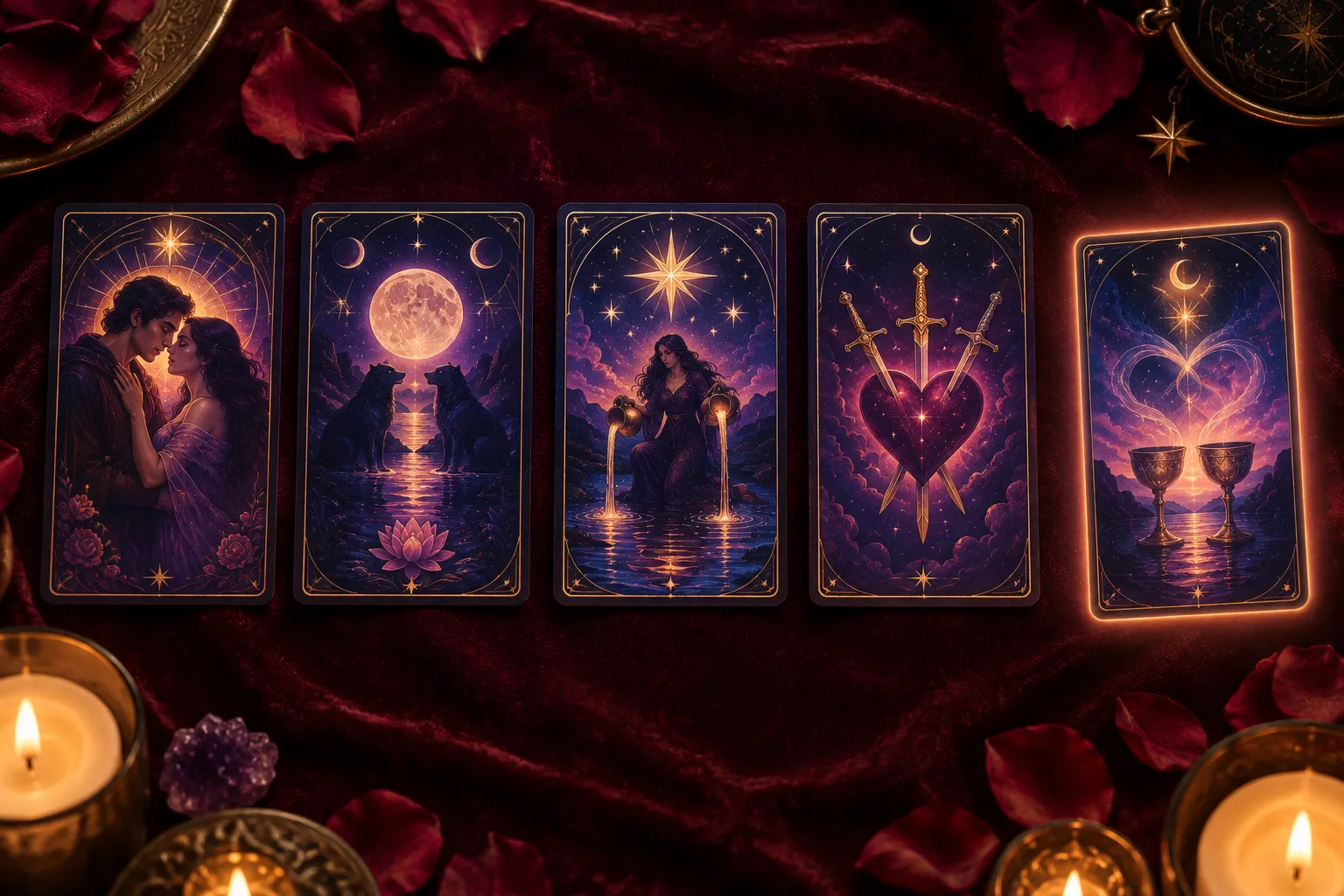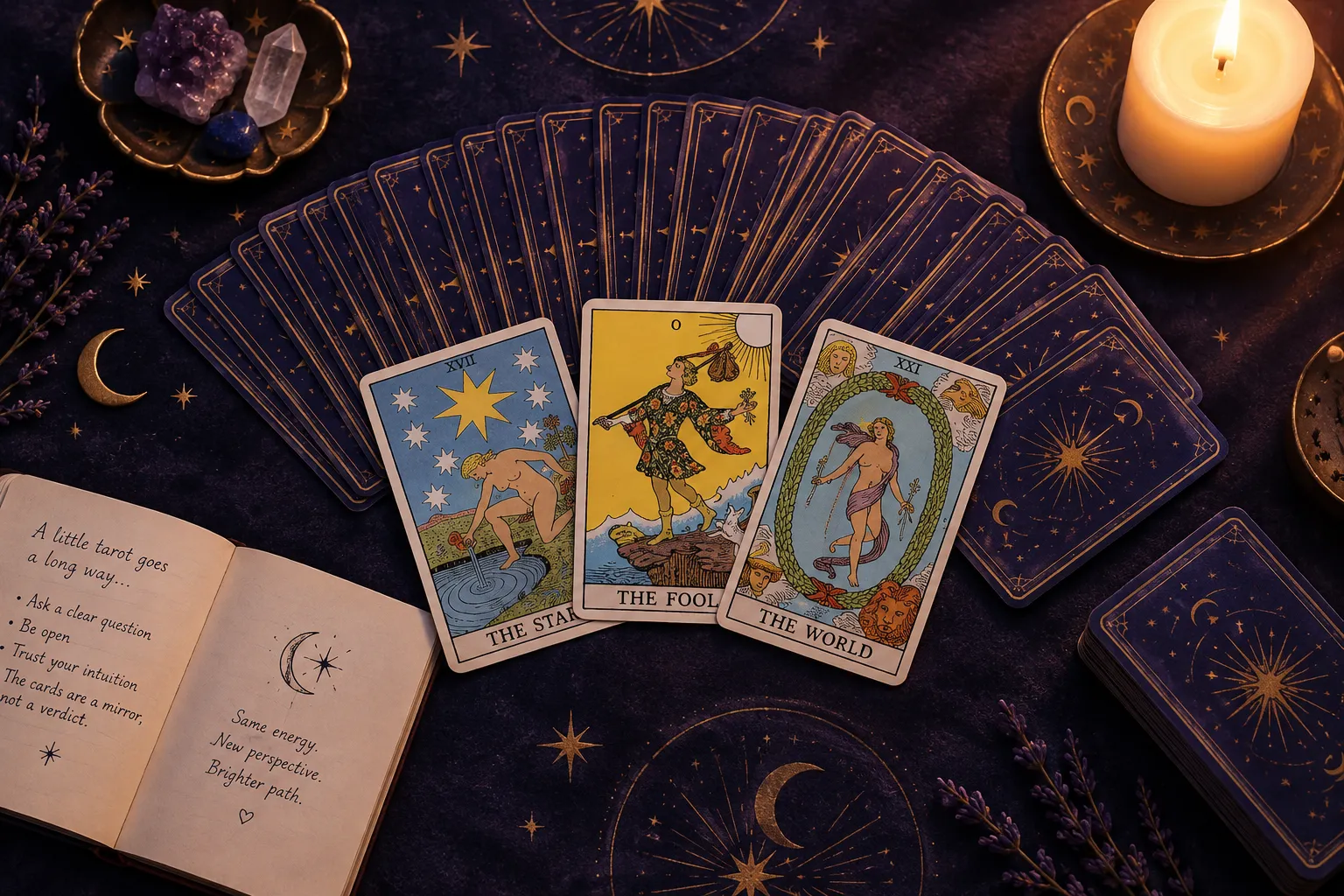


A tarot reading for a reunion asks whether a broken connection can be restored, and what it would take. The cards that most often point toward a yes are the Six of Cups, Two of Cups, Judgement and The Lovers, especially in the outcome or “their feelings” position. The clearest no is the Eight of Cups, followed by the Ten of Swords and Death.
The rest of this page covers how to ask the question, which spread suits your situation, and how each card changes upright, reversed and next to other cards. Meanings are drawn from A. E. Waite’s The Pictorial Key to the Tarot (1910), the Golden Dawn attributions behind the Rider-Waite-Smith deck, and current reader practice, and each one says which source it comes from.
The Short Answer: Which Cards Mean a Reunion
Look for a cluster, not a single card. One Six of Cups is a memory. A Six of Cups beside the Two of Cups and Judgement is a pattern worth taking seriously.
The table below sorts the cards readers watch most closely. The “Waite’s keywords” column quotes or closely paraphrases The Pictorial Key to the Tarot. The modern reunion reading builds on his keywords but often goes beyond them.
| Card | Reunion signal | Waite’s keywords (upright) | Upright in a reunion reading | Reversed in a reunion reading |
|---|---|---|---|---|
| Six of Cups | Strong | “A card of the past and of memories” | Someone from your past returns or thinks of you fondly | Stuck in the past; Waite gives “the future, renewal” |
| Two of Cups | Strong | Love, passion, friendship, affinity, union, concord | Mutual feeling; both sides still open | One-sided feeling; disconnection |
| Judgement | Strong | Change of position, renewal, outcome | A second look, a reckoning, a call back | Avoiding the honest conversation |
| The Lovers | Strong | Attraction, love, beauty, trials overcome | The bond is alive and a conscious choice is due | Waite: “failure, foolish designs”; values clash |
| Knight of Cups | Moderate to strong | Arrival, approach, sometimes of a messenger; proposition, invitation | A message, apology or invitation is coming | Waite: trickery, duplicity; attention-seeking |
| Ace of Cups | Moderate | “House of the true heart,” joy, content | A fresh emotional start, not a rerun | Waite: “house of the false heart,” instability |
| Temperance | Moderate | Economy, moderation, management, accommodation | Slow, patient rebuilding | Imbalance, forcing it |
| The Star | Moderate | Hope and bright prospects | The wound is healing on both sides | Despair, disconnection |
| Wheel of Fortune | Moderate | Destiny, fortune, success, luck | Circumstances shift; timing improves | The same loop repeats |
| Eight of Cups | Strong closure | Decline of a matter | Someone has deliberately walked away | Drifting back out of habit or fear |
| Ten of Swords | Strong closure | Pain, affliction, tears, sadness, desolation | Rock bottom; the relationship has run its course | Partial, impermanent recovery |
| Death | Strong closure | End, mortality, destruction | This chapter is finished | Clinging to what has ended |
How to Prepare for a Reunion Reading
Preparation matters more here than in almost any other reading, because you are rarely neutral. Wanting a particular answer bends how you shuffle, how you read, and how quickly you redraw when you dislike what appears.
Ground yourself before you shuffle
Wait until you are calm. Two or three minutes with your feet flat and your hands resting on the deck is enough. A spread pulled in the middle of crying, anger or a half-drafted text almost always reflects the spike rather than the situation.
Clear the deck
Keep it simple. Knock on the deck three times, pass it over a candle or incense smoke, or shuffle slowly while you breathe out. The point is a symbolic reset so this reading starts clean.
Ask an open question
Closed, outcome-only questions such as “Will he come back?” produce cards that are hard to read and easy to misread. Open questions give the cards room to show the why:
- “What is the current energy between me and [name]?”
- “What would need to change for reconciliation to be possible?”
- “What is [name] feeling about our relationship right now?”
- “What is the most likely direction of this connection over the next three months?”
- “What do I need to understand before I decide whether to reach out?”
A quick single-card pull is fine as a temperature check. Treat it as a starting point, not a verdict. The same discipline applies to all yes/no tarot readings.
Set a redraw rule in advance
Decide before you begin: one reading per question, then a two-week pause. Pulling the same question five times until The Lovers finally appears is a lottery, not a reading. The first spread is the honest one.
Reunion Readings by Situation

The same card means different things depending on who you are reading about. A Knight of Cups for an ex who blocked you is not the same as a Knight of Cups for a partner you are on a break with. Find your situation below, then use the matching spread later on this page.
An ex after a breakup
This is the classic reunion question, and the card that matters most is the one describing their side. Your own heart is usually obvious to you. Theirs is what you came to find out.
- Ask: “What is [name] feeling about our relationship now, and what stands between us?”
- Best spread: the four-card Diamond Cross, which puts your heart and theirs side by side.
- Watch for: Six of Cups or Two of Cups in their position is the strongest sign they are still emotionally engaged. Eight of Cups there means a considered departure, and considered departures rarely reverse.
- Next step: if their card is warm and the obstacle card is circumstantial (Wheel of Fortune, Four of Swords, Eight of Pentacles), a short, low-pressure message is reasonable. If the obstacle is The Devil or the Seven of Swords, deal with the trust issue first.
A partner you are on a break with or separated from
A break is not a breakup, and the cards usually show it. Expect more Temperance, Four of Swords and Hanged Man: pause cards, not ending cards.
- Ask: “What does each of us need to bring back to this relationship for it to work?”
- Best spread: the five-card Reconciliation Spread, because positions 2 and 3 compare each person’s growth.
- Watch for: Judgement means the break is doing its job, and both of you are re-evaluating. Five of Cups in your position means you are grieving rather than reflecting, which is a reason to give it more time.
- Next step: agree on a date to talk rather than drifting. The Wheel of Fortune upright suggests that conversation will land better once an outside pressure eases.
A crush or situationship that went quiet
Reunion readings about someone you never formally dated are common. They need a lighter touch, because there was never a shared commitment to return to.
- Ask: “Is there unfinished interest between me and [name], and what would reopen it?”
- Best spread: the three-card Second Chances Spread.
- Watch for: the Page of Cups or Knight of Cups suggests renewed interest or a message. The Seven of Cups warns that you may be projecting a fantasy onto a person you barely know.
- Next step: a single casual contact. If nothing comes back, the cards have already told you what they could.
Someone new, or someone returning?
Readers often struggle to tell whether a romantic card describes the ex or a new person. Waite helps here. He notes that one reading of the Six of Cups reverses the usual sense and gives “new relations, new knowledge, new environment.”
As a working rule, the Six of Cups, Judgement and the Wheel of Fortune lean toward someone from your history. The Ace of Cups, Page of Cups and a court card you cannot match to anyone lean toward someone new. When both groups appear together, the spread is often showing a choice between the past and a new possibility. That is The Lovers’ territory.
A friend or family member
Reunions are not only romantic. For estranged friends or relatives, the Three of Cups (shared celebration), the Four of Wands (homecoming) and the Six of Cups (shared childhood) carry the most weight. Waite’s keywords for the Four of Wands include “haven of refuge,” “concord” and “harmony,” which suits a family gathering. The Five of Cups reversed is worth a second look in family readings. Waite’s reversed meanings for it include “affinity, consanguinity, ancestry, return,” all of them family words.
The decision: reach out or wait?
Sometimes the real question is about your own next move, not their feelings. Frame it that way and the cards become much clearer.
- Ask: “What happens if I reach out now, and what happens if I wait?”
- Layout: two columns of three cards, one for each path.
- Watch for: the Two of Swords (blindfolded, arms crossed) says you are avoiding information you need. The Knight of Cups on the “reach out” side favours making the first move. Strength or The Hermit on the “wait” side favours patience.
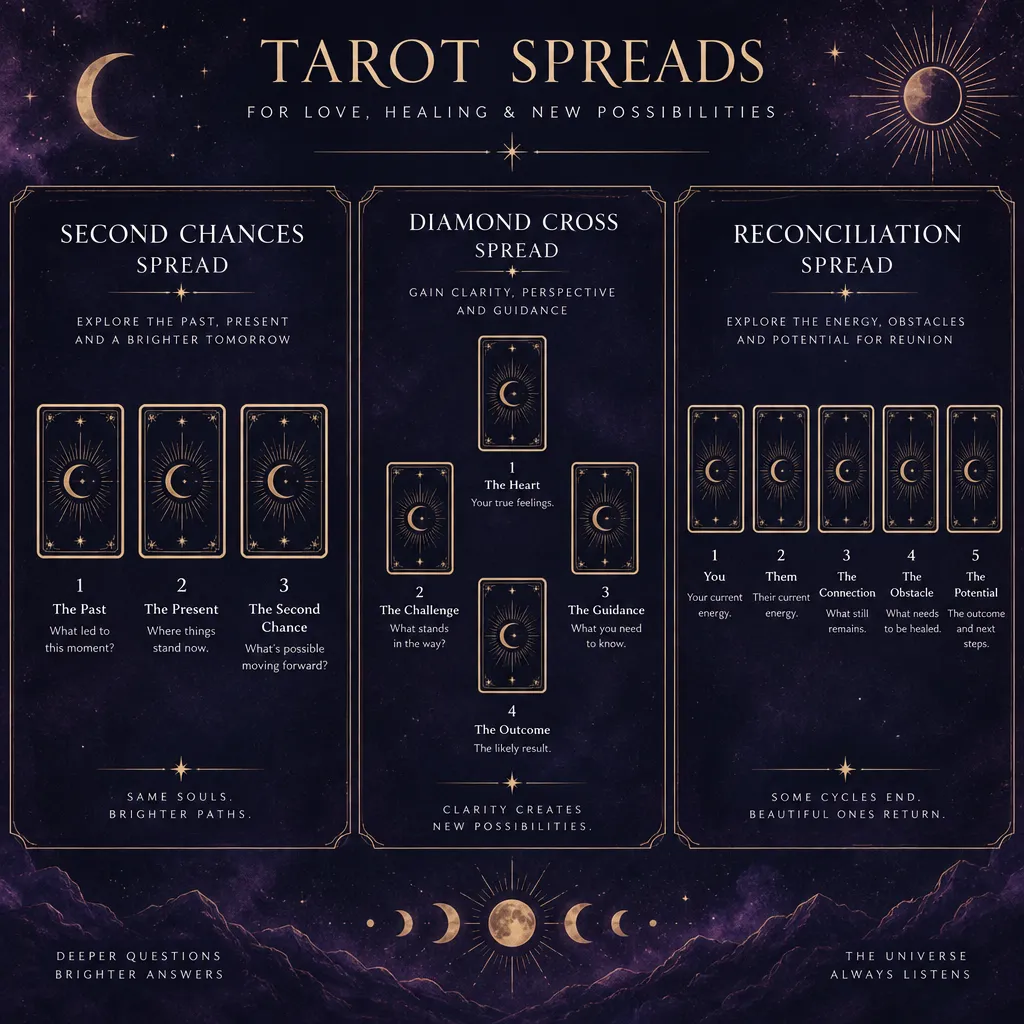
Tarot Spreads for Reunion Readings
Pick the spread by how much emotional bandwidth you have, not by how much you want to know. Three cards give clarity fast. Seven cards give context but take an hour to read properly.
| Spread | Cards | Best for | Key position |
|---|---|---|---|
| Second Chances | 3 | Quick check-in, crushes | Card 3, direction |
| Diamond Cross | 4 | Comparing your heart and theirs | Right, the obstacle |
| Reconciliation | 5 | Breakups and breaks | Cards 2 and 3, growth on each side |
| Hexagram | 7 | Complex situations with outside pressures | Centre card |
| Celtic Cross | 10 | Experienced readers | Card 9, hopes and fears |
The Second Chances Spread (3 cards)
- What the relationship was: the core dynamic that defined you.
- Where things stand now: the current energy, including anything unspoken.
- The most likely direction: where this is heading if nothing changes.
If card 3 is a Cups card, The Lovers, Judgement or The Star, reconciliation is in the picture. Eight of Cups, Ten of Swords or Death point to closure. Ambiguous cards such as The Hanged Man, Two of Swords and The Moon usually mean the situation is genuinely undecided, often because you are.
The Diamond Cross Reunion Spread (4 cards)
Lay one card at the top, one left, one right and one at the bottom.
- Top, your heart: what you actually feel beneath the pride or panic.
- Left, their heart: what the other person feels toward you now.
- Right, the obstacle: what stands between you. This is often the most important card.
- Bottom, the foundation: what would need to be true for a reunion to last.
This spread is built to expose a mismatch. Two of Cups on your side and Eight of Cups on theirs is an uncomfortable answer, but a clear one.
The Reconciliation Spread (5 cards)
Laid in a horizontal line, this layout balances feelings, causes and outcome.
- Why it ended: the real cause, not the surface argument.
- How you have changed since.
- How they have changed since.
- What still connects you: the thread that has not been cut.
- The outcome if you both act on this insight.
Positions 2 and 3 decide the reading. Reunions that last need growth on both sides. If your card is The Star and theirs is The Devil or the Five of Pentacles reversed, you have moved and they have not, and the spread is warning you about repeating the cycle.
Worked example: reading the five cards together
Suppose you draw:
- The Tower
- Temperance
- Judgement
- Six of Cups
- Two of Cups
The Tower in position 1 says the ending was sudden and structural, not a misunderstanding. Temperance and Judgement in the growth positions show both people doing real work: patience on your side, a genuine reckoning on theirs. The Six of Cups in position 4 confirms that shared memory still binds you. The Two of Cups as the outcome is about as clear a reconciliation signal as the deck offers.
Now swap card 3 for the Seven of Swords. The outcome card stays the same, but the reading changes completely. They have not done the reckoning, and a reunion would rest on something unspoken. Read the outcome through the positions that lead to it, never on its own.
The Hexagram Spread (7 cards)
Six cards form a six-pointed star with a seventh in the centre.
- Top point, the past: the relationship’s original foundation.
- Upper right, the present: the current state of the connection.
- Lower right, the near future: roughly the next four to six weeks.
- Bottom point, your role: what you contribute, consciously or not.
- Lower left, their role: what they contribute.
- Upper left, external influences: friends, family, distance, new partners, timing.
- Centre, the heart of the matter: the card that ties it together.
Read the centre card first, then treat the other six as the explanation for it.
The Celtic Cross
The ten-card Celtic Cross, popularised by Waite in The Pictorial Key to the Tarot, adapts well to reunion questions. Its hopes-and-fears position (card 9) is especially revealing, because it often shows that what you fear and what you hope for are the same outcome. Beginners will get more from the five-card Reconciliation Spread. More layouts are collected in the love tarot spreads section.
Major Arcana Cards That Signal Reunion
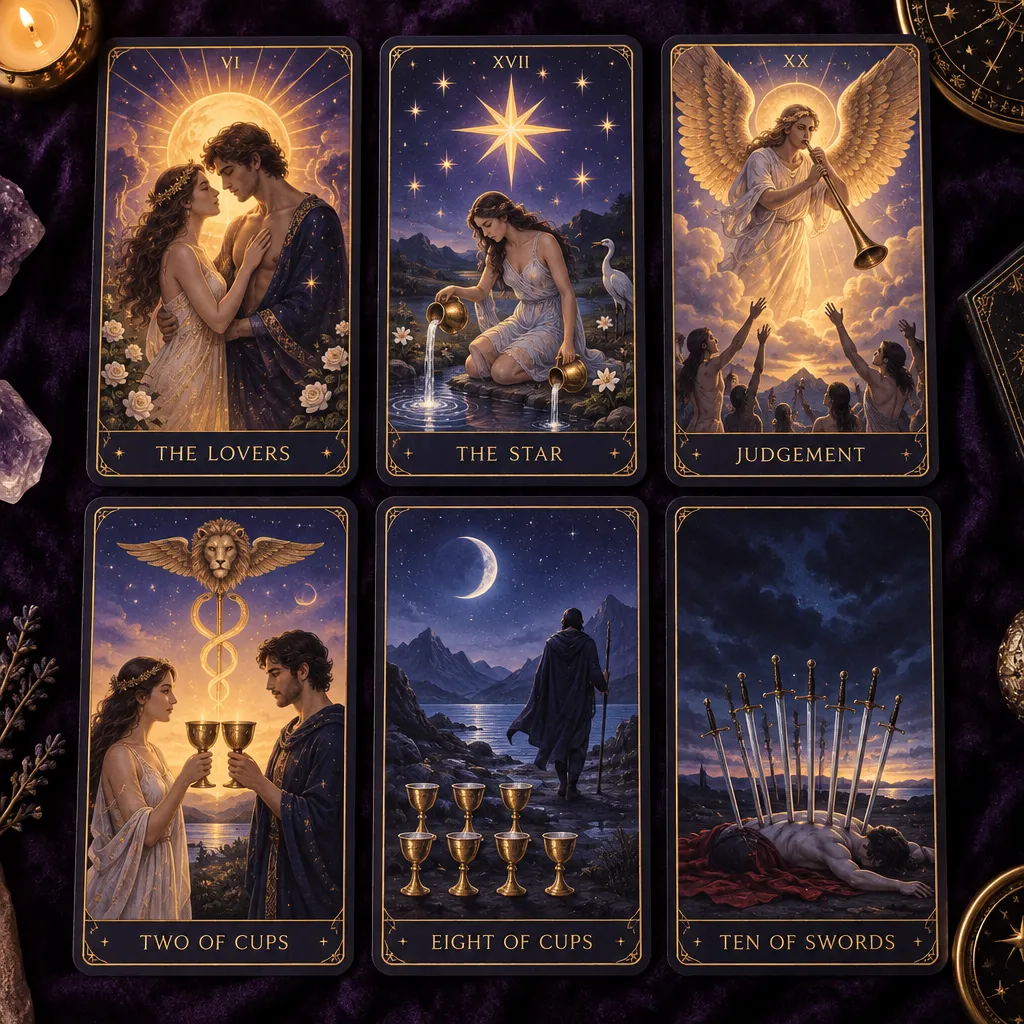
Major Arcana cards describe the relationship’s larger arc: turning points, choices, timing. When several appear in one reunion spread, the situation is bigger than a single misunderstanding.
The Lovers
The Lovers is the best-known reunion card. It says the bond is alive and that a real choice is waiting. In Pamela Colman Smith’s drawing, a great winged figure (often identified as the archangel Raphael) blesses a naked man and woman. The Tree of Life stands behind him and the Tree of Knowledge, with its serpent, behind her. The Golden Dawn assigns the card to Gemini, the twins, which fits a card about two people facing each other.
Waite’s divinatory meaning is “attraction, love, beauty, trials overcome.” In a reunion reading, the “trials overcome” part matters most. The card asks whether you are choosing this person clearly or choosing to avoid being alone.
- Reversed: Waite gives “failure, foolish designs.” Modern readers add misaligned values, or one person wanting the reunion far more than the other.
- Beside The Devil: strong attraction with an unhealthy hook. A reunion is likely, and so is a repeat of the old pattern.
Judgement
Judgement is one of the strongest signs that a relationship is being re-evaluated, by both people. Smith drew an angel sounding a trumpet as a man, a woman and a child rise from their coffins with arms open. Waite’s meaning is “change of position, renewal, outcome.” The Golden Dawn attributes the card to elemental Fire.
Judgement does not guarantee a return. It promises that confusion is ending. Sometimes that clarity arrives as a message from them, and sometimes as finally understanding why it ended. Before acting on it, take an honest inventory:
- What did each of you contribute to the breakdown?
- What has actually changed since, as opposed to what has been promised?
- Would getting back together tomorrow start a new relationship, or reopen the old one unchanged?
Reversed: Waite lists “weakness, pusillanimity, simplicity; also deliberation, decision, sentence.” In practice, one or both of you is dodging the conversation that would make reconciliation possible.
Judgement is not Justice. Justice concerns fairness and consequence: the outcome will reflect what each person put in. Judgement concerns awakening and a second look. Both appear in reunion readings, and they say different things.
Temperance
Temperance predicts gradual rebuilding, not a dramatic return. Smith’s angel pours water between two cups, one foot on land and one in a pool. Waite’s keywords are “economy, moderation, frugality, management, accommodation,” and the Golden Dawn links the card to Sagittarius.
The message is to slow down. Expecting the other person to feel what you feel on your timeline is how reunions fail a second time. Temperance favours moderation in how often you reach out, how much you disclose and how fast you expect trust to return.
Reversed: Waite’s reversed meanings include “disunion, unfortunate combinations, competing interests.” It often appears when someone is trying to force a reunion through intensity, such as constant messages or grand gestures.
The Star
The Star says the wound is closing. Smith drew a kneeling woman pouring water onto land and into a pool beneath one large star and seven smaller ones. Waite records two readings: “loss, theft, privation, abandonment” and, in another tradition, “hope and bright prospects.” Modern reunion readers use the second. The Golden Dawn assigns the card to Aquarius.
Sometimes that healing leads to a reunion and sometimes to a friendship. Either way, the worst is behind you.
Reversed: loss of hope. In a reunion spread it usually mirrors your own despair rather than the other person’s intentions, which is a prompt to look after yourself before taking any action.
The Wheel of Fortune
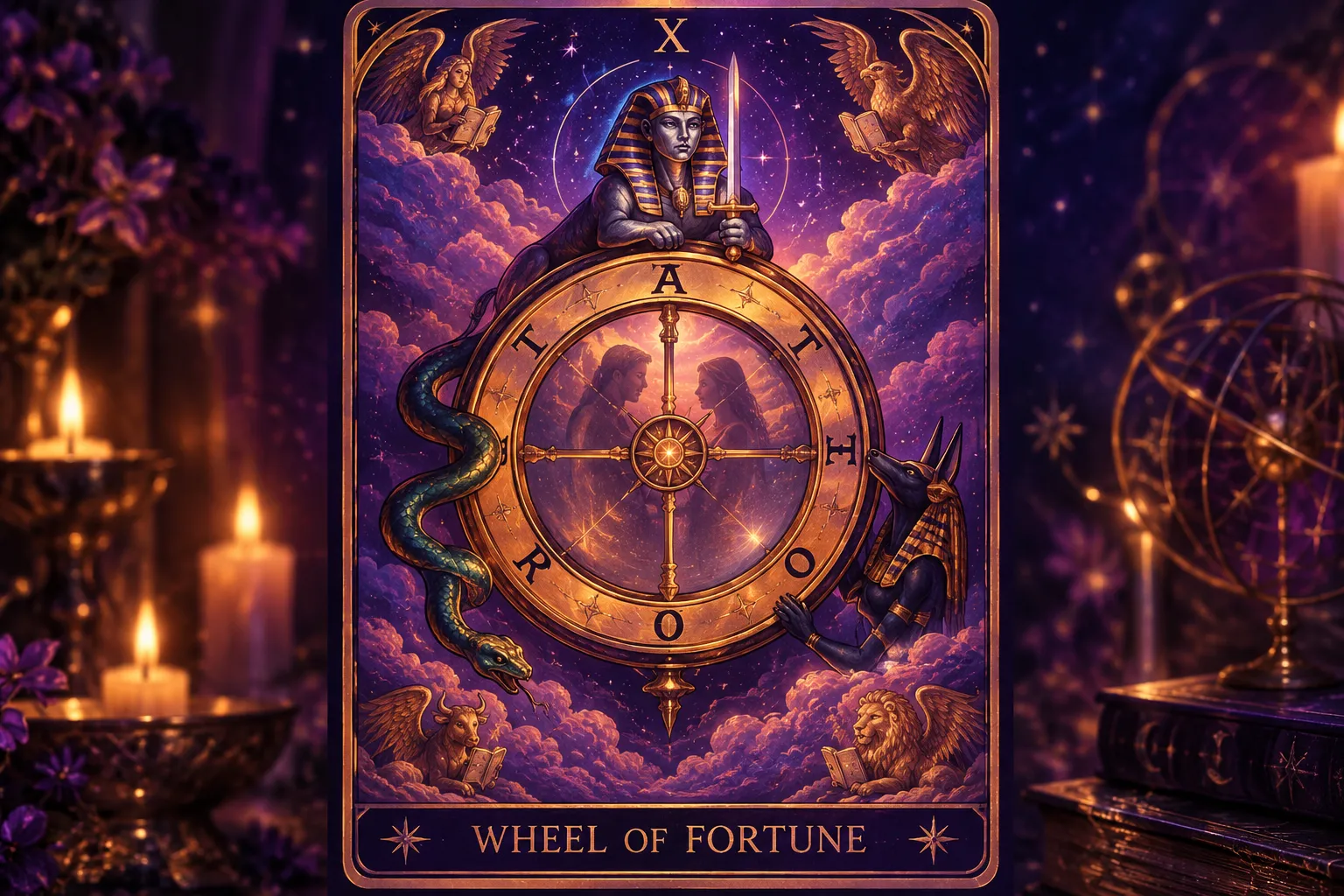
The Wheel points to timing: the problem was circumstances, not feelings, and circumstances are about to change. Waite’s keywords are “destiny, fortune, success, elevation, luck, felicity.” The Golden Dawn gives the card to Jupiter, the planet of expansion.
If your question was “when,” the Wheel’s usual answer is “not yet, but the cycle is turning.” Typical triggers are distance closing, a job settling or a hard period ending.
Reversed: Waite oddly gives “increase, abundance, superfluity.” Modern readers treat it as bad timing, or a cycle that would simply repeat.
The Empress
The Empress shows that the emotional ground is still fertile. She sits in a field of ripening wheat with a heart-shaped shield bearing the symbol of Venus, the planet the Golden Dawn assigns her. Waite’s keywords begin with “fruitfulness, action, initiative.” She often appears when the breakup came from stress or exhaustion rather than contempt.
She also carries a message about self-care. Someone who returns to a partner who has been quietly rebuilding their own life tends to stay.
Reversed: smothering or dependency, often a dynamic in which one partner parented the other until resentment set in.
The Tower
The Tower confirms that the breakup was not a blip. Smith drew lightning striking a tower, knocking off its crown, with two figures falling. Waite calls it “a card in particular of unforeseen catastrophe,” and the Golden Dawn assigns it to Mars.
That is not necessarily the end. The Tower clears ground, and any reunion has to be built on new foundations. Ask whether what broke things was situational (timing, stress, outside pressure) or structural (values, respect, effort). A situational Tower can be survived. Rebuilding the same tower in the same way cannot.
- Reversed: a collapse being resisted, or a couple clinging to a structure that has already fallen.
- Followed by The Star: the classic sequence of necessary rupture and real healing. If a reunion happens, it is likely to be a better relationship than the first.
The Hanged Man
The Hanged Man says you are stuck, and the stuckness is inside you. Smith’s figure hangs calmly by one foot from a living T-shaped tree, his head ringed with light. Waite’s keywords include “wisdom, circumspection, discernment, trials, sacrifice.” The Golden Dawn attributes the card to elemental Water.
The card asks you to loosen your grip on the outcome, on who was right and on the timeline you have imposed. Paradoxically, it often comes just before movement. The energy between two people frequently shifts once one of them stops needing a particular result.
Reversed: stalling, or endless sacrifice for a reunion that is not coming. It asks whether you are waiting or avoiding a decision.
Minor Arcana Cards That Signal Reunion
The Minor Arcana describe what is being felt and done right now. In reunion readings, Cups dominate, because Cups are the suit of emotion and relationships.
Six of Cups
The Six of Cups is the clearest “someone from your past” card in the deck. Smith drew two children in an old garden. The older one offers the younger a cup filled with white, star-shaped flowers. Waite calls it “a card of the past and of memories, looking back, as, for example, on childhood; happiness, enjoyment, but coming rather from the past.” The Golden Dawn title is Lord of Pleasure, attributed to the Sun in Scorpio.
The trap is that the past is not the future. Sometimes the card means a reunion, and sometimes it means rose-tinted memory of the relationship before things got hard. Its neighbours decide which:
- With the Two of Cups or Ace of Cups: a genuine reunion signal.
- With the Five of Cups or The Moon: nostalgia doing the talking.
- With the Eight of Cups: looking back while walking on.
Reversed: modern readers see someone stuck in the past. Waite’s reversed meaning points the other way: “the future, renewal, that which will come to pass presently.” Both readings are defensible, so let the surrounding cards decide. A fuller treatment is on the Six of Cups meaning page.
Two of Cups
The Two of Cups means the feeling runs both ways. Smith drew a young man and woman pledging cups to each other, with a caduceus crowned by a winged lion’s head rising between them. Waite’s keywords are “love, passion, friendship, affinity, union, concord, sympathy.” The Golden Dawn calls it Lord of Love, attributed to Venus in Cancer.
Where The Lovers speaks about choice, the Two of Cups speaks about reciprocity. In the “what still connects you” or outcome position, it is one of the clearest indicators that reconciliation is mutual and possible.
Reversed: imbalance, or one person carrying the emotional weight. In a “their heart” position it often means they have emotionally moved on without saying so.
Three of Cups
The Three of Cups often signals reconnection through friends or a social event. Smith drew three women raising cups among fruit and flowers. Waite describes “the conclusion of any matter in plenty, perfection and merriment; happy issue, victory, fulfilment, solace, healing.” The Golden Dawn title is Lord of Abundance, attributed to Mercury in Cancer.
It can also mean that a reunion starts as friendship before it becomes romantic again, which tends to be the steadiest route back.
Reversed: third-party interference, gossip, or an ex now living in a social world that does not include you.
Ace of Cups
The Ace of Cups says that a reunion, if it happens, can be a new relationship rather than a rerun. Smith’s hand emerges from a cloud holding a cup that overflows in five streams, while a dove descends with a wafer. Waite calls it the “house of the true heart, joy, content.” It often appears when one person is ready to be vulnerable in a way they were not before.
Reversed: Waite’s “house of the false heart, mutation, instability.” The emotional door is not open yet.
Knight of Cups
The Knight of Cups is the card most associated with someone actually reaching out. Smith drew a knight riding slowly, holding a cup out before him, with wings on his helmet and heels. Waite’s meaning is “arrival, approach, sometimes that of a messenger; advances, proposition, demeanour, invitation.” In practice that means a message, an apology or an invitation to talk. It can also mean that you are the one being called to move first.
The Knight is sincere but not always steady. Enjoy the gesture, then watch for follow-through.
Reversed: Waite lists “trickery, artifice, subtlety, swindling, duplicity, fraud.” In modern reunion readings, that often describes an ex who wants attention, not reconciliation.
Cards That Signal Closure, Not Reunion
An honest reunion reading has to be able to say no. When these cards land in the outcome, “their heart” or direction positions, they point to completion rather than a comeback. They are information, not punishment.
Eight of Cups
Someone is walking away on purpose. Smith drew a cloaked figure with a staff leaving eight stacked cups, with a visible gap in the stack, and heading toward barren hills under a moon with a face. Waite says the card usually shows “the decline of a matter, or that a matter which has been thought to be important is really of slight consequence.” The Golden Dawn title, Lord of Abandoned Success, attributed to Saturn in Pisces, sums it up.
Unlike a sudden rupture, this is a considered departure, and considered departures rarely reverse.
Reversed: Waite gives “great joy, happiness, feasting.” Modern reunion readers see a different risk in it: drifting back out of habit, because leaving is frightening rather than because staying is right.
Ten of Swords
The Ten of Swords is rock bottom. Smith drew a man lying face down under ten swords, beneath a black sky with yellow dawn breaking over still water. Waite gives “pain, affliction, tears, sadness, desolation” and adds that “it is not especially a card of violent death.” The Golden Dawn calls it Lord of Ruin, attributed to the Sun in Gemini.
In reconciliation readings it usually confirms a wound too deep to reopen, such as betrayal or deception. The mercy is that dawn on the horizon. Things improve from here, but not by going back.
Reversed: Waite lists “advantage, profit, success, favour, but none of these are permanent.” A relationship pulled back from the brink is possible, but the signal is fragile.
Five of Cups
The Five of Cups usually describes your state, not theirs. Smith’s cloaked figure mourns three spilled cups while two stand untouched behind him. Waite: “a card of loss, but something remains over.” The Golden Dawn title is Lord of Loss in Pleasure, attributed to Mars in Scorpio.
It does not rule out reconciliation, but it says you are not yet in a place from which a healthy one can start.
Reversed: Waite’s reversed meanings include “news, alliances, affinity, consanguinity, ancestry, return.” This is a gentler card than it looks, and in family readings especially it can point to a homecoming.
Death
Death is the clearest closure card in the Major Arcana. Smith drew a skeleton in armour on a white horse, carrying a black banner marked with a white rose, while a king falls and a bishop pleads. Waite’s keywords begin “end, mortality, destruction.” The Golden Dawn assigns it to Scorpio.
One of you is no longer the person who was in that relationship. Very occasionally Death marks the end of the old relationship so that a new one can form between the same two people. That reading holds only when the Ace of Cups, Two of Cups or The Lovers surround it.
Reversed: Waite gives “inertia, sleep, lethargy… hope destroyed.” This is stagnation, or clinging to something already over.
How Neighbouring Cards Change the Answer
A card’s meaning shifts with the cards beside it, and reunion readings depend on this more than most. Use the pairs below as a starting vocabulary, then trust what the full spread says.
| Combination | What it usually means for a reunion |
|---|---|
| Six of Cups + Two of Cups | Mutual feelings rekindled through shared history. The strongest reunion pair. |
| Six of Cups + Five of Cups | Regret and nostalgia, with more memory than movement. |
| Knight of Cups + Page of Cups | A tentative message or first contact is coming. |
| Knight of Cups + Seven of Swords | Contact with an ulterior motive. Check what they want. |
| Judgement + Two of Cups | A second chance built on a shared reckoning. |
| The Lovers + The Devil | Powerful pull, unhealthy pattern. Likely to happen, likely to repeat. |
| The Tower + The Star | The split was necessary, and healing makes a better rebuild possible. |
| Death + Ace of Cups | The old relationship is over; a new one between the same people is possible. |
| Temperance + Six of Cups | A slow, gradual reconnection, often through friendship first. |
| Wheel of Fortune + Eight of Wands | Circumstances change fast, and contact may come suddenly. |
| Ten of Swords + Three of Swords | Definitive heartbreak. Closure is the answer. |
| Eight of Cups + Two of Swords | Someone has left and is refusing to look back at the decision. |
How to Read Reversed Cards in Reunion Spreads
Reversals in love readings rarely mean the simple opposite. Pick one of these three methods and use it consistently:
- Blocked energy. The upright meaning exists but is obstructed. Two of Cups reversed: the bond is there, but something stops it flowing.
- Internalised energy. The card describes an inner state rather than an event. Knight of Cups reversed: you want to reach out but keep second-guessing it.
- Excess or deficiency. Too much or too little of the card’s quality. Temperance reversed means impatience; Empress reversed means smothering.
Waite’s own reversed meanings sometimes contradict the modern ones, as the Six of Cups and Eight of Cups show. That is not a mistake on either side. Waite was compiling older cartomantic traditions, and modern readers build reversals from the image. Beginners can read every card upright until they feel confident. A well-read upright spread beats a confused reversed one.
Timing Your Reunion Reading
Timing does not change what a reading says, but many readers find some windows calmer for love questions:
- New moon: questions about a fresh start with the same person.
- Full moon: revealing hidden feelings, theirs and yours, and release readings if closure seems likely.
- Waning moon: “what do I need to let go of?” spreads.
- Friday: traditionally Venus’s day and associated with love.
Venus retrograde in autumn 2026
Venus is retrograde right now. It stationed retrograde at 8° Scorpio on 3 October 2026, moved back into Libra on 25 October, and turns direct at about 22° Libra on 13 November (the evening of the 13th in the Americas). Its post-retrograde shadow runs until mid-December.
Astrologers associate Venus retrograde with exes resurfacing, and readings done during it are prone to nostalgia bias. If you read now, note the date and re-check the same question after 13 November.
The Six of Cups season
The Golden Dawn ties each pip card to a ten-degree slice of the zodiac. The Six of Cups belongs to the Sun in the second decan of Scorpio, which the Sun crosses in early-to-mid November each year. Some readers treat a Six of Cups that appears during that window as an especially pointed message about the past.
None of this is required. The most important timing rule is still the first one: do not read in the middle of an emotional spike.
Twin Flame, Soulmate and Karmic Reunion Readings

These three labels come from modern spiritual practice, not from Waite or the Golden Dawn. Many readers still find them a useful way to describe how a reunion spread feels.
- Twin flame separations tend to produce spreads full of Major Arcana: The Tower, The Hanged Man, Judgement, The Star, The World. The Hermit or Eight of Cups often marks the separation phase even when a reunion comes later. In this framework, a reunion depends on both people doing individual work first. The Sun, The World and the Two of Cups in the outcome position are the strongest reunion signals.
- Soulmate reunions read more gently, through the Six of Cups, Ten of Cups, The Empress and Temperance. The bond is nourishing rather than volcanic.
- Karmic relationships are the ones the cards most often warn about. The Devil, the Seven of Swords, the Five of Pentacles and a repeated reversed Wheel of Fortune are common. A karmic ex may well come back, and the cards ask whether you want the lesson to repeat.
If you are unsure which kind of bond you have, add one position to any spread: “What kind of connection is this?”
Best Tarot Decks for Love and Reunion Readings
Any deck works. The ones below were chosen for three things: how closely they follow Rider-Waite-Smith imagery (so the meanings on this page transfer directly), how clearly they show emotion between figures, and how easy they are to find.
| Deck | Creator / publisher | Why it suits reunion readings |
|---|---|---|
| Rider-Waite-Smith (Radiant or Smith-Waite Centennial editions) | Pamela Colman Smith and A. E. Waite; U.S. Games Systems editions | The reference imagery behind every meaning here |
| Light Seer’s Tarot | Chris-Anne; Hay House | Emotionally expressive, contemporary figures |
| Modern Witch Tarot | Lisa Sterle; Liminal 11 | Rider-Waite structure with inclusive modern people |
| Ethereal Visions | Matt Hughes; U.S. Games Systems | Soft Art Nouveau style for gentle healing readings |
| The Wild Unknown | Kim Krans | Animal and abstract imagery for intuitive readers |
Beginners should start with Rider-Waite-Smith or a close variant. Smith’s 1909 artwork is the source of nearly every image described on this page, so you can check each meaning against the card in your hand. The Wild Unknown is the honest exception for experienced readers: with no human figures, it is harder to project your own story onto the cards.
Tarot Compared With Other Methods for Reunion Questions
For reunion questions, tarot gives the most detailed answer of the common methods. It combines structure (spreads and positions) with emotional range (78 cards). That lets it address a harder question than “will they come back,” namely “should I want them to?”
- Oracle cards are free-form and affirming. They are good for healing, but less suited to diagnosing why something ended.
- Pendulums give fast yes/no answers but are highly vulnerable to the reader’s bias, which is a real problem when you badly want one answer.
- Astrology (synastry and transits) is useful for timing and compatibility patterns. It pairs well with tarot: astrology for “when and why,” tarot for “what now.”
- Runes give direct, unsentimental answers but lack tarot’s emotional vocabulary.
What to Do After Your Reunion Reading
A reading only matters if it changes what you do next.
If the cards leaned toward reunion: do not send a text within the hour. Wait a day. If you still want to reach out, keep it short, warm and free of expectation: a message that opens a door rather than demanding entry. Knight of Cups energy is an invitation, not a pursuit.
If the cards leaned toward closure: let yourself grieve. The Five of Cups is a stage, not a failure. A few weeks later, try a reading focused entirely on you: “What do I need to heal?” rather than “What are they doing?”
If the cards were mixed: that is often the honest answer. The situation is undecided, frequently because you are. Take at least two weeks off from readings on this topic, since repeated pulls cloud intuition and rarely add anything new.
In every case: keep a record. Write down the date, the question, the cards and your interpretation. When you look back after hearing from them, or not, you will learn how the cards speak to you more reliably than any guide can teach.
FAQ
What tarot cards mean my ex will come back?
The strongest signals are the Six of Cups, Two of Cups, Judgement and The Lovers, followed by the Knight of Cups (a message) and the Ace of Cups (a fresh start). The Star, Temperance, The Empress and the Wheel of Fortune support a reunion without promising one. Look for two or more of them together, especially in the outcome or “their heart” position.
Does the Six of Cups mean a reunion?
Often, but not always. Waite calls it “a card of the past and of memories,” so it confirms that the past is active, not that it will return. Beside the Two of Cups or Ace of Cups it points to a real reunion. Beside the Five of Cups or The Moon it is more likely nostalgia.
Which cards mean my ex is not coming back?
The Eight of Cups is the clearest, because it shows a deliberate, considered departure. The Ten of Swords, Death and the Three of Swords also point to closure, as does the Two of Cups reversed in the “their heart” position. If these dominate both the outcome and their position, the reading is about completion.
What is the best tarot spread for reconciliation?
For most breakups, the five-card Reconciliation Spread (why it ended, your growth, their growth, what connects you, outcome) gives the best balance of depth and clarity. Use the four-card Diamond Cross to compare your feelings with theirs, and the three-card Second Chances Spread for a quick check.
Can tarot tell me when my ex will come back?
Not precisely. The Wheel of Fortune and the Eight of Wands suggest movement soon, while The Hanged Man and the Four of Swords suggest delay. Some readers map suits to seasons or use the Golden Dawn’s zodiac attributions for each card, but treat any timing from the cards as approximate.
Can a candle spell or energy work bring someone back?
A tarot reading describes the situation. It does not steer another person’s choices. Many witchcraft and pagan practitioners treat raising and directing energy at a specific person without their consent as an ethical line, and prefer to focus that work on their own healing and clarity. If the cards show closure, a spell does not change what the other person has decided.
Is it unhealthy to keep doing readings about an ex?
Reading once to understand the relationship and your own patterns is healthy. Reading every day to check on someone who has asked for space usually means avoiding your own grief, and the cards tend to reflect that back with The Moon, the Two of Swords or the Five of Cups. Ask once, then wait at least two weeks.
Before You Act on the Cards
No card controls another person’s heart. The Lovers does not summon anyone, and the Ten of Swords does not forbid anyone. What a good reunion reading gives you is a clearer view of the ground between you and the other person, so that whatever you choose (reaching out, waiting or letting go) is your decision and not a reflex.
If a breakup has left you struggling to function, treat the reading as one support among several. Friends, family and qualified counsellors can hold what the cards cannot. When your own heart is too involved to read neutrally, a professional reader can provide that distance: you can book a live reunion reading or request a detailed email reading and come away knowing which next step is yours.
Add Yes No Tarot as a preferred source on Google, and the sites you pick are more likely to appear in your Top Stories.