Six Of Pentacles As Love Outcome (Upright & Reversed) Tarot Card Meaning
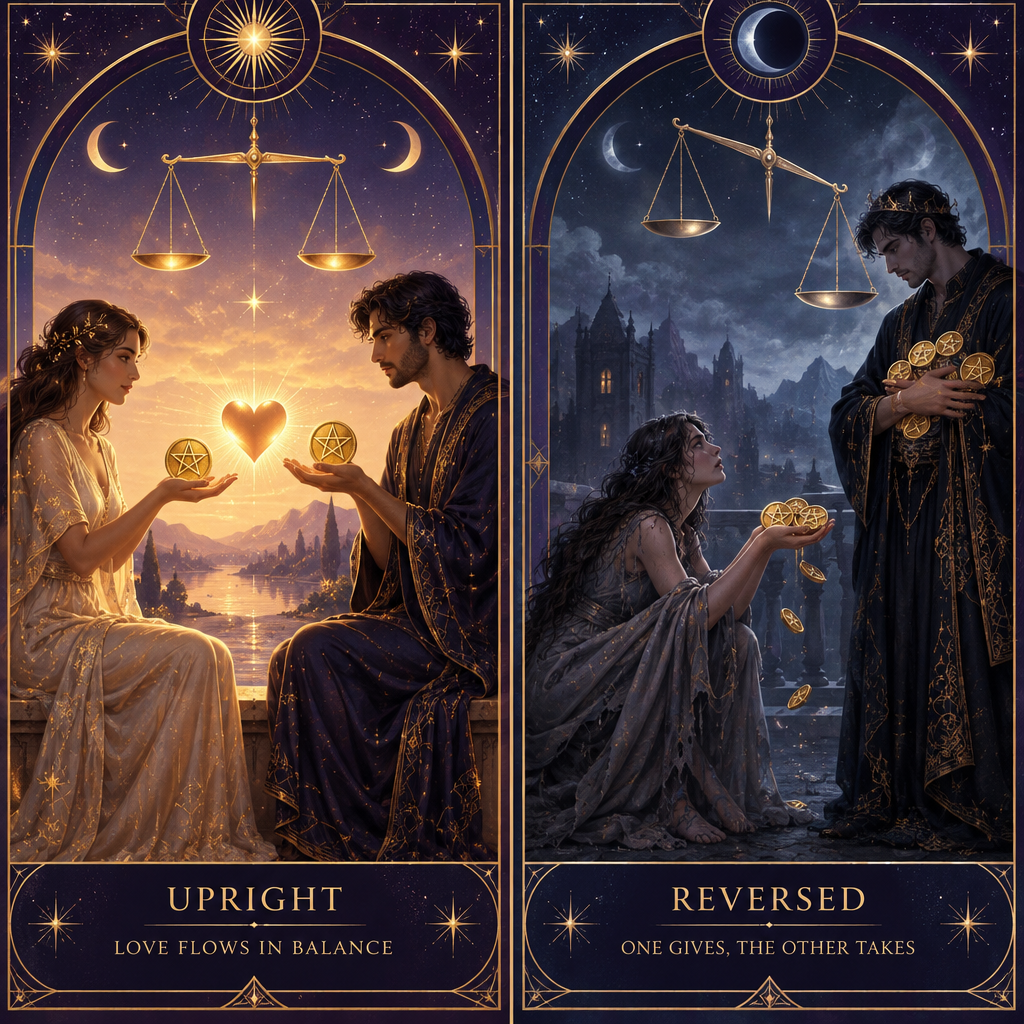
The Six of Pentacles as a love outcome points to how giving and receiving will balance out between you and another person. Upright, it predicts a relationship where support flows both ways and nobody keeps score. Reversed, it warns that one of you will end up doing the giving while the other does the taking, often with money or control tangled into the dynamic.
What the Card Shows and Why It Matters for Love
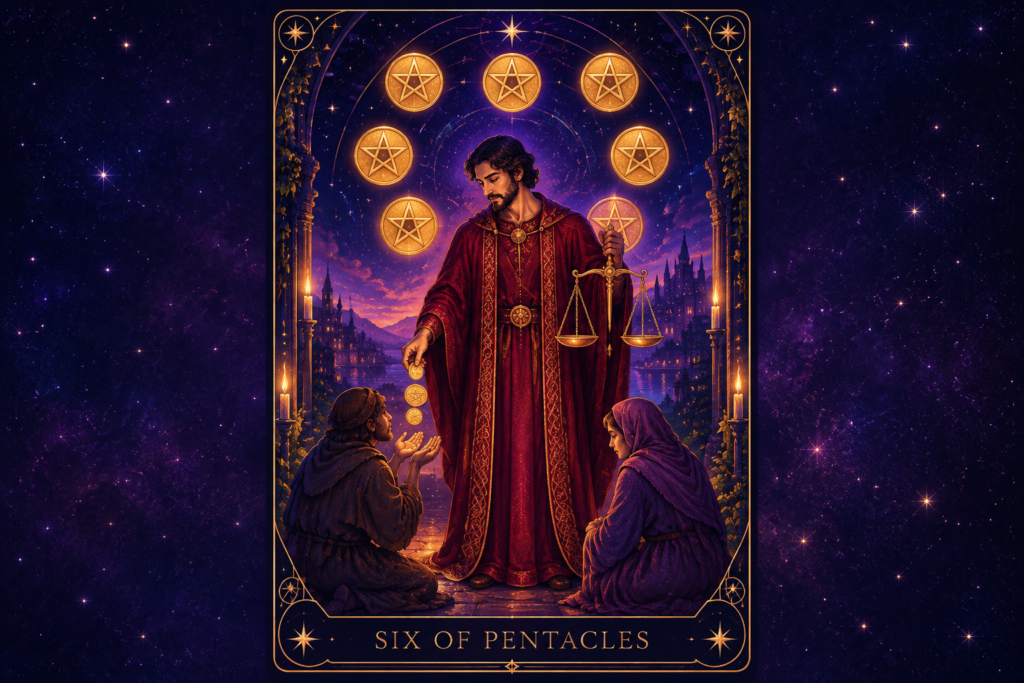
In the Rider-Waite-Smith deck, a merchant in a rich red robe stands between two kneeling beggars. He holds a set of scales in his left hand and drops coins into the open palm of one beggar with his right. Six pentacles hang in the sky above them. Pamela Colman Smith drew the scene so your eye goes straight to the scales, and that is the detail to hold onto in a love reading.
Each element carries a specific message for relationships:
- The scales stand for fairness. In a love outcome, they ask whether effort, affection and resources are actually being weighed, or whether one person is simply assumed to be the one who gives.
- The coins are generosity made visible. Money is the literal reading, but in romance they represent time, attention, emotional availability and practical help.
- The two beggars represent the vulnerability of receiving. Accepting help, comfort or love from a partner takes a kind of openness that many people find harder than giving.
- The wealthy figure holds the power. He decides who gets what. That is the quiet tension inside this card: generosity is wonderful, but the person who controls the flow controls the relationship.
Upright, the scales are level and the giving is clean. Reversed, picture the merchant tipping the scales or closing his hand. The same cast of characters, a very different outcome.
Keywords at a Glance
Upright: Generosity, Balance, Reciprocity, Support, Fairness, Charity, Shared Resources, Gratitude, Mutual Care
Reversed: Imbalance, Selfishness, Inequity, Dependency, Greed, Conditional Love, Financial Control, Debt, Resentment, Strings Attached
Astrological and Elemental Associations
The Golden Dawn system assigns the Six of Pentacles to the Moon in Taurus, the second decan of Taurus, which runs from roughly May 1 to May 10. The Moon governs emotional needs and nurturing; Taurus governs money, comfort and the physical world. Put together you get a card about meeting emotional needs through tangible means: a partner who shows up with soup when you are sick, who covers rent during a bad month, who remembers how you take your coffee.
The suit of Pentacles belongs to the element of Earth. Earth cards in love readings describe what a relationship is actually made of in daily life rather than how it feels in theory. Compare it to the Six of Cups, which describes nostalgia and emotional sweetness, or the Six of Wands, which describes recognition and triumph. The Six of Pentacles is more grounded than either. It is about whether the practical architecture of a relationship holds two people up equally.
Six of Pentacles Upright as a Love Outcome
Upright, the outcome is a partnership where both people contribute and both people are allowed to need things. Nobody is permanently cast as the strong one. When one of you is depleted, the other steps in, and the roles swap without drama when circumstances change.
Material stability is part of this picture, and it deserves to be said plainly. The upright Six of Pentacles often shows up when a couple handles money well together: open conversations about income, no secret spending, a willingness to share when one earns more. A 2024 reading for a client who had just moved in with a partner earning twice her salary produced this card, and the honest interpretation was not “romance” but “he will not make you feel small about the difference.” That turned out to be exactly the point.
The card also carries a thread of gratitude. The relationship works because both people notice and acknowledge what the other brings, whether that is a paycheck, a listening ear or the labour of keeping a household running.
Potential Relationships (Upright)
If you are asking about someone you have not yet dated, the upright Six of Pentacles says this person has something to offer and is willing to offer it. Expect practical kindness early: they pay for the first dinner without making a performance of it, they send a message to check you got home, they remember something you mentioned in passing.
The deeper signal is that this connection will not be lopsided. You will not have to chase. The potential partner is secure enough in themselves to give freely, and open enough to let you give back.
Watch for one thing. The card describes a giver, and givers can attract people who want to be rescued. Make sure you are drawn to the person rather than to the comfort they provide.
Reflection prompts:
– What has this person actually done for you so far, versus what have they said?
– Are you attracted to them, or to feeling taken care of?
– Have you let them see a need of yours, and how did they respond?
New Relationships (Upright)
In the first months of dating, the upright card predicts a steady, even-handed pace. Both of you initiate plans. Both of you pay sometimes. Neither of you is tracking who texted last. This is not the dizzying intensity of the Knight of Cups or the fireworks of the Lovers; it is the quieter satisfaction of realising that this person is dependable.
Money often becomes a real conversation around this stage, and the Six of Pentacles says it will go well. If one of you is a student and the other has a salary, the card suggests the imbalance will be handled with grace rather than turned into leverage.
Give the relationship room to be mutual. If you are naturally the caretaker, resist the urge to take over. Let them cook for you. Let them drive.
Reflection prompts:
– When they offered help recently, did you accept it or deflect?
– Do your plans together reflect both your budgets and both your preferences?
– Has either of you started quietly keeping a tally?
Existing Relationships (Upright)
For a committed couple, this is one of the healthier outcome cards in the deck. It predicts that the relationship will continue to function as a genuine partnership through whatever comes next: a career change, a new baby, a sick parent, a redundancy. The person with more capacity in that season will carry more, and the other will do the same when roles reverse.
It can also indicate a specific act of generosity ahead. One partner supports the other through retraining, or the couple decides to pool finances properly for the first time, or one of you forgives a debt or an old grievance that has been sitting unspoken. The card says the gesture lands well and strengthens the bond.
If you have been feeling like you are doing all the work, the upright Six of Pentacles is encouraging. It suggests your partner is capable of stepping up once you name the need clearly. The scales can be rebalanced here without a crisis.
Reflection prompts:
– What is each of you carrying right now, and does your partner know the weight of it?
– When did you last thank your partner for something routine?
– Is there money, time or forgiveness you have been withholding that you could release?
Single and Asking What to Expect (Upright)
If you are single and pulled this as an outcome, the partner heading your way is a provider in the full sense. Not necessarily rich, but reliable, warm and unafraid of commitment. Think of someone who notices your car needs new tyres and just handles it, or who turns up to your family’s Sunday lunch and washes the dishes without being asked.
The card can also be a nudge about your own role. Are you ready to receive? People who have been single for a long time, especially those who have built fierce independence after a bad relationship, often struggle with the beggar’s position in this card. Letting someone help you is a skill, and the Six of Pentacles says you will need it.
Reflection prompts:
– When someone offers help, is your first instinct to say “I’m fine”?
– What would you want a partner to provide, honestly, beyond affection?
– Have you been giving to friends and family in ways that leave nothing for yourself?
Reconciliation and an Ex Returning (Upright)
For questions about an ex, the upright card is cautiously positive. It suggests that if the two of you reconnect, the old imbalance that caused problems can be corrected. The person who used to take may be ready to give. Sometimes this manifests literally: an ex paying back money they owed you, returning possessions, or making amends for a debt they ignored during the breakup.
A key sign that the card is truly upright in this context: the ex makes the first real gesture, and it costs them something. An apology that comes with changed behaviour counts. A late-night text that costs nothing does not.
Reflection prompts:
– What specifically was unequal in the relationship before, and has anything changed?
– Is your ex offering something concrete, or just offering to be back?
– Would you be the giver again if you reconciled, and is that acceptable to you?
Six of Pentacles Reversed as a Love Outcome
Reversed, the scales tip. The outcome is a relationship where one person gives and the other takes, and both of them know it even if neither says it. The merchant’s generosity turns into a tool: affection that must be earned, money that comes with conditions, help that gets mentioned later in arguments.
This is also a card of dependency. One partner may become reliant on the other financially, emotionally or practically, and the imbalance becomes the structure of the relationship rather than a temporary phase. The dependent person loses confidence. The providing person loses respect. Resentment grows on both sides.
Four specific patterns show up again and again when this card falls reversed in love readings.
Financial Control
Money becomes a leash. One partner controls the accounts, questions every purchase, or earns more and makes sure the other never forgets it. The person with less money finds themselves asking permission for things they used to decide alone. This can be subtle: a partner who insists on paying for everything but then expects you to be available whenever they want. Generosity that removes your freedom is not generosity.
Love-Bombing
In the early stages, reversed Six of Pentacles can describe a flood of gifts, grand gestures and declarations that feel wonderful and arrive far too fast. The giver is not building a relationship; they are building an obligation. Once you are hooked, the flow stops or becomes conditional. If someone you have known for three weeks has already paid for a holiday and talked about moving in, this card is asking you to slow down and notice what they expect in return.
Conditional Giving
“After everything I’ve done for you” is the sentence this card dreads. Support that is tracked, mentioned and eventually invoiced in emotional terms is not support. A partner who helps you through a hard time and then expects you to tolerate their behaviour indefinitely as repayment has turned a gift into a debt.
One-Sided Emotional Labour and Giver Burnout
The quieter version of the reversed card is the partner who does everything. They remember birthdays, manage the household, absorb their partner’s moods and handle every difficult conversation. The other partner simply lets them. The giver eventually burns out, and when they finally stop, the taker is baffled, because they never saw the labour in the first place. If you recognise yourself as the giver here, the card is telling you the exhaustion will not resolve on its own.
Potential Relationships (Reversed)
Someone you are interested in may already be showing signs of taking without giving. They let you plan, pay and initiate. Or the opposite: they overwhelm you with attention that feels like a down payment. Either way, the card says this connection is unlikely to settle into something balanced.
It can also describe your own position. If you are drawn to someone because you want to fix them, fund them or rescue them, the reversed Six of Pentacles says you are walking into the merchant’s role, and you will not be thanked for it.
Reflection prompts:
– Who has initiated the last five interactions?
– Are you attracted to this person, or to the idea of saving them?
– Does their generosity make you feel free or indebted?
New Relationships (Reversed)
A few months in, the reversed card predicts the first real imbalance becoming visible. One of you is always the one who travels to see the other. One of you covers every bill. One of you listens for hours and never gets asked how your week went. This often coincides with a money conversation going badly: a partner reacting defensively to splitting costs, or hinting that you should contribute more without ever asking directly.
The relationship can survive this if the imbalance is named now. If it is tolerated to avoid conflict, it becomes the template.
Reflection prompts:
– Has a conversation about money or effort left you feeling guilty for raising it?
– What have you given in the last month that was never acknowledged?
– Would you be comfortable if the current ratio stayed exactly the same for five years?
Existing Relationships (Reversed)
In a long-term partnership, the reversed Six of Pentacles describes a dynamic that has calcified. One partner has become the permanent provider and the other the permanent recipient, and the roles no longer flex. The provider feels used. The recipient feels controlled or diminished. Sex and warmth often decline because it is hard to desire someone you resent, and hard to feel attractive when you feel like a dependant.
The financial dimension is frequently literal here. Separate accounts with one partner secretly in debt. A stay-at-home parent given an “allowance” and made to justify it. A high earner who uses income as the final word in every decision. The card does not say the relationship is over, but it does say the current arrangement is unsustainable.
Reflection prompts:
– If you stopped giving tomorrow, what would collapse, and would your partner notice why?
– Who makes the financial decisions, and does the other person feel they can object?
– When did resentment last come out sideways as sarcasm or withdrawal?
Reconciliation and an Ex (Reversed)
Reversed, the card is a clear caution about getting back together. The imbalance that ended things has not been addressed. If your ex is reaching out, look closely at the timing: do they need somewhere to live, money, or a comfortable fallback after another relationship failed? The reversed Six of Pentacles often appears when an ex returns because they want to be given to again, not because they are ready to give.
If you were the taker in that relationship, the card asks whether you have changed anything, or whether you are simply missing the support.
Reflection prompts:
– What does your ex stand to gain practically from reconciling?
– Did either of you address the imbalance after the split, or just the loneliness?
– If you got back together, who would be carrying whom?
Crush or Unrequited Interest (Reversed)
For a crush, the reversed card is blunt: the attention is flowing one direction. You are giving thought, energy and hope to someone who is giving back little or nothing. They may enjoy your attention without any intention of returning it. The card asks you to redirect the generosity to yourself before it turns into quiet humiliation.
Reflection prompts:
– What have they done, unprompted, to show interest?
– How much mental space does this person occupy compared to the space you occupy in their life?
– What would you do with that energy if you stopped spending it here?
An Attachment Style Lens
Many readers now interpret this card through attachment theory, and it fits unusually well. Upright, the Six of Pentacles describes secure attachment: two people comfortable both offering and accepting support, without panic or withdrawal. Giving does not feel like losing, and receiving does not feel like weakness.
Reversed, it tends to describe an anxious-avoidant or fearful-avoidant pairing. The anxious partner over-gives to earn closeness. The avoidant partner accepts the care but keeps control by never fully reciprocating. Each reinforces the other’s wound. If this pattern sounds familiar, the card suggests the fix is not giving harder but giving less and watching what the other person does with the space.
Love languages are another useful filter. A partner whose language is acts of service or gifts may be giving sincerely in a way you do not register, and vice versa. Upright, the couple learns to translate. Reversed, each insists the other is not giving at all.
Is the Six of Pentacles a Yes or No for Love?
Upright: yes. The relationship has a fair foundation and both people are willing to contribute. It is not a passionate or dramatic yes, but it is a reliable one.
Reversed: no, or not in its current form. The card is not predicting cruelty, but it is predicting imbalance, and imbalance erodes love over time. If you are asking whether to pursue someone, the reversed card says wait until you see them give without being prompted.
Upright vs Reversed Comparison
| Dimension | Upright | Reversed |
|---|---|---|
| Emotional balance | Both partners can need and be needed; roles flex | One fixed giver, one fixed taker; roles harden |
| Relationship health | Stable, grateful, low resentment | Resentment, dependency, quiet contempt |
| Communication | Needs are stated and met; gratitude expressed | Help is tracked and weaponised; needs go unspoken |
| Financial dynamic | Open accounts, shared decisions, income gap handled gracefully | Money as control, secret debt, allowance dynamics |
| Early dating signs | Steady, reciprocal, practical kindness | Love-bombing or chronic one-sided effort |
| Reconciliation outlook | Possible if the past imbalance is addressed | Ex returns for support, not partnership |
| Attachment pattern | Secure | Anxious-avoidant cycle |
How to Restore Balance if the Card Is Reversed
- Audit the last month honestly. Write down what each of you gave: money, time, emotional support, household labour. Most people are surprised by the gap in one direction or the other.
- Stop over-functioning for two weeks. Do not announce it. Simply stop filling every gap and observe whether your partner steps in or whether things fall apart.
- Have the money conversation directly. Not “we should talk about finances someday” but a specific proposal: shared account for joint costs, proportional contribution based on income, full transparency on debt.
- Name the conditional pattern. If support is being brought up in arguments, say so: “When you mention what you paid for, it makes the help feel like a debt.”
- Decide what you will not accept. The Six of Pentacles reversed can right itself, but only if the giver is willing to stop giving when the taking continues.
FAQ
Is the Six of Pentacles a yes or no for love?
Upright, yes. It points to a relationship built on fairness and mutual support. Reversed, treat it as a no for now, because the connection is lopsided and will stay that way unless something changes.
What does the Six of Pentacles reversed mean for an ex?
It suggests the ex is returning for what you provided rather than for you. The original imbalance has not been fixed. Be especially careful if they need housing, money or emotional rescue at the moment they reach out.
Does the Six of Pentacles mean marriage?
Not directly. Cards like the Four of Wands, the Ten of Cups or the Hierophant point more clearly to marriage. The Six of Pentacles describes the quality of the partnership rather than the ceremony: a marriage with this card upright would be one of shared resources and mutual care, which is a solid foundation even if the card itself does not predict the wedding.
What does the Six of Pentacles mean for someone single?
Upright, expect a generous, dependable partner who is comfortable with commitment and practical support. It also asks whether you are able to receive help rather than only give it. Reversed, it warns against attracting or becoming a rescuer.
How is the Six of Pentacles different from the Five of Pentacles in love?
The Five of Pentacles shows two figures left out in the cold with no help coming. The Six shows help arriving. In a love reading, the Five describes loneliness and scarcity within or after a relationship, while the Six describes support, either balanced (upright) or controlling (reversed). Pulling the Six after the Five often signals that a hard period is ending.
Does the Six of Pentacles always involve money?
No, though it often does. Pentacles are an Earth suit, so money is the most literal reading. In love, the card more broadly covers anything that can be given and received: time, attention, emotional labour, practical help. Money is simply the easiest place to see whether the scales are level.