
Drawn as a love outcome, the Seven of Pentacles tells you that the relationship is in an evaluation phase: real effort has gone in, the results are not fully visible yet, and someone is pausing to decide whether the return justifies the investment. Upright, that pause ends in continued commitment. Reversed, it ends in frustration, imbalance, or walking away.
Interpretations follow the Rider-Waite-Smith tradition and Arthur Edward Waite’s descriptions in The Pictorial Key to the Tarot (1910).
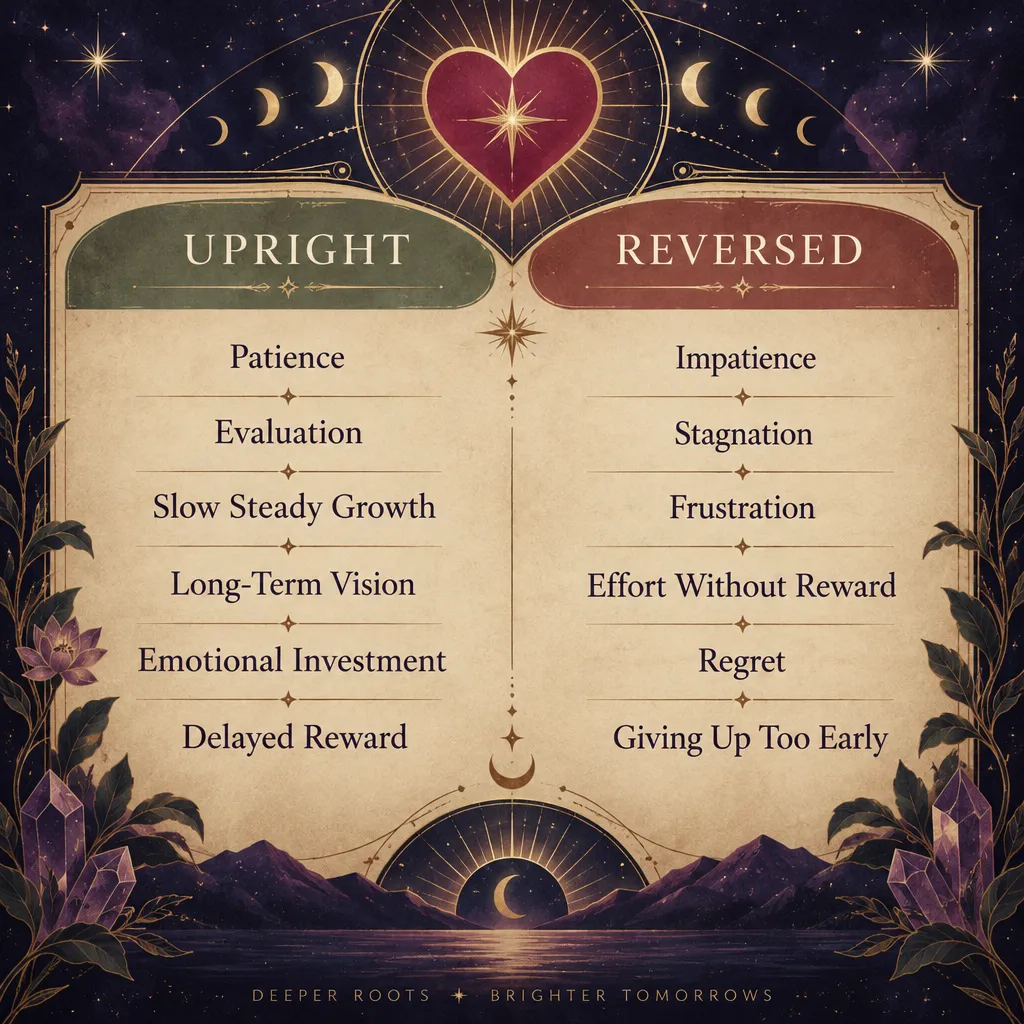
Quick Reference: Upright vs. Reversed Keywords
| Upright | Reversed |
|---|---|
| Patience | Impatience |
| Evaluation and assessment | Stagnation |
| Slow, steady growth | Frustration |
| Long-term vision | Effort without reward |
| Emotional investment | Regret over wasted time |
| Delayed but likely reward | Giving up too early, or holding on too long |
| Taking stock before committing | Rushing compatibility |
The Imagery, Read as a Love Metaphor
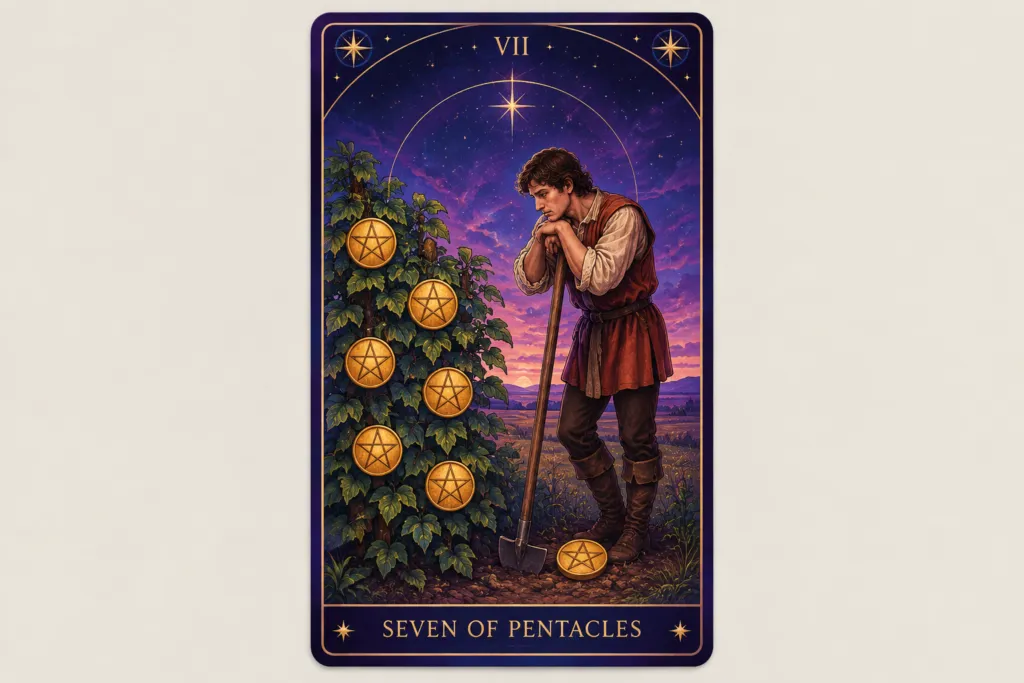
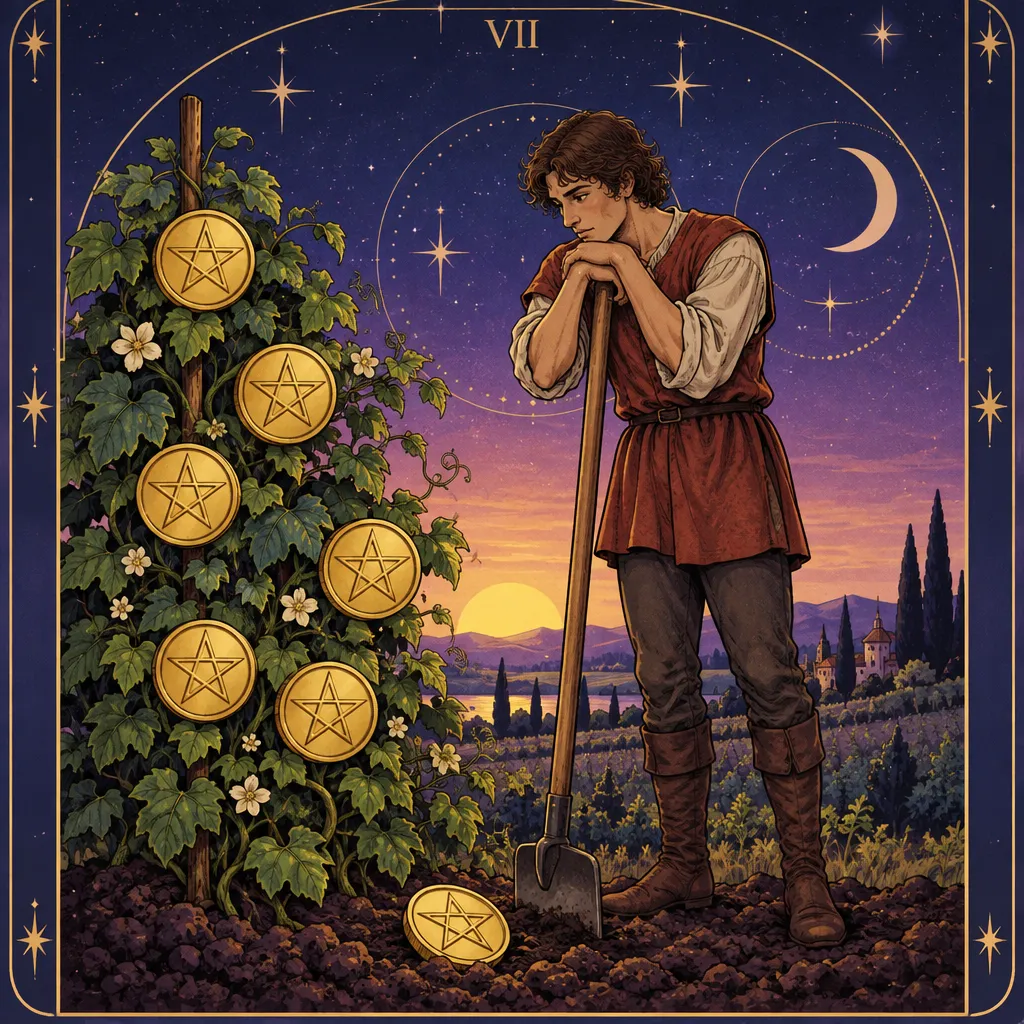
In Pamela Colman Smith’s 1909 illustration, a young farmer leans on a hoe and stares at a leafy vine heavy with pentacles. Six coins hang on the plant; the seventh sits on the ground by his boots. Waite wrote that “one would say that these were his treasures and that his heart was there.” Nothing in the picture is happening. That is the point.
The farmer leaning on his tool. He is not working and he is not resting. He is appraising. In a love reading, this is the partner who has stopped to ask whether the relationship is becoming what they hoped. His posture is tired but not defeated.
The vine. Relationships grow the way plants grow: unevenly, invisibly for long stretches, then all at once. The vine says the connection is alive and rooted. It does not say it is finished.
The six pentacles on the plant and the one on the ground. Most of the value is still attached, still maturing. One piece has already dropped and can be picked up now. Translated: there are early rewards in this relationship, but the bulk of what you want from it is not ready to harvest.
The clear sky and flat horizon. No storm, no drama. The problem here is never conflict. It is waiting, and the doubt that creeps in while you wait.
Where the Card Sits: Suit, Element, Astrology
The Seven of Pentacles belongs to the Minor Arcana, the 56 numbered and court cards that describe everyday circumstances rather than the big life chapters of the Major Arcana. Pentacles are the Earth suit, tied to the zodiac signs Taurus, Virgo, and Capricorn. Earth cards in a love reading talk about the practical body of a relationship: time spent, reliability, shared routines, money, physical presence.
The Golden Dawn system assigns this card to Saturn in Taurus and titles it “Success Unfulfilled.” Saturn is the planet of delay, tests, and structures that hold only if they were built properly. Taurus wants comfort, loyalty, and tangible proof. Put them together and you get the exact mood of this card in love: a slow-moving, security-minded partner being tested on their patience.
Sevens across all four suits mark a check-in point. The Seven of Cups weighs fantasies, the Seven of Swords weighs honesty, the Seven of Wands defends a position. The Seven of Pentacles weighs whether the work is worth it.
Seven of Pentacles Upright as a Love Outcome
Upright, the overall verdict is positive but conditional. The relationship will continue to grow if both people keep tending it, and the reward arrives later than you want. This is not a card of passion or sudden proposals. It is the card of the couple who moves in after three years rather than three months and is still together at ten.
Upright: New Relationship
You have been seeing someone for a few weeks or months and things are pleasant but not accelerating. The Seven of Pentacles says that pace is correct. One or both of you is quietly measuring compatibility: do the weekday evenings feel as good as the weekend dates, does this person follow through, do your lives actually fit together. The outcome is a relationship that keeps building, provided neither of you panics about the lack of fireworks.
What to do:
- Stop checking for milestones and start noticing consistency. Did they text when they said they would? Did they show up on time? That is what this card values.
- Give it one more season before you demand a label. Earth cards operate on months, not weeks.
- Invest in shared routines, not grand gestures. A standing Thursday dinner builds more here than a surprise weekend away.
Upright: Existing or Long-Term Relationship
For established couples, the card describes a plateau that feels uncertain from the inside and looks healthy from the outside. The honeymoon chemistry has become something steadier, and one of you is wondering if “steady” is enough. The outcome: yes, the relationship holds, and the next stage (a home, a child, a shared business, a deeper intimacy) comes to those who keep working at it. The vine is bearing fruit even if you are too close to see it.
What to do:
- Have an honest check-in conversation. Not a crisis talk, a stocktaking one. “Where do we want to be in two years, and are we on track?”
- Name one thing you have each stopped doing since the early days and reinstate it.
- Audit the practical layer: finances, chores, time together. Earth cards point to problems in logistics far more often than problems in love.
Upright: Single or Hoping for a Potential Relationship
If you are single, this card is less about a specific person and more about your own groundwork. It says the effort you are putting into yourself, your social life, or a slow-burn connection with someone you already know will pay off, just not on your preferred schedule. If you have a particular person in mind, they are interested but evaluating, and they will not be hurried.
What to do:
- Keep planting. Stay on the apps, keep saying yes to the dinner party, keep the friendship with the person you quietly like.
- Drop the deadline. A partner “by my birthday” is the kind of thinking this card resists.
- Look at what you have already harvested. The pentacle on the ground is often an existing connection you have undervalued.
Upright: Reconciliation or an Ex Returning
This is where readers most often hope for a dramatic answer and get a measured one. Upright, the Seven of Pentacles says reconciliation is possible and will be slow. Your ex is weighing it. They are looking back at what the two of you built and asking whether it can be salvaged and whether the problems that ended it have actually changed. If they return, they return cautiously, and the rebuilt relationship will need to be grown from the roots, not resumed where it left off.
Does it mean they will come back? It means the door is not closed and someone is standing in it thinking. It does not promise a knock.
What to do:
- Do the work on your side of the break-up whether or not they return. That is the only investment you control.
- If contact resumes, let it stay low-stakes for longer than feels natural. Coffee, not a weekend.
- Set your own limit on how long you are willing to wait in the field. The farmer is patient, not infinitely so.
Seven of Pentacles Reversed as a Love Outcome
Reversed, the pause becomes a problem. The effort has stopped paying out, or it was never balanced, or one person has quietly decided it is not worth continuing. Older texts give the reversed card a flavour of anxiety about something lent and not returned; in love, that becomes the sense that you gave more than you got.
Two distinct situations hide inside this card. Keep them separate when you read it.
Reversed Scenario One: Stagnation and Imbalanced Effort
The relationship is still alive but has stopped growing because one person is doing the tending while the other leans on the hoe. The one investing feels unseen and tired. The one coasting may not even realise it. Nothing dramatic is wrong, which is exactly why it goes unaddressed for years.
Reversed Scenario Two: Questioning Whether to Continue
Here the evaluation has already happened, privately, and the answer was “probably not.” Someone is staying out of sunk cost, habit, or fear of starting over. The outcome tilts towards an ending unless the relationship changes fast and materially.
Reversed: New Relationship
Early-stage reversed, the warning is about rushing compatibility. You have skipped the evaluation phase entirely: moved in after six weeks, merged finances, told the family. Alternatively, you are pushing for commitment from someone who has not finished assessing. The outcome is a relationship that either stalls under the weight of premature expectations or ends when the mismatch surfaces.
What to do:
- Slow down one notch. If you were about to move in, keep separate places another six months.
- Ask the unglamorous questions now: debt, kids, where you each want to live, how you fight.
- If you feel impatient, ask what the hurry is protecting you from. Rushing often masks a fear the connection will not survive scrutiny.
Reversed: Existing Relationship
For established couples the reversed card is a mutual effort audit that one partner is failing. Resentment is building in the person doing more. Sex, conversation, and plans have gone flat. This is one of the clearest couples-therapy signals in the deck: the problem is structural and repetitive, not a single fight, and it will not fix itself.
What to do:
- Say the imbalance out loud, with specifics. “I plan every weekend and arrange every visit to your parents” lands; “you never make an effort” does not.
- Book a counsellor if the same conversation has happened three times without change.
- Set a review point. Agree what “better” looks like and when you will check whether you got there. Earth cards respond to measurable terms.
Reversed: Separation or Divorce
If you are already separating, the reversed Seven of Pentacles is the card of effort that did not yield. You tried; it did not grow; and the outcome is walking away from the field. Regret is part of this reading, usually regret over time rather than over the decision itself. The card does not call the choice wrong. It calls the investment finished.
What to do:
- Resist the urge to recount everything you put in. That ledger only keeps you standing in the field.
- Harvest what did grow: skills, boundaries, a clearer sense of what you need. The pentacle on the ground still counts.
- If reconciliation is being floated during separation, the reversed card says no for now. Revisit only if the thing that failed has visibly changed.
Seven of Pentacles as Feelings: How Do They Feel About You?
Readers frequently pull this card asking how a specific person feels, not what will happen. Upright, the person feels invested and is assessing. They see you as something they have put real time into and want to see mature. They are not swept away, and they are not indifferent. They are cautious, serious, and quietly hopeful, the way someone looks at a house they have been renovating for a year. If you want to know whether they are “sure,” the honest answer is that they are deciding, and leaning towards yes.
Reversed as feelings, the person feels drained or doubtful. Either they believe they have given more than they received, or they have looked at the relationship’s progress and found it lacking. They may feel guilty for staying or tired of trying. Impatience is common here too: a partner who wants results faster than you are giving them.
A useful tell in both positions: this card almost never describes casual feelings. People who feel nothing for you do not stand around assessing the vine.
Is the Seven of Pentacles a Yes or No Card in Love?
Maybe. It is one of the most honest “maybe” cards in the deck, because its entire image is a person who has not finished deciding.
Upright, the maybe leans towards yes, with a condition: yes, if you are willing to wait and keep working. Reversed, it leans towards no, or towards “not like this.” If you need a clean binary, redraw with a clarifying card and treat the Seven as the context: whatever the second card says, it will take time and effort to get there.
Card Combinations in Love Readings
Pairings sharpen the outcome considerably. These are the combinations that come up most often alongside the Seven of Pentacles in relationship spreads.
- With the Two of Cups: The slow build pays off in a genuine, mutual partnership. The evaluation ends in a clear yes; expect commitment to follow within the year.
- With The Lovers: A values-based decision is being made. Someone is choosing this relationship deliberately after weighing an alternative, and the choice is considered rather than impulsive.
- With Justice: Fairness is the question. In a healthy relationship this points to a balanced arrangement being formalised, often legally. In a struggling one, it is a reckoning over who gave what.
- With Judgement: A past relationship or old pattern is being re-evaluated. Strong signal for reconciliation after reflection, or for finally releasing an ex you have been quietly tending.
- With the Six of Pentacles: Watch the give-and-take. Upright together, both partners contribute and the imbalance corrects. With either card reversed, one person is the perpetual giver.
- With the Eight of Pentacles: The pause ends and the work resumes. This is the couple who decides to put the effort in: therapy, date nights, a shared project. Very favourable for long-term outcomes.
- With the Three of Swords: The assessment uncovers something painful. The relationship may survive, but only after an honest conversation about hurt.
- With the Ten of Pentacles: Patience is rewarded with lasting stability: marriage, a home, family. One of the best pairings this card can have.
Reading the Card Well: Three Mistakes to Avoid
Reading it as “nothing is happening.” Growth is happening below the surface. The card asks you to trust the process, not to conclude the process has stopped.
Treating the pause as rejection. Especially in “how do they feel” questions, a person who is evaluating is engaged. Disengaged people do not weigh things.
Ignoring the practical layer. This is an Earth card. When it shows up in love, look at time, money, logistics, and physical presence before you look at feelings. The relationship problem the Seven of Pentacles describes is usually fixable with a calendar and a frank conversation, not a grand emotional breakthrough.
FAQ
What does the Seven of Pentacles mean in love?
It means the relationship is in an evaluation phase. Effort has been invested, the full reward is not yet visible, and at least one partner is pausing to judge whether to keep going. Upright, that judgement favours continuing with patience. Reversed, it points to stagnation, unequal effort, or a decision to walk away.
Is the Seven of Pentacles a yes or no card?
It is a maybe. Upright it leans towards a conditional yes that depends on patience and continued effort. Reversed it leans towards no, or towards “not on the current terms.” The card’s image is literally a person who has not yet decided.
What does the reversed Seven of Pentacles mean for relationships?
Two things, which should be read separately. Either the relationship has stagnated because one partner carries most of the effort, or one partner has privately concluded the relationship is not worth continuing and is staying out of habit or sunk cost. The first calls for an honest conversation and often couples counselling. The second usually precedes an ending.
Does the Seven of Pentacles mean someone will come back?
It means they are thinking about it. Upright, your ex is weighing what you built together and whether the problems have changed; reconciliation is possible but slow and cautious. Reversed, they have weighed it and the effort does not seem worth it to them, at least for now.
How does someone feel about you if the Seven of Pentacles appears?
Upright, they feel invested, serious, and cautiously hopeful, but they are still assessing where this is going. Reversed, they feel drained, doubtful, or impatient, often because they believe they have put in more than they got back.
What zodiac sign is the Seven of Pentacles?
It belongs to the Earth suit, associated with Taurus, Virgo, and Capricorn. In the Golden Dawn decan system it is specifically Saturn in Taurus, which explains its mix of loyalty, slowness, and testing.
Add Yes No Tarot as a preferred source on Google, and the sites you pick are more likely to appear in your Top Stories.