Seven Of Cups As Love Outcome (Upright & Reversed) Tarot Card Meaning
The Seven of Cups as a love outcome tells you the ending is not settled yet, because someone in the story is still choosing between pictures rather than people. It is one of the few outcome cards that describes a state of mind more than an event, which is exactly why it frustrates readers who want a clean answer. Here is how to read it for your specific situation, upright and reversed, plus what to do about it.
The short version
Upright, the Seven of Cups as an outcome means the relationship stays in the realm of possibility, fantasy or indecision. Nothing collapses, but nothing lands either. Reversed, it splits two ways: either the fog clears and a real decision gets made, or the indecision hardens into paralysis and disillusionment. Which reversed reading applies depends on the cards around it and on how honest you are being about the situation.
As a yes-or-no card for love, it is a maybe leaning toward “not yet, and not like this.”
The Rider-Waite-Smith image, cup by cup
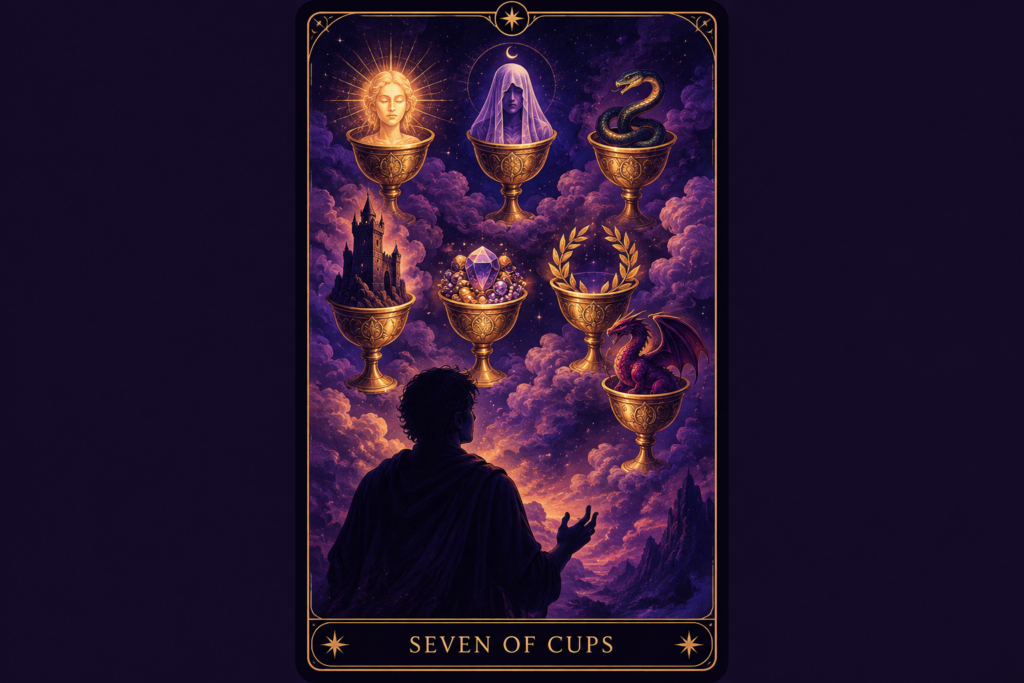
Pamela Colman Smith’s 1909 illustration for the Rider-Waite-Smith deck shows a dark, silhouetted figure with its back to us, facing seven cups that float on a bank of cloud. The silhouette matters. We never see this person’s face, which is the card’s first statement about love: the querent (or their partner) is not fully present. They are a shape in front of a display, not a participant.
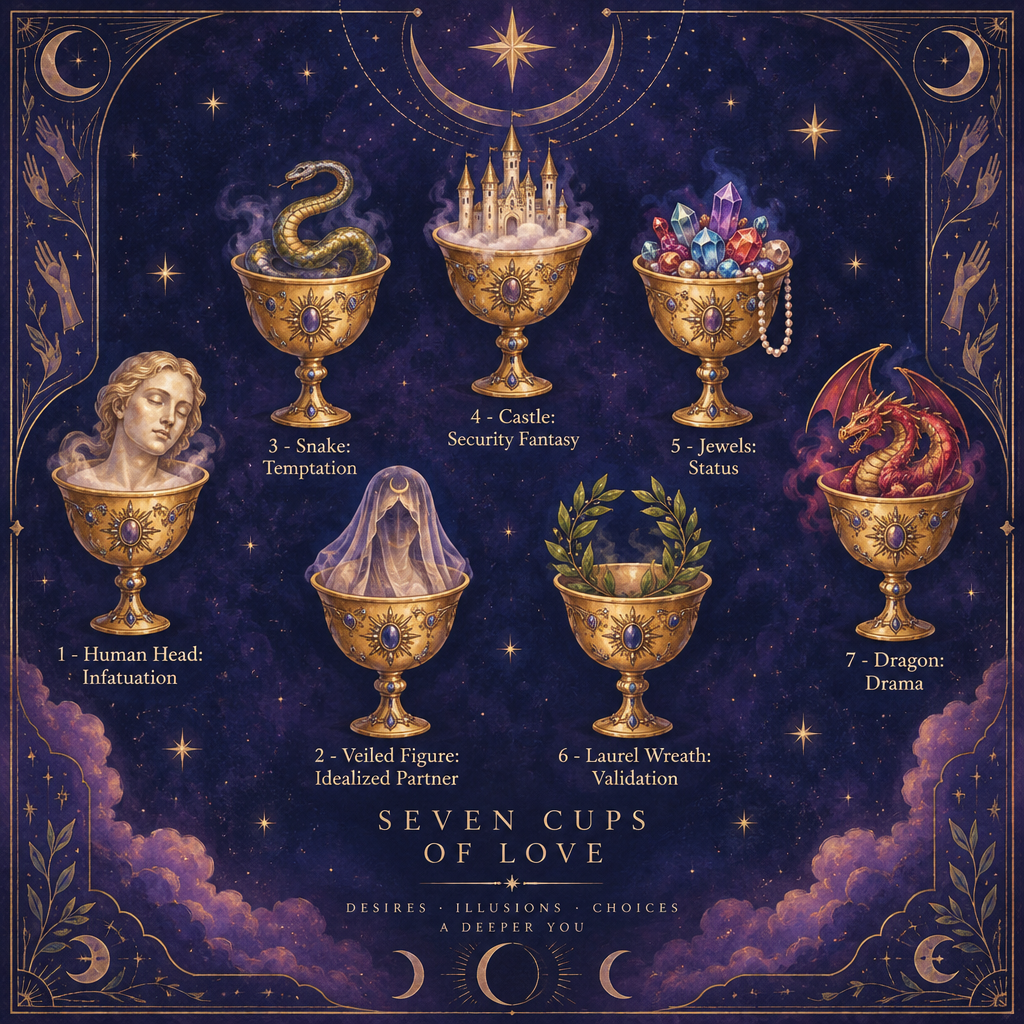
Each cup holds something different, and each one maps neatly onto a romantic temptation or trap.
| Cup | Contents | What it means in a love reading |
|---|---|---|
| 1 | A human head | Infatuation with a face or a type. Attraction to an image of a person rather than the person. |
| 2 | A glowing, shrouded figure | The idealised partner, the “one.” Nobody can be seen clearly through the veil, so nobody can disappoint you yet. |
| 3 | A snake | Sexual pull, temptation, and the quiet knowledge that this option could bite. Affairs and dangerous chemistry live here. |
| 4 | A castle or tower | Security, marriage, the house with the garden. Wanting the life a relationship promises more than the relationship itself. |
| 5 | Jewels | Status, money, the partner who looks good on paper or in photos. |
| 6 | A laurel wreath | Victory and validation. Wanting to “win” someone, or to be chosen, as proof of worth. Smith painted a faint skull on this cup, a reminder that winning is not the same as loving. |
| 7 | A dragon | Drama, intensity, the relationship that feels like a storyline. Thrilling, and exhausting to live inside. |
When the card comes up as an outcome, ask which cup your situation is sitting in. A reader stuck on an ex is usually staring at the shrouded figure. Someone bouncing between three dating-app matches is split between the head, the jewels and the snake. Someone who stays in a flat relationship for the mortgage is holding the castle.
Astrological and elemental background
The Golden Dawn system, which the Rider-Waite-Smith deck follows, assigns the Seven of Cups to Venus in Scorpio, the third decan of Scorpio. Its old title is “Lord of Illusionary Success.” Venus is love, pleasure and attraction. Scorpio is depth, secrecy, obsession and sex. Put together you get desire that runs deep and hides things, including from itself. That is the romantic signature of this card: wanting intensely, and not quite knowing what you want.
The suit of Cups belongs to the Water element, so everything here is emotional rather than practical. Water takes the shape of its container, and the Seven shows what happens when there is no container at all. Feelings spread across seven vessels instead of filling one. Compare this with the Two of Cups, where two people pour into a single shared bond, and the difference in outcome is obvious.
Seven of Cups upright as a love outcome
If you are single
The outcome is more browsing. You will have options, possibly a lot of them, and the card predicts that having options becomes the activity rather than the step toward a relationship. Expect a season of talking stages, promising first dates that fizzle, and a running mental comparison between people who each have one thing you like.
There is a second, quieter upright reading for singles: you are more attached to an imagined partner than to anyone available. If you have a detailed picture of “the one” and nobody real has come close in years, the Seven of Cups as your outcome is saying the picture is the problem.
If you are in a new relationship (under roughly six months)
The honeymoon is doing the talking. One or both of you is in love with the potential, and the outcome card says the relationship stays at the potential stage for now rather than deepening. Watch for a partner who talks about the future constantly but avoids concrete plans, or who keeps their options visibly open. Also watch yourself: are you dating this person, or the version of them you have filled in?
The card is not a death sentence for a new relationship. It is a warning that it has not yet been tested by anything real.
If you are in a long-term relationship
Here the Seven of Cups as an outcome usually points at one of three things.
- One partner is fantasising about alternatives. That can mean an emotional affair, a persistent “what if I had chosen differently,” or heavy daydreaming about a different life. It rarely means an active physical affair on its own; look for the Three of Swords, the Knight of Cups reversed or The Devil nearby for that.
- The couple keeps discussing big changes (moving, children, marriage, a business) without committing to any of them. The relationship is stuck in the planning stage.
- One of you has an idealised memory of how things used to be and measures the present against it. The Six of Cups sitting next to the Seven makes this reading much stronger.
In all three cases the outcome is stasis. The relationship will not end because of this card, but it will not move forward until someone chooses.
If you are asking about an ex or reconciliation
This is one of the clearest uses of the card. As a reconciliation outcome, the Seven of Cups says the reunion exists mainly in someone’s imagination. Either you are romanticising the past and editing out the reasons you broke up, or your ex is nostalgic and sends the occasional late-night message without any intention of doing the work.
A reconciliation that happens under this card tends to replay the old relationship with the same fantasy-versus-reality gap. If you want the honest version, pull a clarifier. The Eight of Cups says walk away; the Two of Cups or the Six of Cups says there is real feeling left to work with; the Five of Cups says grief is doing the choosing, not love.
If you are asking about a crush or a situationship
The outcome is that it stays undefined. A crush under the Seven of Cups is largely a projection; you have assembled a person out of a handful of interactions and a lot of imagination. The real person will not match the file you have built.
For a situationship, the card describes the other person’s position precisely: they like having you as one of several open possibilities. Keeping things vague costs them nothing and keeps the shrouded figure in play. Expect the status quo to continue unless you force a decision, and expect them to prefer the fantasy of you over the responsibility of a defined relationship if you do.
Seven of Cups reversed as a love outcome
Older love-tarot guides treat the reversed Seven of Cups as uniformly good news, a “reality check.” That is half the picture. Current practice recognises two distinct reversed readings, and you need the surrounding cards to tell them apart.
The clarity reading
The clouds part. Someone stops scrolling, closes the other tabs and picks. For singles this is the outcome where you delete the apps and commit to one person, or where you drop the fantasy spec and notice who is actually in front of you. For couples it is the moment the endless “should we” conversation ends with a decision. For reconciliation questions it means you see the ex as they were rather than as you remembered them, which usually ends the longing rather than rekindling it.
Cards that support the clarity reading: the Ace of Cups, the Two of Cups, the Four of Wands, Temperance, The Sun, The Star.
The disillusionment reading
The alternative is that the options collapse without a real choice having been made. This looks like:
- Confusion and paralysis: so afraid of choosing wrong that you choose nothing, and the people you were considering move on.
- Disillusionment: the fantasy breaks, and instead of seeing your partner clearly you see only what they are not. This is a common outcome for new relationships that started very hot.
- Rigidity: a checklist of partner requirements so specific that it functions as a wall. “No one meets my standards” as a permanent state.
- Lack of options: a period where the love life simply goes quiet and the field feels empty.
Cards that support the disillusionment reading: the Five of Cups, the Eight of Cups, the Four of Cups, the Five of Pentacles, The Moon, the Nine of Swords.
Without clarifiers, treat the reversed card as “a decision becomes unavoidable” and let the querent’s own honesty fill in whether that decision will be made from clarity or from exhaustion.
Seven of Cups as feelings: how someone feels about you
Pulled in a feelings position, the Seven of Cups is rarely the answer people hope for, and it is worth being plain about it.
Upright, the person is attracted to an idea of you. They may be genuinely drawn to your looks (the head), your lifestyle (the jewels), your stability (the castle) or the chemistry (the snake), but they have not integrated those into a feeling about you as a whole person. They also, very often, feel the same way about someone else. Daydreamy interest, yes. Settled affection, no. If you ask how an ex feels and get this card, they miss the fantasy version of the relationship, not necessarily you.
Reversed, their feelings have either resolved or soured. In the clarity direction, they have realised what they actually feel and it is probably more definite than before, in whichever direction. In the disillusionment direction, they have compared you to the image they held and are now disappointed, which says more about their image than about you.
A useful test when this card shows up for feelings: does this person know specific, unglamorous things about you and still want to be around you? If not, the Seven of Cups is accurate.
Is the Seven of Cups a yes or no card in love?
It is a maybe, and a soft no for questions that need commitment.
- “Will we get together?” Maybe. The desire exists, the decision does not.
- “Does this person love me?” Not yet in the grounded sense. Infatuation, possibly.
- “Will my ex come back?” Maybe in thought, unlikely in action.
- “Should I commit to this person?” Not until you can see them clearly. Ask again after a reality test.
- “Is this relationship a good idea?” The card declines to answer because the relationship has not become real enough to assess.
Reversed, it moves slightly toward yes if the clarity cards are present, and toward no if the disillusionment cards are.
The “wish card” trap
Some readers call the Seven of Cups a wish card because it shows everything the querent wants laid out on a platter. Technically, it can mean you get exactly what you asked for. The catch is in the Golden Dawn title: illusionary success. You get the castle and discover it is empty. You win the laurel and find the skull on the cup. The Nine of Cups is the genuine wish card, with the satisfied merchant and the cups actually in hand. The Seven is wanting with nothing in hand, and if something does arrive, it tends to be the version you imagined rather than one that holds up in daylight.
In love this is the person who finally lands the partner they fixated on, and within months realises they were in love with the chase.
The modern parallel: paradox of choice and dating apps
The card predates smartphones by a century and describes them precisely. Psychologist Barry Schwartz’s 2004 book The Paradox of Choice argued that beyond a certain point, more options make us less satisfied and less likely to decide at all. The study most often cited alongside it, by Sheena Iyengar and Mark Lepper, found that shoppers offered 24 jam flavours bought far less often than shoppers offered 6. Abundance produced browsing, not buying.
Dating apps are the Seven of Cups rendered as an interface: a row of faces (the head), profiles curated to show the best photos and the best trips (the jewels, the laurel), a constant sense that the next swipe could be the shrouded figure. Pew Research Center’s 2023 survey found about three in ten US adults have used a dating site or app, so for a large share of querents this card is describing their actual Tuesday night rather than a metaphor.
The comparison loop the card warns about has a modern form, too: continuing to swipe while in a new relationship, “just to see,” or benchmarking a real partner against the composite of everyone else’s highlight reel. When the Seven of Cups shows up as a love outcome for someone who is active on apps, the first practical question is whether the apps are still installed.
Reading it against neighbouring cards
The Cups sequence around the Seven clarifies what it is and is not.
- Six of Cups before it: nostalgia feeds the fantasy. In reconciliation readings this pairing almost always means you are in love with a memory.
- Eight of Cups after it: the choice gets made by leaving. Someone walks away from all seven cups rather than picking one. As a love outcome this pairing is a slow, deliberate ending.
- Five of Cups nearby: the fantasies are a way of not grieving. The querent is distracting themselves with possibilities to avoid a loss.
- Two of Cups nearby: a real bond exists underneath the daydreaming. Good sign, and it tells you which cup to pick.
- The Lovers: a genuine fork in the road with real stakes, as opposed to the Seven’s imaginary menu. Together they say the choice is real and the querent is avoiding it.
- The Moon: deception, including self-deception, is heavy. Verify everything the other person has told you.
- The Devil: the snake cup is in charge. Obsessive attraction that is hard to leave.
- The Star or Temperance: strong support for the clarity reading if the Seven is reversed.
What to do when this card is your love outcome
Upright
- Name the cup. Write down, honestly, which of the seven things you are actually chasing in this situation. Most people find it is not the person.
- Stop adding options. If you are single and swiping, pause for a set period, even two weeks, and give one connection a real chance to be boring. Boring is where information lives.
- Test the fantasy against evidence. For a new relationship or crush, list five concrete things you know about this person that you did not learn from their photos or your imagination. If you cannot, you are not far enough in to feel what you feel.
- In a long-term relationship, pick one of the hovering decisions and make it, even a small one. Movement breaks the stasis the card describes.
- For reconciliation, write the actual reasons you broke up before you reply to the next message.
Reversed
- If clarity has arrived, act on it quickly. The reversed Seven of Cups has a short window before the clouds roll back in.
- If you are paralysed, lower the stakes of the decision. You are not choosing a spouse, you are choosing who to have dinner with on Friday.
- Audit your requirements. Separate the three that genuinely protect you from the fifteen that protect you from ever being disappointed.
- If the fantasy has broken and left you disillusioned with a real partner, do not act for a month. Disillusionment is a swing of the pendulum, not the truth.
- If the field feels empty, this is the card telling you to rest rather than hunt. The Eight of Cups follows for a reason.
FAQ
Is the Seven of Cups a good love outcome?
Not on its own. It describes indecision, fantasy and unfinished choosing rather than a relationship forming or ending. It is not a bad omen either; nothing breaks under this card. It is an unresolved outcome that asks the querent to become more realistic before the real outcome can be read.
What does the Seven of Cups mean for reconciliation with an ex?
The reunion is mostly imagined. Either you are idealising the past or your ex is nostalgic without intending to change anything. If a reconciliation does happen, expect the same fantasy-versus-reality gap that ended things before, unless the reversed card appears with clarity cards like the Two of Cups or The Star.
What does the Seven of Cups mean as an outcome for a crush?
The crush stays a crush. You are drawn to a constructed image of the person, and the real person will not match it. The card suggests spending more ordinary time with them before investing further feeling, so you can learn whether the attraction survives contact with reality.
Does the Seven of Cups mean someone is cheating?
By itself, no. It points to fantasising about alternatives or keeping options open, which can be a precursor to infidelity but is not the same thing. For an actual affair, look for supporting cards such as the Three of Swords, The Devil or the Knight of Cups reversed alongside it.
What does the Seven of Cups reversed mean in love?
Two possibilities. The positive reading is clarity: the fog lifts, a decision gets made, and the relationship either commits or ends cleanly. The negative reading is disillusionment: paralysis, unrealistic standards that block anyone from getting close, or the fantasy breaking and leaving disappointment behind. Surrounding cards decide which applies.
Is the Seven of Cups a yes or no?
Maybe, leaning no for anything requiring commitment. The desire is present but the decision is not, so questions like “will we get together” or “will they commit” get a “not yet” rather than a yes.
What does the Seven of Cups mean as how someone feels about you?
They are attracted to an idea of you, often one specific quality, and probably feel similarly about other people or possibilities at the same time. The feeling is real but shallow and unsettled. Reversed, their feelings have either clarified into something definite or soured after comparing you to the image they held.