Queen Of Cups As A Person (Upright & Reversed) Tarot Card Meaning
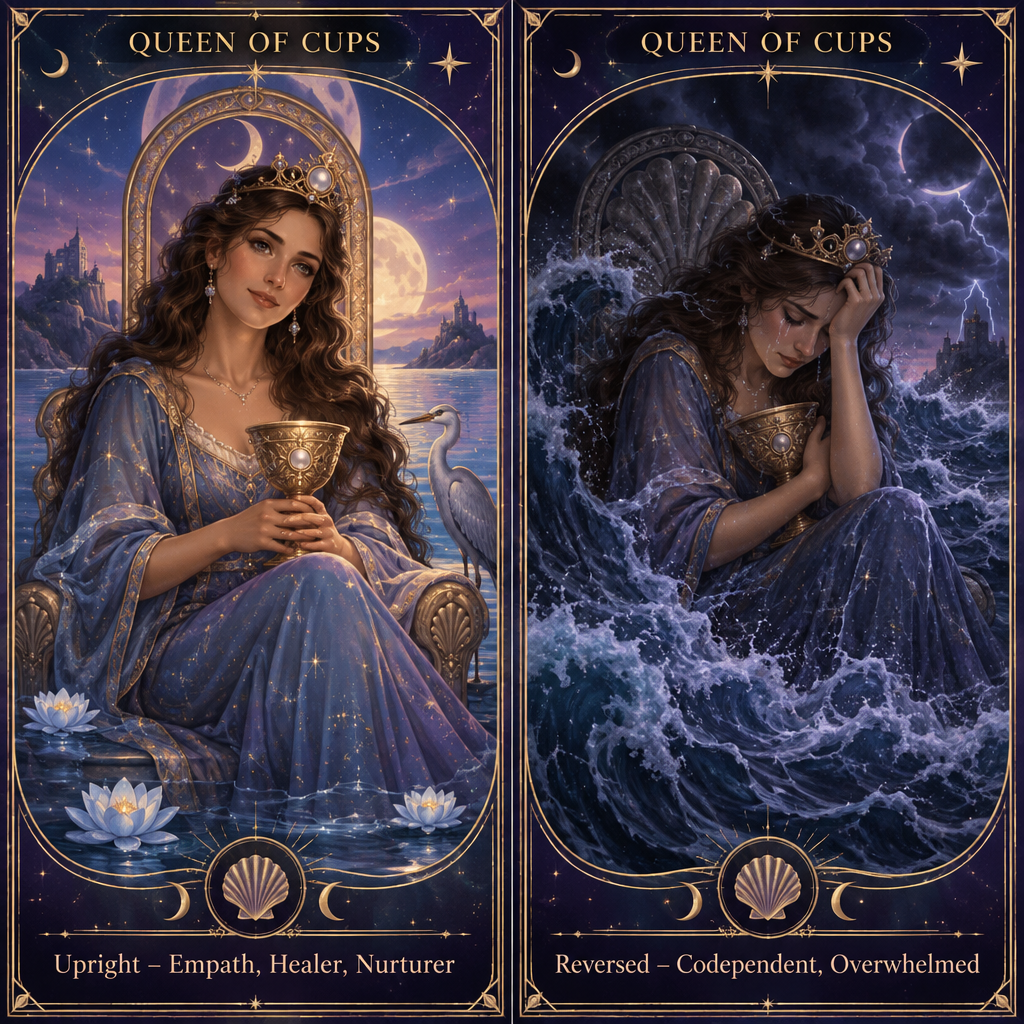
The Queen of Cups as a person is the emotional anchor in any room: the one who notices you’ve gone quiet, asks the right question, and holds what you tell her without making it about herself. Upright she describes a healer, counsellor or creative with strong intuition; reversed she points to someone whose feelings have overrun their boundaries, through codependency, martyrdom, overwhelm or shutdown. This guide covers how to recognise her in a reading about a specific person (or yourself), and what to do about it.
Queen of Cups at a Glance
| Upright | Reversed | |
|---|---|---|
| Core personality | Empath, nurturer, intuitive, creative, counsellor | Codependent, overwhelmed, self-neglecting, emotionally shut down |
| How they treat others | Listens deeply, gives without scorekeeping | Over-gives then resents it, or withdraws completely |
| Inner state | Calm, secure, in touch with feelings | Flooded, insecure, grieving, numb |
| Strength | Emotional wisdom, loyalty, compassion | Awareness of pain that needs healing |
| Weakness | Daydreaming, easily wounded, shy | Lack of boundaries, moodiness, martyrdom |
| Yes or No | Yes | No, or not yet |
| Element | Water of Water | |
| Zodiac | Cancer (primary), with Scorpio and Pisces as water-sign kin | |
| Numerology | 13th card of the suit, reduces to 4 |
The Imagery: Why Her Cup Is Closed
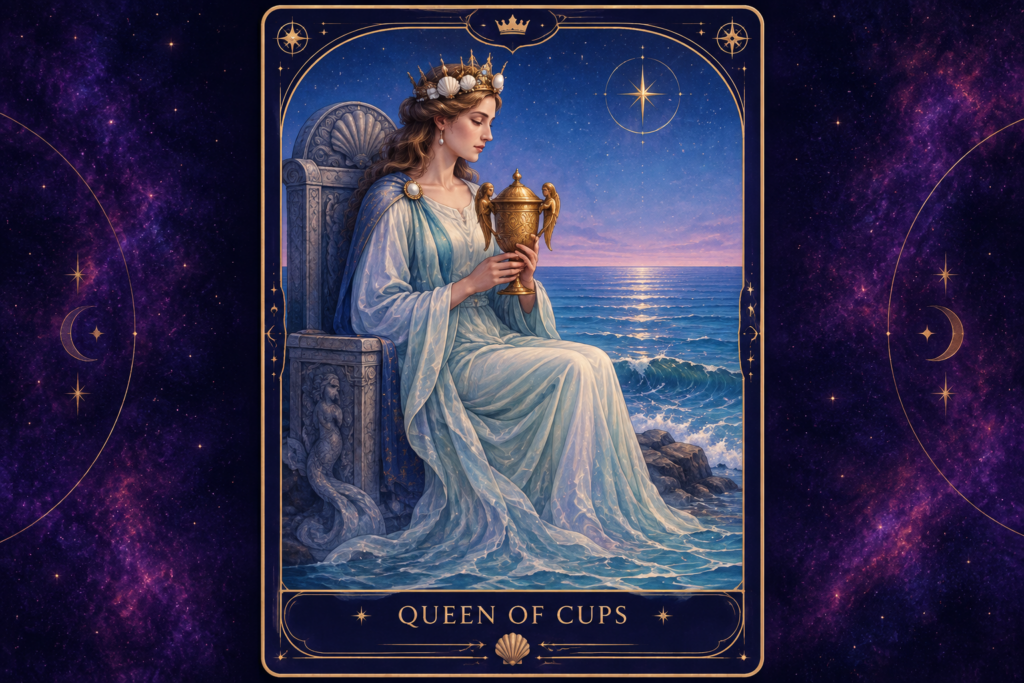
In the Rider-Waite-Smith deck the Queen of Cups sits on a stone throne at the water’s edge. The throne is carved with child-like water spirits (often read as cherubs or undines) and a large scallop shell rises behind her head. Pebbles and small shells lie at her feet, and the hem of her pale robe appears to dissolve into the water, which is the detail most readers point to: there is no hard line between her and the sea. She is not standing apart from emotion and studying it. She is in it.
The cup she holds is the only one in the entire suit that is covered. It is tall, ornate, with angel-shaped handles and a lid topped by a cross. Pamela Colman Smith drew every other cup open to the sky. This one is sealed, and the Queen gazes at it rather than drinking. Readers take that two ways, and both are useful when identifying a person:
- The closed cup is the inner life. This person has a rich interior world, and they decide who gets access to it.
- The closed cup is contained emotion. She feels everything, but she does not spill. That containment is the difference between emotional depth and emotional chaos, and it is exactly what disappears when the card reverses.
Behind her, the sea is calm and the sky clear. A cliff rises on the far shore. The overall picture is stillness over depth: nothing dramatic on the surface, a great deal going on underneath.
Element, Astrology and Numerology
Water of Water. In the Golden Dawn system each court card combines two elements. Queens carry Water, and the Cups suit is Water, so this is the purest expression of the emotional element in the deck. In practice that means the person has no “dry” counterweight built in. They do not think their way through feelings (that is the King’s Air of Water) or act them out (the Knight’s Fire of Water). They simply feel, and they feel accurately.
Astrology. The Golden Dawn attribution places the Queen of Cups across the last decan of Gemini and the first two decans of Cancer, so Cancer is her home sign: protective, moon-ruled, home-oriented, quick to pick up moods. Many modern readers widen this to all three water signs, and the shorthand holds up. The Scorpio flavour shows in her loyalty and her ability to sit with heavy emotion without flinching. The Pisces flavour shows in her imagination, her creativity and her tendency to drift. If the person you are reading about has strong Cancer, Scorpio or Pisces placements, the match is usually immediate.
Numerology. Counting Ace as one, the Queen is the thirteenth card of the suit. Thirteen reduces to four, the number of stability and foundations (think of the Emperor and the Fours of each suit). It fits. The healthy Queen of Cups is not flighty. She is the steady emotional foundation other people build on.
Queen of Cups Upright as a Person
Picture the friend everyone calls after a breakup, the nurse who remembers your mother’s name, the therapist who says almost nothing and somehow gets you to say everything. That is the upright Queen of Cups. The energy is mature feminine, but it is not restricted to women. Men, non-binary people and anyone who has done the work of becoming emotionally fluent can be this card.
Core Traits
Natural healer and counsellor. People confide in this person without being asked. They have a gift for making others feel safe, and they are drawn to roles where that gift is used: therapy, nursing, social work, hospice, teaching young children, chaplaincy, veterinary care.
Psychic empath. They often know how you feel before you say it, and sometimes before you know it. In a reading this can be literal (intuitive, dream-oriented, pulls cards themselves) or simply a very finely tuned read on people.
Creative. Water of Water is the artist’s temperament. Many Queen of Cups people write, paint, make music, or cook as a form of love. If they do not have a creative outlet they tend to become unwell, because the feeling has nowhere to go.
Loyal and devoted. Once this person commits, they stay. They remember anniversaries, show up to hospital visits, and keep secrets permanently.
Calm under emotional pressure. This is the trait that separates the Queen from the Page. A crisis does not knock her over. She can sit beside someone’s grief, rage or panic and remain steady, which is why people find her presence healing rather than merely sympathetic.
The Soft Spots of the Upright Card
Even upright, this person has recognisable vulnerabilities, and knowing them helps you confirm the identification:
- Daydreaming. They lose hours to imagination and can be slow to act on practical matters like paperwork, money, or difficult phone calls.
- Easily wounded. A sharp comment that others would shrug off lands on them like a blow. They rarely retaliate; they go quiet and process it for days.
- Shyness. They are warm one-to-one and often invisible in large groups. Do not mistake quietness for coldness.
- Over-absorbing. Because they feel other people’s moods, they can leave a room carrying emotions that were never theirs.
Reflect: Who in your life leaves you feeling calmer after ten minutes of conversation? Do you give that same steadiness back to them?
Queen of Cups Reversed as a Person
Older tarot writing paints the reversed Queen as a scheming manipulator, and occasionally that is accurate. But in most readings the reversal describes something far more ordinary and more sympathetic: a deeply feeling person whose cup has tipped over. The water has stopped being contained. Here is the full range of what that looks like.
Codependency
The reversed Queen needs to be needed. Her sense of worth comes from being the helper, so she attaches to people in crisis, struggles when they get better, and feels abandoned when someone solves a problem without her. She says yes to everything and privately keeps a ledger of what she is owed.
Martyrdom
Closely related: this person gives until they are empty, then makes sure everyone knows it. Sighs, long-suffering comments, “no, it’s fine, I’ll do it.” Her care comes with invisible strings, and the people around her feel guilty without knowing why.
Emotional Overwhelm
Some reversed Queens are simply flooded. Tears at small triggers, mood swings, decisions driven entirely by whatever they felt that morning. They are not manipulating anyone; they have no filter between stimulus and reaction. Often there is an unprocessed loss underneath.
Self-Neglect
Everyone else gets fed, listened to, and looked after. She skips meals, cancels her own appointments, and has not had an honest conversation about her own needs in years. This is the Queen whose closed cup has been passed to everyone but herself.
Emotional Shutdown
The opposite presentation, and easy to miss. After being hurt too many times, the empath goes numb. The reversed Queen can look cold, detached, even dismissive. She has sealed the cup and thrown away the key, usually to survive. If this describes someone you are asking about, the coldness is a scar, not a character.
Insecurity and Jealousy
When the Queen loses her inner stability, she looks outside for reassurance. She reads your texts, needs constant confirmation that she is loved, and interprets neutral events as rejection.
Grief
Sometimes the reversal is nothing more complicated than a person in mourning. Bereavement, divorce, a miscarriage, a lost friendship. The card is asking you to extend compassion rather than suspicion.
The Manipulative Shadow
It does exist. A Queen of Cups whose intuition has turned sour knows precisely where people are soft and uses it: guilt trips, selective tears, emotional blackmail, “after everything I’ve done for you.” This is the small minority. Before you assign it, check whether one of the gentler shadows above fits better.
Reflect: If this card describes you, which of these seven patterns is closest? What would putting your own name on the care list look like this week?
Queen of Cups as a Person in Love
Upright
As a partner the Queen of Cups is attentive, affectionate and emotionally present. She wants to know how your day actually went, not the summary. Physical affection matters to her, as does being chosen consistently. She is loyal to a fault and will often stay in a relationship longer than she should because she can see your potential.
If you asked “how does this person feel about me?” and pulled the upright Queen, the answer is: deeply, and more than they have said. This person tends to feel first and declare later. If you asked what kind of partner someone would be, expect devotion, patience and an occasional retreat into their own head.
Dating a Queen of Cups works best if you are emotionally honest. Half-truths register with her instantly, and the gap between what you say and what she senses is corrosive to her trust.
Reversed
In love the reversed Queen shows up as the partner who loses herself. She adopts your friends, your hobbies, your opinions, and then resents that there is no “her” left. Or she becomes clingy and anxious, needing reassurance several times a day. Or, after betrayal, she shuts down entirely and the relationship goes quiet and cold.
Pulled for a prospective partner, this card is a caution about emotional availability rather than a verdict on character. Pulled for yourself, it is asking whether you are over-functioning for someone who is under-functioning.
Reflect: In your closest relationship, who does more of the emotional labour? Is that balance by agreement or by habit?
Queen of Cups as a Person at Work
The upright Queen is the colleague who notices the new hire eating lunch alone, the manager who remembers you had a sick parent and asks about it a month later. She excels in any role built on care, trust or creativity: counselling, HR, healthcare, teaching, design, writing, hospitality, non-profit work. In a reading about a boss, this card promises someone who leads with empathy and gives honest, kind feedback. In a reading about a business partner, it suggests someone trustworthy but not aggressive about money.
She struggles with hard-edged environments. Cutthroat sales floors, hostile offices, or jobs that demand constant confrontation drain her fast. She also tends to undercharge for her work and avoid salary negotiations, because asking for herself feels uncomfortable.
Reversed in a career context, this person is burnt out from caring. Compassion fatigue is the classic presentation: the nurse who has stopped feeling, the teacher counting days to the holidays. It can also show a colleague who takes everything personally, brings home drama into the office, or uses emotional pressure to get out of accountability. If you pulled it about a workplace, expect poor boundaries somewhere in the chain.
Reflect: Does your current role use your emotional intelligence, or just consume it?
Queen of Cups as a Person in Friendship and Family
Among friends she is the confidante, the one who hosts, the one who turns up with soup. She holds the group’s secrets and rarely gossips, because she knows what being gossiped about feels like. As a mother, father or caregiver, the upright Queen is protective, patient and tuned to each child’s temperament. As a daughter or son, she is the one who ends up coordinating care for ageing parents.
Her friendship weakness is passivity. She waits to be invited, assumes she is bothering people, and can drift out of friendships through sheer quietness rather than conflict.
Reversed in family or friendship, watch for the smothering parent who cannot let an adult child make a mistake, the friend who only calls when she is in crisis, or the relative whose love is conditional on gratitude. Enmeshment is the family-system word for it: emotional boundaries so blurred that one person’s mood becomes the household’s weather.
Reflect: Which friend or relative do you lean on most? When did you last ask how they were doing, and wait for the real answer?
Is the Queen of Cups a Yes or No Card?
Upright: yes. The card carries warmth, trust and good intention. For questions about whether someone cares, whether a relationship is worth pursuing, or whether to trust your gut, the upright Queen says go ahead, and lead with honesty.
Reversed: no, or not yet. Emotions are unsettled, either yours or theirs. The reversed Queen rarely means a hard, permanent no. It more often means the feelings involved need to settle before a sound decision is possible.
How the Queen Differs From the Other Cups Court Cards
Readers frequently pull the Queen and wonder whether the person they had in mind is really a King or a Knight. Here is the quick test.
| Card | Elemental mix | Relationship to emotion | The person looks like |
|---|---|---|---|
| Page of Cups | Earth of Water | Discovering it | Sensitive teen or young adult, new to feelings, easily swept up |
| Knight of Cups | Fire of Water | Chasing it | The romantic pursuer, charming, idealistic, inconsistent |
| Queen of Cups | Water of Water | Inhabiting it | The empath who feels fully and stays grounded |
| King of Cups | Air of Water | Governing it | The calm counsellor who manages emotion with reason |
The clearest distinction is between Queen and King. Both are emotionally mature. The King stands slightly apart from his feelings and directs them (he is the diplomat, the therapist with a clipboard). The Queen is immersed in hers and remains steady anyway (she is the therapist who tears up with you and still holds the session together). If your person leads with compassion but keeps a visible analytical distance, you probably want the King.
The Queen of Cups in Other Decks
The Rider-Waite-Smith imagery dominates, but two other decks are worth knowing because they shift the emphasis.
In the Thoth Tarot, Crowley and Lady Frieda Harris paint the Queen almost entirely as reflection: a veiled figure in rippling water, holding a shell cup, surrounded by light that makes her hard to see directly. Crowley described her as mirroring whoever looks at her. As a person, that is the Queen’s empathy taken to its extreme: she becomes what others need, which is both her gift and, reversed, her loss of self.
In Lisa Sterle’s Modern Witch Tarot, the Queen is a contemporary woman in blue beside water, still holding the cup, with the same contained calm but without the medieval throne. Readers who struggle to see themselves in a crowned figure often connect with this version first.
If This Card Is You: Practical Next Steps
- Schedule one act of care for yourself before anyone else this week. Not a reward after helping. A first priority. Notice the discomfort.
- Practise the “that’s not mine” check. When you leave a conversation feeling heavy, ask whether the feeling started with you. If it did not, let it go consciously.
- Say no once without an explanation. The Queen’s boundaries are usually thinned by over-justifying.
- Give your feelings a container. Journaling, art, music, swimming. The closed cup on the card is a reminder that depth needs a vessel.
- Journal prompts: Am I living from emotional wisdom, or emotional habit? Whose feelings am I currently carrying? What would I ask for if I believed I deserved it?
FAQ
What does the Queen of Cups mean as a person?
Upright, she describes an emotionally mature, intuitive, nurturing person: a natural healer or counsellor who feels deeply, listens well, and stays calm under pressure. Reversed, she describes someone whose emotions have overrun their boundaries, showing up as codependency, martyrdom, overwhelm, self-neglect or emotional shutdown.
Is the Queen of Cups a yes or no card?
Upright, yes. Reversed, no or not yet, because unresolved feelings make the situation unstable.
What zodiac sign is the Queen of Cups?
Cancer is her primary sign in the Golden Dawn system, which places her across late Gemini and early Cancer. Many readers extend the association to all three water signs: Cancer, Scorpio and Pisces.
What does the Queen of Cups reversed mean as a person?
A sensitive person who has lost their emotional footing. Common presentations include needing to be needed, giving until resentful, mood swings, neglecting their own needs, going numb after hurt, insecurity, or active grief. Manipulation is possible but is the least common reading.
Can the Queen of Cups represent a man?
Yes. The card describes mature, receptive emotional energy, not a gender. Any person who leads with empathy and emotional steadiness can be the Queen of Cups.
How do I tell the Queen of Cups from the King of Cups when reading about a person?
The King manages emotion from a slight distance and leans on reason; the Queen is fully immersed in feeling and stays grounded anyway. If the person strikes you as compassionate but analytical, choose the King. If they are compassionate and visibly feeling it with you, choose the Queen.