

How to Shuffle Tarot Cards: 5 Methods and What They Mean for Your Reading
How I shuffle a tarot deck changes how a reading feels, and sometimes what turns up. Below are the five methods I use: overhand, riffle, cutting, pile and chaos. I cover when each one makes sense, how to bring reversals in on purpose, and how a simple ritual can steady a yes/no question.
Why the Shuffle Matters More Than People Think
Shuffling does two jobs at once. The practical job is randomness. You want the cards in an order you didn’t arrange, so that what you draw isn’t just a replay of your last reading.
The second job is focus. Those thirty seconds of handling the cards are when I settle my breathing and get clear on the question. Many readers describe this as putting their energy into the deck. I think of it as the moment I stop thinking about dinner and start thinking about the question.
Both jobs matter. A shuffle that is perfectly random but rushed gives me a muddled reading. A shuffle that feels lovely but barely mixes the cards keeps producing the same three cards for weeks. The methods below balance those two jobs in different ways.
What You Need Before You Shuffle
You don’t need much. Here is my basic setup:
- A tarot deck. Most standard decks follow the Rider-Waite-Smith structure of 78 cards: 22 Major Arcana and 56 Minor Arcana across four suits.
- A clean, flat surface. A table works. A cloth on top helps for chaos shuffling and protects the card backs.
- A reading cloth (optional). Any fabric works. Cotton or velvet gives the cards a bit of grip without sticking.
- A clear question. Write it down if your mind tends to wander.
- Dry, clean hands. Hand lotion and snack crumbs ruin card stock faster than anything else.
- A decision about reversals. Decide before you shuffle whether upside-down cards will count. More on this below.
A quick note on size. Tarot cards are bigger than playing cards. A typical Rider-Waite-Smith style deck runs about 2.75 by 4.75 inches, while a poker deck is 2.5 by 3.5 inches. That extra length is why shuffles that feel easy with playing cards can feel awkward with tarot, especially if your hands are small. Don’t worry if your first attempts look clumsy. That’s the card size, not a lack of skill.
Breaking In a New Deck First
A brand new deck arrives in a fixed order. Usually that means the Major Arcana from The Fool to The World, then each suit from Ace to King. If you shuffle a fresh deck three times and read straight away, whole runs of one suit can still sit together.
When I open a new deck, I do this:
- Go through every card face up, one at a time. I look at the art and notice which images I react to.
- Lay all 78 cards face down on a cloth and spread them around with both hands for a full minute or two.
- Gather them, then do a pile shuffle (method 4 below) into seven or eight piles.
- Finish with several overhand or riffle shuffles.
That first deep mix breaks up the factory order. After that, normal shuffling between readings is enough. The card-by-card look also builds familiarity. If you’re still learning the meanings, our guide on how to read tarot cards beginners can follow step by step pairs well with this first session.
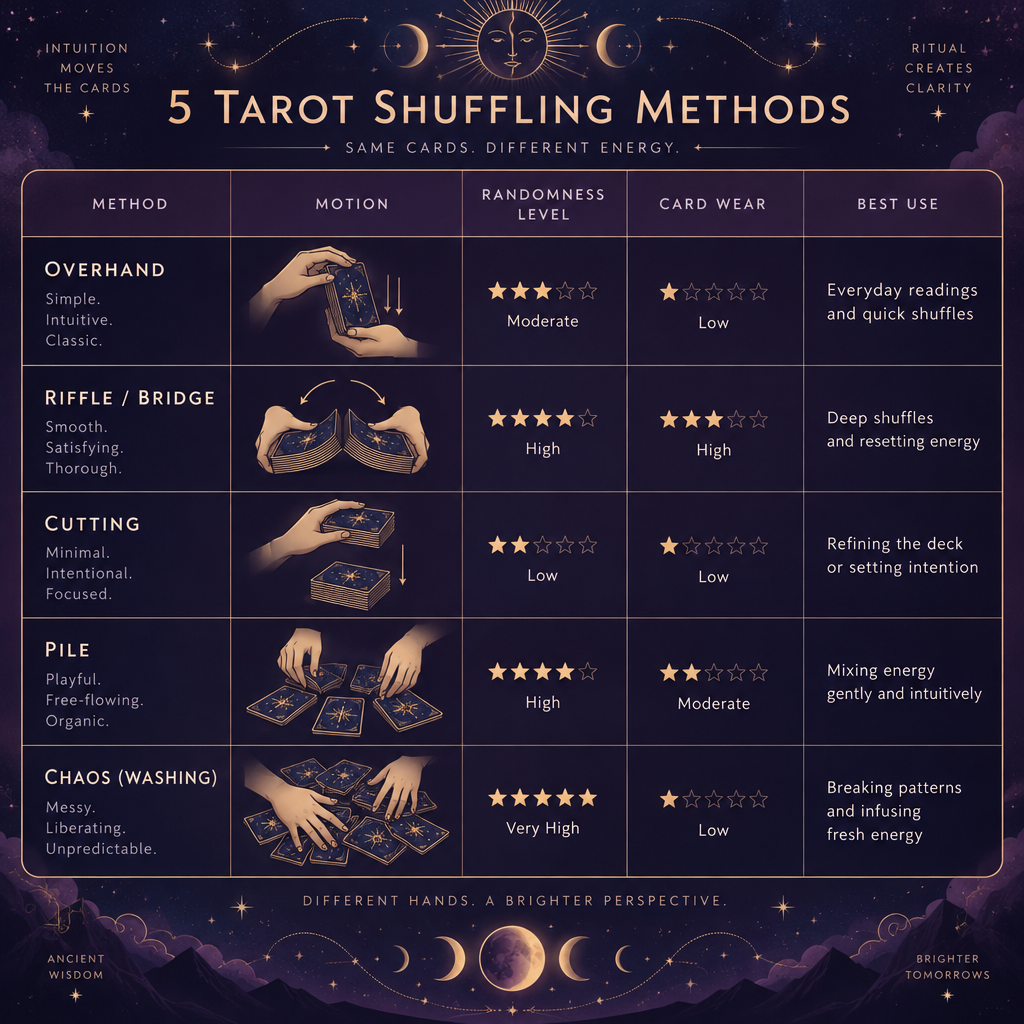
The 5 Tarot Shuffling Methods at a Glance
| Method | Randomness | Wear on cards | Makes reversals? | Best for |
|---|---|---|---|---|
| Overhand | Low per shuffle, fine with repetition | Very low | Rarely | Daily pulls, beginners, delicate decks |
| Riffle / bridge | High | Medium to high | No | Thick decks, fast thorough mixing |
| Cutting | Low on its own | Very low | Yes, if you flip a pile | Finishing any shuffle, involving a querent |
| Pile | None alone (reorders only) | Very low | Yes, if you flip piles | Breaking up clumps, new decks |
| Chaos (washing) | Very high | Low to medium | Yes, naturally | Reversals, big readings, a full reset |
Now the details.
1. The Overhand Shuffle

This is the shuffle most people picture. You hold the deck in one hand and drop small packets into the other. It’s gentle, quiet and easy to do while talking or thinking, which is why I use it most.
How to do it
- Hold the deck in your dominant hand, cards standing on their long edge, faces toward your palm.
- Rest the bottom edge on the palm of your other hand.
- With your thumb, slide a small packet of cards off the front of the deck into the waiting hand.
- Keep dropping small packets, letting each one land in front of the last.
- When the first hand is empty, pick up the new stack and repeat.
- Keep going until it feels done, or for a set count you choose in advance.
With tarot cards, I hold the deck sideways, long edge down. Holding it upright makes the cards top-heavy and I end up spraying them across the floor.
When to use it
The overhand shuffle suits daily one-card pulls, quick check-ins and any deck with thin or glossy stock. It also suits beginners, because it’s hard to damage the cards.
The catch
One overhand shuffle doesn’t mix much. Cards tend to stay near their old neighbours. Mathematicians who study card shuffling have found it takes many times more overhand shuffles than riffle shuffles to fully mix a deck. I don’t count to hundreds, but I do shuffle longer with this method, and I end with a cut.
2. The Riffle Shuffle (and the Bridge)
The riffle is the casino shuffle. You split the deck in two and let the corners interleave. It mixes cards fast and well.
How to do it
- Split the deck into two roughly equal halves.
- Place them on the table, short ends facing each other, a small gap between.
- Lift the inner corners with your thumbs, bending them up slightly.
- Release the cards slowly so the corners fall and overlap.
- Push the two halves together into one stack.
- For the bridge finish, arch the combined stack upward with your fingers and let it fall flat. Skip the arch if you want to protect your cards.
When to use it
I riffle when I want a thorough mix with little time. It’s handy before a large spread like the Celtic Cross, where I want to be confident the deck is truly mixed.
There’s real math behind this. In 1992, mathematicians Dave Bayer and Persi Diaconis showed that about seven riffle shuffles are enough to properly randomize a standard 52-card deck. A 78-card tarot deck is bigger, so it needs a few more. I aim for nine or ten riffles when I use this method alone.
The catch
Riffling bends cards. Over time, the bridge in particular can leave a curve in the deck, and the corners start to fray. Many tarot decks use thinner stock than casino cards, and some have gilded edges that chip.
My rule: riffle only decks with sturdy stock, and skip the bridge. If you love a deck, or it’s out of print, use one of the other four methods.
3. Cutting the Deck
A cut means splitting the deck into parts and stacking them in a new order. On its own, a cut barely randomizes anything. The cards inside each section stay in the same sequence. Its value is ritual and finish.
How to do it
- After your main shuffle, place the deck face down on the table.
- Using your non-dominant hand, lift part of the deck and set it beside the rest.
- For a three-way cut, split once more, so you have three piles.
- Restack the piles in a different order from how they started.
- If you want reversals, turn one pile 180 degrees before restacking.
Why the left hand?
Many readers cut with the left hand, and some traditions link it to the intuitive or receptive side. I don’t think the hand changes the outcome. I do find that using my less practiced hand slows me down, and that small pause helps me focus.
When to use it
I cut at the end of every shuffle. I also use cutting when reading for someone else. Asking them to cut gives them a role in the reading and a sense that the cards are theirs. Some readers ask the person to pick which pile goes on top. It’s a nice touch and costs nothing.
4. The Pile Shuffle
The pile shuffle deals cards one at a time into several piles, then gathers the piles together. People who sort physical cards for games use it, and it works well with tarot.
How to do it
- Decide how many piles you’ll use. Five to eight works for 78 cards.
- Deal cards face down, one at a time, into the piles in order: 1, 2, 3 and so on, then back to pile 1.
- Keep going until the deck runs out.
- Gather the piles in a random order, not 1 to 8.
- Follow with a few overhand shuffles or a cut.
When to use it
The pile shuffle is great for breaking up clumps. If I notice that a suit keeps showing up together, or a reading left several cards bunched in a block, a pile shuffle spreads them out. It’s also ideal for new decks and very large cards that are hard to hold.
It’s also my go-to suggestion for anyone with arthritis, wrist pain or small hands. You never need to grip the whole deck at once.
The catch
Here’s the thing many guides skip. A pile shuffle on its own isn’t random. If you deal into the same number of piles and gather them the same way, you’ll get a predictable order every time. That’s why I always vary the gathering order and add another shuffle after.
5. The Chaos Shuffle (Washing the Cards)
The chaos shuffle goes by many names: washing, smooshing, the scramble. You spread the cards face down on a surface and swirl them around with both hands, like mixing dominoes.
How to do it
- Lay a soft cloth on your table.
- Spread the whole deck face down across it.
- Place both palms flat on the cards and move them in slow circles, mixing in every direction.
- Keep going for 30 seconds to a couple of minutes.
- Gather the cards back into a single stack, keeping whatever direction each card ended up in.
- Square the deck and cut once.
When to use it
This is the most random method of the five. It also creates reversals naturally, because cards spin as you move them. I use it before big readings, after a heavy or emotional session, and whenever a deck feels “stuck,” meaning the same cards keep coming up.
A lot of readers find the chaos shuffle the most meditative method. Both hands are on the cards and the motion is slow. It suits a reading where you want to slow down and think.
The catch
It takes space and time. It’s awkward on a small café table and noisy on a bare wooden surface. Gathering the cards back up is fiddly, and you need to be careful not to drag edges across rough surfaces. A cloth fixes most of this.
How Many Times Should You Shuffle?
There are two schools of thought. Some readers shuffle a set number of times, often a number that means something to them. Others shuffle until something tells them to stop: a sense of calm, a pause in their thoughts, a card that feels ready.
I use a mix. I make sure the deck is mixed enough to be random, then I shuffle on until it feels right. In practice:
- Overhand: at least a minute of steady shuffling, then a cut.
- Riffle: nine or ten riffles for a 78-card deck.
- Pile: one round, then a few overhand shuffles.
- Chaos: at least 30 seconds of real mixing.
The feeling of “done” is more useful once the deck is truly mixed. Before that, it’s easy to stop on habit and get a reading built from the last one.
How to Handle Reversals on Purpose
A reversal is a card that lands upside down. Some readers read reversed cards as blocked, delayed, internal or opposite energy. Others ignore them. Either is valid. What matters is deciding before you shuffle, and shuffling in a way that matches that decision.
If you want reversals
Most shuffles never turn a card around. Riffle and overhand both keep cards facing the same way they started. To get reversals you have to bring them in on purpose. Here are four ways I do it:
- Rotate half the deck. Split the deck in two, turn one half 180 degrees, then shuffle the halves back together. This gives roughly half reversals over time.
- Flip a pile during the cut. When you cut into three, rotate one pile before restacking. This adds fewer reversals, roughly a third.
- Use the chaos shuffle. Cards turn as you swirl them, so reversals happen naturally and unevenly.
- Flip piles in a pile shuffle. Turn one or two piles around before you gather them.
I like method 1 for even results and method 3 when I want it to feel less controlled. If a reading comes up with almost no reversals, that’s information too. I don’t reshuffle to get more.
If you don’t want reversals
Some readers prefer upright only, especially early on. If that’s you, check that every card faces the same way before you shuffle. Avoid the chaos shuffle, and turn any card that lands upside down the right way up as you lay it out.
There’s no shame in this. Many experienced readers never use reversals and pull nuance from the surrounding cards instead.
Reversals you didn’t plan for
If you don’t use reversals but a card shows up reversed anyway, maybe because it got turned during a previous reading, you have two options. Read it upright, or treat it as a deliberate signal. Pick one rule and stick with it. Changing the rule mid-reading because you don’t like the answer erodes trust in your own practice.
Shuffling for a Yes/No Reading
Yes/no readings are where shuffling ritual matters most. The question is narrow, the answer usually comes from one to three cards, and there’s a strong pull to keep reshuffling until you get the answer you hoped for.
A steady ritual keeps you honest.
My yes/no shuffling routine
- Write the question. Make it a true yes/no question with a time frame. “Will I hear back about the job by the end of the month?” works better than “What’s happening with work?”
- Settle the deck. Do a quick overhand or chaos shuffle to clear the last reading. Don’t hold your question in mind yet.
- Decide the rules. One card or three? Do reversals count? What counts as “maybe”? Decide all of this before you start.
- Shuffle with the question. Use a gentle overhand shuffle while silently repeating the question. I find this method best for yes/no, because it’s calm and repetitive, which helps me concentrate.
- Stop when it feels right. Then cut once with your non-dominant hand.
- Draw from the top. Or fan the cards and pick by feel. Choose your draw style ahead of time.
- Accept the answer. Write it down, with the date.
Why the ritual changes the reading
I’m careful here. I can’t prove that shuffling with focus changes which card appears. What I can say from long practice is this. When I shuffle distracted, I read the cards distracted. I get vague, skip the card’s real message, and end up asking again.
When I follow the same ritual each time, I’m far more likely to accept the first answer. That’s the real “energy” of a yes/no shuffle. It’s the mindset you bring to the card you turn over.
Reversals in yes/no readings
Many readers treat upright as leaning yes and reversed as leaning no, or as “not yet.” If you work that way, you need reversals in the deck, so use the rotate-half or chaos method in step 2. If you don’t use reversals, read the card’s upright meaning instead. A card like The Sun reads as a strong yes either way. Our list of tarot cards for yes answers is a handy reference for how individual cards lean.
Love and relationship questions
Love questions are where people reshuffle most. “Will he text me?” turns into four readings in ten minutes. If you notice yourself doing this, stop after the first draw and leave the deck for a day. When you do read again, try an open question instead of yes/no. A three-card spread gives more nuance than a single card, and our guide to tarot cards for reconciliation covers which cards tend to come up around a returning ex.
Shuffling When You Read for Someone Else
Reading for another person adds a few choices.
Who shuffles? Some readers never let anyone else touch their deck. Others hand it over. I usually shuffle myself and ask the other person to cut. This protects delicate decks and still gives the querent a role.
Ask before you hand it over. Some people are nervous about handling tarot cards. Offer, don’t insist.
Reading remotely? Online or phone readings remove the cut. I ask the person to say “stop” while I shuffle, or to choose a number, and I count that many cards down. Both give them a hand in the draw.
Keep your ritual the same. Use the same method you use for yourself. A consistent ritual makes your readings more reliable across different people.
What to Do When a Card Jumps Out
Sooner or later, a card will fly out of the deck mid-shuffle. Readers call these jumpers. Some see them as messages. Others see them as a sign the shuffle was too rough.
My rule is simple and I set it in advance. If a card lands face up, I note it as a side message and put it back. If it lands face down, I put it back without looking. I don’t let jumpers replace the spread.
If cards are jumping often, that’s a technique issue, not a sign. Loosen your grip, shuffle lower to the table, or switch to the pile or chaos method.
Clearing the Deck Between Readings
Many readers “cleanse” a deck between sessions. Methods include knocking on the deck, passing it through incense smoke, leaving it in moonlight, or setting a crystal on top. These are personal rituals, and I won’t tell you they’re required.
What I will say is that a physical reset helps. Putting cards back in order, or doing a long chaos shuffle, stops the last reading from leaking into the next one. That’s useful both for randomness and for your own head.
Here’s my reset after a heavy reading:
- Turn every card face up and the right way round.
- Find any card that came up repeatedly and look at it for a moment.
- Turn them all face down and do a full chaos shuffle.
- Finish with a pile shuffle and a cut.
Common Mistakes and How to Fix Them
Shuffling too little. Three quick overhand shuffles leave the deck almost in its old order. Fix: shuffle longer, or add a pile shuffle.
Same cards keep coming up. Usually this is a mixing problem. Fix: chaos shuffle, then pile shuffle. If the same card still shows up after a deep mix, take the message seriously.
Bent or curved cards. This comes from riffling or bridging. Fix: switch methods, and press the deck under a heavy book overnight.
Reshuffling until you like the answer. This is the biggest one. Fix: set rules before you start and write the first answer down.
Dropping cards everywhere. Tarot cards are long and slippery. Fix: hold the deck sideways for the overhand shuffle, sit closer to the table, or use the pile method.
Forgetting the reversal decision. You get an upside-down card and don’t know whether it counts. Fix: decide before you touch the deck, every time.
Asking a cloudy question. No shuffle fixes a vague question. Fix: write it down and make it specific.
Reading while rushed. A five-second shuffle between meetings gives a five-second reading. Fix: wait until you have a few calm minutes.
What a Good Shuffle Should Feel Like
When you get the shuffle right, a few things happen. Cards from all four suits and the Major Arcana turn up in a fair mix over several readings. Reversals, if you use them, appear at roughly the rate your method creates. Repeat cards show up now and then, but not every time.
Your hands should feel relaxed. Your question should feel clearer when you finish than when you started. Most of all, you should feel ready to accept the first card you turn over.
For love spreads, a deck that has been properly mixed can surprise you in useful ways. A spread full of tarot cards meaning love lands differently when you know you didn’t stack the deck by accident.
If one method doesn’t feel right, try another for a week. Most readers settle on one main shuffle and one backup. Mine are overhand for daily use and chaos for big readings and resets.
FAQ
What is the best way to shuffle tarot cards for beginners?
I suggest the overhand shuffle followed by a cut. It’s gentle on the cards, easy to learn, and calm enough to help you focus on your question. Add a pile shuffle now and then to break up clumps.
Is it bad to riffle shuffle tarot cards?
It isn’t bad for the reading, but it can damage the cards. Riffling bends the stock, and bridging can leave a lasting curve. Use it only on sturdy decks, and skip the bridge.
How do I get reversed cards when I shuffle?
Split the deck, turn one half around, and shuffle the halves together. You can also flip a pile when cutting, or use the chaos shuffle, which turns cards naturally.
Can someone else shuffle my tarot cards?
Yes, if you’re comfortable with it. Many readers let the querent cut the deck instead of shuffling it, which protects the cards and still gives the other person a role.
How do I know when to stop shuffling?
First make sure the deck is mixed enough: at least a minute of overhand shuffling or at least seven riffles. After that, stop when you feel settled and your question is clear.
Should I shuffle differently for a yes/no question?
I use a slow overhand shuffle for yes/no questions while repeating the question in my head. Set your rules first, draw once, and accept the answer rather than reshuffling.
What does it mean if the same card keeps appearing?
First check your shuffle. A shallow mix often produces repeats. If the card still keeps appearing after a full chaos and pile shuffle, treat it as a theme that deserves attention.