High Priestess As A Person (Upright & Reversed) Tarot Card Meaning
Someone in your life keeps their cards close, listens more than they speak, and seems to know things before they are said. When the High Priestess appears to represent a person in your spread, that is who the deck is pointing at, and this guide shows you how to recognise them, what they are like in love, friendship and work, and what the reversed card says about them when something inside has gone quiet.
The Person Behind the Card
The High Priestess is the second card of the Major Arcana, numbered II. As a person she is the keeper of what is not said out loud. She works from intuition rather than argument, holds confidences without effort, and tends to be the calmest presence in any room. People confide in her without planning to. She rarely volunteers an opinion, but when she does, it lands because it has been considered in silence first.
Three attributes define her emotional make-up:
- Number II. Two is duality held in balance: conscious and unconscious, speech and silence, what is shown and what is kept back. This person lives comfortably between opposites and refuses to collapse a question into a single easy answer.
- The Moon. Her planetary ruler is the Moon, which governs cycles, memory and the inner life. Her moods ebb and flow, and she trusts feeling as a form of knowledge.
- Water. Her element makes her receptive and absorbent. She picks up the emotional temperature of a room on arrival and often cannot explain how she knows what she knows.
In the Golden Dawn system she corresponds to the Hebrew letter Gimel, the camel that crosses the desert carrying what others need. That image fits her well. She carries knowledge across the gap between the surface mind and the deep one, and she does it quietly.
A note on gender: the card uses feminine imagery and sits at the heart of what tarot calls the Divine Feminine, but the person it describes can be anyone. A reserved male counsellor who reads a room perfectly is just as much a High Priestess as a woman who runs a meditation circle.
How to Recognise Them
Appearance and bearing
Tarot cards describe energy rather than faces, but the High Priestess person tends to share a recognisable physical presence. Posture is upright and still; they do not fidget. The gaze is direct but soft, the kind that makes you feel seen rather than examined. Movements are economical. They speak at a lower volume than the people around them and leave pauses that others rush to fill.
Clothing often runs to deep blues, blacks, silver and layered fabrics, though plenty of High Priestess types dress plainly and let their stillness do the work. What you notice first is not what they wear but the sense that there is more going on behind the eyes than they are showing.
Behavioural tells
- They ask one precise question that reframes the whole conversation.
- They remember a detail you mentioned months ago.
- They leave gatherings early, not out of rudeness but because they have absorbed enough.
- They are the last person to spread a rumour and the first to notice one forming.
- They avoid small talk but will talk for hours about dreams, patterns, or what someone really meant.
Reading the Card’s Symbols as Personality
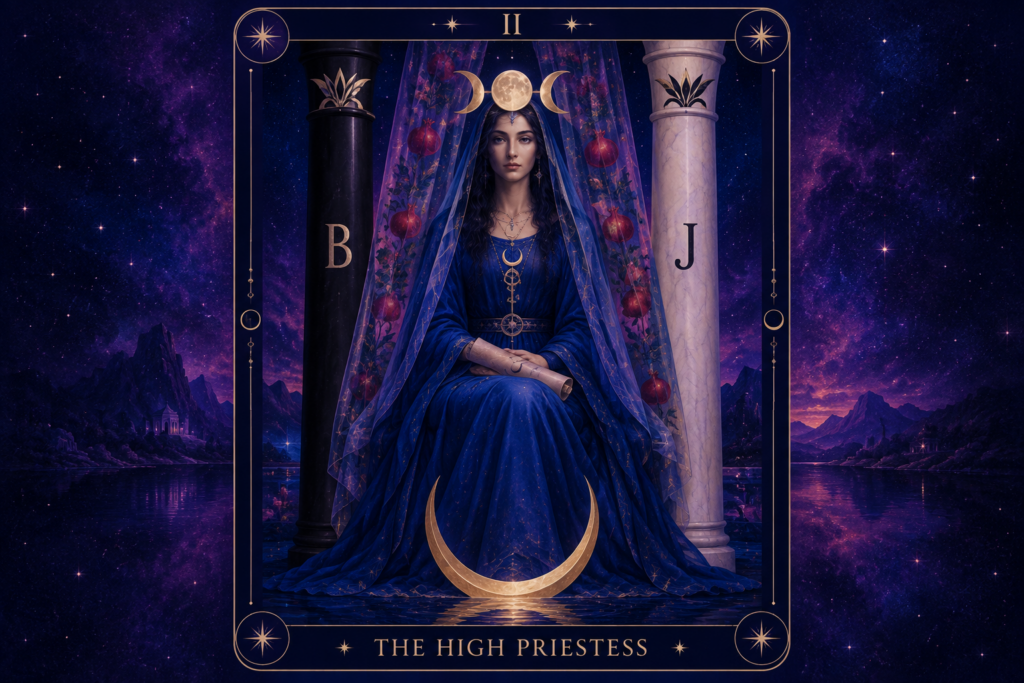
Every object on the Rider-Waite-Smith card maps onto a trait you can observe in the person.
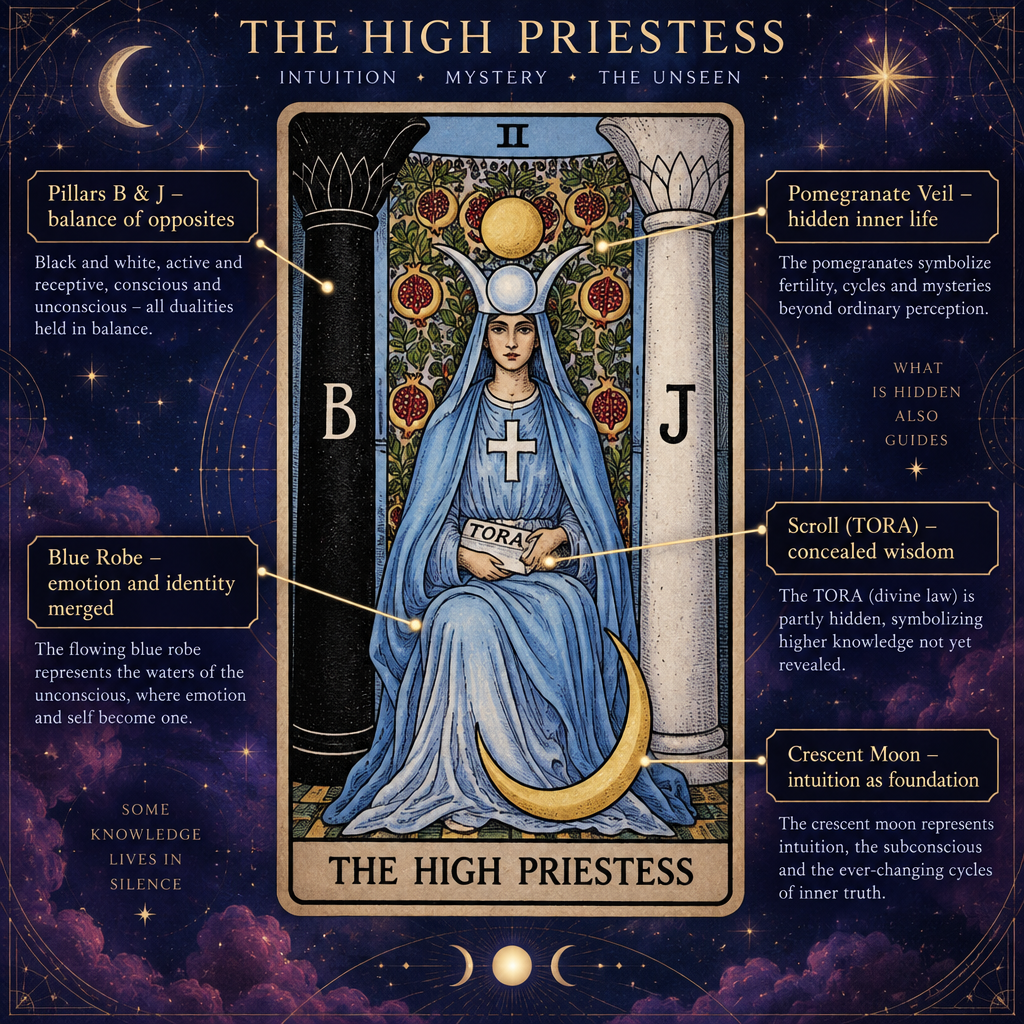
The two pillars, marked B and J. These are Boaz and Jachin, the pillars at the entrance of Solomon’s Temple, one black and one white. She sits between them. In a person this is the refusal to take sides prematurely, the ability to hold two truths at once, and the tendency to act as a mediator because they can see both positions without being pulled by either.
The veil of pomegranates and palms. The veil hangs behind her, screening the water beyond it. Pomegranates are a symbol of hidden knowledge and of Persephone, who ate the seeds and became queen of the underworld. The person this describes has an inner life you only glimpse. Intimacy with them is earned in stages; each conversation lifts the veil slightly, never all at once.
The crescent moon at her feet. The Moon sits below her, meaning she stands on intuition as her foundation rather than reaching for it. This person’s first instinct is usually right, and they have learned to trust it over a persuasive argument.
The scroll marked TORA. Half concealed by her robe, the scroll represents sacred law and accumulated wisdom. She holds it but does not display it. The person has real expertise, often formal, and shows almost none of it unless asked directly.
The blue robe flowing into water. Her garment pools at her feet and becomes the water behind the veil. Emotion and identity are not separate for her. She feels things fully, then lets them settle before responding.
The horned crown and solar cross. The crown is the triple Moon, waxing, full and waning. The cross on her chest balances the four elements. Together they describe someone cyclical by nature, who goes through visible phases of withdrawal and return and who is steadier for it.
Positive and Negative Traits at a Glance
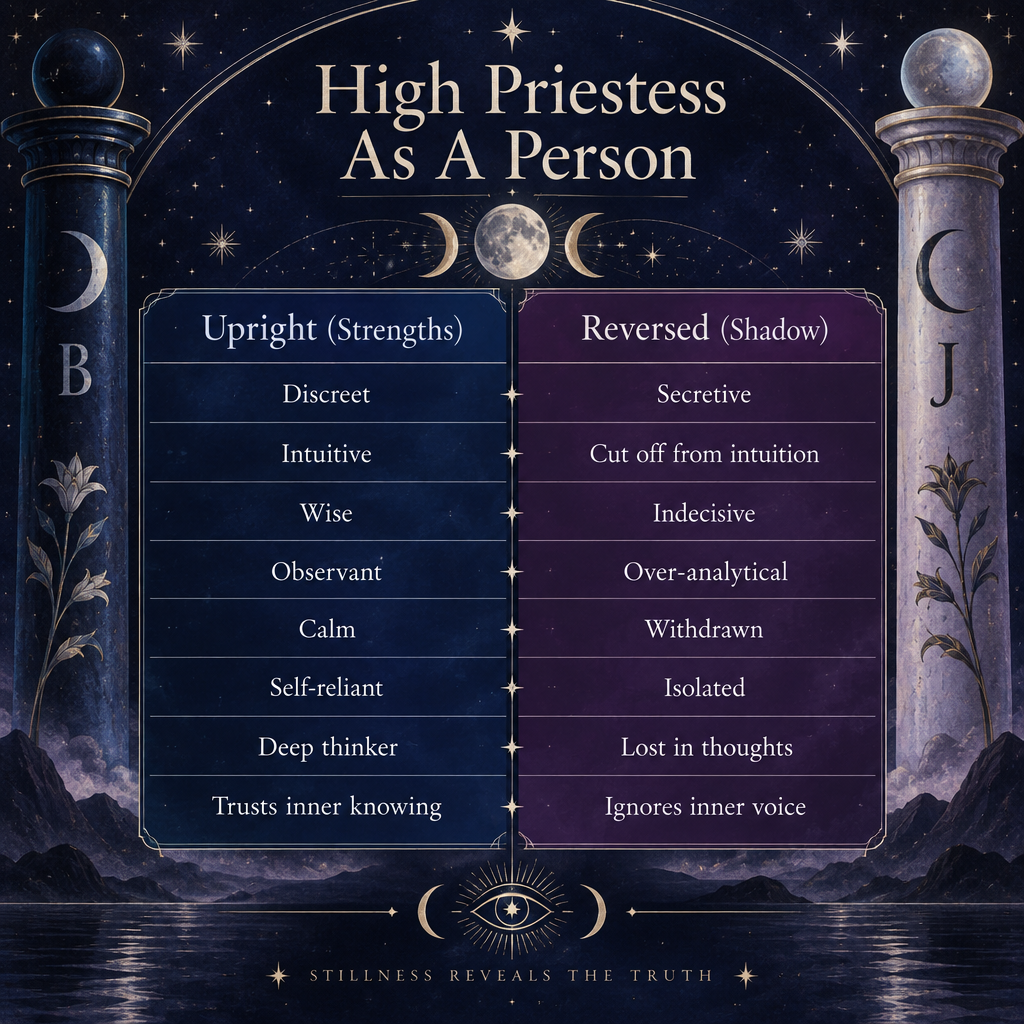
| Upright (strengths) | Reversed (shadow) |
|---|---|
| Discreet; holds secrets without strain | Secretive to the point of shutting people out |
| Intuitive, often uncannily accurate | Cut off from their own intuition, second-guessing everything |
| Calm and emotionally steady | Emotionally withdrawn, numb or repressed |
| Deep listener | Passive, avoids hard conversations |
| Wise counsel when asked | Withholds help, or uses knowledge as leverage |
| Comfortable with solitude | Isolation that tips into loneliness |
| Mediates between opposing views | Fence-sitting that frustrates everyone |
| Spiritually grounded | Superstitious or performatively mystical |
| Trustworthy confidant | Breaks confidence, gossips (shadow extreme) |
The High Priestess in Love and Relationships
As a romantic partner (upright)
A High Priestess partner is slow to commit and complete once committed. They do not perform affection publicly; love shows up as attention, remembered details and a steadiness that outlasts drama. They will notice when something is off with you before you have admitted it to yourself, and they will wait until you are ready to talk rather than pushing.
The connection often feels fated or uncanny. Many readers describe this card in a relationship position as a soul connection or karmic bond, and the lived experience supports that: conversations go deep quickly, silences are comfortable, and both people feel known in a way that skips the usual stages. The trade-off is pace. This person needs long stretches of solitude even inside a happy relationship. Partners who read that as rejection will struggle. Partners who treat it as weather, something that passes and returns, do well.
Sexually, the High Priestess is private and intense rather than demonstrative. Trust is the precondition for everything.
In a love reading
When the card represents a person you are asking about, upright, read it as someone whose feelings are real but largely unspoken. They are holding something back, not out of deceit but because they have not finished processing it. Patience is the strategy. Pressing for a declaration now will get you silence; giving space tends to produce a quiet, decisive move later.
If the card represents you in a love reading, the message is to stop over-explaining yourself and trust what you already sense about the other person. You know the answer. You are looking for permission to act on it.
How they see you and how they feel about you
Pulled in a “how do they see me” position, the High Priestess says they find you intriguing and are watching closely. They see depth in you that others miss and they are not yet sure what to do with that. Attraction is present but it is being observed rather than acted on.
In a “how do they feel about you” position the card describes feelings that are deeper than their behaviour suggests. They may seem cool or hard to read. Internally, they are more invested than they let on and are waiting for some private signal that it is safe to show it.
Reversed in these positions, the picture changes: they are confused about their own feelings, avoiding the question, or hiding something that would change how you see the situation. The feelings may still exist, but the person has lost access to them.
Reversed in love
A reversed High Priestess partner has stopped listening to their own inner voice, and the relationship shows it. Typical patterns:
- Emotional unavailability dressed up as independence
- A refusal to discuss anything difficult, with long silences used as a wall rather than a pause
- Secrets that have grown from private to harmful, such as an undisclosed debt, a concealed friendship, or feelings for someone else that have not been admitted even to themselves
- Repressed resentment that leaks out sideways as coldness
The old reading of this card as a flirt or a betrayer is a shadow extreme, not the baseline. Most reversed High Priestess partners are not scheming. They are shut down, and they often do not know why.
As a Friend
The High Priestess is the friend you call at 2 a.m. and who answers calmly. They will not tell you what to do unless you ask twice, and even then they will frame it as a question. They remember your mother’s diagnosis, your ex’s name, and the thing you said you would never do again.
They are not a group-chat friend. Expect long gaps in contact followed by a conversation that picks up exactly where it left off. They dislike being the centre of attention and will quietly steer credit toward others; the old phrase about fixing someone’s crown without telling anyone describes them exactly.
Reversed, this friend goes dark. Messages go unanswered for weeks, and when they reappear they deflect. In the worst case, the discretion that made them a safe confidant fails, and something you told them comes back to you through someone else. That is rare, and it almost always signals that the person is in crisis themselves.
In Career and Work
Upright professional profile
This person excels in roles where listening, pattern recognition and confidentiality matter more than visibility. Common fits:
- Therapist, counsellor, psychoanalyst
- Researcher, academic, archivist or librarian
- Mediator, ombudsman, HR investigator
- Spiritual advisor, chaplain, meditation or yoga teacher
- Intelligence analyst, forensic accountant, auditor
- Editor or ghostwriter, where the work is invisible by design
- Diagnostic roles in medicine, especially those relying on pattern and intuition alongside data
In meetings they contribute late and briefly, often with the observation everyone else missed. They are strong strategic thinkers because they are comfortable sitting with incomplete information instead of forcing a premature decision. Managers who value visible energy underrate them; managers who track outcomes do not.
Reversed at work
Reversed, the pattern inverts. The person who normally trusts their gut starts ignoring it, overrides their own judgment to please a louder voice, and makes decisions they regret. They go quiet in meetings for the wrong reasons, withholding a warning rather than weighing one. In extreme cases, privileged access becomes leverage: client information shared loosely, confidences used for advantage, a conflict of interest left undisclosed. Those are breaches of the card’s core value, and they are the clearest sign that the person has lost connection with who they are.
Health and Spirituality
In a health reading, the High Priestess as a person points to someone with a strong body-mind link. They feel illness coming, and they are often right. The risk sits with Water: they absorb other people’s stress and store it, and physical symptoms (headaches, digestive trouble, sleep disruption) tend to appear when they have ignored the need to withdraw. The Moon connection adds a cyclical quality; energy rises and falls in phases, and the person functions best when they plan around that rather than against it.
Spiritually, this is the most naturally contemplative figure in the Major Arcana. Formal religion may or may not feature, but a practice almost always does: journaling, dreamwork, meditation, tarot itself, time in nature, prayer. Reversed, the practice has lapsed and the person feels cut off from the inner source they used to rely on. Restoring it is usually the first step out of the reversed state.
The Reversed High Priestess as a Person
Reversed, this card does not turn a wise person into a villain. It describes a wise person who has lost the thread.
The primary meanings are internal. Intuition is still there but the person has stopped listening, drowning it in other people’s opinions, constant noise, or overwork. Feelings are repressed rather than processed; the water behind the veil has gone stagnant. Withdrawal, which upright is a healthy rhythm, becomes avoidance. Secrets, which upright are held for others’ protection, are now held for self-protection and start causing harm.
The secondary, shadow meanings are the ones the old reading fixated on: gossip, manipulation, using insight to control, inappropriate boundaries. They happen. But they are symptoms, usually appearing when a deeply private person is frightened or hurt and reaches for the only power they have, which is information. Read them as a warning about where the person is, not a verdict on who they are.
Archetypes Behind the Personality
Persephone. The pomegranate on the veil is hers. A High Priestess person has typically been through a descent of some kind, a loss, an illness, a period of isolation, and came back knowing things that cannot be taught. They move between the surface world and the deep one with ease, and part of them is always in the other place.
The Oracle. Like the Pythia at Delphi, this person speaks truth that arrives sideways, often in a single line that makes sense later. They do not argue a case. They state what they perceive and let you work out what to do with it.
The Wise Woman. The village figure who was consulted for birth, death, remedies and dreams. Practical knowledge held quietly, offered when asked, never advertised.
The Guardian of the Mysteries. The gatekeeper at the threshold. They decide who gets to go behind the veil, and the deciding is slow by design.
Compared With the Magician, Hierophant and Hermit
The three cards that surround or echo her clarify what she is by showing what she is not.
- The Magician (I) acts; the High Priestess (II) knows. The Magician person is a talker, a doer, a channel for will made visible. The High Priestess is receptive where he is projective. Together they are the active and passive poles of the same intelligence.
- The Hierophant (V) is her institutional counterpart. He teaches doctrine out loud, inside a structure, with rules. She teaches by presence and keeps the doctrine half hidden under her robe. A Hierophant person wants you to follow the tradition; a High Priestess person wants you to find your own way to it.
- The Hermit (IX) shares her love of solitude but has gone further into it. The Hermit has left the temple with a lantern. The High Priestess still sits at the gate, available. If the person in your life has withdrawn almost entirely and seems to be on a solitary search, that is Hermit energy. If they are quiet but still present and still receiving visitors, that is the High Priestess.
How to Relate to a High Priestess Person
Give them silence and they will fill it with something worth hearing. Interrupt, rush or interrogate and they will close. Specific approaches that work:
- Ask open questions and then stop talking. Count to ten if you have to.
- Treat their need for solitude as maintenance, not a message about you.
- Never repeat what they told you in confidence, even once, even to someone safe. One breach ends the access permanently.
- Share your own inner life. They open in proportion to what they are given.
- When they offer an intuition, test it before dismissing it. Their hit rate is high.
- If they have gone reversed, do not confront. Create quiet space near them and let them come back at their own pace.
FAQ
What does the High Priestess mean as a person?
A deeply intuitive, discreet, emotionally steady individual who listens more than they speak and holds knowledge others do not see. In a reading, the card identifies someone who is trustworthy with secrets, hard to read on the surface, and far more invested than their calm exterior suggests. Reversed, it describes the same person cut off from their intuition and emotionally withdrawn.
Is the High Priestess a yes or no card?
Treat it as “not yet.” The card asks you to wait for information that has not surfaced rather than giving a clean yes or no. If you need a binary answer, lean toward a conditional yes when upright and a no when reversed, but the honest reading is that the answer exists and you do not have access to it yet.
What zodiac sign is the High Priestess?
None. Her correspondence is planetary: she belongs to the Moon, not to a sign. Pisces is sometimes attached to her by mistake; in the standard Golden Dawn system Pisces belongs to the Moon card (XVIII). Because the Moon rules Cancer in astrology, some readers describe her as Cancerian in flavour, which is a reasonable shorthand but not a formal attribution.
What does it mean if I am the High Priestess in a reading?
You already know the answer to the question you asked. The card is telling you to stop seeking outside confirmation, reduce the noise, and trust your own perception. It can also indicate that you are holding something back from someone, and that the silence is either protecting you or costing you, depending on whether the card is upright or reversed.
Can the High Priestess represent a man?
Yes. The imagery is feminine and the card carries Divine Feminine energy, but that energy describes a mode of knowing, receptive and intuitive, that belongs to anyone. A quiet, perceptive, discreet man is a High Priestess person without qualification.
What is the High Priestess’s element and Hebrew letter?
Water and Gimel. Water accounts for her emotional depth and her tendency to absorb what is around her. Gimel, the camel, describes her role as a carrier of knowledge across the distance between the conscious mind and what lies beneath it.