Chariot As Love Outcome (Upright & Reversed) Tarot Card Meaning
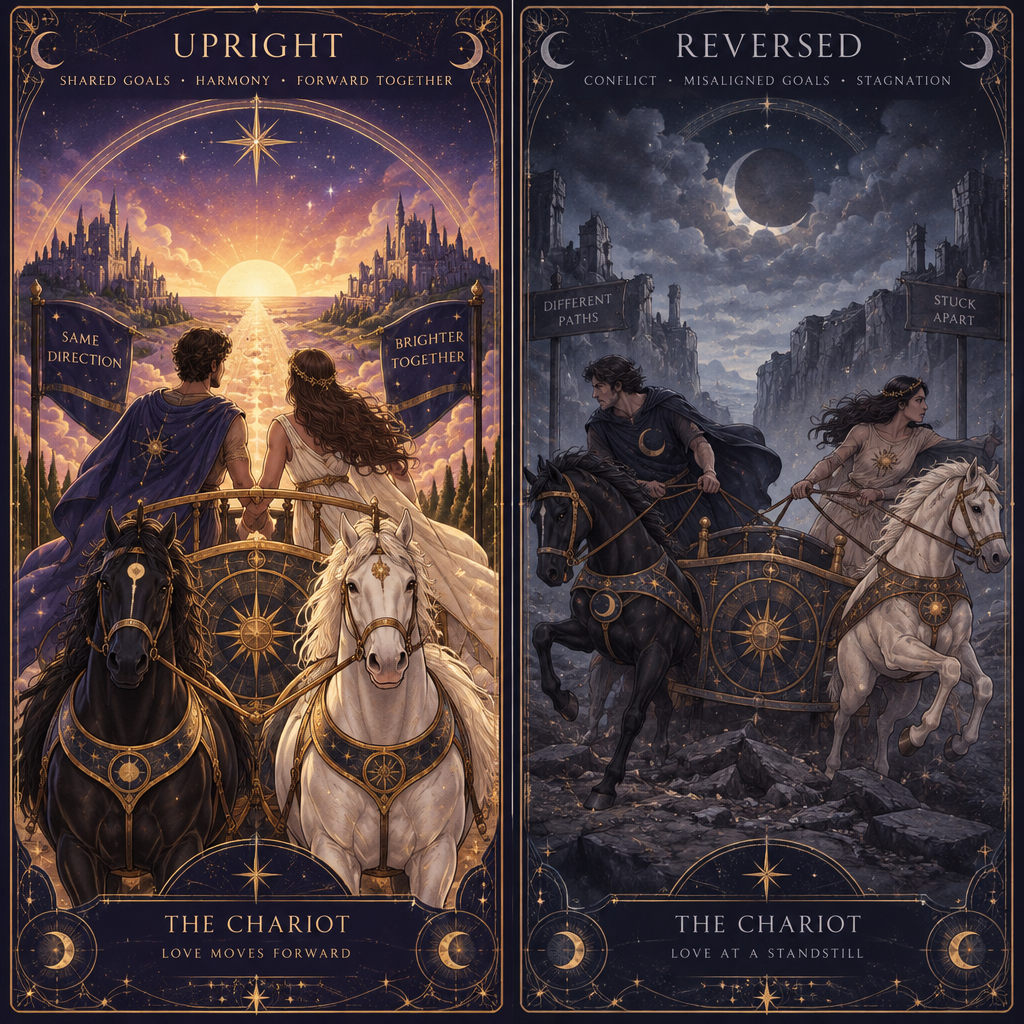
Pulling the Chariot as the outcome card in a love reading means the situation is heading somewhere, fast, and the direction depends on how well two strong wills are steered. Upright, it points to a relationship that moves forward through shared effort and clear intent. Reversed, it warns of stalled momentum, power struggles, or someone pushing too hard in the wrong direction.
Quick Reference
| Card number | VII (7) |
| Arcana | Major |
| Element | Water |
| Zodiac | Cancer |
| Upright love keywords | Forward motion, commitment, shared goals, determination, victory through effort, protective devotion |
| Reversed love keywords | Stalling, power struggles, ego clashes, aggression, avoidance, reckless pursuit, lack of direction |
| Yes or no in love | Upright: yes, if you act. Reversed: not yet |
| Timing | Often within the season, or tied to a move, trip, or decision point |
Why the Chariot Is More Emotional Than It Looks
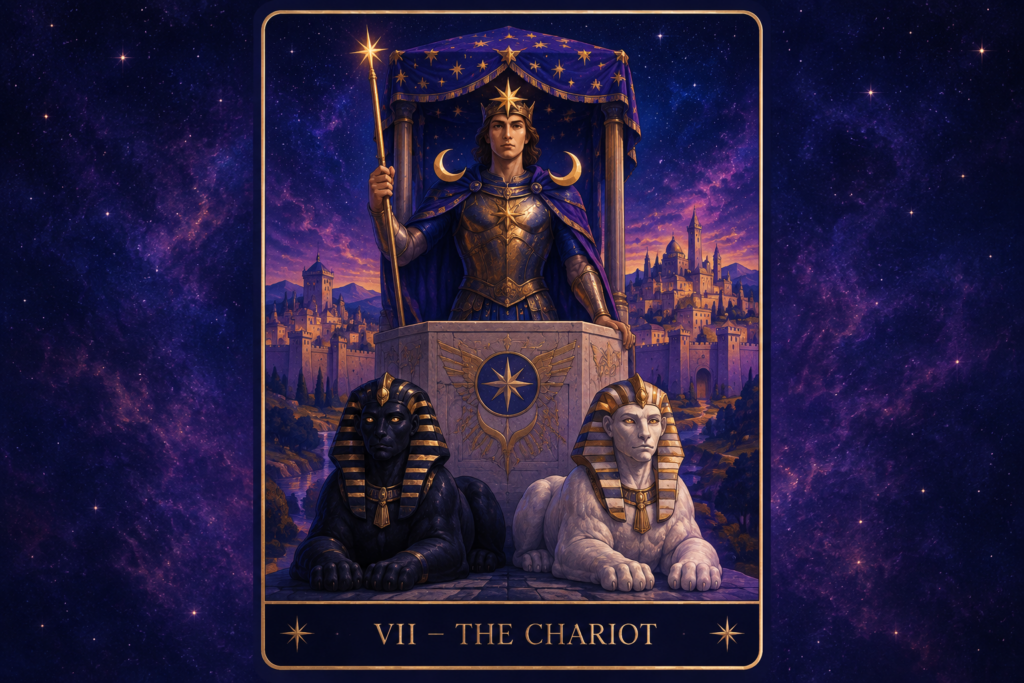
Most people see the armor and assume this is a card about conquest. In love readings that reading is shallow. The Chariot belongs to Cancer in the Golden Dawn system that underpins the Rider-Waite-Smith deck, and Cancer is ruled by the Moon. Look at the charioteer’s shoulders: two crescent moons sit there, one waxing and one waning. The star canopy above him is the night sky. This is a Water card wearing metal.
That combination tells you what the Chariot really describes in a relationship. Feelings run deep and strong, but they are held in check by discipline. The person this card represents wants to protect what they love, sometimes to the point of controlling it. They commit hard, they defend the home, and they do not let go easily. Cancer’s reputation for loyalty and its reputation for clinginess both live inside this card.
So when the Chariot lands as a love outcome, ask two questions. Where is this relationship being driven? And who is doing the driving?
The Symbolism, Decoded for Love Readings
Every element on the RWS Chariot maps onto a relationship dynamic. Reading them together gives a far more precise answer than the generic “success” interpretation.
The two sphinxes, one black and one white. These are opposing forces pulling the same vehicle. In love, they represent competing desires: independence and intimacy, passion and stability, your goals and your partner’s goals. Notice they are lying down, not straining. The card promises that opposites can be held in balance, but only by an active hand.
No reins. The charioteer controls the sphinxes with will alone. This is the single most important detail for a love outcome. The relationship succeeds through focus, intention, and steady character, not through force, ultimatums, or manipulation. If someone is gripping the reins in your relationship, the card is already tipping toward its reversed meaning.
The armored figure. Armor protects, but it also creates distance. A partner represented by this card is guarded. They show devotion through action rather than vulnerability. You will know they care because they show up, not because they say so.
The wand. Held upright, it echoes the Magician’s wand. The charioteer directs energy toward a goal. In relationship terms, this is a person who has decided what they want and is moving toward it.
The star crown and canopy. Guidance from above, or higher purpose. The relationship is aligned with something larger than momentary attraction: a shared future, a life plan, a sense of destiny.
The cubic chariot. A square, stable base. The card wants a relationship built on solid ground before speed is applied.
The walled city behind. The charioteer has left the comfort of the town. Love under this card means leaving a safe position, which can mean literal relocation, ending a comfortable single life, or stepping out of a stagnant pattern.
The winged disc and the lingam-yoni symbol on the front panel. Union of masculine and feminine principles, plus spiritual momentum. This is the card’s quiet nod toward sexual and romantic union that is purposeful rather than casual.
Is the Chariot a Yes or No for Love?
Upright, the answer is yes, with a condition attached. The Chariot never hands out effortless outcomes. It says the thing you are asking about is achievable if you commit and steer. “Will we get together?” Yes, if one of you makes a decisive move. “Will this relationship last?” Yes, if you keep pulling in the same direction.
Reversed, the answer leans toward no, or more precisely “not now, not like this.” Something is out of alignment and forcing the issue will backfire. Treat a reversed Chariot as a red light that could turn green once the underlying conflict is addressed.
Chariot as Love Outcome for Singles
Upright
Your single status is about to change because you decide it will. The Chariot rewards initiative. Someone who sends the first message, asks for the second date, or finally states what they are looking for tends to see results under this card. Passive waiting produces nothing here.
The card frequently points to a partner who arrives through movement: a work relocation, a trip, a new city, or a shift in routine. Online dating fits the Chariot’s energy well because it is a deliberate, directed search. The card favors people who use it with intent rather than idle swiping.
There is a second layer for singles that gets ignored on most pages. The Chariot is a card of individual mastery. Sometimes the outcome it describes is not a partner at all but a period where you build the confidence, career, or identity that makes you ready for one. The charioteer rides alone. If you have been rushing from relationship to relationship, this card can be the reading that says the next victory is yours alone.
Reversed
You are pulling in two directions and going nowhere. Common patterns: chasing someone who is not available, sabotaging good matches out of fear, or declaring you want a relationship while your behavior says otherwise. The reversed Chariot for singles often shows up when someone is still driving toward an ex or an idealized “type” that does not exist.
It can also flag recklessness. Moving too fast with a stranger, ignoring obvious warning signs, or treating dating as a competition to win rather than a connection to build.
Chariot as Love Outcome in a New Relationship
Upright
This is one of the better outcomes for a fresh connection. The person you are seeing is focused on you and treats the relationship as a direction, not a distraction. Expect concrete progress: introductions to friends, weekend trips, the “what are we” conversation, or a decision to go exclusive.
Long-distance couples should pay attention. The Chariot is a travel card, and in an early relationship it often signals someone who will drive four hours on a Friday night because they want to see you. It can also indicate that the distance closes: one of you moves.
The caution is pace. The Chariot has one speed, and it is fast. Two people who are both this determined can outrun their actual knowledge of each other. Enjoy the momentum, but check that the cubic base is being built underneath it.
Reversed
The new relationship is either stalling or careening. Stalling looks like someone who was enthusiastic and has gone quiet, who cancels plans, or who cannot decide what they want. Careening looks like intensity that feels performative: grand declarations, pressure to commit, jealousy showing up in week three.
Watch for early power plays. A reversed Chariot in a new relationship can reveal a partner who needs to win every disagreement, who makes all the plans without asking, or who treats your independence as a threat. These patterns rarely soften on their own.
Chariot as Love Outcome in a Long-Term Relationship
Upright
An established couple pulling the Chariot as an outcome is a couple that has a project. Buying property, moving, having a child, starting a business together, or working through a hard patch with visible progress. The card confirms that you share a destination and are both willing to work for it.
It also describes a protective, loyal partnership. Cancer energy at its best: home matters, family matters, and each partner defends the other. Couples under this card tend to present a unified front to the outside world.
If the relationship has felt stuck, the upright Chariot says the stall is ending. Something breaks the inertia, often a decision one partner finally makes.
Reversed
The long-term reversed Chariot has several distinct faces, and it matters which one you are looking at.
Different destinations. You want children, they do not. You want to move abroad, they want to stay near family. Two sphinxes pulling opposite ways, with no one in control of the chariot.
One driver, one passenger. A partner who makes every decision, controls the finances, or dictates the social calendar. The other partner has stopped steering and resents it.
Loss of momentum. Nothing is wrong, exactly. Nothing is moving, either. The couple has parked outside the walled city and never left.
Suppressed conflict. Cancer’s shadow side is avoidance. The reversed Chariot can indicate two people who have stopped fighting because they have stopped engaging. The armor is fully on and no one is getting through.
Chariot as Love Outcome for Reconciliation
Upright
Getting back with an ex under an upright Chariot is possible, but the card is specific about how. Reconciliation happens because someone takes decisive action and because the two of you agree on a new direction. Simply drifting back into old patterns is not what this card describes.
If you are the one hoping for a return, the Chariot suggests your ex is capable of the kind of determined effort a reunion requires. Often it shows them as the one who makes the approach. If you are deciding whether to go back, the card asks: has the destination changed? If the same two sphinxes are still pulling in the same opposing directions, you will end up in the same ditch.
Distance is relevant here too. The Chariot as a reconciliation outcome sometimes indicates that an ex who moved away returns, or that one of you will travel to make the reunion happen.
Reversed
Leave it. The reversed Chariot in a reconciliation reading tends to describe an ex who wants to win you back rather than be with you, or a reunion driven by ego, loneliness, or competition with your new life. It also shows up when one person is pursuing recklessly, ignoring clear signals that the other has moved on.
Sometimes it describes both people quietly wanting to reconnect but neither willing to step out of the armor and say so. Nothing moves. That paralysis is a kind of answer.
The Chariot as How Someone Feels About You
When you ask how a specific person feels and the Chariot appears, they see you as a goal worth pursuing. Their feelings are strong, focused, and probably not fully expressed in words. This person is more likely to act on their feelings than to discuss them: planning things, showing up, solving problems for you.
There is a protective, slightly possessive quality. They want to be the one who takes care of you. If that feels good, it is a promising card. If you value a lot of independence, expect some friction around it.
Reversed as feelings, the person is conflicted. They may feel attraction and resistance at the same time, or they may be more interested in the chase than in you specifically. Occasionally it reveals someone who feels they have lost control of their feelings and is overcompensating with distance or aggression.
Power Dynamics, Ego, and the Hero Problem
This is the angle that turns a decent Chariot reading into an accurate one. The charioteer is a hero figure. Heroes need something to conquer. In a relationship, that instinct can become a problem in three ways.
The chase that never converts. Some people are excellent at pursuit and lost once they have arrived. If the Chariot describes your partner and the relationship has felt like it is losing steam after the early sprint, this is why. The fix is a new shared goal, something the two of you drive toward together.
Competition inside the couple. Two Chariot personalities can start keeping score: who earns more, who sacrifices more, who is right more often. The relationship becomes a race rather than a shared vehicle.
Domination. One partner takes the wand and the other becomes a sphinx. This can be overt (controlling behavior) or subtle (one person’s career, family, and preferences always take precedence). The reversed Chariot is the classic signal.
What to do when one partner dominates: name the pattern out loud, using specific recent examples rather than general accusations. Then agree on one area where the quieter partner takes the lead completely for the next month. Small transfers of the wand rebalance a relationship faster than one large confrontation.
Self-Love and Identity Before Partnership
The Chariot is Major Arcana card seven, coming right after the Lovers (six). In the Fool’s Journey, the Lovers is the choice to unite, and the Chariot is what happens next: the individual has to develop willpower, drive, and self-command to make that union work. The sequence is not accidental.
In love readings this means the card often asks whether you have a strong enough sense of your own direction to merge it with someone else’s. People who do not know where they are going will let a partner drive, then resent it. People who are too rigid about their direction cannot accommodate a second sphinx.
If you are single and the Chariot appears, consider that the work of the next season may be entirely internal: fitness, career, healing from a previous relationship, or simply deciding what you actually want. The charioteer wins alone before sharing the victory.
Chariot Reversed in Love: The Five Faces
The reversed Chariot is not one meaning but a cluster. Identify which applies before you act on it.
- Aggression. Willpower has become force. Arguments that turn into shouting, jealousy that turns into control, a partner who has to win at any cost.
- Power struggles. Two strong people locked in a contest over decisions, money, family, or lifestyle. Neither will yield, so neither moves.
- Conflict avoidance. The Cancer shadow. Problems are ignored to keep the peace, resentment accumulates, and the relationship quietly stops going anywhere.
- Reckless pursuit. Chasing someone or something without regard to consequences: moving in too fast, pursuing an unavailable person, or abandoning a stable relationship for an infatuation.
- Dishonesty. Armor used to hide things. A partner who is directing the relationship toward a destination they have not disclosed, or who presents a controlled exterior over a very different reality.
Chariot Combinations in Love Readings
Surrounding cards sharpen the outcome. These are the pairings that come up most often in relationship spreads.
Chariot and the Lovers. Strong. Two people who have chosen each other and are actively building. Often points to commitment, engagement, or a decision to relocate together.
Chariot and Two of Cups. Mutual feelings moving into action. A first date that becomes a relationship, or a couple whose emotional bond now translates into shared plans.
Chariot and the Tower. Sudden upheaval forces movement. A breakup that launches someone into a better life, or a crisis that finally makes a couple leave a bad situation. Uncomfortable but rarely directionless.
Chariot and Strength. The two cards of will, side by side. Strength tempers the Chariot’s forcefulness with patience and compassion. A relationship that succeeds because both partners handle conflict with restraint.
Chariot and the Devil. Drive turned toward obsession. Control, jealousy, or an attachment that is hard to break. Check whether the momentum is healthy.
Chariot and Ten of Cups. The destination is the family and home. One of the clearest cards for a lasting, domestic outcome.
Chariot and Five of Wands. Competition and conflict. Two egos in the same vehicle, or a rivalry for one person’s attention.
Chariot and the Hermit. Movement toward solitude. The outcome may be a deliberate period alone, or a relationship where one partner needs significant independence.
What to Actually Do
If the Chariot is upright
- Make the move you have been delaying. Ask them out, book the trip, have the conversation about exclusivity, or put the offer in on the house.
- Define one shared goal with a date attached. The Chariot needs a destination. “We want to live together by next spring” beats “we should be more serious.”
- Check the base before adding speed. Have you had the difficult conversations about money, family, and what each of you needs? Do that this month.
- Protect without possessing. Show devotion through reliability, then step back and let your partner drive sometimes.
If the Chariot is reversed
- Identify which of the five reversed faces you are dealing with. The response to aggression is entirely different from the response to avoidance.
- Stop forcing. If you are pursuing someone or pushing for a commitment, pause for a fixed period, two to four weeks, and see what moves without your pressure.
- Schedule a real check-in. Not during a fight. Sit down with your partner and each answer one question: where do you want this relationship to be in a year? Compare the answers honestly.
- Rebalance the wand. If one person makes most of the decisions, hand one domain fully to the other partner for a month.
- If the card is about an ex, do nothing for now. Reversed Chariot reconciliation attempts tend to fail and cost you dignity.
FAQ
Is the Chariot a good card for love?
Upright, yes. It is one of the more reliable Major Arcana cards for a relationship that progresses, as long as both people are willing to put in effort and agree on where they are going. It is less comfortable than the Two of Cups or Ten of Cups because it promises work, not ease, but the work pays off.
What does the Chariot reversed mean in a relationship?
A relationship that has lost direction or is being driven badly. The most common patterns are power struggles between two strong-willed people, one partner dominating the other, conflict that is avoided rather than resolved, and reckless pushing toward a commitment or a person that is not right. Identify which pattern fits before acting.
Is the Chariot a yes or no card in love?
Upright it is a yes with a condition: you have to act. Reversed it is a no for now, meaning the current approach will not work and something needs to change before the answer can shift.
What does the Chariot mean for singles?
Take initiative. The card rewards singles who date with intention and make the first move. It often brings a partner through travel, relocation, or a deliberate search such as online dating. It can also indicate a period of building yourself up before a relationship, since the charioteer travels alone.
What zodiac sign is the Chariot?
Cancer, a Water sign ruled by the Moon. This is why the card carries so much emotional weight beneath its armored surface: loyalty, protectiveness, and attachment to home are all part of its meaning in love.
Does the Chariot mean an ex is coming back?
Upright, it is possible, and it usually happens because one person takes decisive action and the two of you agree on a genuinely new direction. Reversed, the card advises against pursuing a reunion. The motive is more likely ego or loneliness than real compatibility.