
The Five of Swords is the card of the hollow victory: someone wins the argument and loses the person. When it appears in a feelings position, the person you are asking about is caught between pride and connection, and right now pride is ahead. Here is how to read it for a crush, a new partner, a long-term relationship, and an ex, in both upright and reversed positions.
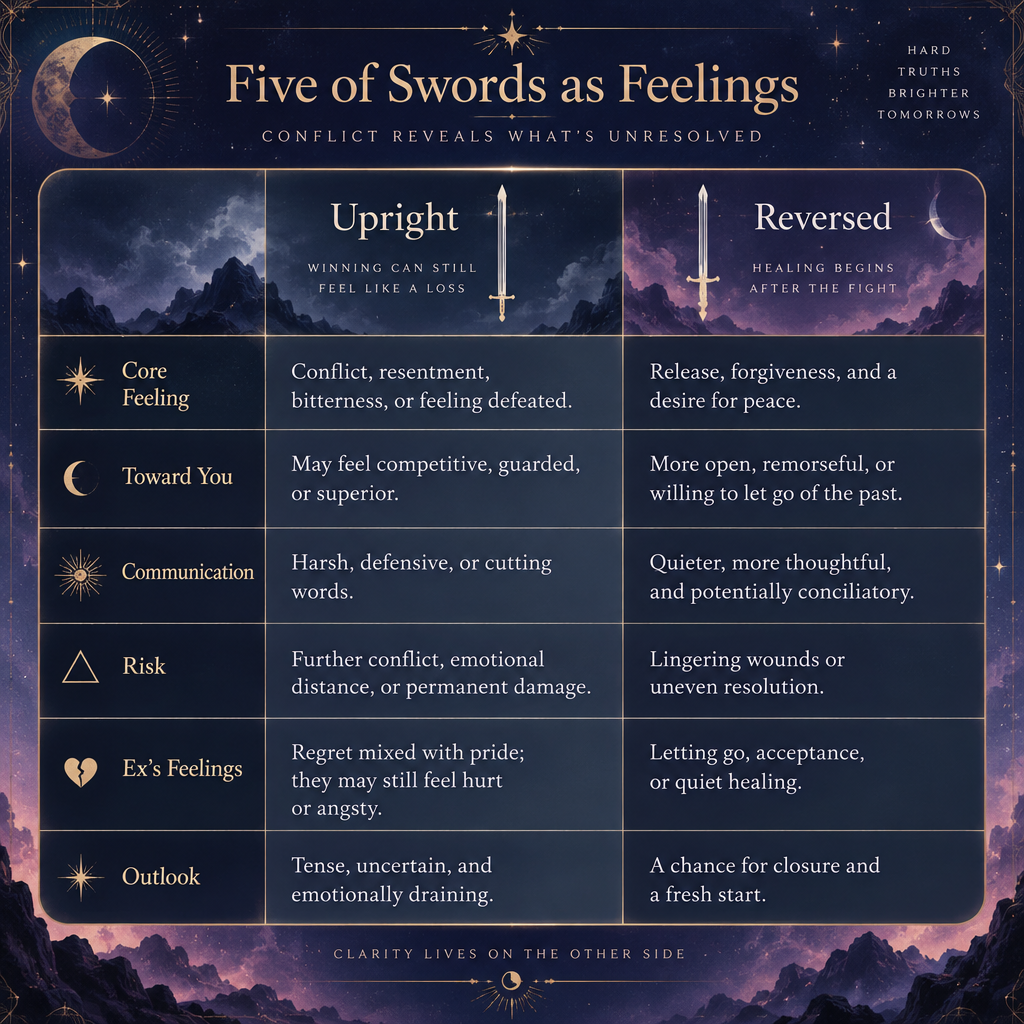
Five of Swords as Feelings at a Glance
| Upright | Reversed | |
|---|---|---|
| Core feeling | Needs to be right more than they need to be close | Regret about how they behaved, wants to repair things |
| Toward you | Guarded, competitive, irritated, scorekeeping | Softening, guilty, uncertain how to approach you |
| Communication | Sharp, point-scoring, picks at your words | Avoids the real issue, or finally admits fault |
| Risk | Resentment hardening into contempt | Passive-aggression dressed up as “keeping the peace” |
| Ex’s feelings | Still arguing with you in their head, blames you | Breakup feels settled, or quiet remorse without action |
| Outlook | Conflict will repeat unless someone drops the sword | Repair is possible if the apology turns into changed behaviour |
About the Card: Imagery, Element and Astrology
What the picture shows
In the Rider-Waite-Smith deck, a young man stands in the foreground gathering three swords, two slung over his shoulder and one held upright. Two more lie at his feet. He looks back over his shoulder with a smirk at two figures walking away from him toward the water. One of them has his head in his hands. Above them the sky is streaked with ragged, wind-torn clouds, and the sea behind is choppy.
Every piece of that scene maps onto a feeling:
- The five swords. Swords are thoughts and words. Five is too many for one person to carry well. He has taken on arguments that were never his to win and he is already struggling to hold them.
- The smirk. He thinks he has won. The smile is the tell. It is satisfaction with no warmth behind it.
- The retreating figures. The people he beat are leaving. Nobody is cheering for him. The victory has cleared the field of everyone who mattered.
- The ragged sky. The storm has passed but the air is still disturbed. Emotionally, this is the brittle quiet right after a fight when nothing has actually been resolved.
- The water in the distance. Water is feeling. It is far away and rough. The emotional connection is still there, but it is turbulent and out of reach while everyone is busy with swords.
Air element and Venus in Aquarius
Swords belong to the element of Air, which governs thinking, speech and judgment. Feelings expressed through Air come out as arguments, analysis and clever remarks rather than warmth or touch. Someone represented by this card will tell you what they think before they tell you what they feel, and often instead of it.
In the Golden Dawn system of decans, the Five of Swords is assigned to the first decan of Aquarius, ruled by Venus. Venus is the planet of love and attraction placed in the most detached, principle-driven sign of the zodiac. The result is affection filtered through ideas. This person can love you and still argue with you about the correct way to load a dishwasher as if the relationship depended on it. They attach to being right as a form of self-protection, and they can mistake intellectual dominance for emotional honesty.
The Hollow Victory Cycle
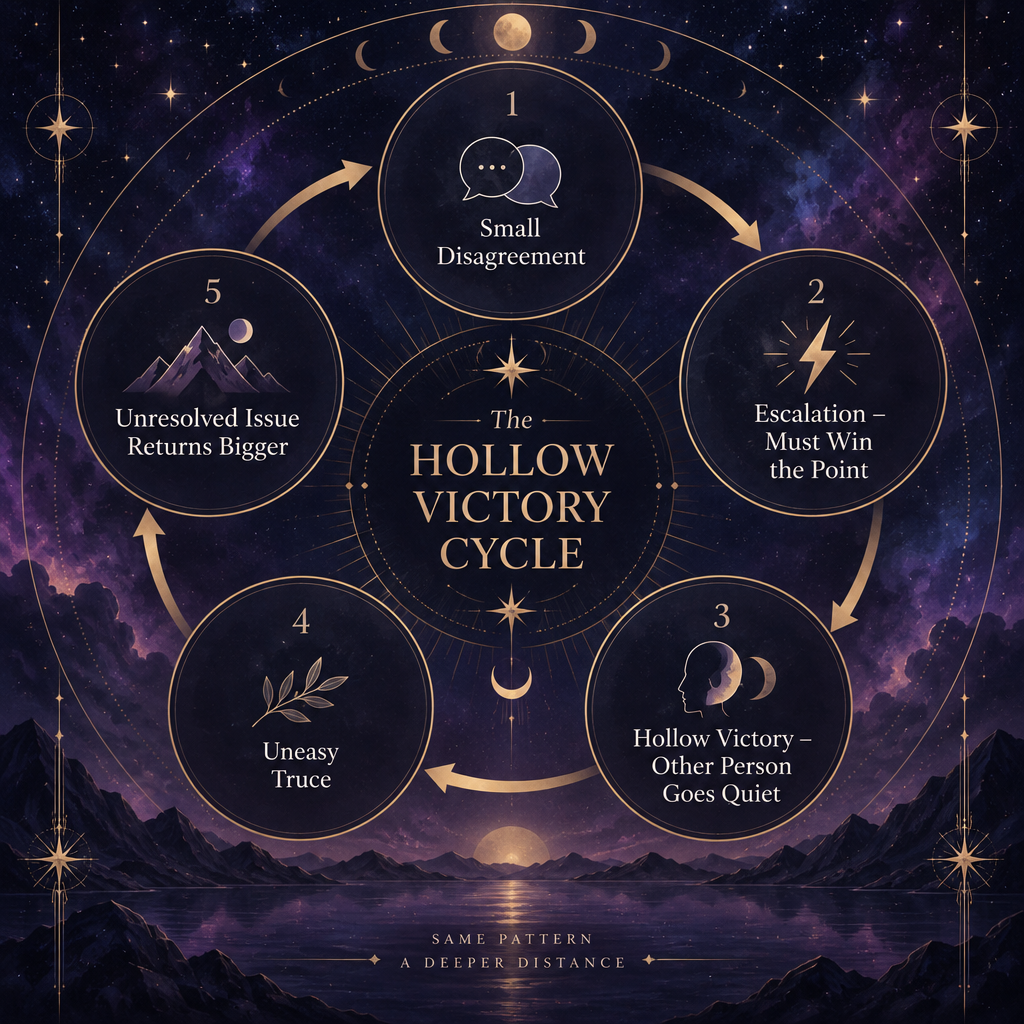
The defining pattern of the Five of Swords in love is not a single blow-up. It is a loop.
- A disagreement starts over something small.
- One person escalates, because losing the point feels like losing status.
- They “win.” The other person goes quiet or gives in.
- There is a cool, uneasy truce. Maybe an apology, maybe just a change of subject.
- The underlying issue is untouched, so it comes back, usually bigger.
Each round costs something. The first few times, the loser forgives quickly. By the tenth round, they have stopped sharing opinions at all because every opinion becomes a battle. That silence is what the retreating figures on the card represent. The man with the swords has not noticed that the people walking away are not coming back.
Relationship research gives this a frame. Caryl Rusbult’s Investment Model describes commitment as a function of satisfaction, the quality of alternatives, and how much has been invested. The Five of Swords dynamic drains satisfaction every cycle while investment keeps people tethered. That is why couples with this card can stay together for years while being quietly miserable. They are not held by love. They are held by sunk cost.
Upright Five of Swords as Feelings for You
The upright card describes someone whose feelings toward you are real but currently overridden by ego, defensiveness or a sense of grievance. Read it as “they feel strongly, and they are handling it badly.”
How a crush or potential partner feels
They are interested, and that interest makes them uncomfortable. Attraction feels like a loss of control to a Five of Swords person, so they compensate by staying one step ahead of you. Expect teasing with an edge, competitive banter, and a habit of correcting you. They may test you by disagreeing just to see if you hold your ground.
Underneath, they are wary. Either they have been burned before and are determined not to be the one who gets hurt this time, or they genuinely cannot tell the difference between flirting and sparring. If you have been wondering why someone who clearly likes you keeps picking small fights, this card is the answer. They want you, and they want to win, and they have not worked out that those two goals cancel each other out.
How a new partner feels
In the first months of a relationship, the upright Five of Swords shows someone who is already keeping score. They notice who texted first, who apologised last, who compromised on the restaurant. Rather than feeling the relationship, they are auditing it.
Their feelings toward you can be intense, but they are expressed as friction. They argue about plans, about how you phrased something, about whether you were “really listening.” Often this person is afraid of being the one who cares more, so they create conflict to prove they have not gone soft. Ask yourself whether the fights are about the actual topic. With this card, they almost never are.
How an existing partner feels
This is the heaviest placement. A long-term partner represented by the upright Five of Swords feels angry, unheard and righteous. They are convinced they are the reasonable one. They replay old arguments and rehearse better comebacks. Communication has broken down to the point where they listen for ammunition rather than meaning.
They still love you, in most cases. But the love is buried under a thick layer of “I was right about that and you never admitted it.” They may stonewall, deliver cold lectures, or bring up things from three years ago. They might also be exhausted by the fighting and quietly wondering if winning every round has left them with anything worth having. If you are asking whether they want to stay, the honest reading is that they want the relationship they imagine they could have if you would just concede. That is not the same as wanting you as you are, and that gap is the problem.
How an ex feels
An ex shown by the upright Five of Swords has not let go of the fight. They still feel the breakup was your fault, or at least that you behaved worse than they did. Resentment is active. They may be telling friends a version of events where they come out as the wronged party, and they would rather be the one who ended it, even if they did not.
Their ego is still engaged with you, which means they are not indifferent. Indifference would be a different card. This ex thinks about you, but the thoughts are argumentative, not fond. If they reach out, it is often to make a point or to win a last round rather than to reconnect. Any contact should be read with that in mind.
Reversed Five of Swords as Feelings for You
Reversed, the swords come down. The man in the picture is looking at the people walking away and realising what he traded for the win. There are two distinct reversed readings and they point in different directions. Do not blur them together.
Primary meaning: remorse, guilt, and wanting to make amends
The main reversed reading is regret. This person knows they pushed too hard. They remember the specific thing they said and they wince. They feel guilty, and the guilt is pointed at you.
What they want is a way back in that does not require them to grovel. They may send a casual message about something unrelated, hoping you will open the door. They may apologise in a roundabout way, or over-apologise and then get defensive if you do not instantly accept. The impulse is sincere. The follow-through is where you should watch. Remorse that produces a changed pattern of behaviour is worth something. Remorse that produces a nice apology and then the same argument a week later is just the hollow victory cycle with a softer soundtrack.
Secondary meaning: passive-aggression and self-sabotage disguised as peacekeeping
The second reversed reading is less flattering. Here, the person has stopped fighting openly but has not stopped fighting. They say “fine, whatever you want” in a tone that makes it clear it is not fine. They agree to things and then do them badly. They tell you nothing is wrong while giving you three days of clipped answers.
They may believe they are being the mature one by avoiding conflict. In practice they have moved the war underground. This person’s feelings toward you are a mix of hurt and a reluctance to admit the hurt, and they are losing the relationship slowly rather than quickly. It can also show self-sabotage: someone who wants you but keeps conceding so much of themselves to avoid arguments that they end up resenting you for it.
To tell the two reversed meanings apart, look at surrounding cards. Cups or the Star suggest sincere remorse. Swords, the Seven of Swords, or the Moon lean toward the passive-aggressive reading.
How a crush or potential partner feels (reversed)
They probably said or did something awkward, maybe came across as too sharp or too competitive, and now they are kicking themselves. Reversed in a crush reading often shows someone who likes you and is trying to figure out how to undo a bad first impression. They have softened. They may be unusually agreeable the next time you talk, which is them overcorrecting.
The passive version shows up as someone who backs off entirely because they would rather not risk rejection. They are not uninterested. They have decided that not trying is safer than trying and losing.
How a new partner feels (reversed)
A new partner reversed is in repair mode after an early fight. They are worried they have shown you a side of themselves they wanted to keep hidden a little longer. Feelings here are tender and slightly embarrassed. They want reassurance that one bad argument has not changed how you see them.
This is a genuinely good moment in a young relationship, if you both use it. The first real conflict and the first real repair set the pattern for everything afterwards. If they are reaching toward you rather than retreating, meet them.
How an existing partner feels (reversed)
Your long-term partner is tired of the war. The reversed Five of Swords in an established relationship usually marks the point where one person says, in effect, “I do not want to win anymore, I want us back.” They feel guilt about things said in anger and they are more willing to compromise than they have been in a long time.
It can also be a white flag raised out of exhaustion rather than love. Some partners stop fighting because they have stopped caring enough to bother. The difference shows in their energy. Remorse comes with effort: initiating conversations, suggesting counselling, changing a behaviour you have complained about. Exhausted surrender comes with flatness.
How an ex feels (reversed)
Here the reversed card diverges most sharply from the hopeful readings above. An ex shown by the reversed Five of Swords has, in most spreads, reached closure. The anger has drained out. They are not rehearsing arguments anymore. They have decided the breakup was justified, or at least necessary, and they are not actively looking to reopen it.
There may be remorse about how things ended. They might wish the last conversation had been kinder. But regret about the manner of the ending is not the same as wanting the relationship back, and reading this card as “my ex wants to reconcile” is the single most common mistake people make with it. Unless it sits beside cards like the Two of Cups, the Six of Cups or the Lovers, treat it as “they have made peace with it being over.”
How the Five of Swords Differs From Other Conflict Cards
Three Swords cards get confused in feelings readings. They describe different emotional states.
- Three of Swords is heartbreak. The pain is already done and the person is grieving. There is no fight left in it, just hurt.
- Five of Swords is the fight itself and its aftermath. The person is still armed. Pride is the active ingredient, not grief.
- Seven of Swords is avoidance and concealment. The person is slipping away or hiding something rather than confronting you.
If you pull the Five of Swords and wanted to know whether someone is sad about you, the answer is: not yet. They are still too busy being right. Sadness, if it comes, arrives later, often as the reversed card.
Five of Swords Combinations in Feelings Readings
Five of Swords + The Lovers
Strong attraction tangled up with conflict. This pairing describes a couple who argue with the same intensity they feel everything else. The connection is real and the chemistry is high, but the relationship runs on drama. It can also point to a choice: continuing to fight for the relationship versus fighting within it. Upright Lovers with reversed Five of Swords is one of the better repair combinations in the deck.
Five of Swords + The Moon
Mind games, mixed signals and a conflict where nobody is saying what they actually mean. The person you are asking about may be hiding the real reason they are angry, or they may be deceiving themselves about it. With the Moon, take the passive-aggressive reversed meaning seriously. Something is going on beneath the stated argument. Ask directly, and expect to have to ask twice.
Five of Swords + Ten of Cups
A painful combination. The Ten of Cups is the picture of family harmony, and the Five of Swords beside it shows that picture being damaged by the need to win. It often appears when conflict is affecting children, in-laws or the home itself. Reversed Five of Swords with the Ten of Cups is more hopeful: the person feels remorse specifically because they can see what the fighting is costing the family, and that is often the strongest motivator for real change.
Other pairings worth knowing
- + The Tower: the argument that ends things. A fight that cannot be walked back.
- + Two of Cups: genuine mutual feeling under strain. Worth saving if both people disarm.
- + Knight of Swords: aggressive, fast-moving conflict. Someone is charging in with words and not thinking.
- + Six of Cups: nostalgia and old grievances. The fight is really about the past.
What to Do When the Five of Swords Appears
If you are asking about a crush or someone new
Stop treating their sparring as a sign of disinterest, and stop rewarding it. The Five of Swords person responds to someone who refuses to play. When they pick a small fight, decline it without coldness: “I am not going to argue about that, but I am happy to hear why it matters to you.” That one move either disarms them or reveals that they only know how to connect through conflict. Both answers are useful.
If the card is reversed, give them one clear opening to repair the awkwardness. Not three. One.
If you are asking about a partner
The question is not “do they love me.” The question is “can they stop needing to win.” Pick one recurring argument and propose a rule for it: nobody brings up past incidents, and the goal is to understand, not to be right. Watch whether they can hold to it for a week. If they can, the hollow victory cycle is breakable. If every conversation still ends with a scoreboard, you are not in a relationship. You are in a tournament.
Reversed, take the remorse seriously but ask for it to show up as behaviour. “I appreciate the apology. What will be different next time?” is a fair question and a Five of Swords reversed person who means it will have an answer.
If you are asking about an ex
Upright: do not engage. Any contact will become a debate, and you will not win it because winning is not the point for them. Protect your peace.
Reversed: let them come to you if they are going to, and read what they actually say rather than what you hope they mean. An apology for how things ended is worth accepting gracefully. It is not an invitation to restart unless they say so plainly. If you want reconciliation, you will need to say so plainly too, because this card describes two people who have spent far too long communicating in subtext.
For yourself
Finally, check whether you are the figure holding the swords. The Five of Swords in a feelings spread sometimes describes the querent’s own stance more than the other person’s. If you have been rehearsing arguments, counting concessions or needing them to admit they were wrong, the card is talking to you.
FAQ
Does the Five of Swords mean they do not care about me?
No. Indifference would show as the Four of Cups, the Eight of Cups or an empty Court card. The Five of Swords shows someone who cares enough to fight. Their feelings are being expressed through conflict and ego rather than tenderness, which hurts, but it is not the same as absence. The problem is the delivery, not the depth.
Can a relationship survive the Five of Swords?
Yes, if at least one person is willing to stop keeping score. The card does not describe incompatibility. It describes a pattern where winning has replaced connecting. Couples break that pattern when they agree the relationship matters more than any single argument and then act on it consistently. The reversed card is the signal that this shift is beginning.
Does the reversed Five of Swords mean they want to reconcile?
Sometimes, and the distinction matters. Reversed means they regret the conflict. For a current partner or new love interest, that regret usually comes with a desire to repair. For an ex, it more often means they have found closure and feel the breakup was justified, with some remorse about how it ended. Check for Cups cards or the Lovers nearby before reading reconciliation into it.
What does the Five of Swords mean as feelings for a crush?
Attraction mixed with wariness. They like you and feel exposed by that, so they stay guarded, competitive or teasing. Reversed, they are embarrassed about having come across too sharp and want a second chance.
Is the Five of Swords a yes or no for a relationship?
Upright, it leans no, or at least “not like this.” Reversed, it is a conditional yes: the relationship can move forward if the remorse the card shows becomes changed behaviour rather than a cycle of apologising and repeating.
How is the Five of Swords different from the Three of Swords in love?
The Three of Swords is heartbreak that has already landed. The Five of Swords is the fight that may cause it. One is grief, the other is pride. If you draw the Five, there is still time to put the sword down.