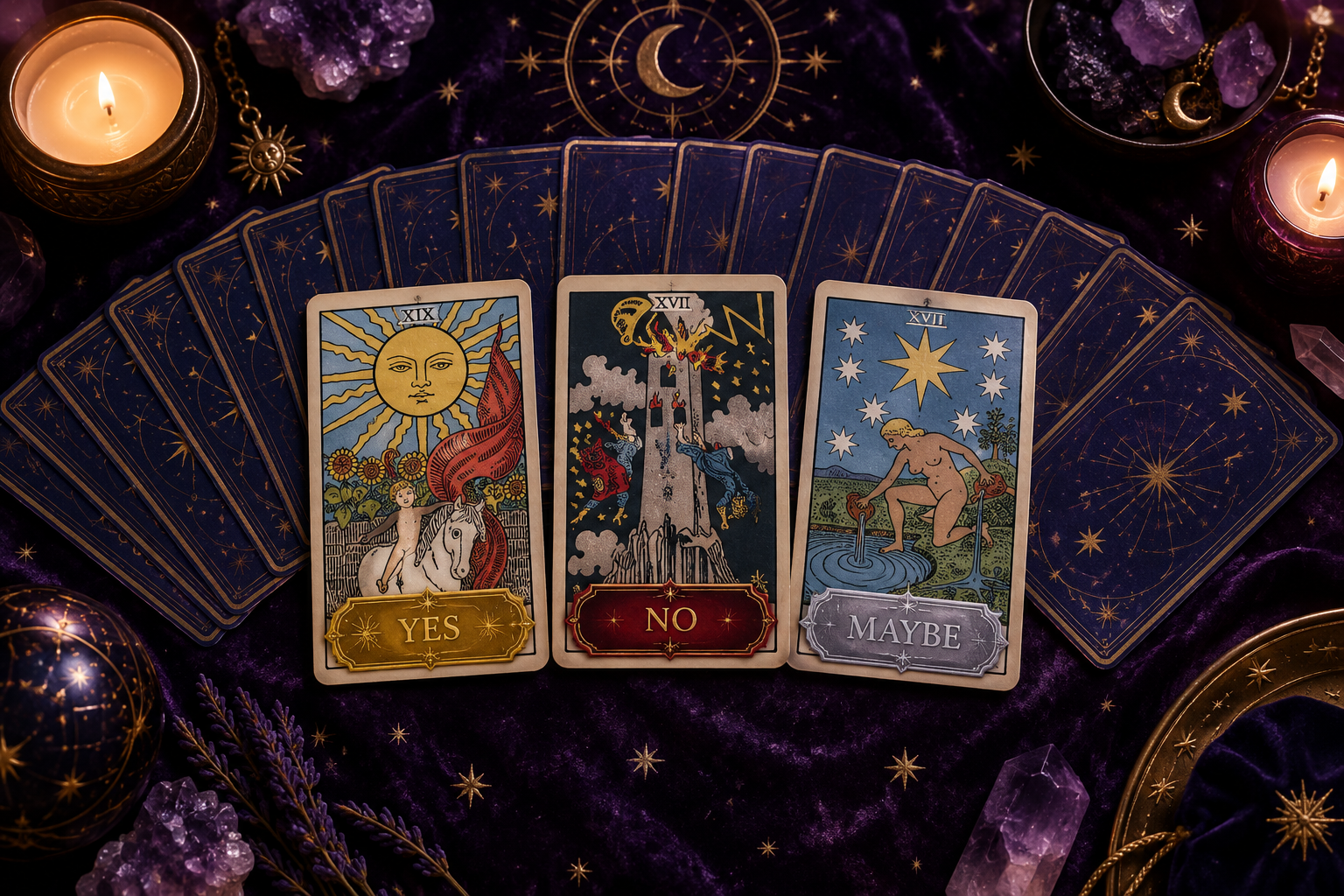
The Four of Swords upright answers “no, or not yet.” It is the tarot’s rest card, and it tells you the thing you are asking about needs a pause before it can move. Reversed, the answer flips to a cautious “yes,” because the resting period is over and you are being told to get back up.
The Quick Verdict
| Position | Yes or No | One-line reason |
|---|---|---|
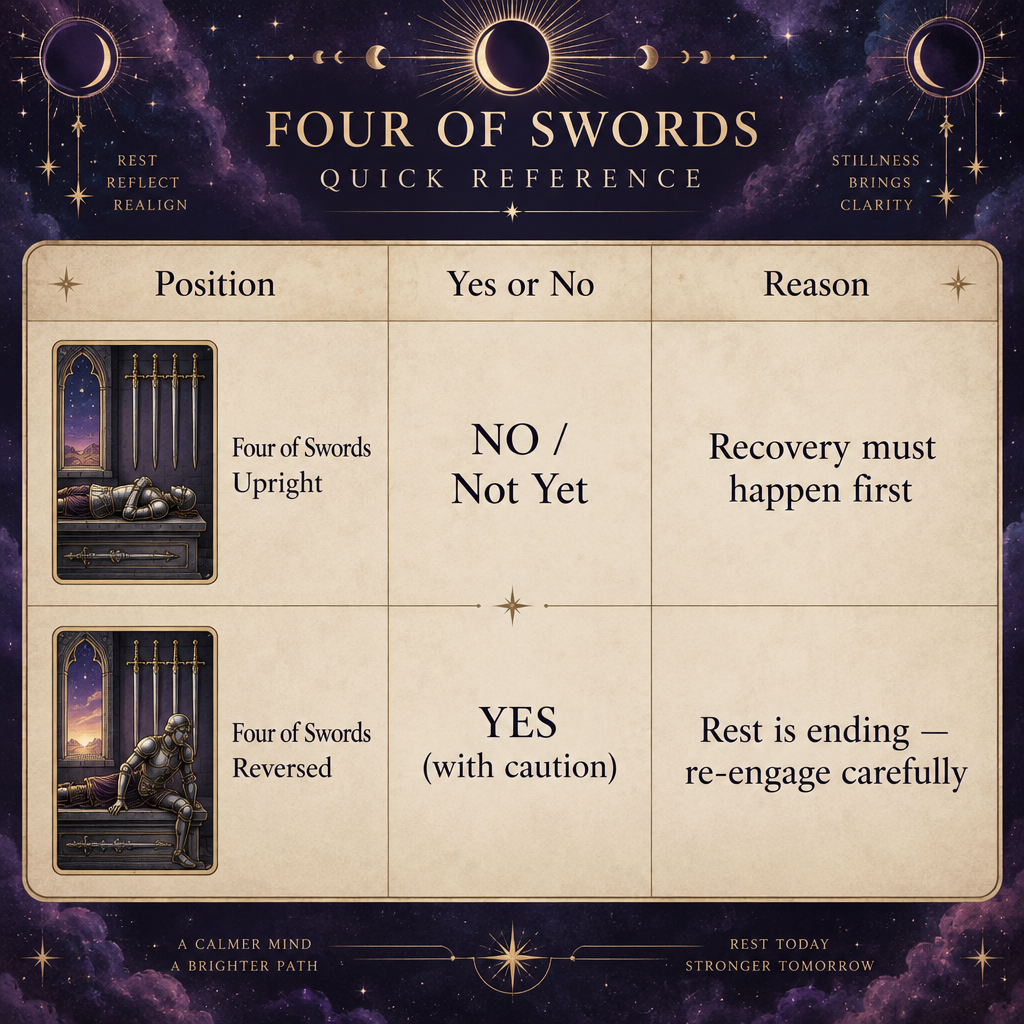
| Upright | No / Not yet | Recovery has to happen first. Acting now means acting depleted. |
| Reversed | Yes (with a caveat) | The retreat is ending. Re-engage, but check you are not just avoiding rest. |
That table is the whole card in miniature. Everything below explains why the answer lands there and how it shifts depending on what, exactly, you asked.
What the Card Shows and Why It Matters for Your Answer
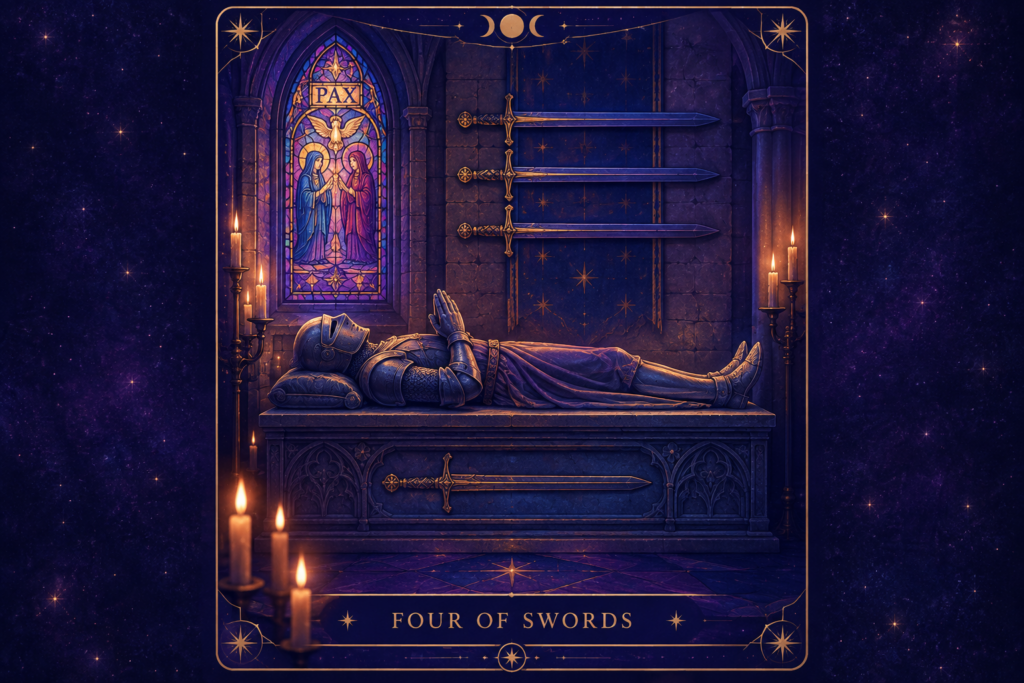
In the Rider-Waite-Smith deck, drawn by Pamela Colman Smith in 1909, the Four of Swords shows a knight lying flat on top of a stone tomb inside a church. His hands are pressed together in prayer. He is carved in effigy, which is how medieval tombs memorialised the person buried beneath. Three swords hang horizontally on the wall above him, points aimed at his head and chest. A fourth sword is carved along the side of the tomb underneath his body. Behind him, a stained-glass window shows two figures, one kneeling before the other, with the letters “PAX” (Latin for peace) worked into the glass.
Each of those details feeds the yes/no reading.
The knight is not dead, he is resting. Arthur Edward Waite’s own notes call this “vigilance, retreat, solitude, hermit’s repose.” The effigy pose is deliberate stillness, not finality. This is the core of the “not yet” answer. The card is not telling you something is over. It is telling you the person involved (often you) is temporarily out of action.
The three swords overhead are pending problems. They have not fallen. They are not in his hands. They hang there, which is what unresolved thoughts do while you try to recover. If you push forward now, you walk straight back under them. That is the “no” to action-based questions.
The single sword beneath him is the one thing he has actually settled. Fours in tarot represent stability and structure. One sword laid to rest out of four means partial resolution. The groundwork exists. It is simply not finished.
The PAX window is the goal. Peace is available, but it sits behind glass, slightly out of reach until the rest period is complete. When the card reverses, the knight effectively sits up, the window comes down to eye level, and the answer becomes yes.
“Not Yet” Is the Honest Answer Most of the Time
Readers searching “four of swords yes or no” usually want a hard binary, and most ranking pages give one. The more accurate position is that the upright Four of Swords is a timing card, and its most frequent true answer is “not yet.”
Here is the practical difference. A hard no (think Ten of Swords or Five of Pentacles upright) says the thing you want will not happen, at least not along this path. The Four of Swords says the thing you want is still possible but is currently frozen while recovery happens. The outcome depends on whether that recovery is allowed to run its course.
So when you draw it upright, read it as: the answer is no for right now, and the door reopens after a defined rest. How long? The card itself does not specify, but in practice readers treat it as weeks rather than days, and the Swords suit’s association with the mind means the rest is mental and emotional, not necessarily physical.
If you need to force the card into a binary for a one-card pull, call it no. Just know that you are rounding down.
The Answer Changes Depending on What You Asked
This is the piece most yes/no guides miss. The Four of Swords is not an absolute “no” card. It is a “rest” card, and whether rest equals yes or no depends entirely on the question.
Questions about pausing, healing, withdrawing or waiting get a yes upright.
– “Should I take the week off?” Yes.
– “Should I step back from this friendship for a while?” Yes.
– “Is it right to delay my decision until next month?” Yes.
– “Do I need to see a doctor about how exhausted I feel?” Yes.
Questions about launching, pursuing, committing or confronting get a no upright.
– “Should I launch my business this quarter?” No, not yet.
– “Should I text them tonight?” No.
– “Will I get the job if I apply this week?” Unlikely, because you are not presenting at full strength.
– “Should I have the hard conversation now?” No, wait until you are rested.
Reversed, the logic inverts. Questions about continuing to withdraw get a no (you have rested long enough, or you are hiding). Questions about re-engaging get a yes.
Before you record the answer, write down the question as you actually phrased it. If it contains words like “rest,” “pause,” “break,” “wait” or “heal,” the upright card is almost certainly agreeing with you.
Upright and Reversed Keywords
Upright
| Keyword | How it shapes the yes/no |
|---|---|
| Rest | Action questions get no |
| Contemplation | Decisions need more thinking time |
| Recovery | You are rebuilding after strain |
| Retreat | Step away from the situation |
| Reflection | Review before you proceed |
| Renewal | Something better follows the pause |
| Sanctuary | Protect your energy from others’ demands |
| Stillness | Nothing moves yet, by design |
Reversed
| Keyword | How it shapes the yes/no |
|---|---|
| Rejuvenation | Energy has returned, yes to re-entry |
| Restlessness | You want to move; check it is readiness, not impatience |
| Burnout | Rest was refused and the body is now forcing it |
| Re-engagement | Yes to returning to work, love, or social life |
| Avoidance | The retreat became hiding; yes to facing things |
| Awakening | Mental clarity after confusion |
| Overexertion | Warning that yes should be a measured yes |
Notice the reversed list contains both positive and negative words. That is not indecision. The reversed Four of Swords has two distinct faces, and surrounding cards tell you which one you are looking at. With supportive cards (Six of Wands, The Sun, Ace of Wands) it is the recovered knight standing up. With stressed cards (Nine of Swords, Ten of Wands, The Tower) it is someone who refused to lie down and is now collapsing. Both still answer “yes” to re-engagement, but the second version adds “and deal with your exhaustion while you do it.”
Four of Swords Yes or No in Love
Upright: No, not yet
If you are asking whether a relationship will start, progress, or reconcile, the upright Four of Swords says the timing is wrong. One of you is depleted. Often the querent has been doing the emotional heavy lifting and needs to stop pursuing for a while.
For singles asking “will I meet someone soon?”, the answer is no for the immediate future. The card wants you to spend this stretch alone on purpose. That is not a punishment. Dating while running on empty tends to attract people who like you tired and agreeable.
For couples asking “should we take a break?”, this is one of the few love questions where the upright card says yes. A deliberate, time-limited pause is exactly what it depicts.
For “will my ex come back?”, read it as: not now, and possibly not until both of you have done your own processing. The three swords overhead are the unresolved issues that ended things. They are still hanging.
Reversed: Yes
Reversed in love, the card signals the end of a dry spell or a cooling-off period. The person who withdrew is ready to return. If you asked “should I reach out?”, yes. If you asked “is the relationship worth another try?”, yes, with the condition that you talk about what caused the exhaustion in the first place.
Watch for the burnout face of the card here. Reversed with the Five of Cups or the Three of Swords nearby, the “yes” is someone rushing back into contact because being alone feels unbearable, not because anything has healed.
Four of Swords Yes or No in Career
Upright: No, not yet
This is where the old version of this page contradicted itself, so to be plain: the upright Four of Swords is a no for career action. Do not apply, launch, pitch, resign, or confront your manager on the strength of this card.
The reasoning is simple. The card indicates that you are operating at reduced capacity. A job interview taken this week will not show your best self. A business launched now will be launched by someone who has not thought through the three unresolved problems hanging over the plan. The card is protecting you from being judged on a weak performance.
Questions where the upright card says yes in a career context:
– “Should I take my annual leave now?” Yes.
– “Should I decline the extra project?” Yes.
– “Is it wise to pause the job hunt for a month?” Yes.
Questions about promotions and raises get a no for the immediate term. The card suggests you have been visible for your effort rather than your results, and the results come after you recover.
Reversed: Yes
Reversed, you are being told the sabbatical, sick leave, or quiet period is over. Yes to applying. Yes to the project. Yes to going back after a career break. The card reversed often appears for people returning from parental leave, burnout leave, or a period of unemployment, and it confirms the timing is right.
The caveat is pacing. Reversed with the Ten of Wands or the Knight of Swords, the yes comes with a warning that you are about to overcommit and land straight back where you started.
Four of Swords Yes or No in Health
Upright: Yes to rest, no to pushing through
The Four of Swords is arguably the most literal card in the deck for health questions. It shows someone lying down. If you asked “do I need to rest?”, “should I take sick leave?”, or “is this exhaustion something I should take seriously?”, the answer is a firm yes.
If you asked “can I keep training through this injury?” or “is it fine to skip the appointment?”, the answer is no.
The card frequently appears around recovery from surgery, illness, or periods of severe stress and anxiety. Because Swords govern the mind, upright it is especially relevant to mental health. Insomnia, racing thoughts, and the inability to switch off are all classic Four of Swords territory, and the card’s advice is structured rest: meditation, reduced screens, a quiet environment, and medical input if the exhaustion is prolonged.
Tarot does not diagnose, and no card replaces a clinician. What the Four of Swords does is validate that the fatigue is real and that ignoring it has a cost.
Reversed: Yes to recovery, with a burnout warning
Reversed in a health context has two readings and the surrounding cards decide. The positive version: you are recovering, energy is returning, and the answer to “am I getting better?” is yes. The negative version: you have refused to rest, and the body is now forcing a stop. Reversed with the Nine of Swords or the Ten of Swords, the card is pointing at burnout or a stress-related crash.
Either way, “should I get back to normal activity?” gets a qualified yes: gradually.
Four of Swords Yes or No for Money and Finances
Upright: No to spending, yes to holding
The upright card is conservative with money. Waite’s reversed meanings for this card included “wise administration, circumspection, economy,” and in modern practice readers apply that cautious energy to the upright position as a hold signal.
- “Should I make this large purchase?” No, wait.
- “Should I invest now?” No, not yet. Review the three unresolved concerns first.
- “Should I lend money to this person?” No.
- “Should I build up my emergency fund before anything else?” Yes.
- “Is it a good time to pause discretionary spending?” Yes.
The card also appears when financial stress itself is the problem. Lying awake doing mental arithmetic is exactly the three-swords-overhead image. The advice is to stop looping, write the numbers down once, and then step away from them.
Reversed: Yes, cautiously
Reversed, money can start moving again. Yes to the investment you researched during the pause. Yes to re-entering a market you stepped out of. Yes to spending on something that was deferred during a lean period. The burnout face appears here as impulsive spending after a long stretch of restriction, so if the Four of Swords reversed sits next to the Devil or the Seven of Cups, slow down.
Four of Swords Yes or No for Family and Friendships
Upright: Yes to space, no to confrontation
Family questions put the Four of Swords in its sanctuary role. If you asked “should I take a break from the family group chat?”, “is it okay to skip this gathering?”, or “should I stop being the one who fixes everything?”, the answer is yes.
If you asked “should I raise the old grievance at dinner?” or “is now the time to resolve the feud with my sibling?”, the answer is no. The three swords are three unspoken resentments, and bringing them up when everyone is tired makes them fall.
For questions about someone else, such as “will my parent recover?” or “is my friend going to be okay?”, the card suggests the person is in a healing phase and needs quiet rather than intervention. The answer is “yes, but not on your timeline.”
Reversed: Yes to reconnection
Reversed, the estrangement or distance ends. Yes to reaching out to the friend you drifted from. Yes to attending the event you avoided. Yes to the family member coming back into contact after a long silence. The avoidance face of the card shows up when someone has been hiding from a family responsibility; reversed, it says the hiding stops now.
Four of Swords Yes or No for Spiritual Questions
Upright: Yes
This is the one area where the upright card is almost always a yes. The knight is in a church with his hands in prayer. The window reads “peace.” If you asked “should I start a meditation practice?”, “should I go on retreat?”, “is it right to step back from my busy life to reflect?”, or “am I on the right spiritual path?”, the upright Four of Swords affirms it.
The card specifically favours contemplative, inward practices: silent meditation, journaling, prayer, solitary time in nature. It is less supportive of outward spiritual activity such as joining a new community or taking on a teaching role, which it would push back to “not yet.”
Reversed: Yes to integration
Reversed, the retreat is complete and the question becomes how to bring what you learned back into ordinary life. Yes to teaching, sharing, or joining a group. The warning version is spiritual bypassing: using meditation or retreat to avoid real problems. Reversed next to the Moon or the Seven of Cups, the card says the practice has become a hiding place.
Zodiac, Element and Numerology
The Four of Swords belongs to the Minor Arcana, suit of Swords, element of Air. Air governs thought, communication, and mental activity, which is why this card’s rest is mental before it is physical. You are being told to stop thinking so hard, not necessarily to stop moving.
In the Golden Dawn system, which most modern tarot astrology follows, the Four of Swords is assigned to Jupiter in Libra, covering the third decan of Libra (roughly 13 to 22 October). Libra brings balance, fairness, and the need to weigh options before choosing. Jupiter brings expansion and wisdom. Together they describe a period of rest that produces a bigger, fairer perspective, which is why the “not yet” is not wasted time. The decision you eventually make after the pause is better than the one you would make now.
Numerologically, fours are stability, foundation, and structure. The Four of Swords is the mind finding a stable floor after the conflict of the Three of Swords and before the dishonest manoeuvring of the Five. It is the exhale between two hard cards.
How Surrounding Cards Change the Answer
A one-card pull gives you the base verdict. A spread refines it.
Cards that soften the no into “soon”: Ace of Wands, The Star, Six of Swords, The Sun, Three of Wands. The rest is nearly complete and the yes is on the horizon.
Cards that harden the no: Ten of Swords, Five of Pentacles, Eight of Swords, The Hanged Man. The pause will be longer than you want, or the situation is more stuck than the Four alone suggests.
Cards that explain why you need the rest: Ten of Wands (overwork), Nine of Swords (anxiety), Three of Swords (heartbreak), Five of Wands (conflict). The Four is the response to whatever that card describes.
The Tower with the Four of Swords: Read this as a collapse that forces rest. If the Tower comes first, the rest is recovery from an upheaval. If the Four comes first and the Tower follows, the warning is that refusing to rest will end in a forced stop. In both orders the yes/no answer is no.
Reversed Four of Swords with other reversed Swords: The burnout reading dominates. The yes to re-engagement still stands, but the primary message is that your mental state needs attention before anything else.
What to Do After Drawing This Card
Upright:
1. Identify the three things hanging over you. Write them down. Do not try to solve them tonight.
2. Set a defined rest period with an end date. Open-ended rest becomes avoidance.
3. Reduce input: fewer decisions, fewer conversations, less news, less scrolling.
4. Revisit the question at the end of the period. Pull again if you want confirmation.
Reversed:
1. Check your motive honestly. Are you ready, or just bored of resting?
2. Re-enter at 70 percent, not 100. The card’s warning is relapse.
3. If the burnout face applies, re-engage with the one most important thing only and delegate or drop the rest.
Quick Reference: Upright vs Reversed by Life Area
| Area | Upright | Reversed |
|---|---|---|
| Love | No / not yet. Take space. Yes only to a planned break. | Yes. Reach out, reconcile, re-enter dating. |
| Career | No to applying, launching, confronting. Yes to leave or declining work. | Yes to returning, applying, taking the project. Pace yourself. |
| Health | Yes to rest and seeking help. No to pushing through. | Yes, recovering. Or burnout warning if stressed cards appear. |
| Money | No to spending, investing, lending. Yes to holding and saving. | Yes to measured spending and re-entering investments. |
| Family | Yes to distance. No to raising old conflicts now. | Yes to reconnection and showing up. |
| Spirituality | Yes to meditation, retreat, inward practice. | Yes to integration, teaching, community. |
| General | No / not yet | Yes, with a check on burnout |
FAQ
Does the Four of Swords mean yes or no?
Upright, it means no, or more precisely “not yet.” Reversed, it means yes. The exception is any question about rest, pausing, or healing, where the upright card says yes because rest is what it recommends.
Is the Four of Swords a good card?
It is neutral to mildly positive. It is not a disaster card. It shows recovery, which implies something was hard, but the knight is alive and peace (PAX) is visible in the window. In a reading about health or stress it is reassuring. In a reading about fast progress it is frustrating.
What does the Four of Swords mean in a love reading?
Upright, one person needs space and the relationship is on pause. Singles are advised to spend time alone before dating. Reversed, the pause ends and reconnection is favoured, provided the original exhaustion gets addressed.
What zodiac sign is the Four of Swords?
Libra, specifically the Jupiter in Libra decan (around 13 to 22 October) in the Golden Dawn attribution. Its element is Air.
How long does the “not yet” last?
The card does not give a fixed timeframe. In practice readers interpret it as a matter of weeks, and the length depends on how fully you commit to the rest. Half-resting prolongs it.
What does the Four of Swords reversed mean as a warning?
Reversed, the card carries a burnout warning when it appears alongside stressed cards like the Nine of Swords or Ten of Wands. It indicates someone who refused to rest and is now being forced to, or someone who is restless and re-engaging before they are ready.
Does the Four of Swords mean someone is thinking about you?
Not in the way the Six of Cups or the Page of Cups does. The Four of Swords as feelings indicates the person has withdrawn into themselves and is processing. They are not actively avoiding you, but they are not reaching out either. Reversed, they are emerging and contact becomes more likely.