


When Justice lands in the “how do they feel about me” position, the answer is measured rather than swooning: this person is weighing you, and their feelings are a direct response to how you have treated them. This guide covers Justice upright and reversed as feelings for a crush, a partner, an ex, and a friend, plus how someone sees you, a yes-or-no verdict, and what to actually do next.
The short version
Justice as feelings means the person is being fair with you in their own head. They have tallied your actions, good and bad, and their emotions match the balance. If you have shown up honestly, they feel steady respect, trust, and a growing sense that you are someone worth committing to. If you have been careless or unfair, they feel exactly as cool toward you as that behaviour deserves.
It is not a passion card. It is a card of considered, earned feeling. Many querents find that frustrating because they want fireworks. It is often read as one of the most reliable signals of a person who intends to treat you properly, which outlasts fireworks every time.
Reading the imagery for a feelings question
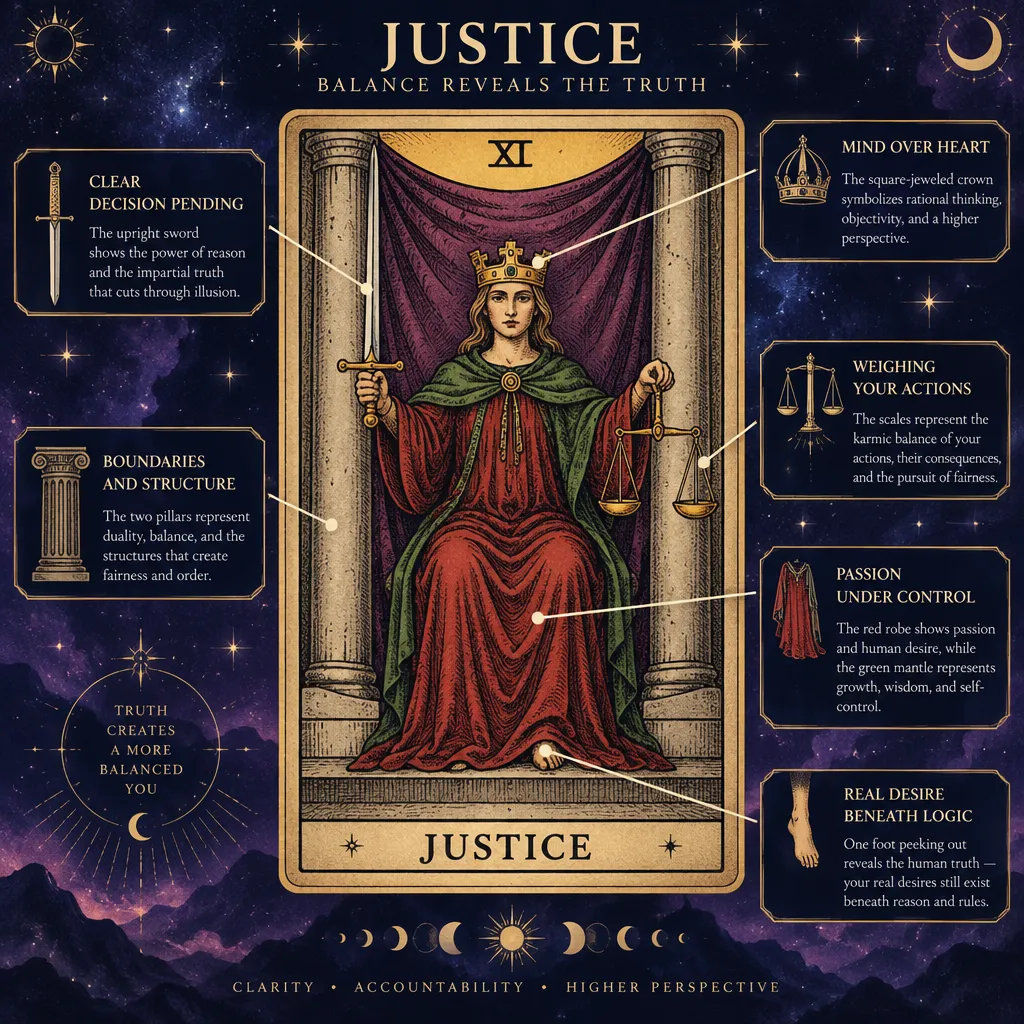
Arthur Edward Waite’s 1910 Pictorial Key to the Tarot places Justice at XI, swapping it with Strength from the older Marseille order, and describes a seated figure with “the pillars of Justice” behind her. Every detail on the Rider-Waite-Smith card tells you something about how this person is feeling.
- The scales in the left hand. They are literally weighing you. Pros against cons, words against actions, what they give against what they get. The feelings follow the tilt of the scales.
- The upright sword in the right hand. Clear thinking and the willingness to make a cut. If the relationship is unfair, this person will end it rather than drift. The sword is held straight up, meaning the decision has not yet been made, but it could be.
- The crown with a square jewel. Clarity of mind over heart. They are thinking about you more than they are daydreaming about you.
- The two pillars and the purple veil. The pillars are the structure of the relationship: boundaries, rules, expectations. The veil hides what lies beyond, which is why Justice as feelings often means a decision is forming privately before it is spoken.
- The red robe and green mantle. Red is passion and action; green is growth and the heart. The passion is there, but it sits under a layer of control. This is someone who could love you deeply, on their terms.
- The one foot peeking out. A small reminder that the person is not purely cerebral. Beneath the robe there is a real body and real desire, just kept in check.
Libra, Venus and Air: why Justice feels cool rather than cold
Justice is assigned to Libra in the Golden Dawn system that most modern decks inherit. Libra is ruled by Venus, the planet of love, affection and partnership, but it is an Air sign, so that love is processed through the mind. The combination explains the card’s texture as a feelings card: genuinely relational, genuinely interested in partnership, but expressed through fairness, reciprocity and conversation instead of grand declarations.
A Libra-flavoured heart wants balance. This person is bothered by inequality in a way that a Fire-type (The Sun, Strength) or Water-type (The Lovers, Two of Cups) person simply is not. If you reply to their texts a day late, they notice. If you remembered a detail about their week, they notice that too and quietly credit it. The Air element also means they talk their feelings through before acting on them, often with a friend or a journal. Expect them to be deliberate.
The karmic layer: you get back what you put in
The oldest meaning of Justice is cause and effect. In a feelings position it says: their emotions toward you are the consequence of your behaviour toward them, nothing more and nothing less. This is both comforting and uncomfortable.
Comforting, because you are not being judged on looks, status or luck. If you have been kind, honest and consistent, the card promises those things are being returned as warmth and loyalty.
Uncomfortable, because if you ghosted them for three weeks and are now wondering why they feel distant, Justice is answering: that is why. The card does not punish; it simply reflects. The practical upshot is that you have more control over this person’s feelings than almost any other card in the deck would grant you. Change the input and the scales shift.
Justice upright as feelings
For singles and crushes
Your crush is sizing you up. They have noticed you, and they are deciding whether what they have seen adds up to someone trustworthy. Attraction is present but subordinate to evaluation. This person wants to know whether you are honest, whether you treat waiters and friends well, whether your stories hold together.
What this means in practice: they will be slow. They may seem lukewarm while they are actually quite interested, because they refuse to commit emotionally until the evidence is in.
Action steps:
- Be consistent. Same person on Tuesday as on Saturday night.
- Do not oversell. Exaggeration registers as dishonesty to a Justice type and sets the scales against you.
- Ask a direct question if you want a direct answer. This person respects straight talk and will usually give it back.
In a new relationship
Justice in the early months means your partner feels the relationship is fair and is relieved by that. They are keeping a light mental ledger: who initiated, who apologised, who made the effort. If the ledger is balanced, they are starting to picture a future. They are not yet in love in the headlong sense, but they are moving toward commitment by choice rather than by chemistry, which tends to last.
Watch for a second meaning: they may feel something is slightly off balance and be waiting to see whether it corrects itself. Justice rarely shouts. It waits a reasonable period, then acts.
Action steps:
- Have the “what do we each want from this” conversation early. They will welcome it.
- If you owe an apology, give it plainly. Partial apologies fail with this card.
- Match effort rather than overfunctioning. Doing too much creates its own imbalance.
In a long-term relationship
Here Justice as feelings is about accountability. Your partner feels committed, loyal, and bound to you by a promise they take seriously. They also feel every unresolved unfairness: the chore split, the money conversation that never happened, the time you dismissed their worry. These are not deal-breakers yet, but they are on the scales.
Positive reading: they feel the partnership is honourable and they are proud of it. Legal or formal steps (marriage, a mortgage, joint finances) often appear alongside this card because the person’s feelings have moved into the territory of binding agreements.
Cautionary reading: they feel they have been more fair to you than you have been to them, and they are waiting for the account to be settled.
Action steps:
- Ask directly: “Is there anything you feel is unequal between us right now?” Then listen without defending.
- Settle one concrete imbalance within the week.
- Put commitments in plain terms. Vagueness unsettles a Justice partner.
Justice reversed as feelings
Reversed Justice flips the scales, and the feelings become distorted by a sense of being wronged, or by a refusal to look honestly at one’s own part.
The most common reversed meaning is the person feels treated unfairly. They believe they have given more than they received, been judged harshly, or been lied to, and their emotions have hardened into resentment. They may not have said this out loud. Reversed Justice often sits in silence, building a case.
The second meaning is guilt and avoidance. The person knows they have behaved badly toward you and feels it, but instead of making amends they are dodging the conversation, minimising, or disappearing when the subject comes up. Their coldness is shame wearing a mask of indifference.
The third meaning is blame-shifting. They have rewritten the story so that the problems are your fault. Feelings here are defensive and self-justifying. Arguments with this person go in circles because they are not actually weighing evidence; the verdict was reached first.
The fourth is emotional imbalance, with feelings that swing from intense to absent. They may be in love one week and detached the next, and the inconsistency is itself the message: they have not found their own equilibrium, so they cannot offer you a stable one.
A fifth, less discussed reading is feeling judged by you. If you have been critical, score-keeping or quick to punish, reversed Justice can describe a partner who feels they can never measure up and has started to withdraw to protect themselves.
How to tell which applies: look at the cards flanking it. The Five of Cups or Three of Swords alongside reversed Justice points to being wronged. The Seven of Swords or The Moon points to guilt and concealment. The Five of Wands points to blame and conflict. The Two of Pentacles reversed or The Tower points to instability.
Action steps for reversed Justice:
- Stop litigating who is right. Ask instead what each of you needs to feel the balance restored.
- If the guilt is yours, own it fully in one conversation. Dragged-out partial admissions make it worse.
- If the person refuses accountability over several honest attempts, take the sword seriously. Justice reversed can mean the fair outcome is to walk away.
Justice as feelings for an ex: will they come back?
Justice is one of the more hopeful cards for reconciliation, with a condition attached. Your ex feels the breakup was either fair or unfair, and that judgement shapes everything.
If they feel the ending was fair, meaning the issues were real and the parting was honest, they hold you in a kind of respectful neutrality. They are not angry. They remember you accurately, flaws and gifts both. A return is possible if circumstances change, but it would need to be built on a clearly different foundation. They will not come back for the same relationship.
If they feel the ending was unfair to them, they still carry a grievance, and they want it acknowledged before anything else. Reconciliation starts with an apology that names the specific harm. Grand romantic gestures will not work; they read as evasion.
If they feel the ending was unfair to you, Justice can indicate an ex who knows they owe you something. They may reach out to make amends. Whether that becomes a rekindling depends on whether both of you want the relationship or just want the ledger closed.
The karmic reading applies strongly here. Justice says whatever happens between you and your ex next will be the natural consequence of how you each behaved during and after the split. If you behaved honourably, expect that to be returned. If the breakup was messy on your side, reversed Justice as your ex’s feelings suggests resentment that will take time and real repair to clear.
In a reconciliation spread
When Justice appears as the ex’s feelings in a reconciliation reading, treat it as a conditional yes. The door is not locked, but there are terms. Common supporting cards: the Six of Cups (nostalgia, genuine fondness) strengthens the chance; Judgement (a second chance consciously chosen) strengthens it further; the Eight of Cups or Ten of Swords beside Justice means they have weighed it and decided to stay gone.
Action steps:
- Write down, honestly, what you did that contributed to the breakup. Justice demands you weigh your own side first.
- If you reach out, lead with accountability, not with how much you miss them.
- Set a time limit. If there is no movement toward balance within a few months, let the sword fall and move on.
Justice as how someone sees you
Upright, the person sees you as fair, honest and trustworthy. They believe you keep your word. They may also see you as a bit serious or exacting, someone who holds high standards and expects others to meet them. For a crush, that perception reads as “marriage material, but intimidating.” For a partner, it reads as “the person I can rely on.”
A second upright perception is that you are the one who decides. They may feel you hold the power in the relationship, or that you are evaluating them. If you have been noncommittal, they might see you as a judge they are waiting on.
Reversed, they see you as unfair, biased or hypocritical. They may think you apply rules to them that you do not follow yourself, or that you have judged them without hearing their side. Reversed Justice as “how they see you” is a strong prompt to check whether you have been keeping score more than you have been listening.
Action steps:
- Ask yourself whether your standards for them match the standards you hold for yourself.
- If you are perceived as the judge, consider whether you have actually told them where you stand.
- Reversed: invite them to tell you where they feel misjudged, and resist the urge to correct the record mid-sentence.
Justice as someone’s intentions
Asked about intentions rather than feelings, Justice is straightforward: they intend to do right by you. They want things above board, clearly defined, and mutual. They are not playing games. This often includes an intention to formalise the relationship, to have the status talk, or to settle an outstanding issue honestly.
Reversed, intentions are murkier. The person may intend to avoid responsibility, to get out of a commitment without being blamed, or to keep the relationship uneven in their favour. Reversed Justice as intentions pairs badly with the Seven of Swords and the Magician reversed; together they describe someone constructing a convenient version of the truth.
Justice in friendships and platonic readings
Pulled for a friend’s feelings, Justice shows a person who values the friendship because it is reciprocal. They feel you are a fair friend, one who shows up when you say you will and splits the bill honestly. Loyalty here is strong but conditional on continued fairness; this is the friend who will quietly step back if the relationship becomes one-sided, rather than explode.
Reversed, a friend feels taken for granted. They have probably been counting the favours, the cancelled plans, the times they listened to your crisis and you did not return the call. The feeling is less anger than disappointment. The fix is the same as in romance: acknowledge the imbalance specifically and correct it with actions.
For a situation where a friend might become more, Justice says they are weighing whether crossing that line would be fair to the friendship. They are cautious and would want to talk it through rather than let it happen.
The neutral reading: respect, not romance
Sometimes Justice as feelings simply means the person feels respect and goodwill without romantic love. They see you clearly, think well of you, and would treat you honourably, but the scales are level rather than tipped toward desire. You may recognise this reading if the rest of the spread lacks Cups or if the person has been friendly, reliable and entirely unflirtatious.
The tell is the absence of any supporting passion card. Justice beside the Knight of Cups, the Ace of Cups or The Lovers describes considered love. Justice beside the Four of Swords, the Hermit or Pentacles court cards describes respect and duty. It is a real feeling, and a valuable one, but it is not what most querents are asking about. Be honest with yourself about which spread you are looking at.
Justice as feelings: yes or no?
Upright: a conditional yes. They feel positively toward you to the degree that you have earned it, and they are capable of real commitment. If the question is “do they have feelings for me,” the answer is yes, with the understanding that those feelings are measured and may need time to become visible.
Reversed: no, or not yet. There is unresolved unfairness, guilt or resentment that must be addressed before the feelings can be trusted. A reversed Justice “no” is rarely final; it is a no until the account is settled.
For “does he love me” questions specifically, upright Justice says he feels serious regard and is moving toward commitment, but if you are asking because he has not said it, the card suggests he will say it only when he is sure it is true. He is not a man who says it to be nice.
Cards that change the message
| Paired card | How it shifts Justice as feelings |
|---|---|
| The Lovers | Considered love with real attraction underneath; a very strong commitment signal |
| The Emperor | Feelings expressed through protection, provision and rules; may be controlling |
| Temperance | Patient, healing feelings; they want to balance things out slowly rather than cut |
| The Empress | Warmth is present; the Justice coolness is a surface over genuine affection |
| Three of Swords | They feel wronged and hurt; fairness has been broken |
| Ten of Cups | They see you as a future spouse and want the relationship made official |
| The Devil | Feelings are tangled with obligation or guilt; something feels owed rather than freely given |
| Eight of Cups | They have weighed it and are leaving |
A three-card spread for Justice feelings readings
Lay these out when Justice appears as feelings and you want to know what to do about it.
- What have I contributed to the balance? Your side of the ledger, honestly.
- What have they contributed? Their side.
- What restores equilibrium? The action the relationship needs.
Journaling prompts to pair with the spread:
- Where in this relationship do I feel I give more than I receive, and have I actually said so?
- What would this person say I owe them, if they were being completely honest?
- If the sword fell today and the relationship ended, would I consider that fair?
Sit with the answers for a day before acting. Justice is an Air card; it rewards thought before motion.
A modern lens: Justice and the commitment side of love
Psychologist Robert Sternberg’s Triangular Theory of Love describes love as built from three components: intimacy, passion, and commitment. Justice as feelings sits almost entirely on the commitment side. This is the decision to love, the choice to stay, the willingness to be bound by an agreement. Sternberg’s framework is useful here because it explains why Justice can feel disappointing to querents who equate love with passion, while describing a person who is, in fact, very serious about them.
Passion fades and intimacy fluctuates. Commitment is the component that carries a relationship through the stretches when the other two run low. If Justice is how your person feels, you are looking at someone who has made, or is about to make, a decision about you. That is worth more than it first appears.
FAQ
Does Justice mean he loves me?
Upright, it means he feels genuine, considered regard and is moving toward commitment, but he will only say “love” when he is certain it is accurate. His feelings are proportionate to how you have treated each other. Look for Cups cards nearby to confirm the romantic dimension.
Is Justice a good card for feelings?
Yes, with a caveat. It describes fair, honest, stable feelings and a person who intends to treat you properly. It is not a passionate card, so it disappoints querents hoping for infatuation. For long-term compatibility, it is one of the better Major Arcana to see.
What does Justice reversed mean for feelings?
The person feels wronged, guilty, or defensive. They may be building a private case against you, avoiding accountability for their own behaviour, or swinging between warm and cold. Reversed Justice as feelings signals an imbalance that needs addressing before the relationship can move forward.
Is Justice a yes or no card for love?
Upright is a conditional yes: the answer depends on whether you have earned it. Reversed is a no for now, pending a correction of unfairness on one or both sides.
Does Justice mean my ex will come back?
It means the possibility is open on terms. Your ex is weighing whether the breakup was fair and whether a renewed relationship would be different. An honest, specific acknowledgement of your part is the fastest route to shifting the scales. Supporting cards like the Six of Cups or Judgement strengthen the chance; the Eight of Cups or Ten of Swords weaken it.
What does Justice mean as how someone sees you?
They see you as honest, fair and trustworthy, possibly also as serious and exacting. Reversed, they see you as biased or hypocritical, applying standards to them that you do not apply to yourself.
Why does Justice feel so cold in a love reading?
Because it is an Air card ruled by Libra, which processes love through the mind. The feelings are real but expressed as fairness and reliability rather than heat. The red robe on the card reminds you that passion exists underneath; it is simply under control.
Add Yes No Tarot as a preferred source on Google, and the sites you pick are more likely to appear in your Top Stories.