Updated for 2026
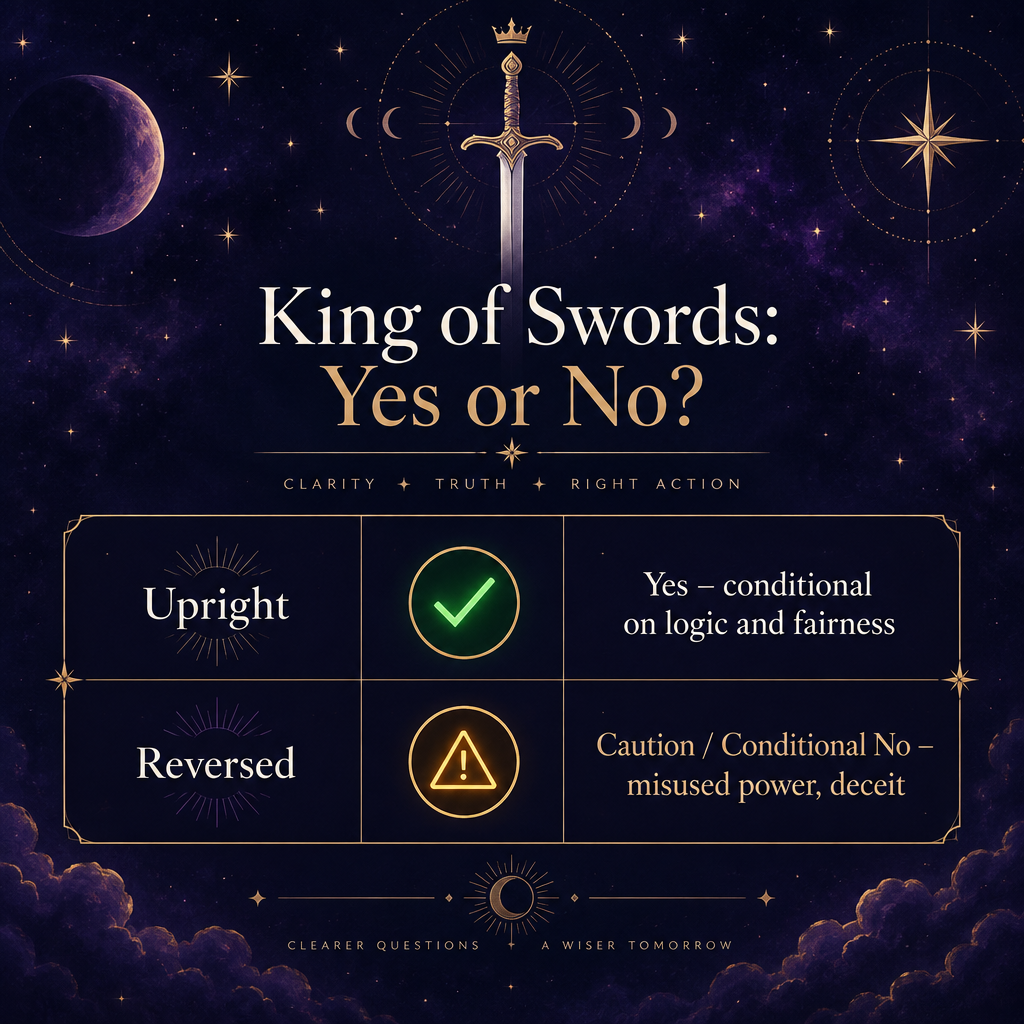
The King of Swords upright is a yes, but a conditional one: the answer holds as long as you act with clear logic, honest motives, and firm boundaries. Reversed, the card shifts to a caution or a conditional no, pointing to cold decisions, manipulation, or a conversation that has gone wrong. Here is the quick verdict, followed by what it means for love, career, money, health, family, and your own growth.
Quick Answer: Is the King of Swords a Yes or No?
| Position | Verdict | Short reasoning |
|---|---|---|
| Upright | Yes (conditional on logic and fairness) | Authority, clarity, a decision made on the facts |
| Reversed | Caution / conditional no | Misused power, cold calculation, miscommunication, deceit |
| Upright with Cups cards | Yes, soften the delivery | Head and heart need to work together |
| Reversed with Wands or Pentacles reversed | Firm no | Power struggles, bad-faith dealings |
If you pulled a single card and only need the headline: upright means proceed, reversed means stop and reassess before you act or speak.
What the Card Shows and Why It Leans Yes
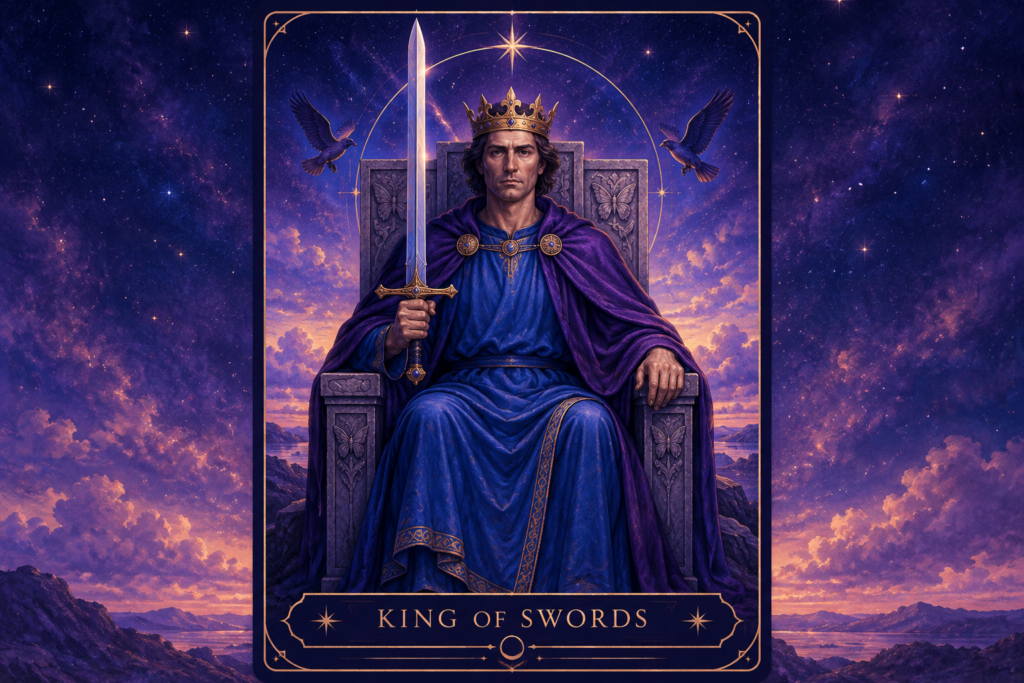
In the Rider-Waite-Smith deck, drawn by Pamela Colman Smith and published in 1909, the King of Swords is the only court card in the suit who looks straight at you. The Queen sits in profile, the Knight charges across the frame, the Page glances over his shoulder. The King faces forward on a plain stone throne. That direct gaze is the first clue for a yes or no reading. He is not avoiding the question, and he expects you not to avoid it either.
He holds a long sword upright in his right hand, tilted slightly to the right rather than perfectly vertical. Readers argue about that lean. The most useful interpretation for a yes or no question is that even the most rational judgment contains a human bias. The King is confident, but his sword is not a machine. Your yes is sound when you have weighed the facts honestly, not when you have talked yourself into a conclusion.
The throne back carries butterflies and crescent moons. Butterflies belong to the Air element across the entire Swords court, and they signal transformation through thought: a shift in how you see the situation. The crescents hint at intuition sitting quietly beneath the logic. Two birds fly in the sky behind him, and the clouds sit low on the horizon rather than crowding the top of the card as they do on the Queen’s. The weather is settling. Whatever storm prompted your question is passing, and clear thinking is now available to you.
His blue robe and purple cloak follow the usual RWS colour logic: blue for the mind, purple for authority. He wears a crown topped with a winged figure, a small detail that reinforces the idea of elevated, impartial judgment.
Put together, the imagery describes someone who sees the whole board, speaks plainly, and decides. That is why the upright card answers yes. The decision you are asking about can be made cleanly, and you have the mental equipment to make it.
The Air Element and the Suit of Swords
The King of Swords is a Minor Arcana court card from the Suit of Swords, the suit ruled by Air. Air governs thought, language, truth, judgment, and conflict. It is the suit that cuts, which is why Swords cards tend to feel harsher than Cups or Pentacles even when their message is positive.
For yes or no work, Air energy produces answers that are definite but conditional on honesty. The suit does not promise comfort or abundance. It promises clarity. So when the King of Swords says yes, he means “yes, this is the correct and logical course,” not “yes, this will feel wonderful.” Keep that distinction in mind when the question is emotional, because the card may confirm that leaving is right without pretending it will be painless.
King of Swords Upright: A Qualified Yes
The upright King of Swords is a yes, and a strong one, with a built-in condition. The outcome depends on you behaving the way he behaves: gathering facts, communicating directly, and acting without emotional flailing or hidden motives.
Three things make the yes firmer:
- The question involves a decision, negotiation, legal matter, contract, or honest conversation. This is the King’s territory. He is the lawyer, judge, surgeon, and senior advisor of the deck.
- You have already done the thinking. If you are asking whether a plan you have researched will work, the card confirms it.
- Your motives are clean. The King rewards fairness. Ask whether you should confront a colleague about a genuine error and the answer is yes. Ask whether you should undermine them to take their job and the card’s upright appearance is a warning that you are about to be judged by someone with higher standards.
Three things weaken the yes:
- The question is purely about feelings. “Will he realise he loves me?” is not a King of Swords question. The card will answer yes to “Should I ask him directly where this is going?” instead.
- You want permission to act impulsively. The King does not move quickly. If you are asking whether to send the angry message tonight, he says yes to sending a message, no to the anger.
- The surrounding cards are heavy with Cups reversed. Logic is winning, but at the cost of the relationship.
King of Swords Reversed: Caution or a Conditional No
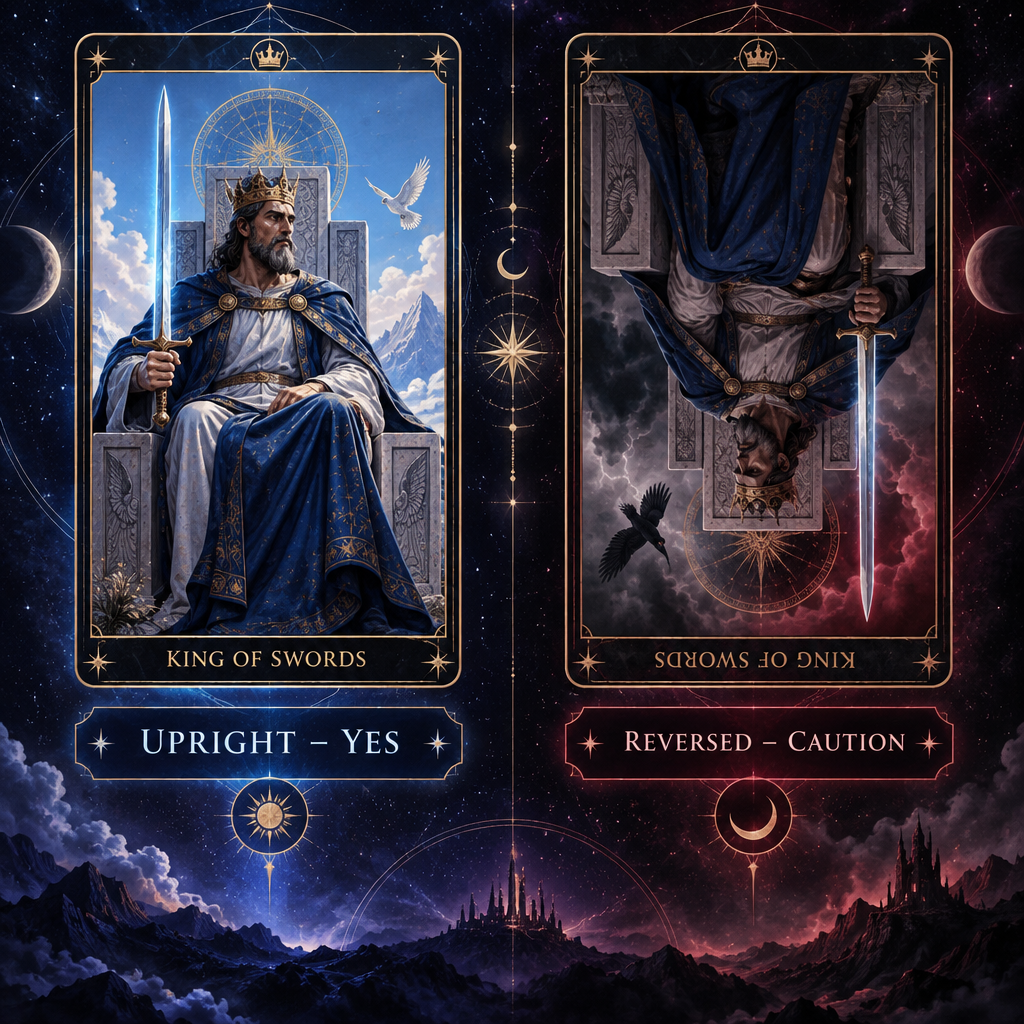
Calling the reversed King of Swords a flat “no” is lazy, and it leads people to abandon situations that only needed a correction in approach. The reversal describes the shadow of the upright card, and the shadow comes in three strengths.
Firm no
When the reversed King appears alongside cards like the Seven of Swords, the Devil, or the Five of Swords, the answer is no. Someone is using intelligence to manipulate, control, or deceive. In a love reading this is the partner who argues you into doubting what you saw. In business it is the counterparty whose contract has clauses written to trap you. Walk away.
Caution, or “not like this”
The most common reversed meaning. The plan may be viable, but the way you or someone else is pursuing it is cold, rigid, or tyrannical. A manager who is technically right but has lost the team. A parent whose rules are correct and whose delivery is cruel. A decision that ignores every human factor. The answer is “not yet, and not in this form.” Soften the method and ask again.
Conditional no that depends on context
Reversed, the King can also show someone who has lost authority: indecisive, scattered, unable to think straight because of stress or grief. Here the no is temporary. You are not in a fit state to decide, and the card is telling you to wait until the clouds lift rather than forcing an answer.
Shadow traits to watch for in yourself or others: intellectual bullying, sarcasm used as a weapon, withholding information, rewriting agreements after the fact, and the particular coldness of someone who has decided that being right matters more than being kind.
The King of Swords as a Person in Your Reading
Court cards frequently represent people rather than situations. When the King of Swords stands in for someone, your yes or no question gets filtered through that person’s character.
Upright, he is a mature, articulate, principled person, often in law, medicine, academia, engineering, the military, or senior management. He will tell you the truth whether or not you want it. If you are asking whether to trust his advice, yes. If you are asking whether he will chase you romantically, understand that he shows interest through attention and problem-solving, not grand gestures.
Reversed, he is the same person with the ethics removed: controlling, verbally cutting, possibly dishonest, and prone to using his cleverness to win rather than to help. If the question is about entering any arrangement with this person, the answer is no.
King of Swords Yes or No in Love
Upright: Yes, provided the relationship can withstand honesty. For singles, the card points to a partner who values intellect and plain speaking, and it answers yes to “Should I be direct about what I want?” For couples, it confirms that the hard conversation you have been postponing will improve things. It is also a yes to boundaries: ending contact with someone who treats you badly, or setting terms in a situation that has been drifting.
Reversed: Caution. Communication has broken down, or one partner is dominating through logic and criticism. The card answers no to “Should I keep trying to win this argument?” and yes to “Do I need to change how we talk to each other?” If deception cards appear nearby, treat it as a firm no to continuing without addressing the dishonesty.
Does the King of Swords mean a breakup? Not by itself. It means a decision made with a clear head. Sometimes that decision is to leave, and the card will confirm it if other cards (Three of Swords, Tower, Eight of Cups) point the same way. More often it means the relationship needs a frank reckoning, not an ending.
King of Swords Yes or No in Career
Upright: Yes. This is one of the strongest career cards for questions about promotions into leadership, negotiating a contract, resolving a dispute with HR, taking a role that requires expertise and judgment, or pursuing legal, medical, consulting, or technical work. It also answers yes to “Should I speak up in the meeting?” and “Will my proposal be taken seriously?”
Reversed: Caution or no. Either you are facing a boss or client who abuses authority, or you are being asked whether to use a hard-line approach that will cost you allies. The card says no to office politics played dirty, no to signing anything you have not read in full, and “not yet” to decisions made while you are angry.
King of Swords Yes or No for Money
Upright: Yes to disciplined financial decisions: refinancing after comparing rates, hiring a professional advisor, pursuing money owed to you through proper channels, or saying no to a loan request you cannot afford. The King favours spreadsheets over hunches. If you have run the numbers, proceed.
Reversed: No to deals that rely on someone else’s clever explanation. Reversed, this card often marks fine print, misleading terms, or an advisor whose interests are not yours. It also warns against being so rigid with money that you damage relationships, such as refusing reasonable help to family over principle.
King of Swords Yes or No for Health
Upright: Yes to seeking expert opinion and following evidence-based treatment. The King is the specialist, the surgeon, the second opinion. If you are asking whether to get the test, book the consultation, or trust the diagnosis you received from a qualified professional, the answer is yes. For mental health questions, the card supports structured approaches like cognitive therapy and clear routines.
Reversed: Caution. Either you are ignoring professional advice in favour of your own theories, or a practitioner is being dismissive and cold with you. The card answers no to self-diagnosing from internet searches and yes to finding a doctor who actually listens. It can also flag stress-related issues from overthinking: tension headaches, insomnia, a mind that will not switch off.
King of Swords Yes or No for Family
Upright: Yes to setting boundaries and having the difficult family conversation. The card often appears when one member needs to step into the role of fair mediator: handling a parent’s affairs, dividing an inheritance, or settling a long-running sibling argument. It confirms that a calm, factual approach will work better than the emotional one that has failed so far.
Reversed: Caution. A family member is ruling through criticism and control, or communication has collapsed into cold silence. The card says no to escalating, no to cutting someone off in anger, and yes to pausing before you say something that cannot be unsaid. If the question is whether a controlling relative will change on their own, the honest answer is no.
King of Swords Yes or No for Spiritual Growth
Upright: Yes to disciplined study and to questioning what you have been taught. The King is the scholar of the deck, and he approves of a spiritual path built on understanding rather than borrowed belief. If you are asking whether to commit to a course, a teacher, or a practice that asks you to think as well as feel, proceed.
Reversed: Caution against intellectualising everything. Reversed, the card describes someone who can explain every symbol and feel none of them, or who uses spiritual language to control others. The answer is no to any teacher who discourages questions and no to using logic as a way to avoid grief, intuition, or vulnerability.
Single-Card Pull vs. Position in a Spread
A single-card yes or no pull gives you the raw verdict: upright yes, reversed caution. In a larger spread, position changes the weight.
- Past position: A decision already made with a clear head. The yes refers to the soundness of that choice.
- Present position: You are in the moment of judgment. The yes is active now.
- Outcome position: The matter will be settled by authority, fairness, or a formal decision. Upright, that settlement favours you. Reversed, expect a ruling or verdict that feels harsh.
- Advice position: Think before you speak. Gather evidence. Say exactly what you mean.
- Obstacle position: Even upright, the card here means your own rigidity or someone else’s authority is in the way.
How the King Compares to Other Swords Cards
The Ace of Swords is a yes based on a breakthrough: new clarity, a fresh idea, the truth finally spoken. It is an opening move. The King is the same clarity after it has matured into judgment and authority. The Ace says “you see it now,” the King says “you have decided.”
The Knight of Swords is also a yes, but a fast and risky one. He charges in with the right idea and poor timing. If you draw the Knight, act quickly. If you draw the King, act deliberately.
The Queen of Swords is a yes that comes with emotional honesty and independence. She has suffered and learned from it. Her yes often means “yes, alone” or “yes, but with clear eyes.” The King’s yes carries more structural power: contracts, rulings, formal authority.
The Page of Swords is a maybe. He is curious and watchful but not yet decisive. If the Page appears where you hoped for the King, you do not have enough information yet.
What to Do When You Draw the King of Swords
Upright:
- Write the decision down in one sentence. If you cannot, you have not finished thinking.
- List the facts you actually know versus what you assume. Act on the first column.
- Have the direct conversation within the week. Delay turns clarity back into clouds.
- Set one firm boundary related to the question and hold it.
- Check your motive. If it would embarrass you to say it aloud, the yes does not apply.
Reversed:
- Do not send, sign, or announce anything for at least 48 hours.
- Ask one person you trust whether you are being fair or just being right.
- Reread any agreement in full, including the parts that bored you.
- If someone is dominating you through argument, stop arguing. State your position once and leave the discussion.
- Pull a clarifying card asking “what am I not seeing?” rather than repeating the yes or no question.
A Note on AI and Digital Yes or No Tarot
Most tarot apps and AI-generated readings classify the King of Swords as a flat “yes” upright and “no” reversed because they rely on a fixed lookup table. That is fine for a one-second answer. It misses the point of the card. The King’s whole message is that outcomes depend on how you think and behave, and an automated verdict cannot evaluate your motives or your delivery. Use digital pulls for the headline, then apply the conditional reading above before you act.
FAQ
Is the King of Swords a yes or no card?
Upright it is a yes, conditional on acting with logic, fairness, and honest intent. Reversed it is a caution or a conditional no, depending on whether the problem is deception, cold delivery, or temporary confusion.
Does the King of Swords mean a breakup?
Not on its own. It means a clear-headed decision about the relationship. If cards like the Three of Swords, Tower, or Eight of Cups surround it, that decision is likely to be an ending. Alone, it more often calls for an honest conversation.
Is the King of Swords a maybe card?
Upright, no. He is one of the most decisive cards in the deck. The “maybe” quality only appears reversed, where the answer becomes “not like this” or “not yet.”
What should I do if I draw the King of Swords reversed?
Pause for at least two days before acting, reread anything you are about to sign, and check whether you or someone else is using cleverness to win rather than to be fair. Then ask the question again with a different wording.
How does the King of Swords change in different spread positions?
In the outcome position, upright, it predicts a resolution through authority or fairness in your favour. In the obstacle position it points to rigidity or an overbearing authority figure. In the advice position it tells you to gather facts and speak plainly.
What does the King of Swords mean for a yes or no about someone’s feelings?
It does not describe feelings well. It describes a person who shows care through attention, honesty, and problem-solving. If you need to know how they feel, the card’s advice is to ask them directly, and it says yes to doing so.
Is the King of Swords a good card for legal questions?
Yes, upright it is among the best. It favours the party with the stronger evidence and the cleaner conduct. Reversed, expect delays, a harsh ruling, or an opponent arguing in bad faith.