

Yes or No Tarot for Career: The 7 Best Questions to Ask the Cards
A yes or no tarot pull can’t sign your offer letter or write your resignation email. It can cut through a week of circular thinking in a few minutes, as long as the question is built properly. This guide gives you seven career questions worth asking, the cards that matter most for each, and a practical way to work with a “no” instead of dreading it.
What You Need Before You Pull
Career readings go wrong most often before a single card is turned. Get these in place first.
- A deck you know. The Rider-Waite-Smith deck, first published in London in 1909 by William Rider & Son with art by Pamela Colman Smith, is the safest choice. Most yes/no charts, including our “tarot yes no guide”, are built on its imagery. Clones and modern decks based on it work too.
- A decision about reversals. Choose before you shuffle whether upside-down cards count as reversed. Don’t decide after you see the card.
- A written question. One sentence, on paper or in your notes app.
- A timeframe. “In the next three months” or “before the end of this year.” Undated career questions get muddy answers.
- The hard facts. The offer letter, your current salary, your notice period, your savings runway, the contract terms. The cards work best alongside this information, not in place of it.
- A notebook or log. You’ll want to compare pulls against what actually happened.
- Ten quiet minutes. Not on your lunch break with Slack open.
How Yes or No Tarot Works for Career Decisions
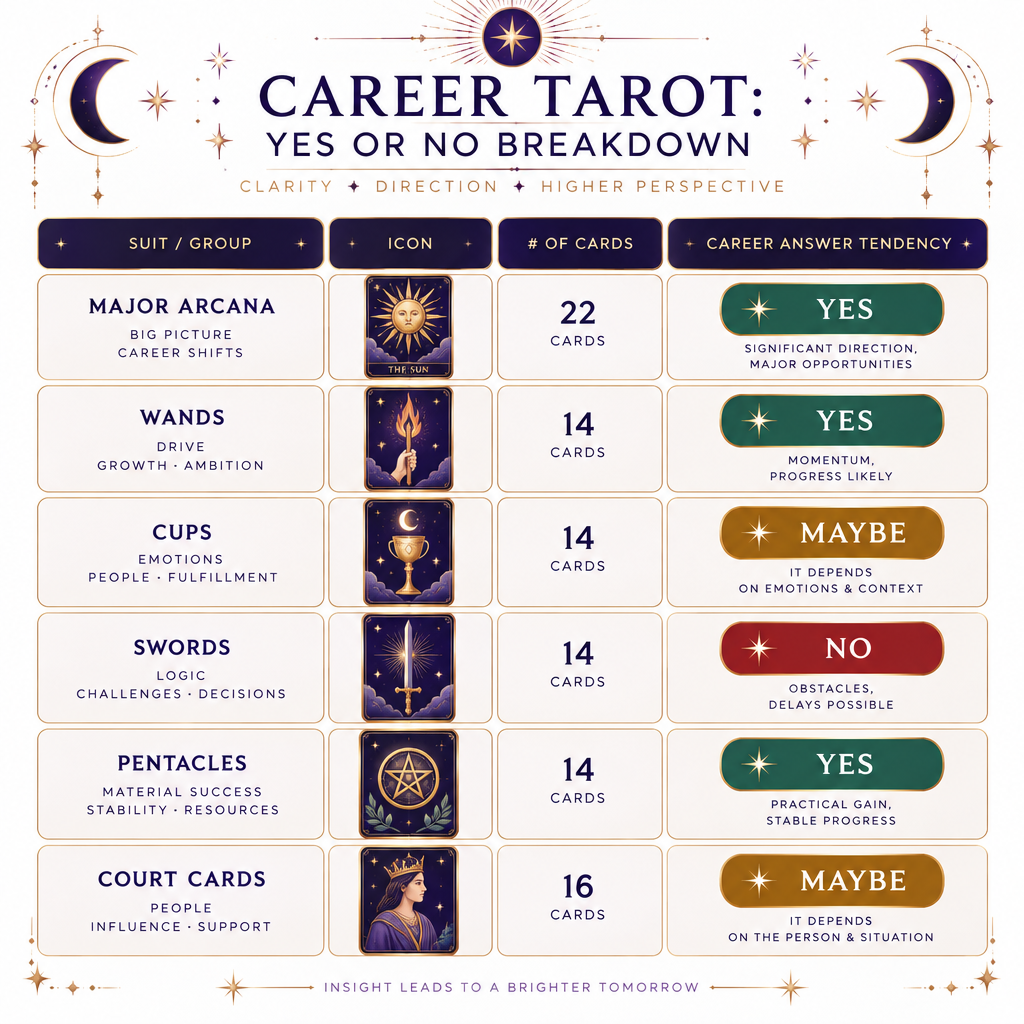
A standard deck has 78 cards. Each one leans yes, no, or maybe based on its traditional meaning. Bright, forward-moving cards like the Sun lean yes. Cards about loss, conflict or collapse, like the Ten of Swords, lean no. Cards about pausing, uncertainty or mixed conditions sit in the middle.
These leanings are conventions, not laws. Different readers assign a few cards differently, and that’s fine. What matters is that you use one consistent system.
Here is how the deck breaks down and how each section tends to behave in a work reading.
| Deck section | Number of cards | Typical yes/no lean | What it usually speaks to at work |
|---|---|---|---|
| Major Arcana | 22 | Strong yes or strong no, few maybes | Major turning points, career direction, long-term path |
| Wands | 14 | Mostly yes | Ambition, initiative, new projects, leadership |
| Cups | 14 | Mixed | Job satisfaction, team relationships, burnout, fulfilment |
| Swords | 14 | Mostly no or caution | Conflict, hard decisions, stress, office politics |
| Pentacles | 14 | Mostly yes, but slow | Salary, skills, stability, business finances |
| Court cards (inside the suits) | 16 | Often maybe | People involved, or the approach you need to take |
That last row matters more than it looks. When you pull a King or Queen on a career question, the card is often pointing to a person (a manager, a client, a mentor) or to the attitude you need. Read it as “it depends on how you show up” before you read it as yes or no.
The Direction Problem
This is the single biggest source of confused career readings, and few guides mention it.
Some cards flip their answer depending on how the question is phrased. The Eight of Cups shows a figure walking away from something that no longer fulfils them. Ask “Should I stay in this job?” and it reads as a clear no. Ask “Should I leave this job?” and the same card reads as yes.
The card didn’t change. Your question did.
The fix is a simple rule: always phrase your question so that “yes” means taking action. Yes means accept, apply, ask, launch, leave. No means hold, wait, decline. Stick with that framing every time and cards like the Eight of Cups, the Death card and the Tower become much easier to read. Our “eight of cups yes or no” breakdown covers this card’s double nature in more detail.
How to Ask a Career Yes or No Tarot Question: Step by Step
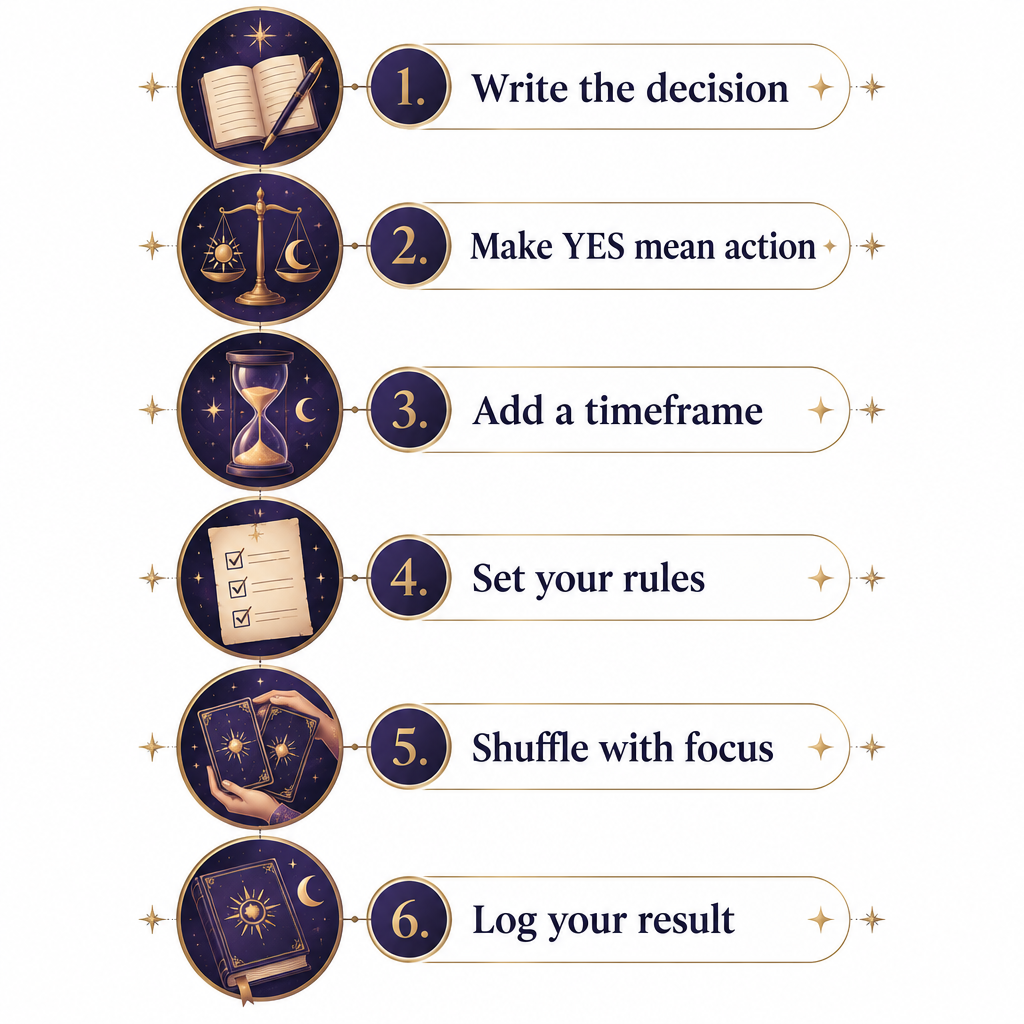
Follow these steps in order. The first three do most of the work.
- Write the decision in one line. Strip out the backstory. “My manager has been weird since the reorg and I got a recruiter message and I don’t know” becomes “Should I respond to the recruiter from Company X?”
- Make “yes” mean action. Rewrite until a yes answer clearly tells you to do something. “Is this job right for me?” becomes “Should I accept the offer from Company X?”
- Add a time window. “Will I get promoted?” becomes “Is the next performance review the right time to ask for a promotion?” Tarot handles near-term questions (up to roughly six months) better than open-ended ones.
- Set your rules. Reversals on or off. One card, or one card plus one clarifier if you pull a maybe. Decide now.
- Shuffle with the question in mind. Say it out loud or hold the written version. Shuffle until it feels done. There’s no correct number of shuffles.
- Draw one card. Off the top, or cut the deck and take the top card of the bottom pile. Pick a method and keep it.
- Read the lean first, then the detail. Is it yes, no or maybe? Then look at the image. What’s the figure doing? A yes from the Seven of Wands (holding your ground) is a different yes from the Six of Wands (a victory parade).
- Log it. Write the date, question, card, your gut reaction and the answer. Your first emotional reaction counts as information. If a no brought relief, take that seriously.
What Yes, No and Maybe Mean in Career Tarot
A yes is rarely a guarantee, and a no is rarely a dead end. In career readings, each answer tends to point you toward a specific next move.
| Answer | Example cards | What it usually means for your work | Best next move |
|---|---|---|---|
| Strong yes | The Sun, the World, Ace of Pentacles, Six of Wands, the Chariot | Conditions support the move and your energy matches it | Act within your stated timeframe |
| Soft yes | Eight of Pentacles, Three of Pentacles, Temperance, Page of Pentacles | Yes, but through steady effort or patience | Act, and plan for a slower build |
| Maybe | Justice, the High Priestess, Two of Swords, Wheel of Fortune | Missing information, or the outcome hinges on someone else | Gather facts, then pull a clarifier |
| Soft no | Four of Pentacles, the Hermit, Seven of Cups, Four of Cups | Not now, or not in this form | Wait, refine the plan, ask again later |
| Strong no | The Tower, Ten of Swords, Five of Pentacles, Three of Swords, the Devil | The move as framed carries real risk or misalignment | Pause and investigate what the card shows |
“Soft yes” Pentacles cards deserve a special mention. They show up constantly in work readings because Pentacles govern money and skill. A soft yes from this suit usually means “this will pay off, slowly.” If you need a quick win, that’s a useful warning. Our “eight of pentacles yes or no” article goes deeper on the most common of them.
The 7 Best Yes or No Tarot Career Questions
Each question below is phrased so that “yes” means action and includes a time anchor. Swap in your own company names, roles and dates.
1. “Should I accept the job offer from [Company] before the deadline?”
Why it works: It’s specific, it has a built-in timeframe (the offer deadline), and yes means accept. Compare it with “Is this the right job for me?”, which has no action and no time limit.
Yes cards to watch for:
– Ten of Pentacles: long-term security, a place you could stay for years.
– Three of Pentacles: good collaboration and respect for your skills.
– Six of Wands: recognition and a strong start.
– The Chariot: forward motion with real momentum.
No cards to watch for:
– Seven of Cups: the offer looks better than it is. Check the details.
– Five of Pentacles: financial strain, possibly an underpaid offer or an unstable company.
– The Devil: golden handcuffs. Great pay, poor culture, hard to exit.
If you get a no: Don’t decline on the spot. A no here often points to a negotiable problem. The Five of Pentacles might mean “not at this salary,” not “never.” Pull a clarifier with the question “What would make this offer a yes?” and then go back to the employer with a specific counter if the card points to money, title or remote terms.
2. “Is my next review the right time to ask for a promotion?”
Why it works: It ties the question to a real event you can plan around. Promotions depend on other people’s decisions, so asking “Will I get promoted?” invites a vague maybe. Asking about your timing puts the action in your hands.
Yes cards to watch for:
– The Emperor: structure and authority are on your side. Leadership sees you.
– Strength: quiet confidence will carry the conversation.
– Nine of Pentacles: you’ve earned this and can show it.
– Knight of Wands: go now, with energy.
No cards to watch for:
– Two of Swords: decision-makers are stalled. Budget or reorg uncertainty is likely.
– Four of Pentacles: money is being held tight right now.
– Seven of Swords: someone may be playing politics. Protect your work and document your wins first.
If you get a no: Treat it as a preparation note. Build your case over the next cycle: track outcomes, gather numbers, line up a sponsor. Then ask again closer to the next review. A no on timing is the gentlest no in career tarot.
3. “Should I hand in my notice in the next three months?”
Why it works: Quitting questions are emotionally loaded, so they need the tightest framing. “Should I quit?” reads differently on a bad Monday than a good Friday. A three-month window forces the cards (and you) to deal with the practical horizon.
Yes cards to watch for:
– Eight of Cups: you’ve already outgrown this. Walking away is the honest move.
– Death: a natural ending. The role has run its course.
– Six of Swords: moving toward calmer water.
– The Fool: a leap, ideally with your savings in order.
No cards to watch for:
– Four of Pentacles: hold on to the security for now.
– Five of Pentacles: the financial cost of leaving could hurt.
– The Hanged Man: pause. Something needs to shift in your view before you move.
The Eight of Swords twist: This card shows a blindfolded figure surrounded by swords, but the bindings are loose and the path is open. On a quitting question, it reads as a no in the moment, with a clear message: you feel more trapped than you are. The constraint is often a belief (“no one else would hire me”) rather than a fact. Our “eight of swords yes or no” piece explains why many readers treat it as a “not yet, but you’re freer than you think.”
If you get a no: Ask what you’d need in place to leave safely. That might be three to six months of expenses saved, a signed offer elsewhere, or a finished certification. A no on quitting is often a no on quitting unprepared.
4. “Is my business idea ready to launch within six months?”
Why it works: “Will my business succeed?” is too big for one card. Success depends on hundreds of later choices. Readiness within a set window is something a single card can actually speak to.
Yes cards to watch for:
– The Magician: you have the tools and skills. Use them.
– Ace of Pentacles: a real financial opportunity, the seed of income.
– Three of Wands: your plans are ready to expand. Look outward.
– Ace of Wands: raw creative spark with energy behind it.
No cards to watch for:
– Seven of Cups: too many ideas, not enough focus. Pick one.
– Five of Wands: crowded market, lots of competition.
– The Moon: something isn’t clear yet. Hidden costs or unvalidated assumptions.
– Ten of Wands: you’ll burn out carrying this alone.
If you get a no: Read the card for the gap. The Seven of Cups says narrow down. The Moon says test your assumptions with real customers. The Ten of Wands says find help or cut scope. Fix the gap, then ask again with a new window.
5. “Am I ready to change careers into [field] this year?”
Why it works: Naming the field keeps the card from answering a generic “should I change something?” Career changes also tend to involve retraining, so a yearly horizon is realistic.
Yes cards to watch for:
– Judgement: a calling you can’t ignore. This is one of the strongest yes cards for career reinvention, and our “judgment tarot yes or no” guide covers it in depth.
– Page of Pentacles: the student phase. Start learning now.
– The Star: renewed hope and alignment after a hard stretch.
– Wheel of Fortune: a cycle is turning in your favour.
No cards to watch for:
– The Hermit: more research and reflection needed first.
– Four of Cups: you may be bored rather than called. Look closely at what’s actually missing.
– Nine of Swords: anxiety is driving the change, not desire.
If you get a no: Check which kind of no it is. The Hermit is a “look before you leap” no: talk to people in that field, shadow them, take a short course. The Four of Cups is a “this may not be the answer” no. Your current role might need a change in projects or team rather than a full career switch.
6. “Should I commit to my current role for at least another year?”
Why it works: This is the counterweight to question 3, and it’s useful for people who aren’t unhappy but feel restless. Phrasing it as an active commitment keeps the “yes means action” rule intact.
Yes cards to watch for:
– Eight of Pentacles: you’re building skills here that will pay off.
– Ten of Pentacles: long-term stability and benefits are worth staying for.
– Temperance: balance is working. Don’t break what’s healthy.
– Knight of Pentacles: slow, reliable progress.
No cards to watch for:
– Eight of Cups: you’ve already checked out emotionally.
– Five of Cups: you’re stuck mourning what the job used to be.
– The Tower: instability ahead, possibly outside your control (layoffs, restructuring).
If you get a no: A Tower answer here deserves a practical response, not panic. Update your resume, reconnect with your network and check your emergency fund. If the Tower doesn’t land, you’ve lost nothing. If it does, you’re ready.
7. “Should I raise this conflict with HR or my manager this month?”
Why it works: Workplace conflicts drain more energy than most job decisions. This question gives the cards a concrete action (escalate) and a short window. It avoids the trap of asking about the other person (“Is my coworker sabotaging me?”), which pulls you into guessing about someone else’s mind.
Yes cards to watch for:
– Justice: facts and fairness will carry weight. Document everything.
– King of Swords: clear, calm, rational communication will work.
– Queen of Swords: be direct and set the boundary.
– The Sun: bringing things into the open will clear the air.
No cards to watch for:
– Five of Swords: you might “win,” but at a cost to relationships or reputation. Our “five of swords yes or no” article unpacks this card’s mixed message.
– Seven of Swords: you don’t have the full picture yet.
– Three of Swords: the conversation will hurt more than it helps right now.
If you get a no: Keep documenting. A no on escalation is often a no on escalating this month or in this way. Consider a direct, private conversation with the person first, or wait until you have clearer evidence. If the issue involves harassment, discrimination or safety, report it through proper channels regardless of the card. Some things aren’t questions for tarot.
Quick Reference: The 7 Questions at a Glance
| Question | Built-in timeframe | Strongest yes card | Clearest no card | What a no usually means |
|---|---|---|---|---|
| Accept the job offer | Offer deadline | Ten of Pentacles | Seven of Cups | Check or renegotiate the terms |
| Ask for a promotion at next review | Next review cycle | The Emperor | Two of Swords | Build your case, then ask |
| Hand in notice | Three months | Eight of Cups | Five of Pentacles | Prepare your finances first |
| Launch a business idea | Six months | The Magician | The Moon | Validate before you launch |
| Change careers into a named field | This year | Judgement | Nine of Swords | Research, or check your motives |
| Commit to current role another year | 12 months | Eight of Pentacles | The Tower | Stay alert, build a safety net |
| Escalate a workplace conflict | This month | Justice | Five of Swords | Gather facts or try a direct talk |
If you want a fuller picture of which cards point toward a yes across every type of question, our list of “tarot cards for yes answers” covers the ten strongest and why they earn that reputation.
How to Interpret a “No” Constructively
Most people pull a no and immediately reshuffle. That’s the fastest way to learn nothing.
In career readings, a no is almost never a final verdict on your talent or your future. It’s usually one of three things:
- A timing note: not now, but later.
- A method note: not this way, but another way.
- A clarity note: you don’t have enough information yet.
The card itself tells you which. The Hermit, the Hanged Man and the Four of Pentacles lean toward timing. The Seven of Cups, the Five of Wands and the Ten of Wands lean toward method. The Moon, the Seven of Swords and the Two of Swords lean toward clarity.
The Three-Card “No” Follow-Up
When you get a no, wait at least a few hours. Then try this short spread with the same deck.
- The obstacle: What’s blocking the yes?
- The lever: What can I change or influence?
- The next step: What’s one concrete action for the next two weeks?
Lay them left to right. Read card 2 most carefully. It’s the most useful card in the spread because it points to something within your control.
A worked example. You ask, “Should I accept the offer from the agency before Friday?” and draw the Five of Pentacles. No.
The follow-up gives you the Four of Pentacles (obstacle: the offer is tight-fisted), the Page of Swords (lever: ask sharp questions, do your research) and the Two of Pentacles (next step: balance the options). That reads as a clear plan. Research the market rate for the role, ask the agency directly about salary flexibility and benefits, and weigh their answer against your current position. The no turned into a negotiation brief.
Questions That Turn a No Into a Plan
After a no, these follow-up questions work well as single-card pulls:
- “What would need to change for this to become a yes?”
- “What am I not seeing about this situation?”
- “What should I focus on for the next month instead?”
- “Is this a no to the goal, or a no to this route?”
The last one is the most useful question in this whole guide. A no to the route is common. A no to the goal is rare.
Common Mistakes (and How to Fix Them)
Asking the same question until you get a yes. Each redraw makes the next one less meaningful. Set a rule: one question, one pull, then wait at least a week or until something in the situation changes. If you need to ask again, change the question, not just the shuffle.
Asking about other people’s choices. “Will the hiring manager pick me?” puts the answer in someone else’s head. Rephrase around your own action: “Is applying for this role a good use of my time this month?”
Double-barrelled questions. “Should I quit and start my own business?” is two decisions. A single card can’t separate them. Ask each one on its own.
No timeframe. “Will I ever find work I love?” has no answer a single card can carry. Add a window.
Ignoring the image. The yes/no lean is a starting point. A yes from the Seven of Wands means you’ll have to defend your position. A yes from the Sun means smooth sailing. Same answer, different experience.
Using tarot to override hard facts. If the offer is 20% below your current pay and the commute doubles, a Sun card doesn’t erase that. The reading should sit next to your spreadsheet, not replace it.
Pulling while panicking. A reading done ten minutes after a bad meeting tends to reflect the meeting. Give yourself a buffer.
Switching yes/no systems mid-reading. If one website says the Hermit is a no and another calls it a maybe, pick one and stay with it. Inconsistency is worse than any single convention.
Troubleshooting Unclear Pulls
You keep getting maybes. Your question probably has a hidden “and” or “or” in it, or depends on someone else. Split it or reframe around your action.
The card contradicts your gut completely. Write down both. Then notice which one you hope is right. That hope is data about what you actually want.
You pulled a court card. Ask yourself who in the situation matches that card’s personality. If no one fits, read it as the approach you should take. The Queen of Pentacles, for example, says lead with practicality and care.
Free online yes/no tools give a different answer than your deck. Online pullers use random selection, so different results across tools are expected. Neither is “more right.” Commit to one pull per question, from whichever source you trust, and use the site or deck consistently.
How to Keep a Career Reading Grounded
Tarot is a reflection tool. It’s good at surfacing what you already half-know and making you look at a decision from a new angle. It is not financial, legal or employment advice.
Before acting on any card, run through a short reality check:
- Money: Do the numbers work? Could you cover rent and bills for at least a few months if things go wrong?
- Contract: What’s your notice period? Any non-compete or clawback clauses?
- Information: Have you talked to someone already doing the work, or researched pay ranges for the role?
- People: Who else does this decision affect, and have you spoken to them?
- Reversibility: If this goes badly, how hard is it to undo?
If the card and the reality check agree, you can move with confidence. If they clash, the reality check usually wins for the decision itself. The card is still useful, though: it tells you what emotional or practical piece you might be overlooking.
Keep a Career Tarot Log
This is the habit that separates useful readings from party tricks. For each career pull, record:
- Date and exact question
- Card drawn (and reversed or not)
- Your interpretation in one sentence
- Your gut reaction
- What you decided
- What actually happened, filled in later
After a few months, patterns emerge. You may notice you consistently misread certain cards, or that your gut reaction predicted outcomes better than your interpretation did. Both are worth knowing. The log also helps you stop re-asking the same question, because you can see what you already pulled.
What to Expect From a Well-Asked Career Question
If you follow the steps above, a typical yes or no career reading should leave you with:
- A clear lean in under five minutes: yes, no or maybe.
- One specific detail from the card’s image or meaning that you hadn’t fully considered.
- A next action for the coming days or weeks, even after a no.
- A clearer sense of what you want, often revealed by your reaction to the card more than the card itself.
What you shouldn’t expect is certainty. No card can promise you’ll love a job you haven’t started or that a business will turn a profit. A good reading leaves you better prepared to decide. The deciding is still yours.
FAQ
Can yes or no tarot tell me if I’ll get the job?
It can, but it’s a weak question. Hiring depends on other candidates, budgets and a manager’s mood on a given day. You’ll get more useful answers asking about your own action, for example “Is this role worth putting my best application into this week?” That keeps the focus on what you can control.
Should I use reversed cards for career questions?
Use them if you already read reversals in other spreads. Most yes/no systems treat a reversed card as weakening or flipping its upright answer, though a few overwhelmingly positive cards, like the Sun, are widely read as a yes even when reversed. If you’re newer to tarot, skip reversals at first. Upright-only readings are simpler and still accurate enough to be useful.
How often can I ask the same career question?
Once per meaningful change in the situation, or about once a week at most for an ongoing question. If you got a no and nothing has changed, asking again will only produce noise. If you’ve received a counter-offer, saved more money or had a key conversation, it’s fair to ask again.
Are free online yes or no tarot readings as good as a physical deck?
They draw from the same 78 cards using random selection, so the principle is the same. The main difference is attention. Shuffling a physical deck slows you down and makes you hold the question longer, which tends to sharpen your interpretation. Free tools are fine for practice and quick checks.
Which cards are the strongest “yes” for career questions?
The Sun, the World, the Chariot, Six of Wands, Ace of Pentacles and Ten of Pentacles are among the most reliable career yes cards. Judgement is especially strong for career changes and callings. For slower, effort-based yeses, look for the Eight of Pentacles and Three of Pentacles.
What if my career question involves a romantic relationship at work?
Split it. Ask the work question (role, reporting lines, career risk) on its own, and handle the relationship side separately. Mixing the two in a single card leaves you unsure which part the card is answering. Our “tarot spreads for love questions” article has layouts that suit the relationship side better than a single pull.
Is it bad luck to pull the Tower or Death on a career question?
No. The Tower signals sudden disruption, which on a work question can mean restructuring, a shock announcement or a plan that won’t hold. That’s a reason to prepare, not panic. Death signals an ending. On a “should I leave” question, it’s often a yes, because it confirms that a chapter has genuinely closed.