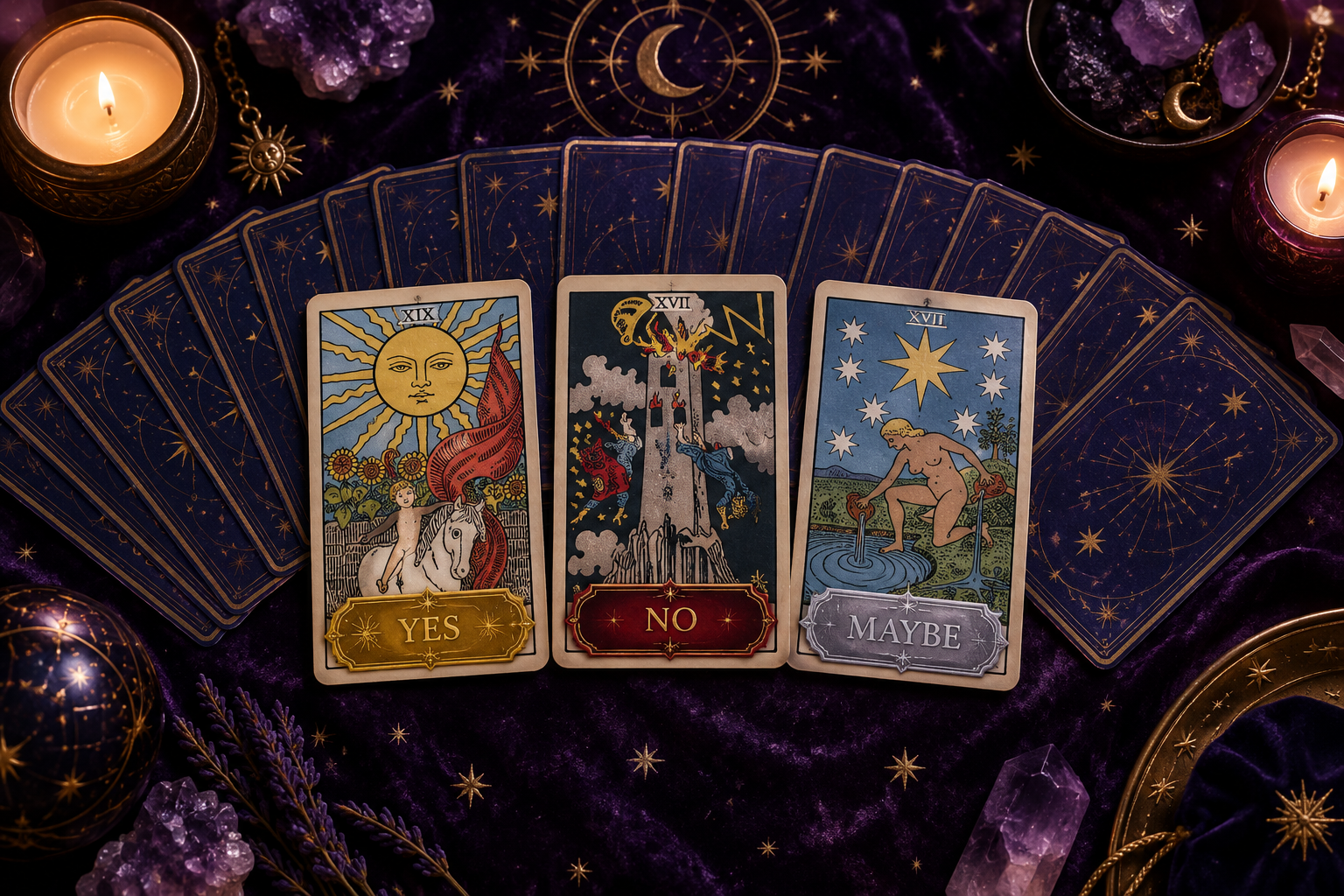
The Six of Swords answers yes when upright and no, or more precisely not yet, when reversed. It is one of the gentler yes cards in the Minor Arcana, and the yes always comes with a condition: you have to be willing to get in the boat and leave the shore behind.
Quick Answer
| Position | Verdict | What it depends on |
|---|---|---|
| Upright | Yes (qualified) | Your willingness to move, change, or let go |
| Reversed | No / Not yet | Unfinished business, bad timing, or running away rather than moving on |
| For reconciliation (upright) | Leaning no | The card travels away from the past, not back toward it |
| For a fresh start (upright) | Yes | Calmer conditions are ahead if you commit to the crossing |
If you need a one-line verdict: upright means yes, go, even though it will not feel triumphant. Reversed means something still anchors you, and until you deal with it the answer stays stuck at no.
What the Card Shows and Why It Matters for a Yes/No Reading
In the Rider-Waite-Smith deck the Six of Swords shows a flat-bottomed boat crossing a body of water. A ferryman stands at the back, poling the boat forward. In front of him sit two cloaked figures, a woman with her head bowed and a child beside her. Six swords stand upright in the hull, planted in the wood of the boat itself. On the right side of the image the water is rippled and choppy. On the left, where the boat is heading, the water is smooth and there is a treed shoreline waiting.
Every detail feeds the yes/no interpretation.
The boat is the point. It is already moving, which is why the upright card leans yes. Nobody in the image is standing on the dock debating whether to leave. The decision has been made and the crossing is underway.
The cloaked, hunched passengers tell you the emotional texture of the yes. This is not a celebration. The woman is grieving or exhausted, the child is quiet. The yes you get from this card is the yes of someone who has accepted that staying was worse than leaving. That is why experienced readers call it a gentle yes or a qualified yes rather than a resounding one.
The six swords in the hull are the baggage that comes with you. Pull them out and the boat leaks. This is the single most useful symbol for yes/no work, because it tells you the problem does not disappear just because you move. It comes along, but it is contained and it is no longer being used as a weapon.
The water going from rough to calm is the promise. Conditions improve. Not instantly, and not on the shore you are leaving, but on the one you are heading toward.
The ferryman is the part people forget. Help is present. Someone, or some circumstance, is doing the work of getting you across. In a yes/no reading that often means the transition will be supported even if you feel alone in the boat.
Element, suit, number, and zodiac
The Six of Swords belongs to the Suit of Swords in the Minor Arcana, which is governed by the element of Air. Air cards deal with thought, communication, decisions, and mental clarity rather than feelings (Cups), action (Wands), or material results (Pentacles). So the yes this card gives is primarily a yes of the mind: you have thought it through, the logic holds, the decision is sound.
The number six in tarot follows the conflict of the fives. The Five of Swords is a hollow victory and bitter words. The six is the retreat from that fight, the moment where harmony is restored by leaving rather than winning. Six is the number of balance and adjustment.
In the Golden Dawn system the Six of Swords is Mercury in Aquarius, the second decan of Aquarius (roughly January 30 to February 8), titled the Lord of Earned Success. Mercury brings clear thinking and movement. Aquarius brings detachment and the ability to look at a situation objectively from a distance. That combination explains why the card so often shows up when someone has finally stopped being emotional about a problem and started being practical about it.
Six of Swords Upright: Yes, Through Change
Upright keywords: transition, moving on, mental clarity, healing, rite of passage, calmer waters, safe passage, leaving conflict behind, necessary travel, earned success
The upright Six of Swords is a yes, but read the fine print. The card does not say “yes, and everything stays the same.” It says “yes, and the thing you are asking about will require you to move from where you currently stand.”
This distinction decides whether the reading helps you or misleads you. Suppose you ask “Will I be happy in this job?” and pull the Six of Swords upright. The literal answer is yes, but the card is telling you happiness arrives through a transition: a department change, a relocation, a shift in how you approach the role, or possibly leaving for a related position. If you interpret it as “yes, stay exactly where you are and happiness will find you,” you have misread the boat as a dock.
The yes is also quieter than most. Compare it with the Sun, the Ace of Cups, or the Three of Wands, which say yes with energy and excitement. The Six of Swords says yes with relief. It is the yes you feel when the hard conversation is finally over, the moving truck has pulled away, or the test results come back clear after weeks of waiting.
Three conditions strengthen the upright yes:
- You are willing to leave something behind. A relationship dynamic, a city, a version of yourself, a grudge. The card cannot deliver if you insist on bringing the whole shore with you.
- You accept outside help. The ferryman is in the picture for a reason. If the question involves a mediator, a recruiter, a therapist, a lawyer, or a friend offering a spare room, say yes to them too.
- You are asking about a process, not a single event. The Six of Swords describes a crossing. If your question is “Will this be resolved by Friday?” the card is less confident than if you ask “Am I heading in the right direction?”
Six of Swords Reversed: No, Or Not Yet
Reversed keywords: emotional baggage, stagnation, resistance to change, unfinished business, delayed healing, returning to a bad situation, stormy waters, running away, feeling trapped, a journey cancelled
Reversed, the Six of Swords is a no. But the most useful thing you can do with this card is ask which kind of no it is, because there are three, and they call for different responses.
The “not yet” no
The most common reversed reading is a timing problem. The boat exists, the far shore exists, but you are not in a position to cross right now. Perhaps the practical pieces are not in place: the money, the job offer, the lease ending. Perhaps the emotional pieces are not in place: you are still too angry or too raw to make a clean decision. In this version the answer is not a permanent no. Ask the same question in a few months and you may well get the upright card.
The “you are fleeing, not moving on” no
This is the subtler trap. The reversed Six of Swords frequently appears when someone is about to leave a situation for the wrong reasons. Quitting a job the day after a bad review. Moving cities to escape an ex. Ending a friendship in the heat of an argument. The movement looks like transition but it is actually avoidance, and the card says no because the swords in the hull have not been dealt with. They will leak into the next boat too.
How do you tell the difference? Moving on feels heavy but settled. Fleeing feels urgent and reactive. If you cannot sit with the decision for a week without it changing shape, you are probably fleeing.
The “unresolved grief” no
The third version is about healing that has not finished. The hunched woman in the upright card is grieving but she is still in the boat. Reversed, she has climbed back out and gone to sit with what she lost. Sometimes that is exactly the right thing to do. Grief cannot be rushed, and the card is not scolding you. It is simply reporting that the crossing is not available yet because the passenger is not ready.
In any of these three cases the practical advice is the same: work out what is anchoring you before you try to leave again. Shadow work, honest conversations, financial planning, or plain time will convert the reversed no into an upright yes faster than forcing the issue.
Six of Swords Yes or No for Love
Love questions need to be split, because the card gives genuinely different answers depending on your situation.
If you are single
Upright: yes, but after a departure. New love is available, and it tends to arrive once you have physically or emotionally left the territory of your last relationship. If you are still checking an ex’s social media, still living in the flat you shared, or still telling the same breakup story to every new date, the card is saying the yes is waiting on the other shore. Get across first.
Reversed: not yet. Something from a previous relationship is still occupying the seat where a new partner would sit. Pursuing dating right now tends to produce rebounds. Deal with the baggage and ask again.
If you are in a relationship
Upright: yes, with movement. The relationship survives and improves, but it changes. Common real-world versions: moving in together, relocating for one partner’s job, going to couples counselling, or leaving behind a recurring argument that both of you have finally agreed to stop having. The Air element matters here. This is a yes built on talking honestly and deciding together, not on romance alone.
Reversed: no, something is stuck. One or both of you is refusing to move past a resentment, an old betrayal, or a pattern. The relationship is not necessarily ending, but the question you asked gets a no until that specific stuck point is addressed. Reversed Six of Swords in a relationship reading often points at a conversation that keeps being postponed.
If you are asking about reconciliation or an ex returning
This is where the card surprises people. Many readers assume any upright yes card means “yes, they come back.” The Six of Swords does not work that way, because its entire motion is away from the past.
Upright: leaning no on reunion, yes on peace. The card says you are moving to calmer water, and that calm comes from distance rather than from reunion. If you ask “Will we get back together?” and pull this upright, the most honest answer is that you are being carried away from that chapter, and you will feel better for it. If you ask “Will I find peace about this breakup?” it is a clear yes.
Reversed: no, with a warning. Reversed, the card can indicate going back to the old situation, and it does not recommend it. The boat has turned around. Returning tends to replay the same problems with the same swords.
Six of Swords Yes or No for Career
Career questions suit this card well because Swords govern decisions and strategy.
Should I change jobs? Upright is yes. The card is practically a job-change card on its own, showing deliberate movement from a worse environment to a better one. Reversed is not yet: either the offer is not right, the timing is wrong, or you are leaving to escape a person rather than to improve your prospects.
Should I resign without another job lined up? Upright gives a cautious yes if you have resources (the ferryman, in practical terms, is savings or a supportive partner). Reversed is a firm no. Jumping out of the boat mid-crossing is how people end up treading water for a year.
Will I get this new opportunity? Upright is yes, often involving relocation, travel, or a change of industry. The success is earned rather than lucky, in keeping with the card’s decan title. Reversed is no for now, and usually points to an application that stalls or an offer that gets delayed.
Should I relocate for work? Upright is one of the clearest yeses the deck offers for this specific question, since the card literally depicts travel over water toward better conditions. Reversed suggests the move is being driven by avoidance or that logistics are not ready.
Six of Swords Yes or No for Family
Family questions get a slightly different reading because you cannot simply sail away from relatives.
Upright: yes, through distance or perspective. The card often appears when someone is deciding whether to set a boundary, move away from a difficult parent, or stop participating in a family conflict. The answer is yes, and the calm water comes from stepping back. It can also show literal family travel, a house move, or a child leaving home, all of which resolve positively.
Reversed: no, and old wounds are driving the question. Reversed in a family context points at generational patterns, unresolved grief after a death, or a return to a family dynamic you had previously escaped. The honest reading is that the answer stays no until the underlying hurt gets named, ideally with professional support.
Six of Swords Yes or No for General and Advice Questions
For questions outside love, work, and family, use this rule of thumb:
- If your question involves leaving, changing, travelling, or resolving a conflict by walking away, upright is yes.
- If your question involves staying, holding on, winning an argument, or getting someone else to change, upright is no, because the card’s energy points in the opposite direction.
- Reversed flips the first group to not yet and leaves the second group at no.
As an advice card rather than a prediction, the upright Six of Swords tells you to stop fighting and start moving. Take the practical, slightly unglamorous route. Accept help. Let the water get calmer before you make your next big move.
Reversed, the advice is to stop and unpack. Something in the hull needs attention before you set off again.
Timing: Sudden Change or Gradual Transition?
The Six of Swords describes a gradual crossing, not a lightning strike. Expect the matter to resolve over weeks or a few months rather than days. If you want a tighter window, the Aquarius correspondence points to late January through early February, and the suit of Swords is traditionally read as weeks (Wands as days, Cups as months, Pentacles as years, though reader conventions vary).
The reversed card stretches the timeline. Whatever you are waiting on is delayed until the anchor is lifted, and no amount of impatience shortens that.
When to Draw a Clarifier
The Six of Swords earns a clarifier more often than most cards because its yes is conditional. Pull one in these situations:
- The question is about reconciliation. Ask “What am I moving toward?” A Cups card suggests emotional peace apart from the person; a Two of Cups or Lovers would be a rare signal that the crossing leads back to them.
- You cannot tell if reversed means “not yet” or “never.” A Wheel of Fortune, Eight of Wands, or any Ace as clarifier says not yet. A Ten of Swords, Five of Pentacles, or Tower says the door is closing.
- You need to know what the baggage is. Ask “What am I carrying in the hull?” and read the clarifier literally.
Draw one clarifier only. Drawing three or four to force a cleaner yes defeats the purpose of a card whose whole message is to accept an imperfect but genuine answer.
How Surrounding Cards Change the Answer
In a spread, neighbours shift the Six of Swords noticeably.
- With the Star or Temperance: the yes strengthens and the healing is deep and lasting.
- With the Eight of Wands or the Chariot: the crossing speeds up; what looked like months becomes weeks.
- With the Five of Swords or Seven of Swords: the departure is tainted by conflict or dishonesty; the yes is weaker and you should check your own motives.
- With the Moon: you are not seeing the far shore clearly. Hold the decision until the fog lifts.
- With the Four of Cups or Hanged Man: even upright, the card reads more like “not yet,” because the surrounding cards signal hesitation.
- With the Ten of Cups or Ten of Pentacles: the destination is settled, happy, and stable. A strong yes for relocation and relationship questions.
The Inner Journey the Card Describes
Beyond external circumstances, the Six of Swords tracks an internal shift from being inside a problem to looking at it from the water. The Aquarian detachment of the card is not coldness. It is the moment you can describe what happened without your voice shaking. That mental clarity, the Air element working as it should, is itself the yes. When you reach it, decisions that felt impossible become straightforward, and the external movement follows almost automatically.
Reversed, the inner picture is someone who keeps rowing back to re-examine the wreck. The card asks you, kindly, to notice when the examination has stopped producing insight and started producing paralysis.
FAQ
Is the Six of Swords a yes or no card?
Upright it is a yes, specifically a qualified yes tied to transition. Reversed it is a no or a not yet. It is not one of the deck’s unconditional yes cards; the answer depends on your willingness to move.
What does the Six of Swords reversed mean in a yes or no reading?
Reversed means no for now. The three usual reasons are a timing problem, an attempt to flee rather than genuinely move on, or unresolved grief that has to be processed before the crossing can happen. Identify which applies and the no often becomes a yes later.
Is the Six of Swords a positive card?
Yes, with a sombre tone. It promises calmer water and relief from conflict, but it also acknowledges loss. Think of it as the positive outcome of a difficult decision rather than good news falling in your lap.
Can I draw a clarifier with the Six of Swords?
Yes, and it is one of the better cards to clarify because its yes is conditional. Draw a single clarifier asking what you are moving toward or what you are carrying with you. Avoid drawing multiple clarifiers to engineer a different answer.
What does the Six of Swords mean for love yes or no?
For singles upright it is yes once you have left the last relationship behind. For couples it is yes through change and honest conversation. For reconciliation it leans no, because the card moves away from the past, though it is a yes for finding peace. Reversed in any love context means not yet, with baggage to clear first.
Does the Six of Swords mean travel?
Often, yes. It is one of the clearest travel and relocation cards in the Minor Arcana, particularly for moves over water or to a different region. Reversed it can indicate cancelled or delayed trips.
Which zodiac sign is the Six of Swords?
Aquarius. In the Golden Dawn system it corresponds to Mercury in the second decan of Aquarius and carries the title Lord of Earned Success, which captures the card’s mix of clear thinking, detachment, and hard-won progress.