
Death as a person tarot describes someone who ends things cleanly and starts again without apology: the friend who quit a stable career at 40, the partner who insists you talk about the hard thing tonight, the colleague who is oddly calm when everyone else is panicking. This guide breaks down the personality, appearance, emotional style, and relationship behaviour of a Death card person, upright and reversed, so you can apply it to a real reading or a real human in your life.
The Card’s Imagery, and What Each Symbol Says About the Person
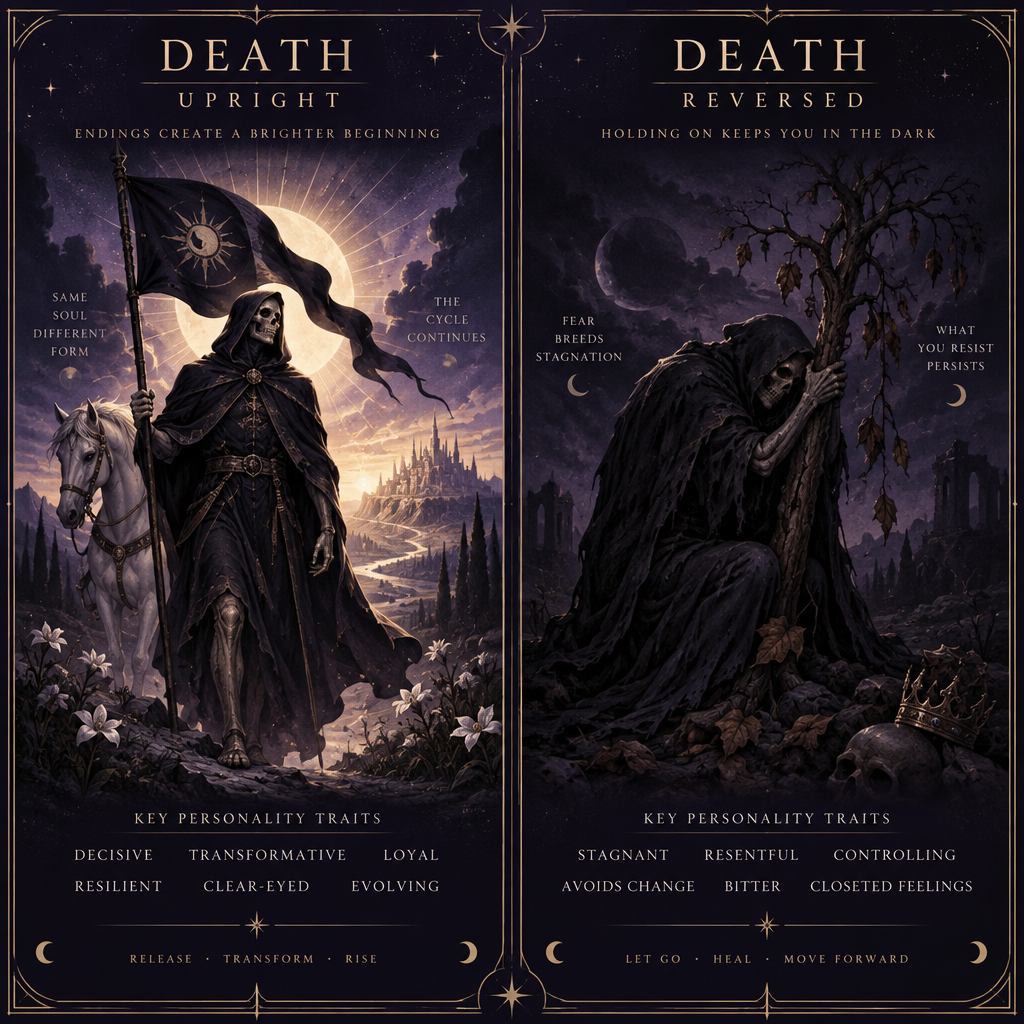
In the Rider-Waite-Smith deck, illustrated by Pamela Colman Smith in 1909 under the direction of Arthur Edward Waite, Death is Major Arcana card XIII. A skeleton in black armour rides a white horse across a field where a king lies dead. A bishop stands with hands raised, a young woman kneels and turns her face away, and a child looks up and offers flowers. Behind them, a river carries a small boat, and the sun rises between two distant towers.
Every element of that scene maps onto a trait you can spot in a person.
| Symbol | Meaning on the card | How it shows up in a person |
|---|---|---|
| Skeleton in black armour | What remains when everything non-essential is stripped away; protection through detachment | Blunt, unbothered by appearances, hard to manipulate emotionally |
| White horse | Purity of purpose; movement that cannot be bargained with | Follows through once a decision is made, does not relitigate |
| Black banner with white rose | The five-petalled Mystic Rose on a field of black: life inside loss, beauty inside endings | Finds meaning in grief, dark humour, comfortable at funerals and hospital bedsides |
| The dead king | Status offers no exemption | Unimpressed by titles, treats the CEO and the intern identically |
| Bishop, maiden, child | Three responses to change: bargaining, avoidance, acceptance | Reads how others handle transition instantly and adjusts their approach |
| Rising sun between towers | Rebirth already underway during the ending | Optimistic in a grounded way; already planning what comes after the loss |
| River and boat | Passage, the ferry to the next stage | Acts as a guide for people crossing thresholds |
The child is the most overlooked figure and the most important for reading this person. Only the child faces Death directly. A healthy Death person has that quality: they look at the ending straight on, without the bishop’s ritual and without the maiden’s flinch.
Upright Death as a Person: Core Personality
An upright Death person is a change agent. They do not merely tolerate endings; they initiate them when something has stopped working, and they do it earlier than most people would.
Key traits:
- Decisive about closure. They leave jobs, cities, and relationships that have run their course, usually after a long quiet period of assessment rather than an impulsive break.
- Intensely private. You can know them for years and still discover a whole chapter of their life you had no idea about. Information is released in layers, and only to people who have proven they can hold it.
- Fascinated by what others avoid. Death, grief, the occult, true crime, psychology, ancestry, the body. They read the obituaries. They ask the widow how she is actually doing.
- Loyal to the transformed version of you. They will support a friend through a divorce or a career collapse with more steadiness than they show at a birthday party. Crisis is where they are most present.
- Allergic to pretending. Small talk exhausts them. They would rather have one honest hour than a pleasant evening.
They are often described as intimidating on first meeting. That reputation comes less from anything they say than from the sense that they are watching and not performing.
Reversed Death as a Person: The Shadow Version
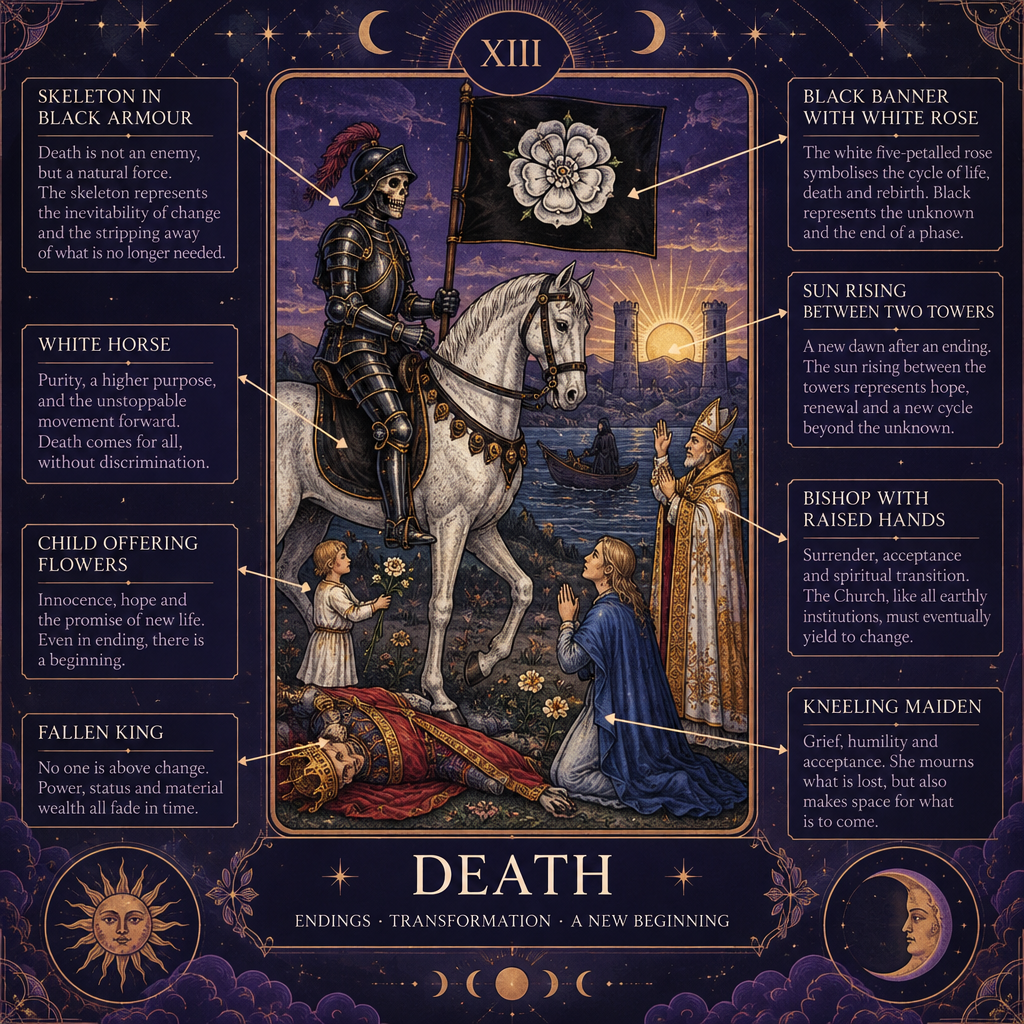
Reversed, the same energy turns inward and stalls. The change agent becomes the person who cannot change.
A reversed Death person:
- Holds grudges for years and can quote, verbatim, something you said in 2016.
- Keeps an ex on a pedestal or in the crosshairs, sometimes both, long after the relationship ended.
- Uses other people’s pasts as leverage in arguments.
- Refuses shadow work while insisting everyone else needs therapy.
- Stays in a dead job, dead marriage, or dead friendship while complaining about it constantly.
- Creates a heavy, draining atmosphere; you leave their company feeling like you need to open a window.
The core wound is fear. Upright Death trusts that something grows after the ending. Reversed Death does not believe that, so they cling to the corpse of a situation because at least it is familiar. Manipulation and control enter as substitutes for the trust they lack.
Physical Appearance and Aesthetic
Tarot cannot tell you someone’s hair colour, but the Death archetype has a recognisable visual signature.
The gaze. This is the tell. Death people hold eye contact a beat longer than is comfortable, and they do not look away first. It reads as penetrating rather than aggressive.
Evolving appearance. Their look changes in distinct eras. A shaved head one year, long hair the next. A new tattoo after every major life ending. Friends from different periods of their life may barely recognise photos from other periods.
Palette and style. Black, deep burgundy, bottle green, oxblood. Leather, silver, heavy boots, or a stark minimalism that reads as armour. Goth and witchy aesthetics are the obvious expression, but a Death person can just as easily be the surgeon in impeccable tailoring or the tattoo artist in a plain black t-shirt. What unites them is deliberateness: nothing they wear is an accident.
Presence. They are noticed in a room without trying to be. Often quiet, occasionally seductive in a slow-burn way, rarely loud. People either lean toward them or feel vaguely judged, and the Death person is aware of both reactions.
Reversed appearance. The evolution stops. The same haircut for a decade, clothes from a former life that no longer fit the person they have become. Or the opposite: frantic, constant image changes with no inner shift behind them.
Emotional and Psychological Profile
Resilience through acceptance. The Death person’s steadiness in a crisis comes from a settled belief that impermanence is the baseline condition, not an emergency. They were not surprised when the company folded. They had already grieved it.
Depth over breadth. They feel a small number of things with overwhelming intensity. They do not do casual attachments well, and they know it.
Empathy for people in transition. Newly bereaved, newly sober, newly divorced, newly diagnosed: these are the people a Death person instinctively moves toward. They are often bad at ordinary friendship and excellent at the friendship that happens at 3 a.m. in a hospital corridor.
Dark humour. Jokes at the funeral, but the right jokes, the ones that let the room breathe.
Shadow traits. Obsession, secrecy that shades into deception, a tendency to test people’s loyalty without telling them they are being tested, and a habit of ending things pre-emptively to avoid being left. In the reversed position these dominate: control, emotional blackmail, and a refusal to let anyone, including themselves, off the hook.
Scorpio, Water, and the Fixed-Sign Paradox
In the Golden Dawn correspondences that underpin the Rider-Waite-Smith system, Death is assigned to Scorpio, a Water sign ruled traditionally by Mars and, in modern astrology, by Pluto.
Water explains the emotional register: intuition, depth, the ability to read a room’s undercurrents, and a memory for feelings that outlasts the memory for facts. A Death person knows how you felt about them in a given conversation years later, even if they have forgotten what was discussed.
Scorpio’s fixed modality explains the paradox that trips people up. This is the card of transformation, yet Scorpio is the most stubborn of the Water signs. A Death person will tear down and rebuild a company, a friend group, or a belief system, and simultaneously refuse to change their own mind about a grudge, a routine, or a self-image. They are transformers of the external world and conservationists of their inner world.
Upright, the fixed quality is an asset: once they commit to a transformation, they do not waver halfway through. Reversed, it is the whole problem. The fixed sign digs in, and the change that should have happened years ago never comes.
Numerology: XIII Reduces to 4
Death is card 13. In tarot numerology, 1 + 3 = 4, which links Death to The Emperor, the card of structure, order, and foundations.
This matters for reading the personality. A Death person is not an agent of chaos. The ending they bring is followed by construction. After the divorce they buy a house. After the layoff they start a company with a written business plan. After the breakdown they build a rigid morning routine and stick to it for a decade.
The number 13 itself carries cultural dread, and a Death person often has a relationship with that dread. Many enjoy being the one others find unsettling. Reversed, the 4 energy calcifies into rigidity: structures maintained long after they should have been dismantled, rules enforced for their own sake.
Death as a Person in Love and Relationships
Upright
An upright Death partner will change your life, and they will tell you that at the start.
- They want depth immediately. Third-date conversations about childhood wounds and what you want written on your gravestone.
- They are fiercely loyal once committed and expect the same. Betrayal is not forgiven; it is filed and the relationship ends.
- They will not stay in a relationship that has died. They are the ones who say “this is over” while the other person is still hoping.
- As an ex, they go quiet. No breadcrumbing, no drunk texts. The door closes and stays closed, which is painful but clean.
- As a crush, they are slow to reveal interest, then sudden and total when they do.
- They are attracted to partners going through change and can lose interest when the partner stabilises. Watch for that pattern.
Reversed
- Cannot leave a dead relationship and cannot let the other person leave either.
- Keeps score. Brings up your ex, your mistakes, your family history when cornered.
- Alternates between smothering intimacy and cold withdrawal to keep you off balance.
- As an ex, they hover: the “just checking in” message on your birthday, the mutual friend who keeps mentioning them.
- Jealous, secretive, and quick to accuse others of secrecy.
Death as a Person in Career and Money
Upright
Death people are drawn to thresholds. Typical careers:
- Hospice nurse, palliative care physician, death doula, funeral director
- Therapist, grief counsellor, addiction counsellor
- Surgeon, especially oncology or trauma
- Life coach, career-change consultant, divorce lawyer
- Activist, union organiser, whistleblower
- Tattoo artist (permanent marks that commemorate change)
- Bartender or hairdresser (people confess to them, and they mark new eras)
- Turnaround CEO, restructuring consultant, bankruptcy specialist
- Archaeologist, forensic scientist, historian, genealogist
At work they are the person brought in to shut a division, fire the founder, or tell the board the truth. They are respected and slightly feared. They are poor at maintenance roles and will leave a job the moment it becomes purely custodial.
Financially, they are comfortable starting from zero. They have done it before. They may cycle through periods of scarcity and rebuilding rather than steady accumulation, and they tend to be unsentimental about selling possessions.
Reversed
The reversed Death person is the employee who has been threatening to quit for eight years. They decline promotions because change is frightening, block reorganisations, and quietly undermine colleagues who move up. Financially they cling to sunk costs: the failing business, the depreciating asset, the loan to the friend who will never pay it back.
Death as a Person for Feelings: How Do They Feel About You?
When Death appears in a “how does this person feel about me” position, the answer is rarely neutral.
Upright: They see you as a turning point. Either you represent a new chapter they want to step into, or knowing you has already changed how they see themselves. Their feelings are intense but held privately; they may not have said anything because they are still deciding whether to let the old version of their life end. If you have recently ended something with this person, upright Death often means they have accepted it and are moving forward, not pining.
Reversed: They are stuck on you and unhappy about it. This can look like resentment, obsession, or a refusal to accept that the relationship changed. Feelings are real but tangled with control. It can also mean they feel about you the way they feel about their own life: paralysed and unable to commit to a direction.
Death as a Person: Yes or No
Death is a card of certainty, so it answers yes-or-no questions clearly, even when the answer is unwelcome.
- “Is this person good for me?” Upright: yes, if you are ready to change. They will not let you stay the same. Reversed: no, they will drain you.
- “Will this person come back?” Upright: no, the ending is final. Reversed: they may reappear, but nothing has changed and the reunion will replay the old dynamic.
- “Is this person trustworthy?” Upright: yes, though private to the point of secrecy. Reversed: no.
- “Should I let this person into my life?” Upright: yes. Reversed: only with firm boundaries and a clear exit.
How to Recognise a Death Person in Your Life
Real-world signals:
- They have reinvented themselves at least twice in ways that surprised everyone who knew them before.
- Their closest friendships were forged during someone’s worst year.
- They are the family member who handles the funeral arrangements while everyone else falls apart.
- Their taste in books, podcasts, and films runs to the morbid, the psychological, or the occult.
- They give unnervingly direct advice and are usually right.
- Small talk with them feels like an interrogation you did not consent to, then oddly like the best conversation of your week.
Reversed signals: they describe the same grievance every time you see them, their story about their ex has not changed in five years, and you feel heavier after time together.
How to Work With, or Protect Yourself From, a Death Person
With an upright Death person: Be honest early; they will find out anyway. Do not expect them to preserve a dynamic you have outgrown, and do not ask them to soften the truth. If you want change in your own life, spend more time with them. If you want to stay exactly as you are, they will frustrate you.
With a reversed Death person: Set boundaries in writing if you can, because they will remember the argument differently. Do not share information that can be used later. Refuse to participate in rehashing the same grievance. Limit contact after an ending; they will test whether the door is really closed. Protect your energy with time limits, and notice if you are becoming the fixer they never asked for.
If you are the reversed Death person: The growth path is the upright card. Pick one thing you have refused to release, a grudge, a job, a person, a self-image, and end it on purpose. Grieve it properly. Then build something in the space it leaves. The 4 in your numerology is waiting for material to work with.
Death Compared with Neighbouring Cards
Reading Death as a person makes more sense against its neighbours in the Major Arcana.
The Hanged Man (XII) comes immediately before. A Hanged Man person is suspended, surrendered, seeing things from an inverted angle but not yet acting. A Death person is what happens after that surrender: the decision is made and the horse is moving.
Temperance (XIV) follows Death. A Temperance person integrates and heals; they blend what survived the ending into something balanced. Where the Death person cuts, the Temperance person stitches. Many Death people partner well with Temperance types for exactly this reason.
The Tower (XVI) is the card most often confused with Death. Both involve endings, but a Tower person creates sudden, external, often shocking collapse, frequently without intending to. A Death person’s endings are internal, deliberate, and usually announced in advance to anyone paying attention. If someone blew up your life in a single afternoon, that is Tower. If they quietly told you eighteen months ago that this could not continue, that is Death.
How Other Decks Shape the Reading
The Rider-Waite-Smith image is the template, but the archetype shifts slightly across decks.
In the Thoth Tarot (Aleister Crowley and Lady Frieda Harris, published 1969), Death is a dancing skeleton with a scythe, surrounded by a scorpion, a serpent, and an eagle, the three stages of Scorpio. The person described is more overtly alchemical and sexual: transformation through intensity rather than through quiet acceptance.
In the Modern Witch Tarot (Lisa Sterle, 2019), the rider is a contemporary woman on a horse, and the card reads as a self-possessed person ending a chapter on her own terms. The threatening edge softens; the decisiveness remains.
Some decks retitle the card, Transformation, Transition, or Rebirth, to reduce the shock for new readers. The personality profile does not change with the name.
FAQ
What does Death as a person mean in tarot?
It describes someone who initiates endings and guides transitions: decisive, private, emotionally intense, comfortable with grief and change, and drawn to thresholds in their work and relationships. They change the people around them, usually permanently.
Is Death a good card to represent someone?
Upright, yes. It points to a person of unusual depth and integrity who will help you grow, though not comfortably. Reversed, it warns of someone stuck, controlling, and draining who cannot release the past.
What does reversed Death mean as a person?
Someone who resists the change they need, holds grudges, uses others’ histories as leverage, and stays in dead situations while pulling others in with them. The transformative energy is present but blocked by fear.
How does a Death person act in relationships?
Upright, they seek depth quickly, commit fully, and leave cleanly when a relationship has ended. Reversed, they cling, keep score, and alternate between smothering and withdrawing to maintain control.
What careers suit a Death card person?
Roles at life’s thresholds: hospice and palliative care, therapy and grief counselling, surgery, funeral work, divorce law, activism, turnaround management, tattooing, and any job that involves helping people end one chapter and begin another.
Is Death as a person a yes or no?
Upright is a yes for questions about growth, honesty, and whether an ending is final. Reversed is a no for questions about trust and whether someone will change.
Does Death as a person mean physical death?
No. In personality readings the card refers to psychological and situational transformation. It describes someone who deals with endings, not someone who causes literal harm.