Last updated: 2025. Written by the site’s tarot editorial team, drawing on the Rider-Waite-Smith tradition and Golden Dawn correspondences.
The Eight of Swords as a love outcome points to a relationship, or a love life, held in place by fear and distorted thinking rather than by anything that cannot be changed. Upright it warns of feeling trapped, unseen red flags, or a controlling dynamic; reversed it signals release, clarity, and the confidence to act. Below you’ll find the reading for singles, new relationships, long-term partnerships, and ex-partner situations, in both positions.
Quick Reference
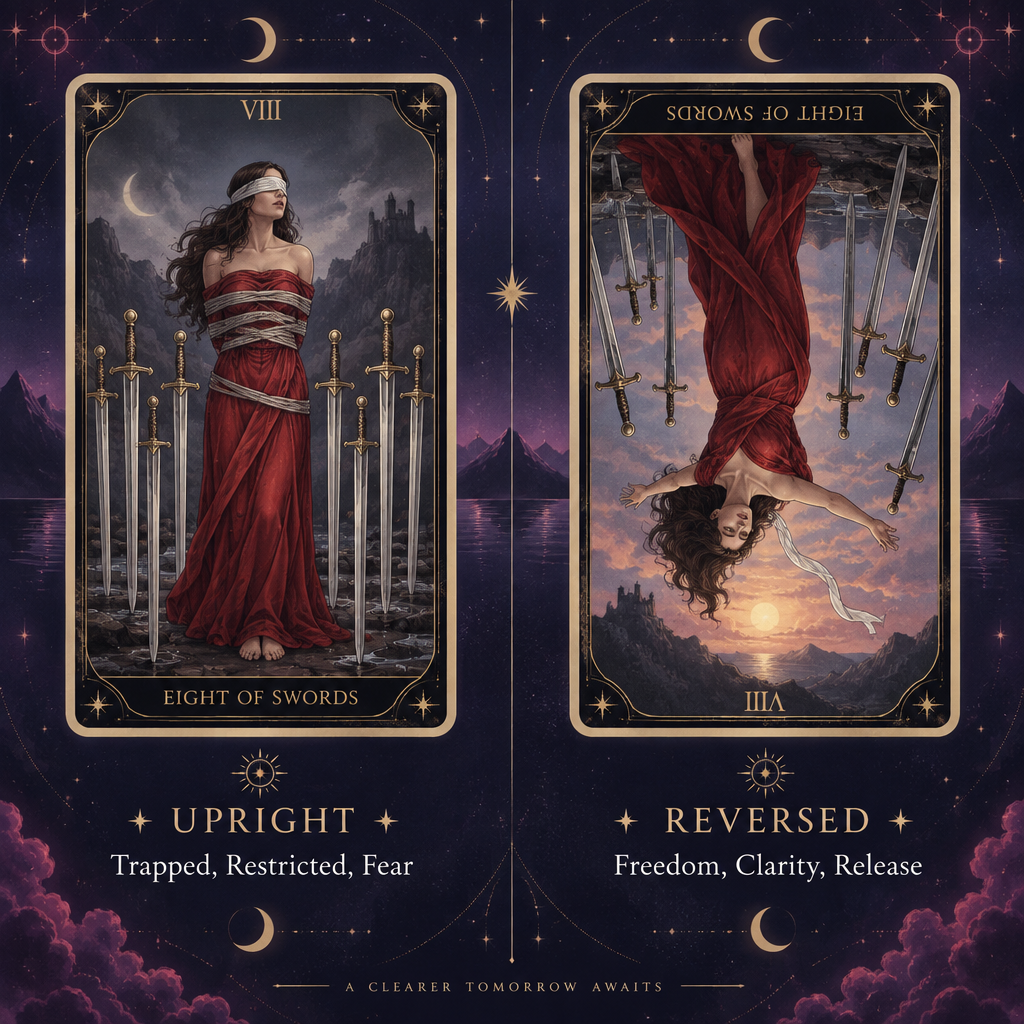
Upright keywords: Restriction, feeling trapped, limitation, fear, self-imposed prison, victim mindset, awareness needed, blocked perspective
Reversed keywords: Freedom, release, empowerment, clarity, liberation, confidence, taking off the blindfold, new perspective
Element: Air (thought, communication, mental patterns)
Astrology: Jupiter in Gemini, the third decan of Gemini (roughly June 11 to June 20)
Golden Dawn title: Lord of Shortened Force
Yes or no for love questions: Upright leans no, or “not yet, not like this.” Reversed leans yes, with a condition: you have to be the one who moves.
The Imagery, Decoded for Love
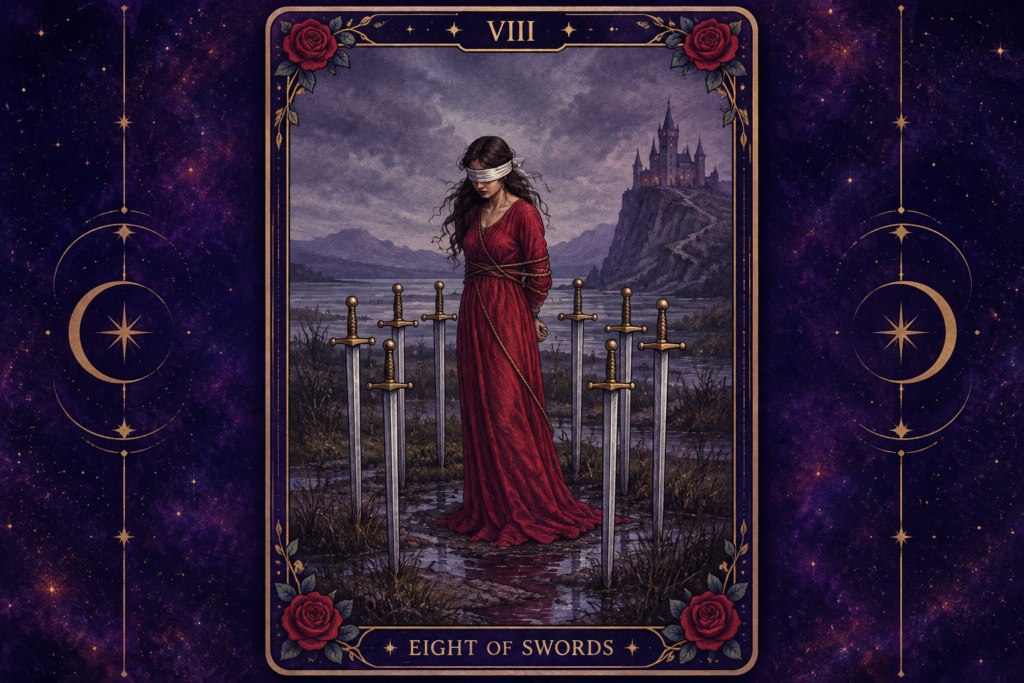
In the Rider-Waite-Smith deck, a woman stands loosely bound and blindfolded, eight swords planted in the ground around her. Her feet rest on marshy, waterlogged ground. A castle sits on a cliff in the distance, and the sky is a flat grey. Every element carries a specific message when the question is about love.
The blindfold. She cannot see her situation clearly. In a relationship reading this is the partner who misses obvious red flags, the person who tells friends “it’s not that bad” while describing something that plainly is, or the single querent who cannot see that the people they keep choosing all share the same flaw. The blindfold is not permanent. She could shake it off. She hasn’t, because she doesn’t yet believe she can.
The bound hands. The bindings are loose. They restrict her arms, which in love language means the inability to reach out, to express what she actually feels, to ask for what she needs, or to leave. Many people pull this card when they have rehearsed a difficult conversation dozens of times and never had it.
The eight swords. Swords are the suit of thought. These are beliefs, not walls: “nobody else would want me,” “I’ve invested too much to walk away,” “if I bring this up, it will end,” “all men/women do this.” Notice there is a gap in the circle of swords. There is always a way out; the obstacle is that she cannot see it.
The water at her feet. Swords cards rarely show water, so its presence here matters. Unprocessed emotion has soaked the ground she’s standing on. Old hurts, unspoken resentment, and grief from earlier relationships have clouded the clear thinking that Air normally provides. Feelings that were never dealt with are now making decisions for her.
The castle on the cliff. Safety, family, the life she thought she’d have, or the partner themselves, watching from a distance while doing nothing to help. In love outcomes this often represents a partner who is present but unavailable, or a support network the querent has stopped turning to.
Air, Gemini and Jupiter: The Energy Behind the Card
The Eight of Swords belongs to Air, which means the problem lives in the mind first. This is a card of cognitive distortions: catastrophising, all-or-nothing thinking, mind-reading a partner’s intentions, and treating a temporary state as a permanent fact. That matters for a love outcome, because mental traps respond to mental work. You cannot think your way out of a partner who is genuinely abusive, but you can think your way out of the belief that leaving is impossible.
Jupiter in Gemini adds a specific flavour. Jupiter expands whatever it touches, and in Gemini it expands thought and talk. The result is overthinking on a grand scale: a dozen possible interpretations of one text message, endless scenarios, analysis that produces more anxiety and no action. The Golden Dawn called this decan “Shortened Force” for a reason. Enormous mental energy is being spent and almost none of it is reaching the physical world.
The practical takeaway: when this card lands as a love outcome, the situation usually needs less analysis and more action, and the action is usually smaller and more available than the querent believes.
Is the Eight of Swords a Fixed Outcome or a Warning?
Treat it as a warning about trajectory. This is the most important thing to understand before reading any of the scenarios below.
The Eight of Swords does not say “this relationship will fail” or “you will be alone.” It says “if nothing changes in how you are thinking and acting, you will remain stuck.” The woman in the card is not chained to a wall. Her restraints are loose, the swords don’t touch her, and the way out is behind her. The card describes a temporary condition of restriction that the querent has the power to end, not a permanent trap.
Where the card becomes more serious is when it appears alongside cards that indicate an external source of control: the Devil, the reversed Emperor, the reversed King of Swords, the Five of Pentacles, or the Seven of Swords. In those combinations, the restriction is being maintained by someone else’s behaviour, and the card shifts from “you’ve talked yourself into a corner” to “you are being kept in a corner.” Both are escapable. The second requires outside help.
Eight of Swords Upright as a Love Outcome
The core message
The relationship, or your love life as a whole, is being shaped by fear rather than by what you want. You are staying, waiting, silent, or single because of a belief about what will happen if you do otherwise, and that belief has not been tested. The card’s honest answer to “where is this going?” is: nowhere new, until you take the blindfold off.
Upright for singles
You are not single because of a shortage of options. You are single because of a story you tell yourself about why it won’t work. Common versions: “I’m too old,” “I have too much baggage,” “everyone decent is taken,” “I always get hurt so why bother.” The Eight of Swords upright says these stories are the swords, and they are doing the work of keeping you isolated far more effectively than any real circumstance.
It can also indicate someone who is technically single but emotionally bound to a past partner, or to a person who has made it clear they are not interested. The blindfold is the refusal to see that the situation is over.
What to do: Write down the exact sentence you say to yourself when you decide not to pursue someone or not to put yourself out there. Then ask where you learned it and whether it is actually true today. If you cannot answer that alone, this is a genuinely useful thing to bring to a therapist. Take one small, low-stakes step within the week: reply to the message, say yes to the invitation, tell one friend you are open to being set up.
Upright in a new relationship
Something is already making you feel small or uncertain, and you are explaining it away. In the early stages this card frequently flags one of two things.
The first is your own anxiety. You are so afraid of losing this person that you are censoring yourself, agreeing with things you don’t agree with, and not raising the concerns you already have. That is a relationship built on a blindfold, and it will not hold.
The second is more serious: a partner who is already testing boundaries. Early controlling behaviour is rarely dramatic. It looks like mild criticism of your friends, “jokes” about what you wear, checking your phone “as a game,” or sulking when you make plans without them. The Eight of Swords upright as a new-relationship outcome asks you to look directly at anything that already makes you feel like you need permission.
What to do: Ask yourself one question: “Do I feel more like myself around this person, or less?” If the answer is less, name the specific behaviour causing it and raise it once, calmly. A healthy partner will hear it. A controlling one will make you feel unreasonable for mentioning it, and that reaction is your answer.
Upright in an existing or long-term relationship
This is where the card most often describes a controlling or manipulative dynamic, or a relationship that has become a cage of routine and fear.
In the controlling version, one partner has gradually shaped the other’s world: who they see, what they spend, how they dress, what they are allowed to be upset about. The bound person may not even describe the relationship as controlling. They will say their partner “worries a lot” or “just has strong opinions.” The water at the woman’s feet is the accumulated resentment and confusion that makes it hard to think straight about what is happening.
In the stagnation version, nobody is being cruel, but both people have stopped saying anything real. Conversations are logistics. Sex is infrequent or absent. One or both partners have privately decided that leaving is impossible because of the mortgage, the children, the shared friends, or the sheer effort of starting over. The Eight of Swords says the relationship’s outcome, left alone, is more of exactly this.
What to do: If the dynamic is controlling, the first step is not confronting your partner. It is reconnecting with one person outside the relationship who knew you before it, and telling them the truth about how things are. Isolation is what keeps the blindfold on. A relationship counsellor or a domestic abuse helpline can help you assess what you are dealing with; both are appropriate even when there is no physical violence.
If the problem is stagnation, have the conversation you have been rehearsing. Say the uncomfortable thing plainly and once. Couples counselling is designed precisely for relationships where both people are stuck and neither knows how to begin.
Upright with an ex or for reconciliation
As an outcome for reconciliation, the upright Eight of Swords is not encouraging. It usually describes one of three states.
Denial: you are holding onto a version of the relationship that never quite existed, and the blindfold is keeping you from seeing why it ended.
Not ready: your ex, or you, is still bound by the same fears and patterns that broke the relationship the first time. Reuniting now would replay the same script.
The victim mindset: you have cast yourself as the wronged party so completely that you cannot see your own part in what happened, which means nothing has been learned and nothing would be different.
Occasionally the card shows an ex who wants to return but feels trapped by pride, a new relationship they regret, or a belief that you would never take them back. Even then, the message is that they are not moving, and waiting for them to move is a poor use of your life.
What to do: Stop analysing their social media, their mutual friends, and the meaning of their last message. Jupiter in Gemini will happily feed that habit forever. Write an honest list of what actually caused the breakup, including your part. If you cannot fill that list without blaming them for everything, you are not ready to reconcile, regardless of what they do.
Upright as feelings and how someone sees you
As their feelings toward you: They feel trapped or stuck in relation to you. That can mean they want to be closer and feel unable to say so, or it can mean they feel obligated and are staying out of guilt. Either way, they are not acting on what they feel, and the block is in their head.
As how they see you: They may see you as someone who is stuck, anxious, or not living up to your own potential. In a less flattering version, they see you as someone who plays the victim. In the most concerning version, they see you as someone they can keep in a position of dependence.
Eight of Swords Reversed as a Love Outcome
The core message
The blindfold comes off. Reversed, the Eight of Swords as a love outcome is one of the more hopeful cards in the suit, because it shows the moment the querent realises the restraints were never locked. It brings clarity, release, and the confidence to act, and it often follows a period of feeling trapped that is now ending.
Two cautions. First, the reversal can also indicate someone who has seen the exit and is still refusing to take it, which is a more frustrating state than not seeing it at all. Second, in a small number of readings it shows restriction deepening rather than lifting, particularly when surrounded by other heavily reversed cards. Context decides. In most love spreads, though, reversed means liberation.
Reversed for singles
You are ready, and the readiness is real rather than performed. The reversed Eight of Swords for a single person describes someone who has genuinely stopped believing the old story about why love won’t work for them. Confidence is returning. The filter that made every prospect look like a repeat of the last disaster has lifted, which means you will start seeing people you would previously have dismissed.
It can also mark the end of an emotional attachment to someone unavailable. The single querent who has been “not really single” finally is.
What to do: Act on the clarity while it is fresh. Update the profile, tell people you are dating again, accept the invitation. The reversed card’s energy fades if it isn’t used. Be honest about what you learned during the stuck period, because that self-knowledge is what will make the next relationship different.
Reversed in a new relationship
Anxiety is easing and you are starting to show up as yourself. Early insecurity, the fear of scaring them off, the over-analysis of every message: all of it is loosening. The relationship’s outcome, in this position, is a shift from tentative to real.
It can also show that you have spotted an early red flag and decided to address it rather than swallow it. That is exactly what the card wants. A new relationship that survives one honest conversation about a boundary is on much firmer ground than one that has never had one.
What to do: Say the thing you would previously have kept quiet about. Let them see a preference, an opinion, or a need. If the relationship is as good as it feels, this will make it better. If it isn’t, you have saved yourself months.
Reversed in an existing relationship
Someone has stopped accepting the cage. In a long-term relationship this can go two ways, and both are forms of liberation.
The first: the relationship itself is freed. The unspoken thing gets spoken, counselling starts working, a controlling partner is confronted and, against expectation, actually changes. The couple stops operating from fear. This is the reversed Eight of Swords at its best, and it usually appears when supportive cards like the Two of Cups, the Star, or the Six of Cups sit nearby.
The second: one partner leaves. If the upright card described a genuinely controlling or dead relationship, the reversal often shows the bound partner walking out. This is still a positive reading. Freedom from a relationship that required a blindfold to tolerate is a good outcome, even when it hurts.
What to do: Decide which version you are in before acting. If the relationship has real warmth under the stuckness, invest in the conversation and get professional help to structure it. If you have been waiting for permission to leave a relationship that has been harming you, the reversed card is that permission. Make a practical plan, tell one trusted person, and follow through. Clarity without action puts the blindfold back on.
Reversed with an ex or for reconciliation
Recovery. As an outcome for questions about an ex, the reversed Eight of Swords most often shows the querent finally letting go, seeing the relationship clearly for what it was, and getting their life back. That is the primary reading and it should not be softened.
It can also indicate genuine reconciliation, and here it is more encouraging than the upright, with one condition: the return only works because at least one person has done real inner work in the interval. The pattern that caused the split has been seen and named. If your ex is reaching out and this card appears reversed, ask whether they can articulate what went wrong the first time. If they can, and you can too, the timing may be right. If the conversation is only about missing each other, nothing has changed except the loneliness.
What to do: If you are the one being asked to return, name your conditions before you say yes. If you are the one hoping to return, lead with what you understand now that you didn’t before. If neither applies and you are simply moving on, mark it somehow: remove the photos, take the trip, say yes to the date. The reversed card rewards a clear line drawn.
Reversed as feelings and how someone sees you
As their feelings toward you: They feel free with you, or free because of you. Something about you has helped them see past their own fears. Alternatively, they have recently had a realisation about the relationship and are about to act on it, for better or worse.
As how they see you: They see you as someone who has grown, who has stopped playing small, or who has recently found their voice. If they previously benefited from your being stuck, they may see this as a threat. That reaction tells you a great deal.
Upright vs. Reversed at a Glance
| Situation | Upright | Reversed |
|---|---|---|
| Overall love outcome | Stuck, restricted by fear or control; nothing changes without action | Release, clarity, confidence to act |
| Singles | Isolated by limiting beliefs or attachment to someone unavailable | Genuinely ready to date; old story no longer believed |
| New relationship | Self-censoring from anxiety, or early controlling behaviour ignored | Anxiety easing; boundaries named; relationship becomes real |
| Existing relationship | Controlling dynamic or fearful stagnation; more of the same ahead | Honest conversation frees the relationship, or one partner leaves |
| Ex / reconciliation | Denial, not ready, victim mindset; waiting is wasted | Letting go and recovering, or reconciliation after real inner work |
| As feelings | Trapped, blocked, obligated | Freed, awakened, about to act |
| Yes or no | No, or not yet | Yes, if you take the step |
| Core action | Take the blindfold off: name the fear, tell one person, seek counselling | Use the clarity now: speak, decide, follow through |
Eight of Swords Yes or No for Love
Upright: No, or more precisely, “not while things stay as they are.” Asked “will we get back together,” “does this person want me,” or “will this relationship work out,” the upright card says the current trajectory does not lead there. It is not a closed door. It is a door you have not tried.
Reversed: A conditional yes. The outcome you want is available, but the card gives credit to the person who moves, not the person who waits. If your question is “should I leave,” reversed is a strong yes. If your question is “will they come back,” reversed says something is shifting, and you should look for evidence of real change rather than assuming it.
Practical Steps When This Card Is Your Love Outcome
- Name the sword. Write down the exact belief keeping you in place: “I can’t leave because…”, “I can’t say this because…”, “nobody else would…”. Cognitive distortions lose most of their power once they are written in plain words.
- Test it against evidence. Ask what actually happened the last time you did the thing you are afraid of. Most Eight of Swords fears have never been tested at all.
- Break the isolation. Tell one trusted person the unvarnished truth about your love life or relationship. The card’s restriction depends on you being alone with your thoughts.
- Get a professional perspective where appropriate. Individual therapy for entrenched patterns, couples counselling for shared stagnation, and a domestic abuse service if any part of your relationship involves fear, monitoring, or control over your money, movements, or contacts.
- Do the inner work before the external change. Leaving one relationship with the blindfold still on leads to the same relationship with a different name. Understand the pattern first.
- Take one physical step within seven days. Air cards drown in planning. Send the message, book the appointment, have the conversation, or go on the date. Small and real beats large and imagined.
FAQ
What does the Eight of Swords mean in love?
It means a love life or relationship shaped by fear, limiting beliefs, or a controlling dynamic rather than by genuine choice. Upright it shows feeling trapped and unable to see the way out; reversed it shows the moment of clarity and release. In both positions the card insists the restriction is escapable.
Is the Eight of Swords a yes or no card?
Upright it leans no, or “not yet, not like this.” Reversed it leans yes, on the condition that you act rather than wait. For “should I leave” questions, reversed is a clear yes.
What does the Eight of Swords reversed mean in love?
Freedom, clarity, and empowerment. Reversed, it shows anxiety lifting, boundaries being spoken, a stuck relationship either healing or ending, and, for ex-partner questions, either genuine recovery or reconciliation after real inner work. Occasionally it warns of someone who sees the exit and still refuses to take it.
Does the Eight of Swords mean a relationship will end?
Not by itself. It describes a trajectory of restriction, not a fixed ending. If nothing changes, the relationship stays stuck. If the querent addresses the fear or the controlling dynamic, the outcome can be a freed relationship or a healthy exit. Combined with cards like the Devil, the Tower, or the Three of Swords, an ending becomes more likely.
What does the Eight of Swords mean for an ex coming back?
Upright, it is unlikely: it points to denial, unreadiness, or a victim mindset that would replay the old pattern. Reversed, it is more encouraging, provided at least one person can clearly explain what went wrong the first time and what is different now. Without that, a reunion repeats the trap.
Is the Eight of Swords a sign of a controlling partner?
It can be, especially upright in a long-term relationship reading and when paired with the Devil, the reversed Emperor, or the reversed King of Swords. The blindfold and bindings describe someone whose world has been narrowed by another person’s behaviour, often so gradually they don’t call it control. Feeling you need permission, being cut off from friends, or having your reactions constantly reframed as unreasonable are the signs to take seriously.