
The Five of Pentacles in a feelings reading points to someone who feels left out in the cold, usually because they believe they have little to offer or that reaching out will cost them more than they can afford. This guide breaks down what the card says about another person’s feelings toward you (and your own) across every relationship stage, in both upright and reversed positions, plus the practical steps that actually help when it shows up.
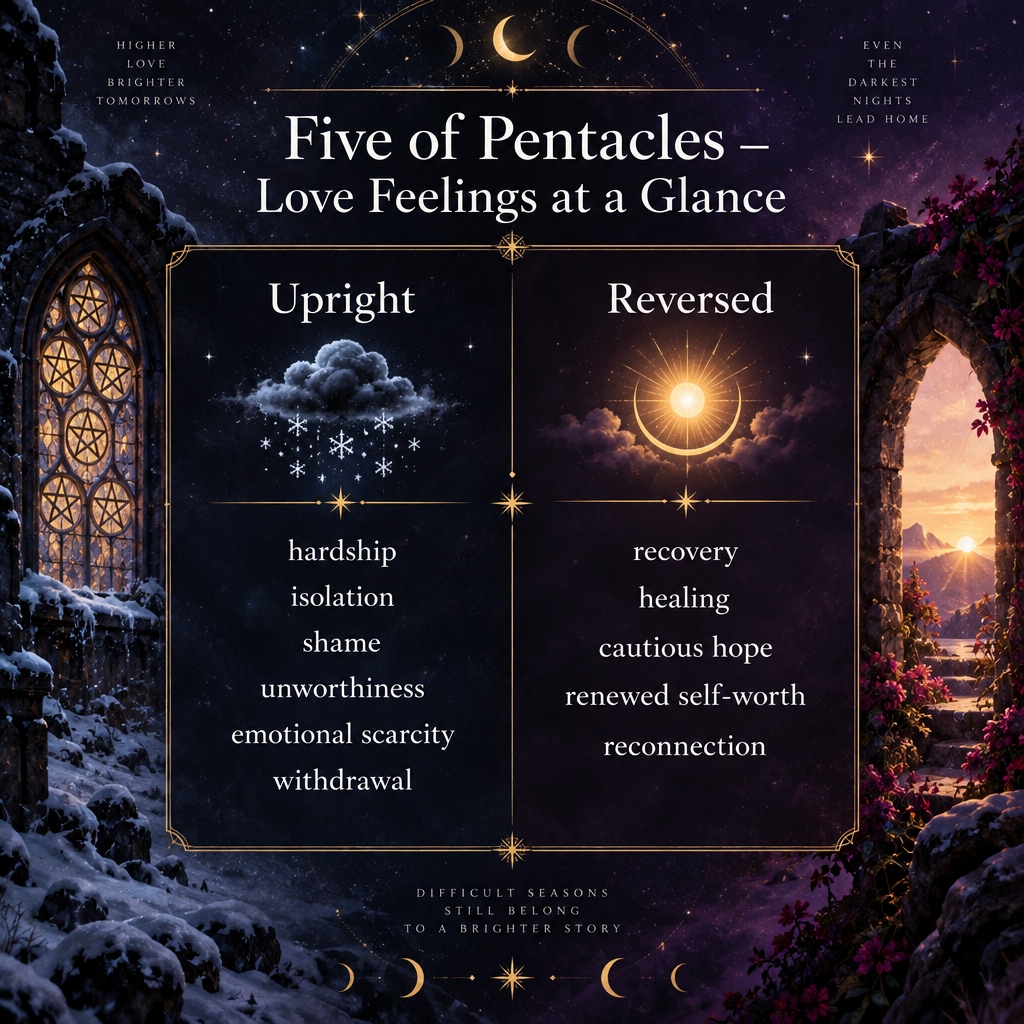
Quick Reference: Five of Pentacles Love Keywords
| Position | Core feeling | Love keywords |
|---|---|---|
| Upright | “I’m not enough, and I’m on my own” | hardship, isolation, rejection, emotional scarcity, shame, unworthiness, fear of being a burden, withdrawal |
| Reversed | “Maybe I don’t have to carry this alone” | recovery, healing, cautious hope, re-investment, asking for help, renewed self-worth, reconnection, letting go |
Keep this table in mind as a sanity check. If your reading drifts far from scarcity (upright) or recovery from scarcity (reversed), you’ve probably wandered off the card.
The Card Itself: Two Figures in the Snow
In the Rider-Waite-Smith deck, the Five of Pentacles shows two people trudging through a snowstorm at night. One walks on crutches with a bandaged head and a wounded leg. The other is barefoot, wrapped in a thin shawl, hunched against the wind. Behind them glows a church window, warm and lit from within, with five golden pentacles set into the stained glass. Neither figure looks at it. They pass right by.
Every piece of this image matters for a love reading.
The window is help, warmth, belonging. It is close enough to touch. The pentacles inside it are arranged like the lower branches of the Tree of Life, which Pamela Colman Smith used deliberately: spiritual and material support exist here, in this scene, not somewhere far off.
The figures don’t look up. This is the heart of the card. The problem is not that love is absent. The problem is that the person cannot see it, or does not believe they are allowed to walk in. In a feelings context, that translates to someone who has decided in advance that they will be rejected, so they never ask.
The crutch and the bandage are old wounds still being carried. Past relationships, family patterns, a breakup that never got processed. The injury limits how far this person can move toward you.
The bare feet signal exposure. Someone showing this card feels raw, unprotected, and ashamed of how little they think they bring.
Two figures, not one. They are suffering together, which is the detail most readings skip. The card can describe two people who are bonded by hardship rather than by joy, which matters enormously when you get to the trauma-bonding section below.
Tarot readers often call this the “poverty mindset” card. Financial poverty is one layer. The deeper layer is a poverty of self-worth: the conviction that you are a cost to the people around you rather than a gift. That conviction drives nearly every feeling this card describes.
Astrological correspondence
The Golden Dawn system assigns the Five of Pentacles to Mercury in Taurus, the first decan of Taurus (roughly April 20 to 29). Taurus rules the Second House of possessions, money, and self-worth. Mercury here is the mind running on a loop about what you lack. The Earth element grounds the whole thing in tangible reality: rent, health, physical closeness, the body. So when this card appears for someone’s feelings, expect their emotions to be tied up with concrete, material fears, not abstract romantic doubt.
Upright Five of Pentacles: Feelings in General
Upright, the emotional climate is one of deprivation. The person feels unloved, unseen, or undeserving, and the dominant response is to withdraw rather than reach out. Loneliness sits at the centre, but it is a specific kind of loneliness: the type you choose because you are sure the alternative is humiliation.
Three feelings cluster here:
- Shame. Not guilt about something done, but shame about who they are. “If they really saw me, they’d leave.”
- Scarcity. A belief that love, attention, or security is in short supply and must be rationed or protected.
- Exclusion. Feeling like the outsider at the window, watching other people have what they can’t.
When this card describes your feelings, you likely recognise all three. You may be comparing your relationship to others and finding it wanting, or doubting that you deserve the partner you have.
Upright: How They Feel About You
This is usually the real question behind “Five of Pentacles feelings in love”, so here is the direct answer.
They feel unworthy of you. The card does not typically mean they feel nothing. It means their feelings are buried under a heavy layer of “I can’t offer you what you deserve.” They see you as the lit window. They see themselves as the person in rags outside it.
Specific signs this reading is accurate:
- They go quiet during stressful periods instead of leaning on you.
- They deflect compliments or minimise their own achievements around you.
- They apologise for taking up your time, for “being a lot”, for needing anything.
- They pull back right after moments of closeness, as if intimacy triggered the fear of being found out.
- They keep practical struggles (money, health, family) hidden from you until they become unavoidable.
They fear being a burden. This is the single most common upright interpretation. Someone drawing this card about you is often dealing with a real-world problem, and their instinct is to protect you from it by distancing themselves. It reads as coldness. It is actually a clumsy form of care wrapped around a lot of shame.
They feel rejected, whether or not you rejected them. The card can show up when someone has interpreted a small signal from you (a slow reply, a cancelled plan) as confirmation of what they already believed: that they are not wanted. They are reacting to a story in their head more than to you.
What the upright card does not say: it does not say they are indifferent, cheating, or secretly in love with someone else. If you are trying to read betrayal into this card, look elsewhere. The Five of Pentacles is about scarcity, not deceit.
Upright Feelings by Relationship Stage
If you are single
Upright here describes a person (you or the one you’re asking about) who feels locked out of love entirely. Dating feels like standing in the snow watching couples through a window. There may be lingering wounds from a previous relationship, and a running inner script along the lines of “everyone else manages this, why can’t I.”
The attachment pattern to watch for is anxious attachment turning into avoidance by default. The person wants connection badly, expects rejection, and pre-empts it by not trying. Dating apps amplify this: every unanswered message becomes evidence.
If you’re asking how a specific single person feels about you, the upright card suggests interest that they are too insecure to act on. They may like you and have already decided you’re out of their league.
In a new relationship
The card points to someone holding back because they are waiting for you to discover the “real” them and leave. Early-stage upright Five of Pentacles often coincides with a practical imbalance: one partner earns noticeably more, one has stable housing and the other doesn’t, one is going through a health scare they haven’t disclosed.
Feelings toward you here are usually warm but braced for impact. They care, and they are quietly convinced it won’t last. Watch for over-apologising, reluctance to accept generosity, and odd flashes of defensiveness when you offer help.
In an established or long-term relationship
This is where the Pentacles suit’s material themes come to the front. In a committed partnership, the upright card nearly always has a concrete external trigger:
- a job loss or redundancy
- mounting debt, a missed mortgage or rent payment
- a chronic illness or a diagnosis in the family
- caregiving for an ageing parent
- fertility struggles, which land squarely in the body-and-security territory of Taurus
The feeling it describes is two people suffering side by side without turning toward each other. Like the figures in the image, the couple is walking through the same storm but not holding hands. One partner may feel they’ve failed the household and retreats into shame. The other feels shut out and reads the silence as loss of love.
If you are asking how your long-term partner feels about you, upright suggests they still love you and feel like a disappointment to you. Those two things coexist. The distance you’re sensing is shame, not fading attraction.
A second long-term pattern this card flags is co-dependency. One partner has slipped into the rescuer role, the other into the perpetual patient. The crutch in the image can belong to either. Relationships built this way feel loyal and stable from the inside, but neither person gets to be whole.
Feelings for an ex, and reconciliation
Asked about an ex’s feelings, the upright Five of Pentacles says they are not in a position to come back, even if they want to. They feel they lost something valuable and that they were the reason it broke. There is often regret, but it is regret tangled up with “I wasn’t good enough then and I’m not now.”
Reconciliation under the upright card is unlikely to succeed in the near term. The ex is still wounded (the bandages), still limping (the crutch), and still unable to look at the window. If you reunite now, you are likely to re-enter the same dynamic of one person carrying the other.
If the two of you were bonded primarily through hardship, this card is also a warning about trauma bonding: a connection that felt intense because you survived something together, not because you were good for each other. Missing that intensity is not the same as missing the person.
Reversed Five of Pentacles: Feelings in General
Reversed, the figures are finally beginning to notice the window. The storm has not stopped. The injuries have not healed overnight. But the belief that help is unavailable has started to crack.
Emotionally, this is the shift from “I’m on my own” to “maybe I could ask.” It brings:
- a willingness to be seen, including the parts they’re ashamed of
- a recovery of self-worth, often after therapy, a job change, a health improvement, or simply time
- the end of a period of isolation, sometimes by choice (leaving a bad situation) rather than rescue
The reversed card is not a guaranteed happy ending, and any reading that frames it as “triumph” is overselling. Healing from a scarcity mindset is slow, non-linear, and easily set back. Reversed describes the direction of travel, not the arrival.
Reversed: How They Feel About You
They are starting to believe they might deserve you. The reversed card describes someone cautiously re-investing in the connection after a period of pulling away. They have done some internal work, or their external situation has stabilised enough that they can look up from survival mode.
How this shows up:
- They begin sharing things they previously hid: a debt, a diagnosis, a family mess.
- They accept help without the usual flinch.
- They initiate contact after a stretch of silence, often tentatively.
- They talk about the future in small, concrete ways (a trip, a plan, a “we”).
The tone is hopeful but careful. Someone showing this card about you is testing whether the window is really open. One sharp response from you can send them back into the snow, so the reversed card asks for patience on your side too.
There is a second, less comfortable reversed reading: the person has decided to stop waiting outside your window and is walking away to build warmth elsewhere. This usually appears when the relationship has been one-sided for a long time. If you have been the one withholding, reversed can mean they’re done hoping. Context cards will tell you which version you’re looking at.
Reversed Feelings by Relationship Stage
If you are single
Reversed is the end of a dry spell, emotionally if not yet practically. The person feels ready to be seen again. Confidence is returning, often because something tangible improved: a new job, a move, finishing a course of therapy, paying off a debt.
If you’re asking about a single person’s feelings for you, reversed suggests they have been working up to approaching you and are closer than they were. The hesitation is thinning.
In a new relationship
Reversed here is a good sign with a condition attached. The person is dropping their guard and letting you in on the things they were hiding. The condition is that you respond to disclosure with steadiness rather than alarm. The first time they tell you about the money problem or the mental health history is a test they don’t fully know they’re running.
Their feelings for you are growing in proportion to how safe honesty feels.
In an established relationship
The couple has started turning toward each other inside the storm. Practical hardship may still be present, but the shame about it is lifting. Conversations that used to end in silence are now happening.
The most important feeling here is shared responsibility. The partner who felt like a failure is beginning to see the problem as “ours” rather than “mine.” If co-dependency was the pattern, reversed marks the rescuer stepping back and the patient standing on their own feet. That transition is uncomfortable and can feel like loss before it feels like growth.
Feelings for an ex, and reconciliation
Reversed is the most favourable position this card offers for reconciliation, and it still asks for caution. The ex is healing. They have likely addressed, at least partly, whatever drove the distance: the financial crisis, the untreated depression, the shame spiral. Communication tends to reopen under this card, often with an apology or an honest explanation of what was going on.
Their feelings toward you are usually warmer and clearer than at the breakup. They can finally see you as a person rather than as a mirror reflecting their failures.
The warning is this: do not rush. Reversed means they’ve started to recover, not that they’ve finished. A fresh start works when both people can name what went wrong and show, through behaviour over months, that it’s changed. If the ex wants to jump back in immediately, the Five of Pentacles reversed suggests slowing down until the healing has substance behind it.
Long-Distance and Online Relationships
The isolation theme hits differently when the relationship lives mostly on a screen. Upright, the Five of Pentacles in a long-distance context describes a partner who has gone quiet and whose silence you are filling with worst-case stories. Distance strips out the body language that would normally tell you “I’m stressed about money” versus “I’m losing interest.” The card almost always points to the former.
It also flags a very modern version of the poverty mindset: the person who can’t afford the flights, who feels humiliated that they can’t close the distance, and who withdraws rather than admit it.
Reversed, long-distance partners begin to speak plainly about the practical obstacles and plan around them together. The warmth comes back into the messages. Concrete timelines appear.
Financial and Material Stress as a Love Disruptor
Because this is a Pentacles card, the material angle is never incidental. Research on couples consistently finds money to be among the top sources of relationship conflict, and the Five of Pentacles shows the emotional mechanism behind that: money shame produces silence, silence produces distance, distance gets misread as falling out of love.
The pattern runs like this:
- One partner faces a material setback (redundancy, medical bills, a failed business).
- They feel responsible and ashamed.
- They stop talking about it to “protect” the other person.
- The other person senses withdrawal and assumes the worst about the relationship.
- Both now feel alone, walking past the window together.
Breaking the cycle means separating the practical problem from the relational one. Couples who weather this card well do two things: they put the numbers on the table (literally, a shared spreadsheet or a sit-down with every bill laid out) and they say out loud that the hardship is a shared project, not one person’s failure. Health crises follow the same logic. The ill partner often feels like the one on the crutch, dragging the other down, and needs to hear explicitly that they are not a burden.
What to Do When This Card Appears in a Feelings Reading
If the card describes how they feel about you:
- Lower the cost of reaching out. Someone who expects rejection needs the door opened for them. Send the first message. Suggest the low-pressure plan.
- Name practical help concretely rather than offering “anything you need.” “I can cover dinner this month” lands. “Let me know if I can help” doesn’t.
- Resist the urge to rescue them entirely. Support is not the same as carrying. If you take over, you cement the co-dependent pattern the card warns about.
- Respond to disclosure with calm. The first time they tell you the hard thing, how you react decides whether there’s a second time.
If the card describes your own feelings:
- Notice the story. “They’re pulling away because they don’t love me” is a hypothesis, not a fact. Check it before acting on it.
- Ask directly whether something practical is going on. Most of the time with this card, the answer is yes.
- Do your own shadow work on worthiness. If you keep attracting or feeling the Five of Pentacles, the pattern lives in you, and no partner fixes it from the outside.
- Small acts of kindness, given and received, do more here than grand gestures. The card’s remedy is warmth you can actually walk into.
If the card appears about an ex:
- Upright: let the healing happen without you. Reaching out now tends to re-trigger the shame dynamic.
- Reversed: communication is possible, but build it slowly and watch for sustained change over months, not promises over days.
Five of Pentacles Compared With Nearby Cards
Readers often confuse this card with other painful ones. The distinctions matter for feelings readings.
- Three of Swords is acute heartbreak from a specific betrayal or loss. Five of Pentacles is chronic depletion with no single villain.
- The Devil is bondage through compulsion: the partner can’t leave because they’re hooked. Five of Pentacles is bondage through scarcity: they won’t leave, or won’t enter, because they think they have nowhere better to go. When both appear together, trauma bonding is strongly indicated.
- Five of Cups grieves what was spilled. Five of Pentacles can’t see what’s still available.
- Ten of Pentacles is the direct contrast: material security, family, belonging, standing inside the warm house. If it appears in the outcome position after a Five of Pentacles, the storm is temporary.
- The Star following this card is the window finally reached.
Yes or No: Five of Pentacles in Love Questions
Upright, treat it as a no, or not yet. The card describes conditions where love can’t be acted on cleanly: shame, scarcity, withdrawal. Asked “does this person want to be with me,” upright says they may want to but don’t believe they can.
Reversed leans toward a cautious yes. Recovery is underway and the person is re-engaging. It is a yes with homework attached, not a green light to skip the work.
FAQ
Is the Five of Pentacles a yes or no in love?
Upright is a no or a “not now.” The emotional conditions for a healthy yes aren’t present: the person feels unworthy, withdrawn, and under pressure. Reversed shifts toward yes, but only as “yes, if the healing continues.” Neither position is a clean, unconditional answer.
Does this person love me if I pull the Five of Pentacles?
Usually, yes, and they don’t believe they deserve to. The card rarely means absence of feeling. It means feeling buried under shame and a fear of being a burden. Look at how they behave when they’re struggling: if they vanish rather than lean on you, that’s this card.
What does the Five of Pentacles mean for reconciliation with an ex?
Upright: the ex is not ready, still carrying the wounds that ended things, and a reunion now would likely replay the old dynamic. Reversed: the ex is healing, communication is reopening, and a fresh start is possible if both of you move slowly and the change proves real over time.
Is the Five of Pentacles a bad card in love?
It is a hard card, not a hopeless one. The window is lit and the help is right there; the problem is that nobody is looking at it. The card’s message is that the deprivation is largely perceived and therefore changeable. What makes it genuinely bad is ignoring the practical stressors underneath it and letting shame do the talking for months.
Why does the Five of Pentacles keep appearing in my love readings?
Repeated appearances point to a pattern in you rather than in any specific partner: a scarcity belief about love, possibly rooted in anxious or disorganised attachment, that keeps you either outside the window or choosing partners who are. That is shadow work territory, and it responds to therapy and honest self-examination far better than to another reading.
What should I do when I get this card in a feelings reading?
Check for a material cause first (money, health, work), because with Pentacles there almost always is one. Then make the connection cheaper to reach: initiate contact, offer specific help, and respond to vulnerability with steadiness. If the card is reversed, give the recovery room to become real before you build on it.