
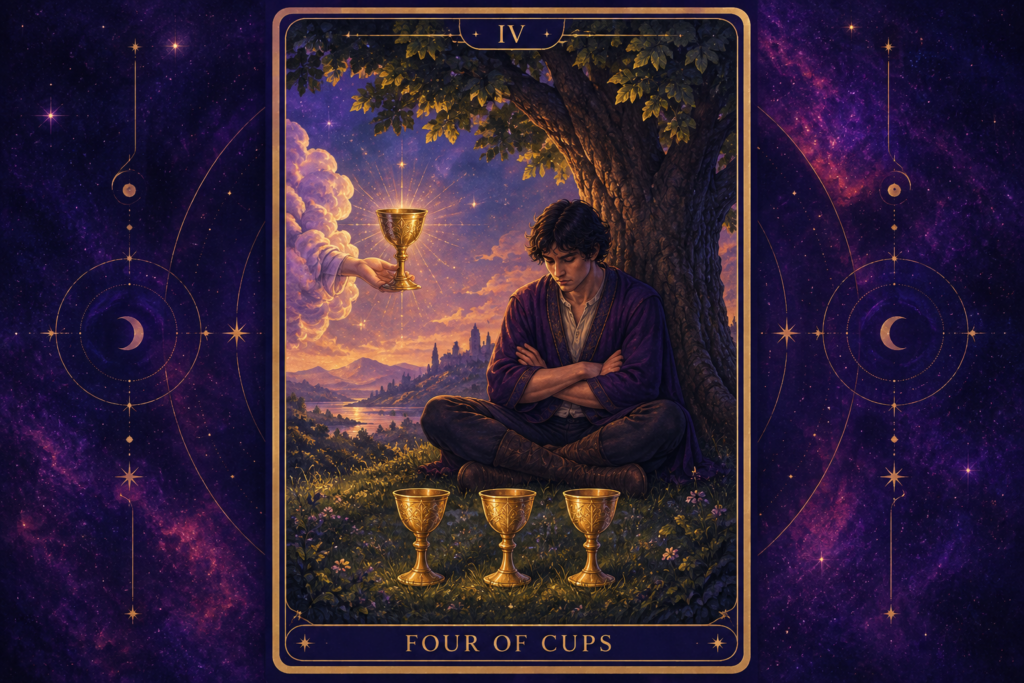
Four Of Cups As Love Advice (Upright & Reversed) Tarot Card Meaning
Last reviewed: October 2026. Interpretations below follow the Rider-Waite-Smith imagery and the Golden Dawn correspondences most readers use today.
The Four of Cups in a love reading points to apathy, emotional withdrawal, and an offer you are not seeing because you are too busy staring at what you already have or already lost. It is not a card of heartbreak. It is a card of sitting still while something good waits at the edge of your vision.
What the Card Shows and Why It Matters for Love
In the Rider-Waite-Smith deck, published in 1909 with artwork by Pamela Colman Smith under the direction of Arthur Edward Waite, a young man sits cross-legged beneath an oak tree. His arms are folded. Three cups stand in a row on the grass in front of him. A fourth cup floats toward him from a small cloud at the left of the frame, held out by a hand that mirrors the one on the Ace of Cups.
Waite’s own note in The Pictorial Key to the Tarot (1911) calls the figure’s mood “discontent with his environment.” Each element carries a love-specific message:
- The oak tree. Oaks signal rootedness and endurance. In a relationship reading, this is the stable ground you are sitting on: a long partnership, a settled single life, a comfortable routine. Stability is real here, but the man is leaning against it rather than growing from it.
- The three cups on the ground. These are the emotional goods already in your life. A partner who shows up, friends who care, past loves you are still cataloguing. They are within arm’s reach, and he is not touching them. That is the “taking it for granted” theme in one picture.
- The fourth cup from the cloud. Something new is being offered, and the offer is coming from outside your current frame of reference. In love this is a person you have dismissed, a conversation you keep postponing, or a different way of relating that your partner has been hinting at. His folded arms say he has decided in advance that he is not interested.
- The closed posture. Crossed arms and a downcast gaze are the body language of someone who has been hurt and is protecting the wound. The card rarely describes a cold person. It describes a guarded one.
Astrology and Numerology Behind the Four of Cups
The Golden Dawn assigned the Four of Cups to the Moon in Cancer, the third decan of Cancer, and titled it the Lord of Blended Pleasure. The Moon is already at home in Cancer, so this is emotion turned fully inward: nostalgia, moodiness, the urge to retreat to a safe shell and replay old feelings. In love readings, Moon in Cancer energy explains why the querent keeps circling the same memories instead of engaging with the person in front of them.
Numerologically, four is the number of structure. Four walls, four legs on a chair. Fours bring security, and the shadow side of security is stagnation. Compare the Four of Pentacles clutching his coins or the Four of Swords lying motionless on a tomb. The Four of Cups is the emotional version of that same freeze: the heart has built a sturdy box and now will not come out of it.
Four of Cups Upright in Love: The Core Message

Upright, the card names four related conditions. Figure out which one is yours before acting on any advice.
- Apathy. You feel flat about love, not devastated, just uninterested. Dates feel like chores. Your partner’s affection registers as background noise.
- Emotional withdrawal. You have pulled back, often without announcing it. You answer texts late, keep conversations shallow, and tell yourself you are “just busy.”
- Taking a partner for granted. The three cups are right there. You stopped noticing them months ago.
- Missed opportunity. Someone is offering connection and you have pre-rejected it because it does not look like the thing you were hoping for, or because the last time you accepted a cup it got knocked over.
The advice that follows from all four is the same in principle: unfold your arms and look up. What that means in practice depends on your situation.
If You Are Single
The Four of Cups upright for singles describes someone who says they want a relationship and then declines every actual invitation. Usually one of two mechanisms is running.
The first is past disappointment. A breakup or a long stretch of dating fatigue has taught you that reaching for the cup ends badly, so you have stopped reaching. The second is a standards problem dressed up as discernment. The fourth cup does not arrive looking like your checklist, so you dismiss the barista who keeps chatting with you, the friend-of-a-friend who asked you out twice, the person on the app whose profile was slightly too earnest.
Concrete steps for this position:
- Name the last three people who showed interest, then write down the real reason you passed on each one. If the reasons are all variations on “not what I pictured,” the card is talking to you.
- Give the next offer a single real yes. One coffee. Not a relationship, a cup.
- If the withdrawal follows a genuine heartbreak and you are still grieving, the card is not scolding you. It is asking you to set a date for when the pause ends, so that rest does not quietly become hiding.
If You Are in a New Relationship
Three to twelve months in, the Four of Cups often shows up when the honeymoon chemistry fades and one person interprets the normal cooling as a sign the relationship is wrong. Nothing has broken. The novelty cup has simply emptied, and you have not yet noticed the fourth cup, which is the chance to build something deeper than novelty.
If you are the one feeling bored: ask yourself whether you are bored with this person or bored with the absence of drama. Those are very different diagnoses.
If your partner seems distant: this card suggests their withdrawal is internal and probably predates you. Ask one direct question, “I’ve noticed you’ve been quieter lately, what’s going on for you?”, and then let them answer without filling the silence. Do not chase. Chasing a Four of Cups person pushes them further under the tree.
If You Are in a Long-Term Partnership
Here the card describes the autopilot dynamic. You coordinate schedules, split bills, sit on the same sofa, and have not had a conversation that surprised either of you in a long time. Neither person is unhappy enough to leave. Neither is happy enough to say so.
The three cups are your shared history, the home you built, the reliability you both provide. The fourth cup is the partner you actually have today, who has changed in the years since you first met and whom you have not re-met.
Practical advice:
- Ask your partner one question you genuinely do not know the answer to. Not “how was your day,” but “what have you been thinking about lately that you haven’t told me?”
- Audit your own reception. When your partner reaches toward you, with a touch, a joke, an invitation, how often do you accept versus deflect? Keep an honest count for one week. Most people drawing this card find they are declining far more than they realised.
- Stop waiting to feel motivated before you re-engage. Feeling follows action with this card, not the other way round.
If You Are Married
Marriage sharpens the long-term reading. Routine is not the enemy; complacency is. The Four of Cups in a marriage reading usually means one spouse has quietly concluded that the emotional part of the relationship is finished and the practical part is all that remains. They have not said this out loud. They may not have fully admitted it to themselves.
The card’s advice is to reestablish contact before resentment calcifies. Schedule a conversation, not a “date night” with a film and no talking, but a sit-down where the question on the table is “what do you need from me that you have stopped asking for?” Expect the first answer to be “nothing.” Stay in the room for the second answer.
If you are the spouse who feels unseen, the card asks whether you have been offering cups in a way your partner can actually receive, or whether you have also folded your arms and are waiting to be noticed.
If You Are Thinking About an Ex or a Reconciliation
The Four of Cups is one of the clearest “no, not yet” cards for reconciliation questions, and the reason is in the image. The man is staring at three cups that are already on the ground. In an ex reading, those cups are the relationship you had. You are examining it, missing it, rearranging it in your head. Meanwhile the fourth cup, which could be a new person or simply your own future, is being ignored.
The specific loop the card describes: you miss them, you reach out or think about reaching out, you remember exactly why it ended, you pull back, and the cycle restarts a week later. Nothing in the pattern has changed because nobody has changed. The card is telling you that reconciliation under these conditions reproduces the old relationship with the old problems.
Advice for this position:
- If your ex is the one reaching out, ask what is different now. If the answer is “I miss you” rather than a specific changed behaviour, the fourth cup is not for them.
- Give the space the card describes, but direct the energy somewhere. Grieving under a tree is appropriate for a season. The card appears when the season has run long.
- If a reconciliation is genuinely on the table, the Four of Cups says do not decide while numb. Wait until you can feel something other than nostalgia.
Four of Cups Reversed in Love
Reversed, the man’s arms come uncrossed, but the card does not simply flip into joy. It describes motion in one of two directions: either apathy breaking and the querent reaching for the cup, or withdrawal that has turned sour and is now leaking out as mixed signals and quiet resentment. Context and surrounding cards tell you which.
Reversed for Singles
The hopeful reading: you are coming out of a long stretch of not caring, and someone has caught your attention in a way that surprises you. The offer you refused before, or one very like it, is being extended again, and this time you are inclined to take it. The advice is to accept before you have fully talked yourself into readiness. Readiness arrives after the first yes, not before.
The warning reading: you are dating again but with the walls still up. You match, flirt, agree to meet, then cancel. You want to want connection. The reversed Four of Cups asks you to notice the gap between what you say you want and what you actually do when it is offered, and to close it by half a step rather than pretending it does not exist.
Reversed in a Relationship
This is where the reversed card gets uncomfortable. The upright card withdraws quietly. The reversed card withdraws politely while keeping score.
Common signs:
- Resentment under courtesy. Everything is “fine.” Requests are met with “sure, whatever you want.” Warmth has been replaced by compliance.
- Mixed signals. Affectionate one day, unreachable the next. Plans made enthusiastically and then dropped. The partner receiving these signals cannot tell whether they are wanted.
- Emotional depletion. One person has been pouring cups for a long time and receiving none back. They have not left, but they have stopped offering.
If you recognise yourself as the resentful one, the card’s advice is to say the thing you have been swallowing, in plain words, within the week. Resentment that stays polite does not dissolve; it compounds.
If you recognise your partner, do not try to fix the mood. Name it. “You keep saying things are fine and I don’t believe you. I’d rather hear the real version.” Then be prepared to actually hear it.
Reversed and Reconciliation
Reversed, the reconciliation loop can finally break, in either direction. For some querents it means they stop reaching backward and the ex loses their grip. For others it means an ex returns with something genuinely different to offer, and this time the querent is able to receive it. The distinguishing question is the same as upright: what has actually changed? If you can name it concretely, the reversed card supports a careful second attempt. If you cannot, it supports letting go.
Four of Cups as Feelings: What Someone Feels About You

Drawn to represent another person’s feelings toward you, the Four of Cups describes emotional unavailability, not disinterest. The distinction matters. They are not indifferent to you. They are guarded against you, usually because of something that happened before you arrived.
Typical readings:
- They notice your attention and feel ambivalent about it, pleased and wary at the same time.
- They are preoccupied with a past relationship or an internal problem and have little emotional bandwidth to spare.
- They are afraid of receiving. Accepting the cup would mean being vulnerable again, and they are not sure they can afford it.
Reversed as feelings, the person is starting to thaw. They have been thinking about you more than they let on and are close to acting on it, or they are frustrated with their own hesitation and may send contradictory signals as a result.
What to do with this information: offer, then stop. The fourth cup in the image is held out steadily. It is not shoved into the man’s hands. If they take it, good. If they do not, the card has told you where they are, and it is not your job to pry their arms open.
Four of Cups Yes or No in Love
Generally no, with a timing clause. The Four of Cups answers “should I move forward with this?” with “not in your current state.” The energy is stalled and the querent is not seeing clearly. The exception is the reversed card alongside active cards such as the Ace of Cups, the Knight of Cups, or the Sun, which shift the answer toward “yes, now that you are finally paying attention.” Even then, the yes is conditional on action: the cup only counts if you reach for it.
Reading the Four of Cups in Specific Spread Positions
- Position 1 (present situation) in a Celtic Cross: the relationship or your love life is in a holding pattern. Nothing is wrong on paper and nothing is moving.
- Position 2 (the crossing card): apathy is the obstacle itself. Look at position 3 or 4 for what caused it.
- Position 3 (foundation or root): an old disappointment is driving present withdrawal. The querent is reacting to history, not to the current partner.
- Position 6 (near future): an offer is coming that you will be tempted to dismiss. Pre-commit to considering it.
- Position 7 (how you see yourself): you believe you are being discerning. Check whether the surrounding cards agree.
- Position 8 (how others see you): your partner or potential partner reads you as closed off, whatever you think you are projecting.
- Position 10 (outcome): the situation stalls unless something in the middle of the spread shows a deliberate change.
In a three-card past, present, future draw, the Four of Cups in the past position is often the healthiest placement: a period of necessary retreat that is now over.
How the Four of Cups Differs From Its Neighbours
Readers new to the Cups suit often blur these cards together. They point in distinct directions.
| Card | Emotional state | Love message |
|---|---|---|
| Ace of Cups | Fresh offer, open heart | A new feeling or connection arrives; accept it |
| Three of Cups | Shared celebration, community | Love supported by friends; joy expressed outward |
| Four of Cups | Withdrawal, apathy | Offer present but refused; look up |
| Five of Cups | Grief over what was spilled | Loss acknowledged; two cups still stand behind you |
The sharpest contrast is between the Four and the Five. In the Five of Cups, something was actually lost; three cups lie spilled. In the Four, nothing has been lost at all. The three cups stand upright and full. The problem is entirely in the sitter’s refusal to engage, which is why the Four is ultimately more hopeful: the fix is a change of posture, not a recovery from damage.
The Ace and the Four share the same hand emerging from a cloud. The Ace is the moment the gift is offered with nothing in the way. The Four is what happens when the recipient has accumulated enough history to hesitate.
Productive Pause or Avoidance? The Honest Self-Check
Not every Four of Cups is a problem. Sometimes sitting under the tree is exactly right: after a breakup, during a stressful season, when you genuinely need to work out what you want before involving someone else. The card becomes a warning only when rest has turned into hiding. Four questions separate the two:
- Does the pause have an end point? Productive retreat has a horizon, even a vague one. Avoidance has none.
- Are you learning something? If you can articulate what the quiet period has taught you about your patterns, it is working. If you are just replaying the same memories, it is not.
- Do offers feel like intrusions or like options? Irritation at being approached is a sign the retreat has hardened.
- Would you recognise the fourth cup if it arrived? Describe, in one sentence, what an offer worth accepting would look like. If you cannot, you have ruled out everything in advance.
Answer honestly and the card has done its job. The man in the picture is not stuck because the cup is out of reach. He is stuck because he has not looked at it yet.
FAQ
What does the Four of Cups mean in love?
Upright, it means apathy or emotional withdrawal in your love life: taking a partner for granted, feeling flat about dating, or dismissing a potential connection because of past disappointment. An opportunity for emotional connection is being offered and ignored. The advice is to examine why you are refusing and to re-engage deliberately rather than waiting to feel inspired.
What does the Four of Cups reversed mean in love?
Reversed, the card shows movement out of stagnation, in one of two directions. Positively, apathy is lifting, you are ready to date again, or you are willing to accept an offer you previously turned down. Negatively, withdrawal has curdled into resentment hidden under politeness, producing mixed signals and emotional depletion in a relationship. Surrounding cards indicate which reading applies.
Is the Four of Cups a yes or no card?
In love questions it is generally a no, or more precisely a “not yet.” The querent is not seeing the situation clearly and should pause before committing. Reversed, and especially next to active, warm cards like the Ace of Cups or the Sun, it leans toward a conditional yes that depends on the querent actually acting on the opportunity.
What does the Four of Cups mean as feelings for someone?
When it represents how someone feels about you, it indicates guardedness and emotional unavailability rather than lack of interest. They notice you but are protecting themselves, often because of an earlier hurt or a preoccupation that leaves them little bandwidth. Reversed, they are beginning to open up and may be close to acting on their interest, sometimes clumsily.
Does the Four of Cups mean a relationship is ending?
No. Unlike the Five of Cups, nothing in this image has been lost; the three cups stand full. The card describes disengagement, not rupture. Relationships showing this card most often need renewed attention and honest conversation, not an exit.
What is the astrological meaning of the Four of Cups?
The Golden Dawn assigned it to the Moon in Cancer, the third decan of Cancer, under the title Lord of Blended Pleasure. This is emotion turned inward: nostalgic, protective, and prone to retreating into a shell. Numerologically, the four adds structure and stability, with stagnation as its shadow.