
You pulled Judgement in the advice position of a love reading, and now you want to know what to actually do. The short version: stop stalling, look honestly at what the relationship has been, and make the call you already know needs making. The longer version depends on whether you are single, newly dating, years into a partnership, or wondering whether an ex deserves another chance, so this guide works through each of those in turn.
What the Card Shows, and Why It Matters for Love
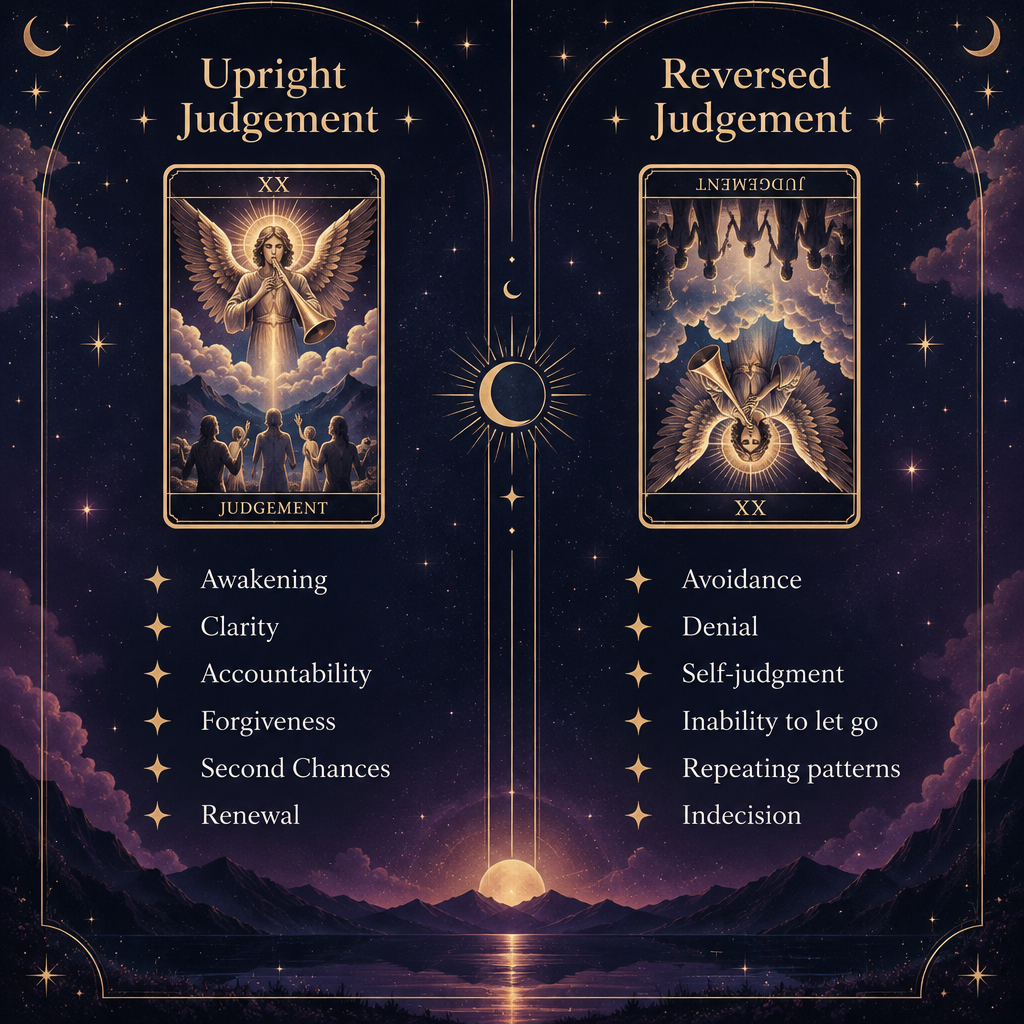
In the Rider-Waite-Smith deck, Judgement is card XX of the Major Arcana, sitting between The Sun and The World. Archangel Gabriel fills the top of the card, wrapped in cloud, blowing a trumpet with a white banner marked by a red cross. Below him, grey-skinned figures rise from open coffins with their arms outstretched: a man, a woman, and a child in the foreground, more behind them. A line of mountains runs across the horizon and water laps at the edges of the graves.
Each piece of that scene has a direct love meaning.
- Gabriel’s trumpet is the wake-up call. Something in your love life has been asleep, and the sound you cannot ignore is already ringing. It might be a conversation you keep postponing or a truth about a partner you have been reasoning around.
- The figures rising from coffins are the parts of you that went dormant. Old versions of how you love, old relationships, old wounds. They are not rising to haunt you. They are rising to be looked at, dealt with, and released.
- The grey skin matters. These people are not yet fully alive. Judgement is a transition card, not an arrival. In love it describes the moment between deciding and living out the decision.
- The mountains form a boundary that cannot be crossed by going back. Whatever you choose from here, the old way of relating is closed off.
- The water is emotion, the one element that connects every figure on the card. Judgement asks you to feel the full weight of a situation before you rule on it.
Not every deck keeps this scene. The Marseille tradition calls it Le Jugement and shows a similar resurrection. Aleister Crowley’s Thoth deck renames the card The Aeon and swaps Gabriel for the Egyptian deities Nuit and Hadit, framing it as the birth of a new era rather than a Christian Last Judgement. Illustrated decks of the last decade often strip the religious imagery entirely, and animal-based decks like Kim Krans’s The Wild Unknown drop the human figures altogether. Whatever the artwork, the core stays the same: a reckoning, a rising, and a point of no return.
Upright vs. Reversed at a Glance
| Upright Judgement | Reversed Judgement |
|---|---|
| Awakening | Avoidance |
| Clarity | Denial |
| Accountability | Self-judgment |
| Forgiveness | Harsh criticism of others |
| Redemption | Inability to let go |
| Second chances | Repeating old patterns |
| Honest evaluation | Fear of being judged |
| Renewal of commitment | Indecision |
The Karmic Layer: Pluto, Soul Contracts, and Divine Timing
Modern astrologers assign Judgement to Pluto, the planet of death, rebirth, and the things we bury because they are too uncomfortable to look at. Older Golden Dawn correspondences give the card the element of Fire, which is purification by burning away. Both point the same direction. Judgement does not tidy up a relationship. It strips it down to what is true and asks whether the true version is worth keeping.
In love readings, the card often flags a karmic relationship: a connection that feels fated, intense, and strangely familiar, and that exists to teach something specific. Readers who work with the idea of soul contracts read Judgement as the moment the contract comes due. You have learned what the relationship was meant to teach, and now you either renew the agreement consciously or let it complete.
Divine timing sits inside this too. The old version of this page warned that resisting the universe “leads to downfall,” which is both vague and unhelpful. A more accurate reading: Judgement appears when the timing is already right. The delay is coming from you, not from fate. If you have been waiting for a sign before having the hard talk, defining the relationship, or closing the door on someone, this is the sign.
Upright Judgement as Love Advice
Upright, the card’s advice is consistent across every situation: evaluate honestly, forgive what can be forgiven, decide, and move. How that plays out depends on where you stand.
If You Are Single
Judgement upright tells you that your readiness for real partnership is being tested, and the test is pattern recognition. Pull out the last three people you dated. Write down what went wrong with each. If the same issue shows up twice, that is the lesson Gabriel is blowing the trumpet about.
The practical advice is to deal with that pattern before the next person arrives, not during. If you always pick emotionally unavailable partners, the work is on why unavailability feels safe to you. If you lose yourself in relationships, the work is on boundaries. Judgement says you are capable of this now in a way you were not before, and that a meaningful connection is waiting on the other side of it.
A second reading applies when you have recently met someone and are unsure whether to pursue it. Judgement upright says yes, this is worth your attention, but go in with your eyes open. The connection likely has a purpose beyond romance, and you will know fairly quickly whether it is a long-term partnership or a short, intense teacher.
If You Are in a New Relationship
A budding relationship under upright Judgement tends to feel significant fast. People describe it as recognising someone rather than meeting them. The advice here is to honour that weight without rushing to label it.
Specifically, have the intentions conversation early. Judgement does not tolerate ambiguity for long. Ask what the other person wants, state what you want, and listen to the actual answer rather than the one you hope for. If you have been holding back something relevant about your past, a divorce, children, a recent breakup, this card says disclose it now. New relationships that start under Judgement either become transformative or collapse under an unspoken truth. There is rarely a lukewarm middle.
If You Are in a Long-Term Relationship
For established couples, Judgement upright calls for what one might bluntly label a state-of-the-union conversation. Not a fight, not a casual check-in. A deliberate, scheduled sit-down where both of you answer the same questions: Are we still choosing this? What have we stopped saying? What needs forgiving?
The card is strongly associated with forgiveness, and in long partnerships that usually means one of two things. Either there is a specific wound, an affair, a financial betrayal, years of neglect, that has never been properly addressed, or there is an accumulation of small resentments that have hardened into contempt. Judgement says name it, out loud, and decide together whether you can genuinely release it. If you can, the renewal that follows is real and often leads to recommitment, moving in, or marriage. If you cannot, the card is equally clear that pretending to forgive while keeping score is worse than an honest ending.
If You Are Thinking About an Ex
This is the question most people bring to Judgement, so here is a direct answer. Upright Judgement as love advice regarding an ex says a second chance is possible, but only under conditions. Reconciliation works when:
- Both people can name what went wrong without blaming only the other.
- At least one concrete thing has changed since the breakup, not just the feeling of missing each other.
- You can forgive the specific harm, not just decide to ignore it.
- The reunion is a choice made from clarity, not from loneliness or fear of starting over.
If those four hold, Judgement supports reopening the door and expects the relationship to be different in kind, not just resumed. If they do not hold, the card’s advice flips: the awakening it describes is you realising the relationship belongs in the coffin it rose from. Look at it, thank it for what it taught, and let it lie back down.
Reversed Judgement as Love Advice
Reversed, the trumpet is still sounding. You are just covering your ears. The reversed card covers far more ground than blame-shifting, and the specific flavour matters.
Reversed for Singles
The most common reversed meaning for single people is self-doubt dressed up as standards. You turn down dates because you are “not ready,” skip the second meeting because they were “not quite right,” or spend first dates mentally grading yourself instead of paying attention to the other person. Shyness and fear of rejection are doing the deciding.
A related pattern is measuring every new person against an ex. Reversed Judgement shows up when you are still litigating an old relationship in your head, replaying what you should have said, and no one new can compete with a person who exists only as a memory. The advice is to put the ex on trial once, properly, reach a verdict, and stop reopening the case.
The card can also point to repeating a pattern you already identified. You know you fall for people who need rescuing. You are doing it again anyway. Reversed Judgement is not angry about this. It simply notes that the lesson is still unlearned and the outcome will match.
Reversed in New Relationships
Early-stage relationships under reversed Judgement are defined by what nobody is saying. One or both of you is avoiding the define-the-relationship conversation. Someone’s intentions are unclear, possibly to themselves. There may be a relevant truth being withheld: a partner not fully out of a previous relationship, a plan to move abroad, a different view on children.
The advice is to force clarity even though it feels like it might end things. A relationship that cannot survive the question “what are we doing here” was not going to survive anyway. Reversed Judgement also warns against judging a new partner too quickly on thin evidence, or conversely refusing to see a red flag because you have decided they are the one. Both are failures of honest evaluation.
Reversed in Long-Term Relationships
Established couples drawing reversed Judgement are usually avoiding a decision they have both already made privately. Separation, a move, having a child, not having a child, whether to try counselling. The topic sits in the room and everyone walks around it.
Three sub-patterns to check for:
- Not learning from past issues. The same argument recurs on a cycle. You have had the conversation about his drinking or her spending or your respective mothers eleven times and nothing structural has changed.
- Mutual blame. The original version of this page covered this well: each partner keeps a ledger of the other’s failures and uses it as a defence. Reversed Judgement says the ledger is the problem, not what is written in it.
- Self-criticism bleeding into the bond. One partner’s harsh view of themselves becomes a constant demand for reassurance, or a pre-emptive withdrawal because they assume they are about to be found inadequate.
The advice is to pick one of the avoided decisions and make it this month. Not perfectly. Just make it.
Reversed and Exes
Reversed Judgement around a past relationship usually means one of two things. Either you are refusing to let go of someone who has already moved on, rehearsing a reunion that is not coming, or you are considering going back purely to avoid the discomfort of being alone. Neither qualifies as a second chance in the sense the upright card means.
Occasionally the reversed card points outward: the breakup involved gossip, false accusations, or a one-sided version of events being spread. If that resonates, the advice is to correct the record where it matters and stop defending yourself to people whose opinion does not affect your life.
The Inner Critic Problem
A thread running through every reversed position is self-judgment. Judgement upright asks you to evaluate honestly. Reversed, the evaluation turns into a verdict with no appeal: I am too much, I am not enough, I ruin things, no one stays.
This matters practically because harsh self-perception makes connection nearly impossible. You cannot receive love you have ruled yourself unworthy of. You will test partners, sabotage good things, or pick people who confirm the verdict. Reversed Judgement as love advice says the first relationship to repair is the one with the judge in your own head. Notice the sentence you say about yourself most often in relationships. Ask whether you would accept it as evidence in anyone else’s trial.
Judgement as Feelings: How the Other Person Sees You
When Judgement comes up to describe how someone feels about you, it rarely means casual interest. Upright, the person is at a crossroads regarding you. They are weighing the relationship seriously, possibly re-evaluating an earlier decision, and feeling that you represent a turning point for them. There is often a sense of being called to you, or of recognising something important they had missed. If this is an ex, upright Judgement as feelings commonly indicates they have been reflecting on what went wrong and are considering reaching out.
Reversed, the person is avoiding the question of how they feel. They may fear your judgment, worry they have already been written off, or be stuck in guilt about something they did. Sometimes it indicates they are judging you unfairly based on a past version of you or on something they heard secondhand. Either way, do not expect them to initiate clarity. Reversed Judgement as feelings means you will have to ask directly if you want an answer.
Judgement in a Three-Card Spread
Position changes the advice considerably.
Past position. A major reckoning already happened. A breakup, a confession, a decision to forgive or not. The present and future cards describe what you are building on that cleared ground. If the past Judgement is reversed, an unresolved issue from a previous relationship is still shaping current choices.
Present position. You are in the reckoning now. This is the purest form of the card’s advice: evaluate, decide, act. The surrounding cards show what you are weighing (past) and where the decision leads (future). A reversed Judgement here is a direct instruction to stop stalling this week.
Future position. A moment of truth is coming. If the relationship is currently vague, expect it to become defined, one way or the other. If you are single, expect a connection that forces you to confront an old pattern. Reversed in the future, the card warns that continuing to avoid the issue in the present card will lead to a stuck, unresolved situation rather than a clean outcome.
Pair it with the cards around it. Judgement next to The Lovers or Two of Cups leans toward renewal and recommitment. Next to the Three of Swords, Tower, or Ten of Swords, the honest evaluation is likely to end in release. Next to the Six of Cups, an ex or the past is central.
Judgement as a Yes or No Card in Love
Upright, Judgement is a yes, with a condition. Yes, if you are willing to be honest about the full picture. “Will this relationship work?” gets a yes if both of you do the evaluation and forgiveness the card demands. “Will my ex come back?” gets a yes if the four reconciliation conditions above are met, and a soft no if they are not.
Reversed, Judgement is a no, or more precisely a “not while you are avoiding this.” The outcome you want is blocked by indecision, denial, or an unlearned lesson. Clear the block and ask again.
Turning the Card into Action
Judgement does not reward reflection that goes nowhere. Pick what applies and do it within the next two weeks.
- Have the hard conversation. Clarity is more loving than comfort. Decide what you need to say, say it plainly, and sit through the response without defending.
- Write the verdict on a past relationship. One page. What happened, what your part was, what you learned, and the sentence that closes it. Then stop reopening the file.
- Name the pattern. Finish this sentence honestly: “In relationships, I keep ending up with…” Then write what you would need to believe about yourself to stop.
- Decide one avoided thing. Not everything. One. The counselling appointment, the DTR talk, the unsent message that would close a door.
- Forgive something specific. Not “I forgive you for everything.” Name the act. Decide whether you can release it. If you cannot, be honest that the relationship is operating on a debt that will never be paid.
Journaling prompts that work well with this card: What have I been pretending not to know about this relationship? If a close friend described my situation to me, what would I tell them to do? What would I do if I were certain I would not be judged for it?
FAQ
What does Judgement mean in a love reading?
Judgement in a love reading signals a turning point that requires honest evaluation and a clear decision. It points to awakening, accountability, forgiveness, and second chances when upright. It calls for releasing the past, having overdue conversations, and either renewing commitment consciously or ending a connection that has run its course.
Is Judgement a yes or no card for love?
Upright, it is a conditional yes: the outcome you want is available if you face the situation honestly and act. Reversed, it leans no, specifically because avoidance, denial, or an unlearned lesson is blocking the result. Address the block and the answer often changes.
What does reversed Judgement mean for relationships?
Reversed Judgement describes avoiding a decision you know needs making, refusing to learn from a repeated problem, harsh self-judgment that undermines connection, fear of being judged by a partner, or an inability to let go of a past relationship. For singles it often shows shyness and comparing new people to an ex. For couples it shows a necessary conversation that both partners are walking around.
Does Judgement mean an ex will return?
Upright Judgement supports reconciliation, but only when both people can own their part, something concrete has changed, the specific harm can be forgiven, and the reunion comes from clarity rather than loneliness. Without those conditions, the card’s awakening is realising the relationship should stay closed. Reversed, it usually means you are holding on to someone who has moved on or considering going back to avoid being alone.
What does Judgement mean as how someone feels about you?
Upright, the person sees you as a turning point and is seriously weighing the relationship, often reconsidering an earlier judgment or feeling drawn to reach out. Reversed, they are avoiding their feelings, possibly out of guilt or fear of your judgment, and will not volunteer clarity unless asked directly.
Which planet is associated with the Judgement card?
Pluto, in modern astrological tarot. Pluto governs transformation, death and rebirth, and the exposure of what has been buried, which matches the card’s theme of a relationship being stripped to its truth before it can be renewed or released. Older Golden Dawn correspondences assign the card to the element of Fire.