How to Ask the Perfect Yes or No Tarot Question (With 50 Examples)
A good yes or no tarot question asks about one outcome, puts you at the centre of it, and names a timeframe you can check later. “Will I get a callback from the Riverside job interview by the end of this month?” works. “What’s going to happen with my career?” doesn’t. This guide shows you how to turn the second kind into the first, with 50 ready-made questions across love, career, money, and life decisions.
What Makes a Yes or No Question Work
A single card can only carry so much. When you pull one card and ask it to settle a question, the card has to answer something narrow enough to fit. Broad questions force the card to stretch across several possible outcomes at once, and that’s when readings turn muddy.
The best yes or no questions share four traits:
- One outcome. The question has a single result you’re waiting on.
- You’re in it. It focuses on your actions, your situation, or something that directly touches your life.
- A deadline. It includes a “by when” so you can later look back and see if the answer held.
- Either answer is acceptable. You can hear “no” without immediately reshuffling.
That last point matters more than most guides admit. If only one answer will satisfy you, you’re asking for reassurance, and you’ll keep pulling cards until you get it.
Why Vague Questions Get Vague Answers
Take the question “Is love coming my way?” It sounds simple. But it hides at least four separate questions: when, from whom, what kind of love, and whether you’ll recognise it. A positive card like The Star could mean a new relationship, renewed self-worth, a friendship deepening, or simply hope returning after a hard year. All of those are “love.” None of them answer what you actually wanted to know.
Vague questions usually fail in one of three ways:
- No subject. “Will it work out?” What is “it”? The cards don’t know, and in a month you won’t remember exactly what you meant either.
- No timeframe. “Will I ever own a house?” With no deadline, almost any answer is unfalsifiable. Yes could mean in 30 years.
- Bundled outcomes. “Should I take the job and move to Leeds?” Those are two decisions. A yes could apply to one and not the other.
The fix is not to make questions longer for the sake of it. It’s to remove the room for interpretation that you’d otherwise fill with hope or anxiety.
The Who, What, When Formula
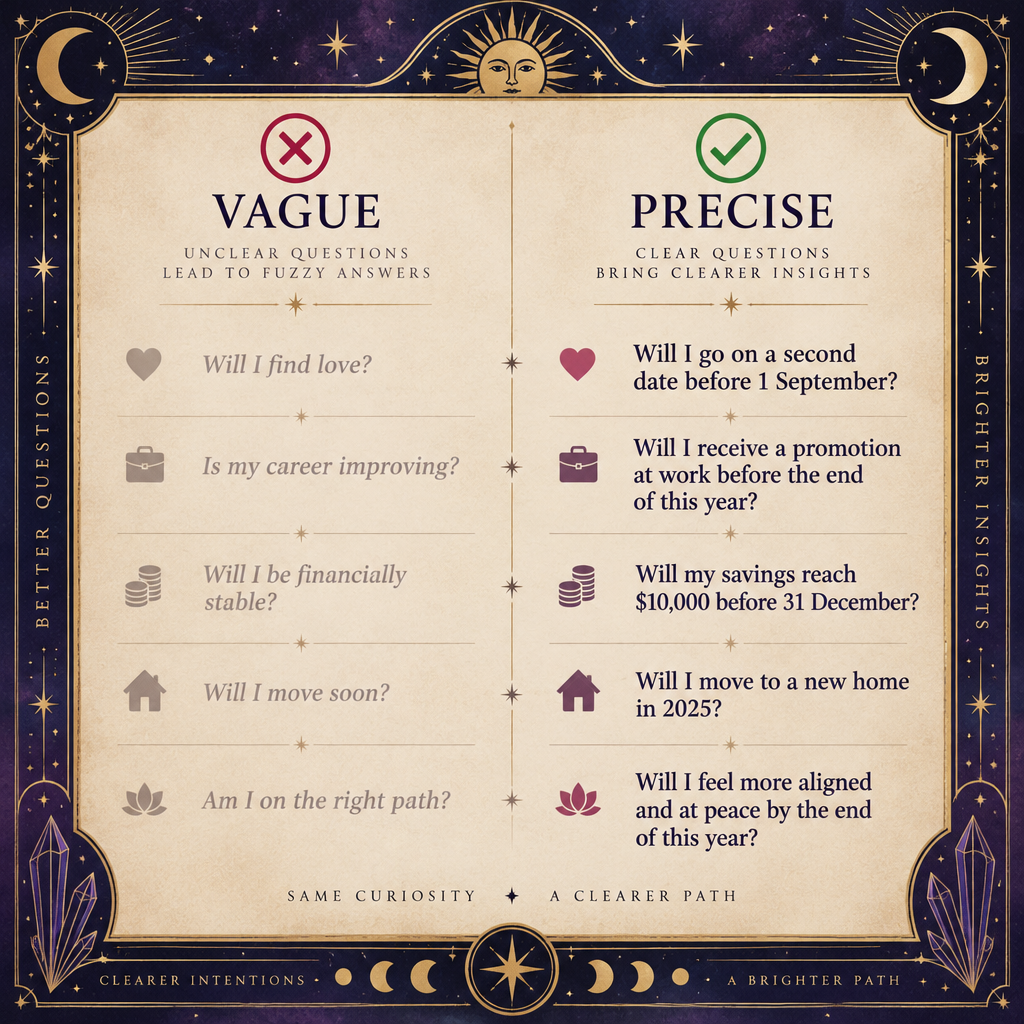
Before you shuffle, run your question through three filters. If you can’t answer all three, the question isn’t ready.
Who
Who is the question about? Ideally, the answer is you. Questions about your own choices and circumstances give the clearest readings, because you’re the one who can act on them.
Questions about other people are trickier. “Does Sam love me?” asks the cards to read someone else’s inner life. “Will Sam and I have a conversation about where we stand before Valentine’s Day?” asks about an event you share. The second is easier to read and easier to verify.
What
What exact outcome are you asking about? Name it. “A promotion” is better than “career growth.” “A reply to my message” is better than “hearing from them.” “Getting my deposit back in full” is better than “the flat situation.”
A useful test: could a stranger read your question and know exactly what a yes would look like? If not, sharpen the “what.”
When
When should this happen? Most readers working with yes or no pulls keep the window to roughly three to six months or less. That’s a practical convention, not a rule printed in any deck. The further out you ask, the more your own choices change the picture, so shorter windows tend to give answers you can actually use.
Use real anchors: “by the end of June,” “before my lease renews,” “within the next 30 days,” “by my next performance review.”
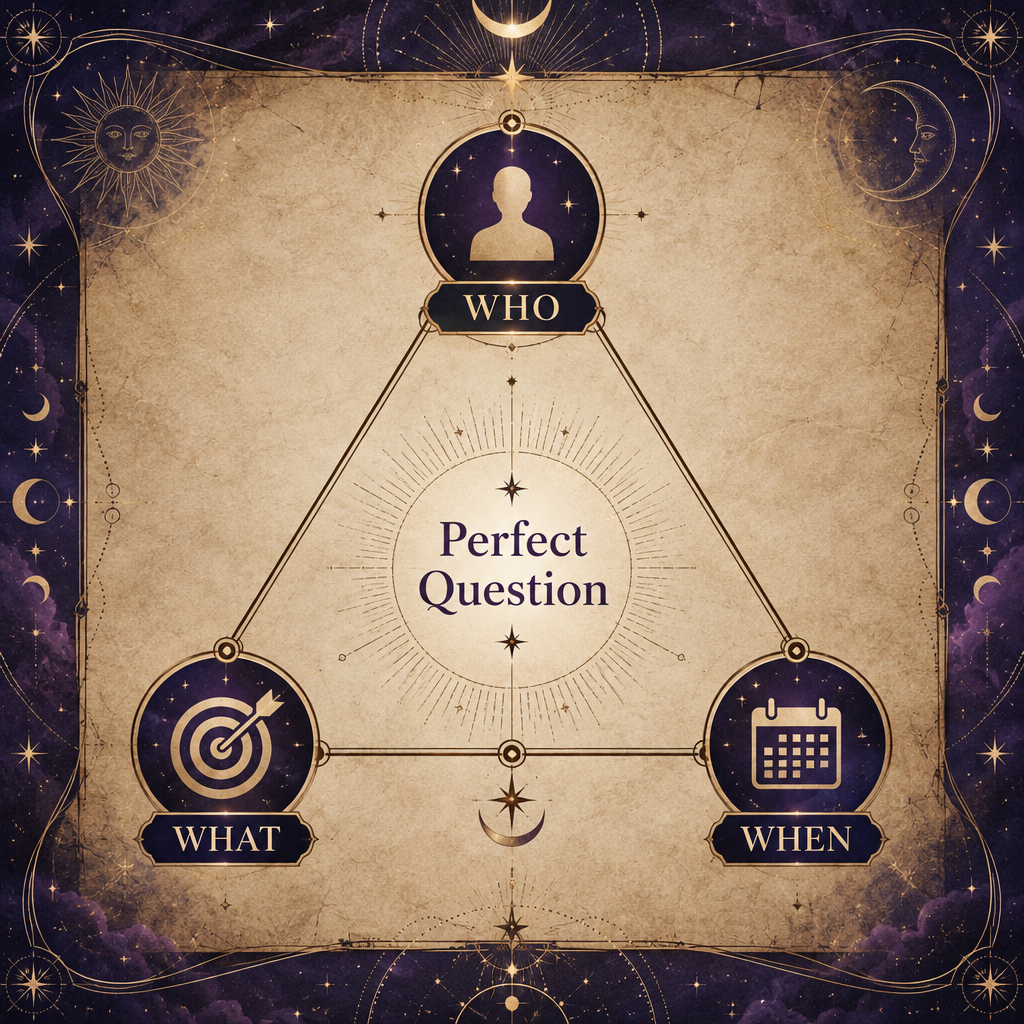
Vague vs. Precise: Side-by-Side Rewrites
| Vague question | What’s missing | Precise rewrite |
|---|---|---|
| Will I find love? | Who, when | Will I go on a second date with someone new before 1 September? |
| Is my career going to improve? | What, when | Will I receive a formal promotion offer at my review in March? |
| Will I have money problems? | What, when | Will I clear my credit card balance by the end of this year? |
| Should I move? | What, bundled | Is moving to Bristol this summer the right choice for my work-life balance? |
| Does he still think about me? | Who’s acting, when | Will my ex contact me before the end of this month? |
| Will the business succeed? | What, when | Will my shop turn a profit in its first full quarter? |
| Is this the right path? | Everything | Will enrolling in the evening data course this autumn help me change careers within a year? |
Notice that every rewrite names a concrete event. You’ll know in a few weeks or months whether it happened.
Questions to Avoid Entirely
Some questions are poorly suited to a yes or no format, and a few aren’t suited to tarot at all.
Medical, legal, and safety questions. “Is this lump serious?” or “Will I win my court case?” belong with a doctor or a solicitor. Tarot can help you reflect on how you’re coping, but it shouldn’t replace professional advice. A reframe like “Will I feel more at ease after getting a second opinion this month?” keeps the reading in its lane.
“Should” questions without a frame. “Should I quit?” pushes the decision onto the card. That’s not a disaster, but the answer is hard to measure. Try instead: “Will quitting before summer leave me better off financially by the new year?”
Double questions. Anything joined by “and” or “or” needs splitting. “Will I get the job or should I stay?” is two readings.
Mind-reading. “What is she thinking right now?” is open-ended and unverifiable. Yes or no questions need a yes or no outcome.
The same question, again. If you didn’t like the answer, asking again five minutes later tells you more about your hopes than the cards. Most experienced readers wait at least a few days, or until something in the situation genuinely changes.
How the Cards Give a Yes or No Answer
There’s no single official method. The Rider-Waite-Smith deck, first published by William Rider & Son in 1909 with illustrations by Pamela Colman Smith and direction from A.E. Waite, didn’t come with a yes/no system. Readers developed these methods over time, and different traditions assign different leanings to the same card. That’s normal. What matters is that you pick a system and use it consistently.
What’s in a Standard Deck
Knowing the deck’s structure helps you understand your odds with each method. These figures apply to any standard 78-card tarot deck.
| Group | Number of cards | Share of deck | Chance of drawing one in a single pull |
|---|---|---|---|
| Major Arcana | 22 | 28.2% | 22 in 78 |
| Minor Arcana (total) | 56 | 71.8% | 56 in 78 |
| Each suit (Wands, Cups, Swords, Pentacles) | 14 | 17.9% | 14 in 78 |
| Court cards (all suits) | 16 | 20.5% | 16 in 78 |
| Aces | 4 | 5.1% | 4 in 78 |
| Numbered pip cards (2 to 10, all suits) | 36 | 46.2% | 36 in 78 |
Two things stand out. First, more than a quarter of single pulls will land on a Major Arcana card, which many readers treat as a stronger, more definite answer. Second, court cards turn up about one time in five, and they’re notoriously hard to read as yes or no because they usually describe people rather than outcomes. Many readers simply treat a court card as “ask again later” or “depends on someone else.”
Common Methods Compared
| Method | How it works | Best for | Downside |
|---|---|---|---|
| One card, upright/reversed | Upright leans yes, reversed leans no | Quick daily questions | Ignores the card’s actual meaning |
| One card, meaning-based | Each card has a yes, no, or maybe lean | Most yes/no questions | Requires knowing all 78 leanings |
| Three-card majority | Pull three, count yes vs. no cards | Questions where nuance matters | Ties possible if you allow “maybe” cards |
| Five-card spread | Count yes/no cards, read the middle card as context | Big decisions | Slower, more interpretation needed |
| Major Arcana only | Use just the 22 Majors | Life-direction questions | Too dramatic for small, everyday things |
With a three-card pull using only yes and no leanings, a split is impossible: you’ll always get a 2-1 or 3-0 result. Once you count “maybe” cards, ties can happen, and that’s often a sign the question needs reframing rather than a fourth card.
Sample Card Leanings
Here’s how many readers lean a handful of well-known cards. Treat these as a starting point; your own deck and tradition may differ. For all 78 cards, our tarot yes no guide covers each one upright and reversed.
| Card | Typical upright lean | Typical reversed lean | Why |
|---|---|---|---|
| The Sun | Strong yes | Delayed yes | Success, clarity, warmth |
| The Star | Yes | Maybe | Hope and healing; reversed suggests doubt |
| Justice | Maybe, leaning yes if you’ve acted fairly | No | Balance and fair results; outcome mirrors your conduct |
| Judgement | Yes | No | Awakening, a call to act; reversed is hesitation |
| The Tower | No | No, but less severe | Sudden upheaval |
| Eight of Swords | No | Leaning yes | Feeling trapped; reversed is release |
| Five of Swords | No | No | Hollow wins, conflict |
| Eight of Cups | No | Maybe | Walking away from something |
| Eight of Pentacles | Yes | Not yet | Steady effort pays off |
A few of these deserve a closer look. The Eight of Swords yes or no reading usually lands on “no” upright, but the card often hints that the obstacle is in how you’re seeing things, so it’s worth asking a follow-up. The Five of Swords yes or no answer is generally “no” either way, since even a win in that card tends to cost more than it’s worth. For Judgement, many modern decks use the spelling “Judgment,” and any judgment tarot yes or no reading tends to read as a firm yes when you’re ready to make a decisive move.
The Eight of Cups yes or no lean is interesting because it’s not a bad card. It often means the answer is no because you’ve already outgrown what you’re asking about. And the Eight of Pentacles yes or no answer is a quiet yes: it’ll happen, but through effort rather than luck.
50 Yes or No Tarot Questions You Can Use Today
Each question below follows the who, what, when formula. Swap in your own names, dates, and details. The point is the shape, not the exact wording.
Love and Relationships (1 to 13)
- Will I meet someone I want to date seriously before the end of this year?
- Will my partner and I agree on a moving-in date within the next three months?
- Will my ex reach out to me before the end of this month?
- Will the person I met at Saturday’s party ask me out within two weeks?
- Is ending my current relationship before summer the right choice for my happiness?
- Will our relationship feel more balanced after we have the conversation I’m planning this weekend?
- Will my partner propose before our anniversary in October?
- Will I feel ready to start dating again within the next six months?
- Will joining a dating app this month lead to at least one good first date?
- Will my partner and I resolve our disagreement about finances before the holidays?
- Will I reconnect with my estranged sister before her birthday in May?
- Will this new relationship still be going well three months from now?
- Will a long-distance arrangement work for us through the end of this year?
Love questions are the easiest to phrase badly, because feelings are hard to measure. Anchor them to an event: a date, a conversation, a message, a decision. If you want to look at a relationship from more angles than a single pull allows, our collection of tarot spreads for love questions includes layouts built for exactly that.
Career and Work (14 to 26)
- Will I receive a job offer from the company I interviewed with last week by the end of the month?
- Will I get a raise at my next annual review?
- Is applying for the team lead role this quarter a good move for my career?
- Will my freelance income replace my salary within the next 12 months?
- Will my manager approve my request for remote work before September?
- Will the project I’m leading launch on schedule this spring?
- Will I pass my professional certification exam on the first attempt in June?
- Will leaving my current job before the end of the year improve my work-life balance?
- Will I land at least two new clients this month?
- Will my side project earn its first sale before my birthday?
- Will the restructuring at my company affect my role before the end of the quarter?
- Will taking the part-time course this autumn help me get promoted within a year?
- Will I feel confident presenting at next month’s conference?
Career questions work best when tied to a named opportunity: a specific role, a review date, a client, a deadline. If work is the area you return to most, our guide to tarot yes or no career questions goes deeper into seven of the strongest ones.
Money and Finances (27 to 38)
- Will I pay off my credit card in full by December?
- Will my savings account reach my emergency-fund goal within six months?
- Will I get my full rental deposit back when I move out this summer?
- Is buying a car this year a sound financial decision for me?
- Will my tax refund arrive before the end of next month?
- Will the price I offered on the flat be accepted this week?
- Will I stick to my monthly budget for the next three months?
- Will lending money to my friend be repaid by the date we agreed?
- Will my mortgage application be approved before my current lease ends?
- Will selling my old furniture online bring in enough to cover moving costs?
- Will cutting back on subscriptions this month noticeably improve my finances by spring?
- Will I be able to afford the holiday I’m planning for next summer without going into debt?
Money questions benefit from numbers. “Will I be better off financially?” is too soft. “Will I have saved £2,000 by June?” is something you can check.
Life Decisions and Personal Growth (39 to 50)
- Is moving to a new city within the next year the right choice for me?
- Will I complete my first half-marathon this autumn?
- Will going back to university next September be worth the cost?
- Will adopting a dog this spring fit my lifestyle?
- Will I feel settled in my new home within three months of moving?
- Is taking a sabbatical next year a good idea for my long-term wellbeing?
- Will I finish writing the first draft of my book by the end of the year?
- Will setting boundaries with my family this month improve our relationship by the holidays?
- Will I make at least one close new friend in my new town before winter?
- Will travelling solo this summer give me the clarity I’m looking for?
- Will I keep up my new morning routine for the next 60 days?
- Will resolving the conflict with my flatmate this week make home feel calmer by next month?
Three Habits That Make Your Readings Sharper
The 50 questions above are a solid base. These habits are what separate readers who get clear answers from readers who keep drawing cards in circles.
Write the Question Down Before You Shuffle
Saying a question in your head lets it drift. Writing it forces you to commit to exact words. It also gives you a record, which matters for the next habit.
Keep a simple log: date, question, card or cards drawn, your reading of the answer, and a blank column for what actually happened. Some people use a notebook. Others use a spreadsheet or a notes app.
Track Your Results
This is the step almost every guide skips. After the deadline in your question passes, go back and fill in the result. Over a few months, patterns emerge. You might find you read certain cards too optimistically. You might find your one-card answers hold up well but your three-card pulls overthink things. You’ll also see which kinds of questions you phrase well and which you still leave too loose.
Tracking turns tarot from a one-off ritual into a practice you can actually learn from. It also protects you from remembering only the hits.
Run the “Opposite Answer” Test
Before you draw, imagine the card says the opposite of what you hope. How do you feel? If a “no” would make you instantly pull another card, you’re not ready to ask. Either wait, or rephrase the question into something you’re genuinely open about.
A related trick: phrase the question so a “yes” points toward action you can take. “Will I get the job?” leaves you passive. “Will following up with the hiring manager this week improve my chances?” gives you something to do with either answer.
What to Do When the Answer Is “Maybe”
Some cards refuse to commit. Court cards, Justice, and a handful of the twos and fours often read as “it depends.” That isn’t a failed reading. It usually means one of three things:
- The outcome hasn’t been decided yet. Your own choices, or someone else’s, will tip it.
- The question is still too broad. Go back to who, what, when and tighten it.
- The timeframe is wrong. Try a shorter or longer window.
Justice is a good example. Its theme is fairness and balance, so a “maybe” from Justice often reads as “the result will match what’s been put in.” If you’ve done the work, lean yes. If you haven’t, the card is telling you so.
Don’t immediately reshuffle the whole deck. Instead, ask one clarifying follow-up, such as “Is the outcome mainly in my hands?” Then take what you get.
Quick Checklist Before You Draw
Run through this list before every yes or no pull:
- Does the question have one outcome?
- Am I the subject, or is it an event I’m part of?
- Is there a clear deadline?
- Could a stranger tell what a yes looks like?
- Am I open to hearing no?
- Have I written it down?
Six yeses and you’re ready to shuffle.
FAQ
Can tarot really answer yes or no questions?
Tarot wasn’t designed as a yes or no tool, and no deck ships with an official system. Readers developed yes/no methods over time, and they work best as a prompt for reflection rather than a guarantee about the future. Treat the answer as one input alongside your own judgement.
How many cards should I pull for a yes or no question?
One card is fine for everyday questions. Three cards give you a majority vote and a bit more nuance, and they avoid ties if you only count yes and no cards. Save five-card spreads for bigger decisions where you want context around the answer.
What does a reversed card mean in a yes or no reading?
In the simplest method, upright means yes and reversed means no. In meaning-based methods, a reversal usually softens or delays the upright lean. A reversed yes card often reads as “not yet,” while a reversed no card can mean the obstacle is easing.
Is it okay to ask the same question twice?
Wait until something in the situation actually changes, or at least a few days. Asking again straight away usually reflects disappointment with the first answer rather than new information. If you keep wanting to re-ask, the question likely needs rephrasing.
Can I ask yes or no questions about other people?
You can, but phrase them around events you share rather than someone’s private thoughts. “Will Jordan reply to my message by Friday?” reads much more clearly than “Does Jordan like me?” Keep the focus on what you’ll be able to observe.
What’s the best timeframe for a yes or no tarot question?
Most readers stick to three to six months or less. Shorter windows give answers you can check and act on. Long-range questions leave too much room for your own choices to change the result.