
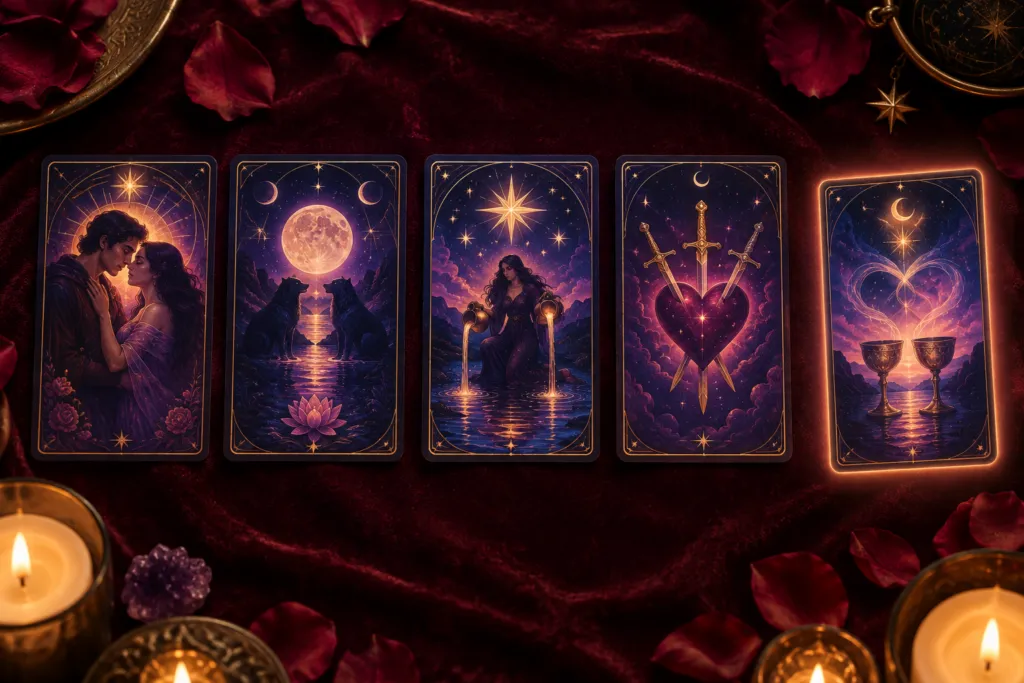
A single card can tell you yes or no, but it can’t tell you why, or what would change the answer. This five-card spread was built for love questions specifically, and it gives you the verdict plus the context around it. Here’s how to lay it out, read it, and avoid the traps that make yes/no readings go wrong.
Why one card isn’t enough for love questions
Most yes/no readings are a single draw. You shuffle, pull one card, and check whether it leans positive or negative. That works fine for “Should I take the Tuesday train?” It falls apart for “Will he come back?”
Love questions involve two people, two sets of feelings, and timing you can’t control. One card compresses all of that into a coin flip. You walk away with an answer and no information about what’s driving it.
The five-card spread fixes this. Position five still gives you a clear yes, no, or not yet. The other four cards show you what’s underneath, so the result actually means something.
How to ask the right question
The wording matters more than the shuffle. Vague questions produce vague cards.
Keep the question binary. “Does she have feelings for me?” works. “What does she think of me?” does not. The second one needs a full reading, not a yes/no.
Give it a timeframe. “Will we move in together within a year?” reads cleaner than “Will we ever live together?” Tarot handles the next six to twelve months far better than the distant future.
Ask about what you can observe or influence. “Will he text me this week?” is readable. “Does he secretly regret leaving?” asks the cards to speak for someone’s private mind, and you have no way to check the answer.
Write the question down before you shuffle. You’d be surprised how often you draw five cards and then realise you were holding two different questions in your head. The written version keeps you honest.
The five positions
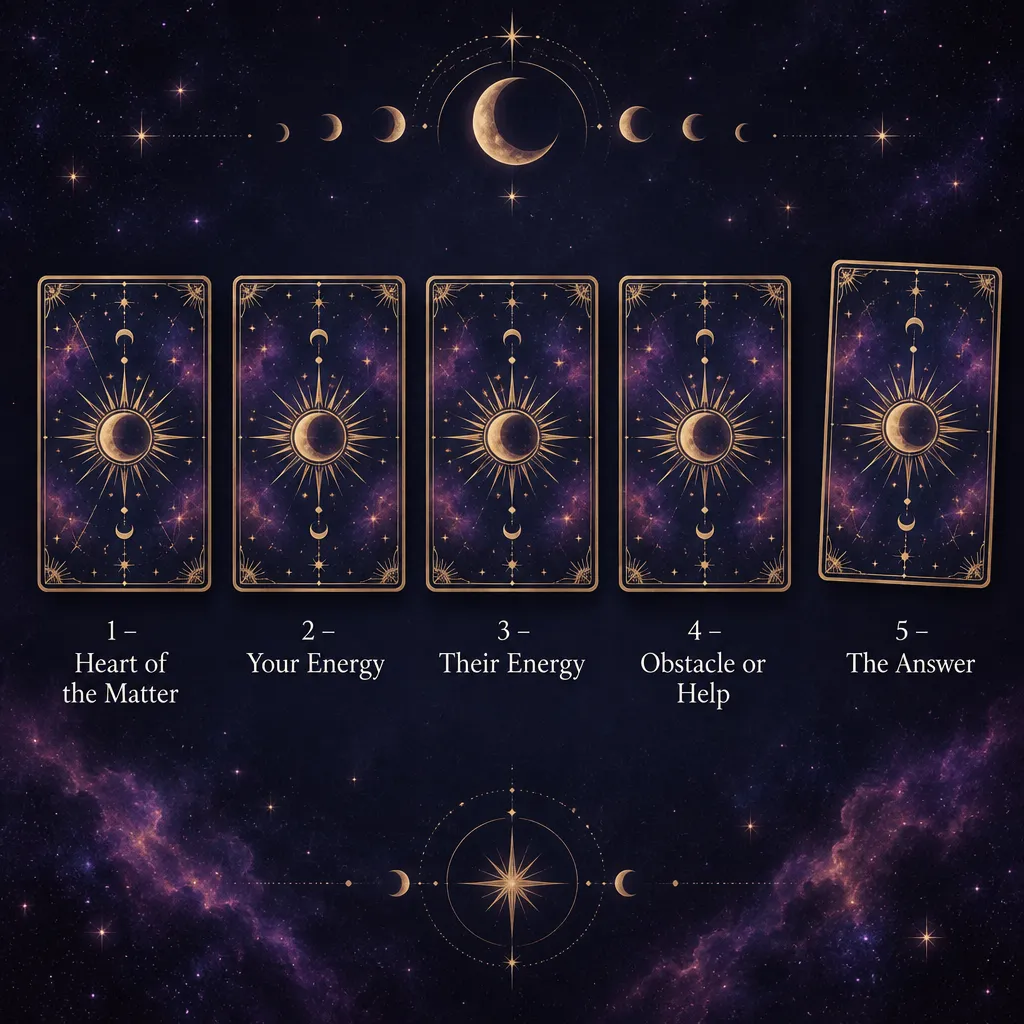
Lay the cards left to right, with the fifth card set slightly apart.
1. The heart of the matter. What the question is really about. Sometimes this card is a surprise. You ask whether someone will commit and the Five of Pentacles appears, pointing to a fear of being left out in the cold rather than a question about them at all.
2. Your energy. What you’re bringing to the situation right now. Hope, fear, pride, impatience. This card rarely flatters, and that’s the point.
3. Their energy. The other person’s current position. If you’re single and asking about meeting someone, read this as the energy heading toward you.
4. The obstacle or the help. What stands between you and a yes, or what’s quietly working in your favour. Reversed cards here often name the exact problem.
5. The answer. Your yes, no, or not yet. This is the main card. The other four explain it.
How to interpret cards for yes or no
Every reader uses a slightly different system. This one is simple and it’s consistent, which matters more than being clever.
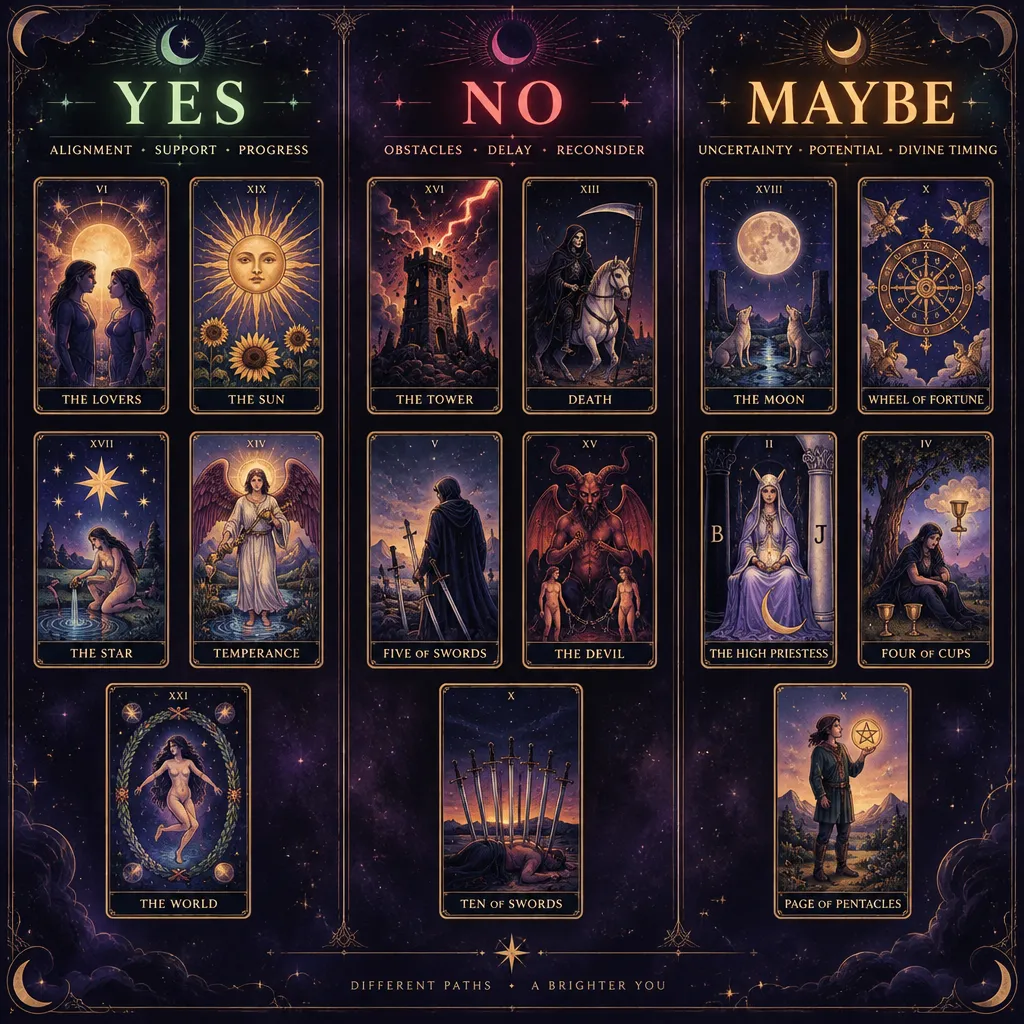
Upright cards with warm or stable imagery lean yes. Reversed cards and cards showing loss, conflict, or stagnation lean no. A handful of cards sit firmly in “maybe” territory regardless of orientation.
For love readings, these are the strongest signals:
Clear yes cards: The Lovers, The Sun, The Star, The Empress, The World, Ace of Cups, Two of Cups, Ten of Cups, Knight of Cups, Four of Wands, Ten of Pentacles, Six of Wands.
Clear no cards: The Tower, Three of Swords, Ten of Swords, Five of Cups, Five of Pentacles, Eight of Cups, The Devil (a yes you won’t enjoy), Ten of Wands, Nine of Swords.
Maybe cards: The Moon, The High Priestess, The Hanged Man, Wheel of Fortune, Two of Swords, Seven of Cups, Judgement, Temperance.
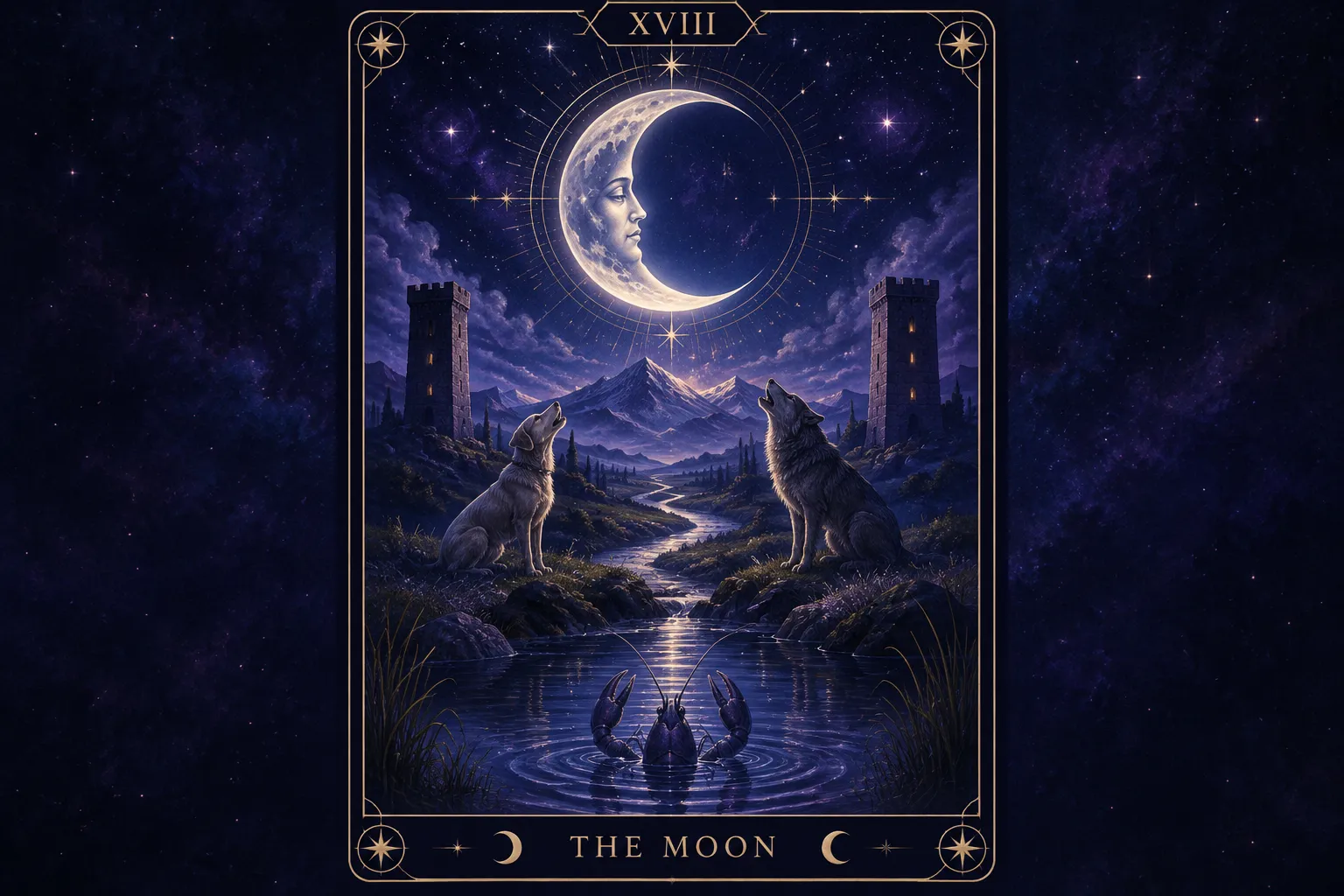
A note on The Moon. It turns up constantly in love readings, and people love to read it as romantic. It isn’t. It means you don’t have the full picture yet. Illusion, projection, something unsaid. If The Moon lands in position five, the honest answer is “you don’t know enough to decide.”
Court cards are tricky. Read Cups courts as yes and Swords courts as no unless the surrounding cards argue otherwise. Wands and Pentacles courts are neutral and take their meaning from position.
Reading the spread as a whole
Start with position five. That’s your headline answer. Then read one through four to understand it.
If position five is a maybe card, use a tie-break. Look at positions three and four together. Two yes-leaning cards there turn your maybe into a soft yes. Two no-leaning cards turn it into a soft no. One of each means the situation is genuinely open, and your next move decides it.
Majors carry extra weight. If three or more of your five cards are Major Arcana, the situation is bigger than the question you asked. The answer might still be yes, but life is moving in ways you’re not accounting for.
Don’t average the cards into mush. Position two is about you, not the outcome. A gloomy card there doesn’t drag the answer down. It just tells you what you’re carrying into the room.
Sample combinations for singles
“Will I meet someone new in the next six months?”
- Eight of Cups. 2. Nine of Pentacles. 3. Knight of Cups. 4. The Hermit reversed. 5. Two of Cups.
Position five says yes. The Knight of Cups in three confirms someone is approaching. The Hermit reversed in four is the catch: you’ve been isolating past the point of usefulness. The Eight of Cups in one shows the question is really about whether you’re done grieving the last thing. The Nine of Pentacles says you’ve built a good life alone. Answer: yes, if you start accepting invitations.
“Is the person I’m texting interested in something real?”
- Seven of Cups. 2. Page of Cups. 3. Seven of Swords. 4. The Moon. 5. Five of Cups.
Position five is a no. Seven of Swords in three suggests they’re not being straight with you. The Moon in four says you’ve been filling gaps with your own hopes. Seven of Cups in one names the issue: you’re in love with the options, not the person. Hard reading, but a useful one.
“Should I say yes to the second date?”
- Ace of Wands. 2. Two of Swords. 3. Page of Wands. 4. Four of Cups reversed. 5. The Sun.
Yes. The Sun is about as clear as it gets. Two of Swords in your position shows you’re stalling for no good reason. Four of Cups reversed in four means the boredom is lifting. Go.
Sample combinations for relationships
“Will we get back together?”
- Three of Swords. 2. Six of Cups. 3. Four of Cups. 4. The Tower. 5. Ten of Swords.
No. Six of Cups in your position is nostalgia, not current reality. Four of Cups in theirs means they’ve checked out. The Tower in four says the break was structural, not a bad week. Ten of Swords in five closes the door. The reading doesn’t offer much comfort, but it offers clarity.
“Will my partner propose this year?”
- Ten of Pentacles. 2. Eight of Wands. 3. King of Pentacles. 4. Four of Pentacles. 5. The Hanged Man.
Maybe, so tie-break. King of Pentacles in three is a yes-leaning card, steady and committed. Four of Pentacles in four leans no: holding on, reluctance to spend or change. One yes, one no. The situation is open. The Eight of Wands in two says you want it fast. The King says they want it secure. The gap between those two speeds is the whole reading.
“Is my relationship worth fighting for?”
- Temperance. 2. Nine of Wands. 3. Queen of Cups. 4. Five of Wands. 5. Ten of Cups.
Yes. Ten of Cups is the long-term happy family card. Queen of Cups in three means your partner is emotionally present. Five of Wands in four is bickering, not war. Nine of Wands shows you’re exhausted and defensive. Temperance in one reframes the question: this is about balance, not survival.
One card, three cards, or five: which spread to use
Here’s how the main yes/no formats stack up for love questions.
| One-card pull | Three-card spread | Five-card love spread | |
|---|---|---|---|
| Time needed | Under a minute | Two to five minutes | Five to ten minutes |
| Best for | Daily check-ins, low-stakes questions | Past, present, future snapshots | Questions about two people |
| What it tells you | Yes or no | Yes or no with direction | Yes or no with both perspectives and the obstacle |
| Risk of misreading | High. No context to catch a bad draw | Medium. Timeline can blur the answer | Low. Four cards cross-check the fifth |
| Weakness | Zero nuance | Positions aren’t love-specific | Overkill for small questions |
One-card pull. Pros: fast, hard to overthink, good for building intuition with daily practice. Cons: a single Moon or Hanged Man leaves you with nothing. Fine for “Should I text first today?” Not fine for anything involving the future of a relationship.
Three-card spread. Pros: adds movement, shows how you got here and where things are heading. Cons: the past, present, future format answers “what’s happening” better than “yes or no.” You often end up with three descriptive cards and no verdict.
Five-card love spread. Pros: dedicated answer position, both people represented, the obstacle named. Cons: slower, and it’s tempting to read every card as part of the answer when only one is.
Verdict: use one card for quick daily questions, and the five-card spread for anything that would actually change your plans. The three-card spread is better saved for general readings than for yes/no.
All three cost nothing beyond a deck you already own. There’s no reason to pay for an app or a hotline to run any of them.
Common mistakes in yes/no love readings
Asking the same question twice. You get a no, reshuffle, and ask again. The second answer is noise. Sit with the first one for at least a week.
Reading position two as the answer. Your own card tells you about you. If it’s the Tower, that means you’re in upheaval, not that the relationship is doomed.
Ignoring reversals. Some readers skip them entirely. For yes/no work, reversals are your most useful tool. They flip a soft yes to a soft no and name blockages precisely.
Asking about a third person’s feelings. “Does his ex still love him?” is unanswerable and unverifiable. Keep the question between you and the person you’re actually asking about.
Treating a no as permanent. Most no cards describe current conditions. The Five of Cups is grief, and grief passes. The exceptions are the Tower and the Ten of Swords, which tend to mean the ending already happened.
When to use yes/no versus a full reading
Yes/no readings work when you already understand the situation and need a decision. You know the history. You know the dynamics. You just want to know whether to act.
They fail when the question is really “what’s going on here?” If you don’t understand why things feel off, no binary answer will help. Pull a full Celtic Cross or a relationship spread instead, then come back to yes/no once you know what you’re deciding.
A good test: if you could explain the situation to a friend in two sentences, you’re ready for a yes/no. If it would take ten minutes, you need a full reading first.
Tips for sharper readings
Shuffle until it feels done, not for a set count. Then cut once. Ritual helps focus, but overcomplicating it adds nothing.
Read the images before you check meanings. Your first reaction to the picture is usually right. The book is for confirming, not replacing, that reaction.
Keep a log. Write the question, the five cards, your interpretation, and the date. Check back in three months. This is how you learn which cards reliably mean yes for you and which don’t.
Avoid reading when you’re upset. Cards drawn at two in the morning after an argument reflect the argument, not the relationship. Wait a day.
Don’t read for your partner without asking. It rarely ends well, and the cards tend to show your anxiety about them rather than their actual state.
Tarot and astrology together
If you work with astrology, the five-card spread pairs well with transits. Venus retrograde periods are notoriously bad for “will we get back together” questions, since the cards often pull toward the past during those weeks. Many readers hold off on love yes/no readings until Venus turns direct.
You can also check the suits against elements. Cups are water, Wands fire, Swords air, Pentacles earth. If the person you’re asking about has a strongly fiery chart and position three gives you a Wands court, that’s a sign the card is actually pointing at them. Not proof, but a useful cross-check.
Neither system needs the other. But the combination gives you two independent readings on the same question, which is the closest you’ll get to verification in this kind of work.
FAQ
Which tarot spread is best for love?
For yes/no questions, the five-card spread above. For understanding a relationship in depth, a seven-card relationship spread or the Celtic Cross works better. The right choice depends on whether you want a decision or a description.
What is a good tarot spread for a yes or no question?
For general questions, a single card is enough. For love questions, use five cards: heart of the matter, your energy, their energy, the obstacle, and the answer. The extra positions catch misreadings a single card would miss.
What tarot spread is good for relationship problems?
Skip yes/no entirely for active problems. Use a spread with positions for both partners, the root of the conflict, what each person needs, and the likely outcome. Yes/no readings assume you already know what the problem is.
Will I ever find love tarot spread?
Reframe the question first. “Ever” is too wide for tarot to answer well. Ask “Will I meet someone meaningful in the next twelve months?” and run the five-card spread. Position three shows what’s coming toward you, and position four shows what’s in the way. That’s far more useful than a yes or no about your whole life.
Add Yes No Tarot as a preferred source on Google, and the sites you pick are more likely to appear in your Top Stories.