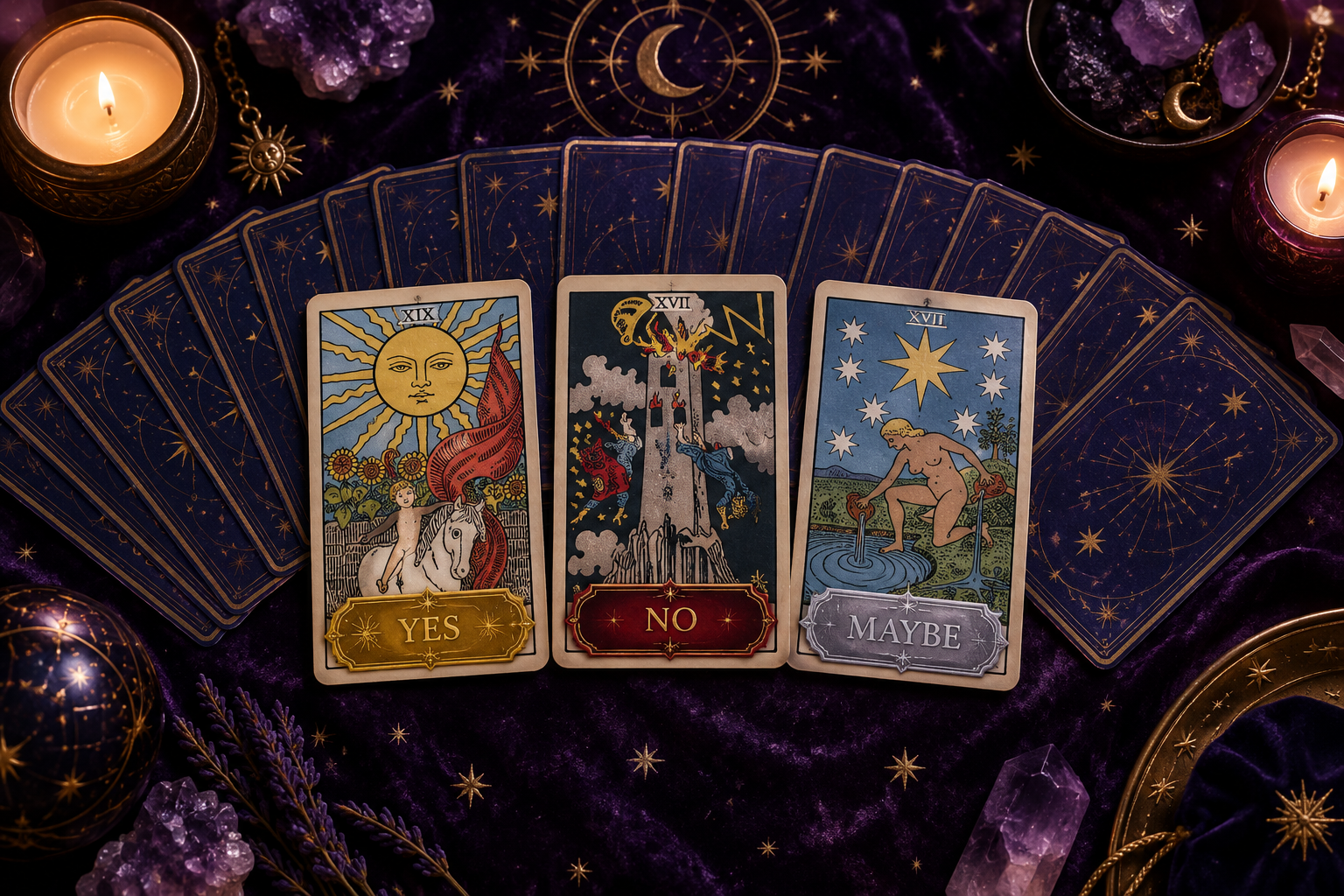
The Tower as a person is the one who tells the truth nobody asked for, walks out of a stable situation on a Tuesday, and leaves everyone else sorting through the rubble. Upright, this is the Awakener, a catalyst who breaks illusions on contact. Reversed, it is the same charge turned inward: someone who feels the ground shifting and spends all their energy pretending it is not.
What this guide covers
- Card facts at a glance
- The Tower’s imagery decoded as personality traits
- Upright Tower as a person: archetype and traits
- Reversed Tower as a person: the corrected reading
- Tower as a man and Tower as a woman
- Love, career, feelings, and yes or no
- How to work with Tower energy, in yourself or in someone else
- The Tower next to the Devil, Death, and the Star
- FAQ
Tower card facts at a glance
| Attribute | Detail |
|---|---|
| Arcana | Major Arcana, card XVI (16) |
| Planet | Mars |
| Element | Fire |
| Zodiac associations | Aries (Mars rulership); Scorpio (traditional Mars rulership) |
| Hebrew letter (Golden Dawn) | Peh, meaning “mouth” |
| Upright keywords | Sudden truth, disruption, awakening, liberation, collapse of false structures |
| Reversed keywords | Resisting change, fear of upheaval, averted disaster, internal crisis, clinging to the old |
| Numerology | 16 reduces to 7 (1+6), linking the Tower to the Chariot’s drive and to the inner reckoning of card VII |
The Mars link matters more than any other attribute here. Mars is the planet of force, conflict, and action without deliberation. Every trait below traces back to it.
The Tower’s imagery, read as a personality
The Rider-Waite-Smith Tower shows a grey tower built on a jagged peak, struck by a lightning bolt that knocks the gold crown clean off the top. Flames pour from three windows. Two figures, one in blue and one in red with a crown, plunge headfirst toward the rocks. The sky is black, and 22 yod-shaped flames hang in the air around the structure. Each piece describes a way this person moves through the world.
The lightning bolt. This is the Tower person’s defining gesture: insight that arrives all at once and cannot be unknown afterward. They do not build to a conclusion over weeks. They see it, say it, and act on it in the same breath. In conversation this feels like being hit with something you were not braced for.
The crown knocked loose. The crown sat on top of the tower, which means the structure was built to hold up ego and status. The Tower person has no patience for authority that rests on appearances. Titles, seniority, “the way we’ve always done it”: none of it earns their respect. They will knock the crown off a boss, a parent, or a partner without noticing they did it.
The falling figures. People get thrown when this person enters a situation. The blue figure is the ordinary person caught by circumstance; the crowned figure is the one who had the most to lose. A Tower person’s presence tends to expose who was coasting on an unearned position.
The flames from the windows. Fire inside the structure means the collapse was internal before it was visible. Tower people have a nose for rot. They sense when a relationship, company, or belief is already hollow and they are usually right, even when their timing is brutal.
The dark sky. No stars, no moon. The Tower person does not offer reassurance during the collapse. Comfort comes later, in the Star (card XVII), and from someone else.
The 22 yods. There are 22 Major Arcana. The scattered flames are a reminder that even this destruction is part of a complete cycle. The Tower person, at their best, understands that what they bring down was always going to fall.
Built on a crag. The tower was never on solid ground. Tower people are magnetic to precarious situations. They find the one unstable thing in the room.
Tower as a person upright: the Awakener
The upright Tower as a person is a disruptive catalyst. They are the colleague who says in the meeting what everyone else has been saying in the hallway. The friend who tells you your partner is lying before you have admitted it to yourself. The sibling who leaves the family business, the family religion, or the family town, and does it without a transition plan.
The core archetype runs three ways:
- The Awakener. They wake people up, often rudely. Their value is that life after them is more honest than life before.
- The Destroyer of Illusions. They cannot tolerate pretense, including their own. A Tower person will blow up their own comfortable life if they discover it rests on something false.
- The Catalyst. They do not necessarily do the work of rebuilding. They start the chemical reaction and the rest of the process happens around them.
Upright Tower personality traits
- Brutally honest. Not cruel for sport, but unwilling to soften anything. They mistake tact for dishonesty.
- Unafraid of chaos. Most people fear the collapse. Tower people feel most alive during it. Crisis sharpens them while it flattens everyone else.
- Revolutionary. They want systems torn down, not reformed. Incremental change bores them.
- Detached from material stability. They will quit a secure job, sell the house, or move countries on short notice. Security is not a value they hold highly, which frustrates people who depend on them.
- Sudden. Decisions arrive fully formed. A Tower person who has been quiet for six months will announce a divorce, a career change, or a move in a single conversation.
- Emotionally volatile under pressure. Mars energy builds and discharges. They can hold things in for a long time and then release everything at once, usually at the worst possible moment.
- Resilient after the fact. They rebuild faster than people expect, because they were never attached to the structure that fell.
The appearance question
Older readings describe the Tower person as striking, tall, or unconventional-looking. Treat this as a minor note rather than the headline. If appearance comes through at all, it shows up as a look that interrupts the room: a sudden dramatic haircut, a style that rejects whatever is currently expected, physical presence that people notice before they hear a word. It is the lightning bolt expressed in clothing. But plenty of Tower people look completely ordinary right up until they open their mouths.
Tower as a person reversed: resisting the collapse
The reversed Tower is not a passive or lackluster person. That reading comes from an older minority tradition and it misreads the card. The reversed Tower carries the same Mars charge as the upright, but the person is spending everything they have to keep the lightning from striking.
Picture someone standing inside a building that is already on fire, insisting the smoke is fine. That is the reversed Tower as a person. They feel the upheaval coming. They have known for months that the job, the marriage, or the belief system is finished. Instead of letting it fall, they prop it up, patch it, and avoid every conversation that might bring it down.
Reversed Tower personality traits
- Avoidant. They dodge difficult conversations, cancel plans when confrontation looms, and change the subject when pressed.
- Fearful of change. Not cautious. Fearful. They stay in situations years past their expiry date because the known pain feels safer than the unknown.
- In denial. They reframe obvious problems as temporary or as other people’s fault.
- Internally chaotic. The outside looks stable. Inside, there is constant low-grade panic, insomnia, sudden tears, irritability that comes from nowhere.
- Clinging. To routines, to people who are already leaving, to a version of themselves that stopped being true.
- Prone to delayed explosions. Suppressed Tower energy does not disappear. It discharges later, bigger, and often at someone who did not deserve it.
- Occasionally, the disaster-avoider. There is a healthier reversed Tower: someone who saw the collapse coming and made a controlled change in time. In a reading, context decides which version you have. Surrounded by positive cards, it is the controlled version. Surrounded by the Moon, the Eight of Swords, or the Five of Pentacles, it is denial.
The difference between upright and reversed is not energy level. It is direction. Upright, the force goes outward and breaks things. Reversed, the force is held in and breaks the person holding it.
Tower as a man
Upright. A Tower man is direct to the point of friction. He challenges authority openly, argues with his father, pushes back on his manager, and has probably been fired or quit abruptly at least once. He is drawn to work and relationships with high stakes, and he tends to leave when things get comfortable, not when they get hard. He has a temper, but it is a flash temper, over as fast as it arrives, and he is often puzzled that others are still upset an hour later. He is a reliable truth source and an unreliable source of stability.
Reversed. A reversed Tower man is often described by the people around him as “fine” while he is quietly falling apart. He stays in the career he hates, keeps the marriage going on habit, and treats every attempt to discuss the problem as an attack. He may numb the internal chaos with work, drink, or screens. When he finally breaks, it is usually sudden and total: an affair, a resignation with no notice, a move across the country. The people closest to him are rarely surprised; they just wish he had said something two years earlier.
Tower as a woman
Upright. A Tower woman says the thing. In a friend group she is the one who confronts the person everyone else has been gossiping about. She leaves relationships cleanly and early rather than letting them drag. Professionally she is often found in roles that involve exposing problems: investigative work, auditing, crisis management, activism, surgery, anything where speed and nerve matter more than diplomacy. She can feel isolating to be around because she refuses to participate in comfortable fictions.
Reversed. A reversed Tower woman holds the structure together for everyone else while it crumbles. She manages the family’s emotional weather, smooths over the problems her partner will not address, and avoids her own reckoning by staying busy with other people’s. She knows exactly what is wrong and could articulate it in a sentence, but the cost of saying it feels too high. Her internal chaos often shows up physically: migraines, exhaustion, a short fuse with the people least responsible for the real problem.
Tower as a person in love and relationships
If your partner is the upright Tower. You are with someone who will never let you coast. They will name problems the moment they notice them, and they expect you to do the same. Lying to this person is pointless; they will find out and the discovery will be worse than the truth would have been. The relationship will go through abrupt resets. They may suggest moving, having a child, or ending things with very little warning. If you need predictability, this will wear you down. If you need honesty and can tolerate turbulence, it is one of the most genuine partnerships in the deck.
If your ex is the Tower. The breakup was sudden, probably their initiative, and it likely exposed something you had been avoiding about the relationship or about yourself. Tower exes rarely come back to rebuild on the old foundation. If they return at all, it is to something structurally different, and only after the dust has fully settled.
If your crush is the Tower. Expect intensity and unpredictability. They will not play a slow, strategic game. Interest from a Tower person tends to arrive as a sudden declaration or a sudden disappearance, and sometimes both in the same month. Do not wait for them to become steady; decide whether you want the storm as it is.
If your partner is the reversed Tower. You are living with a slow leak. They avoid every conversation that matters, insist everything is fine, and get defensive when you push. The relationship may look stable from outside while being unbearable from inside. The practical move is to force the honest conversation gently but firmly, because the alternative is waiting for the explosion they are holding back. Reversed Tower partners rarely leave first; they wait to be left, or they detonate.
If you are the Tower in the relationship. Your honesty is a gift and your timing is a weapon. Learn to separate the two. Say the true thing, but say it before resentment turns it into a bomb.
Tower as a person in career and work
Upright at work. The upright Tower colleague is the whistleblower, the restructurer, the one who tells leadership the product is failing while everyone else is polishing the slide deck. They are valuable in turnarounds, startups, crisis response, and any environment where speed and candor outweigh politics. They are poor fits for bureaucracy, consensus cultures, and roles that reward staying quiet. As a manager, they are fair but blunt, and their teams either love them or request transfers. Expect this person to change jobs often and to leave abruptly rather than negotiate.
Reversed at work. The reversed Tower colleague has been quietly miserable for a long time. They do the minimum, avoid the manager, and complain in private while nodding in meetings. They have seen the layoffs coming and have done nothing to prepare. If this is a boss, they are the leader who knows the department is failing and hides the numbers. If this is you, the card is telling you plainly that the position you are protecting is already gone and your energy is better spent on the exit.
Career fields that suit Tower energy. Emergency medicine, firefighting, investigative journalism, forensic accounting, litigation, demolition and structural engineering, activism, crisis PR, organizational turnaround consulting, and startup founding. Anywhere the job is to break something open and look at what is inside.
Tower as feelings: how someone feels about you
When the Tower appears for how a person feels about you, upright, the feeling is seismic. You have disrupted their life. This could be sudden, overwhelming attraction, the kind that makes them question an existing relationship or life plan. It can equally be the shock of a revelation: they have learned something about you that changed everything, and they are in freefall. Either way, you are not a casual presence in their mind. You are the lightning bolt.
Reversed, they feel the shock but refuse to deal with it. They are suppressing feelings for you, or suppressing their reaction to something you did. Expect avoidance, mixed signals, and a long silence followed by an outsized response. Reversed Tower feelings are rarely neutral; they are strong feelings being sat on.
Tower as a person: yes or no?
For a straightforward yes or no question, the upright Tower is a no, or more precisely, “not in the form you are asking about.” The structure you are asking about will not hold. If the question is “Will this person be a stable partner?”, the answer is no. If the question is “Will this person change my life?”, the answer is an emphatic yes, but the change will not be comfortable.
Reversed, the answer is “not yet, and not without a confrontation.” The person is stuck. Whatever you are asking will happen only after they stop avoiding what they already know.
Use the Tower as a yes or no card with care. It answers the question underneath the question: is the current structure sound? The answer is always no.
How to work with Tower energy
If you are the Tower person
Your gift is seeing what is false. Your liability is that you deliver the truth at the moment of maximum destruction, often because you held it in until it exploded. Three practical adjustments:
- Shorten the gap between noticing and speaking. The explosion comes from the delay. Say the small true thing in week one so you do not detonate the large true thing in month eight.
- Stay for the rebuilding. Catalysts tend to leave once the reaction starts. Staying through the Star phase, when things get rebuilt, is where your credibility is earned.
- Pick structures worth breaking. Not everything that is imperfect is false. Learn to tell the difference between a building with cosmetic cracks and one with a rotten foundation.
If someone in your life is the Tower
Do not try to make them steady. You will fail and resent them for it. Instead, use them for what they are good at: ask them the question you are afraid to hear answered. Set boundaries on timing, not on honesty. “Tell me the truth, but not at my mother’s funeral” is a reasonable request. “Stop being so blunt” is not one they can honor.
If you drew the reversed Tower for yourself
The card is telling you that you already know. Whatever you are propping up has finished. Make the change on your own schedule, while you still have a schedule, because the alternative is having it made for you by lightning.
The Tower next to its neighbors
The Tower makes most sense in sequence. Card XV, the Devil, is bondage to illusion: the comfortable lie, the addiction, the relationship held together by fear. The Tower is what happens when that lie is struck. Card XVII, the Star, is the quiet rebuilding afterward, with hope restored and the sky full of light again.
As people, the contrast is sharp. The Devil person keeps you comfortable and trapped. The Tower person frees you by force. The Star person helps you heal once you are out. A Tower person is not a Star person; do not expect comfort from them after the collapse they caused.
Death (XIII) is often confused with the Tower. Death as a person is slow, inevitable transformation, the one who ends chapters gracefully. The Tower as a person is sudden, violent transformation, the one who ends chapters mid-sentence. Death closes the door; the Tower blows out the wall.
FAQ
What kind of person is the Tower tarot card?
The Tower describes a disruptive truth-teller: brutally honest, unafraid of chaos, revolutionary in outlook, and detached from material security. They expose what is false and trigger sudden change in the lives around them. They are catalysts, not stabilizers.
What does the Tower reversed mean as a person?
Reversed, the Tower is someone resisting change they know is coming. They avoid hard conversations, cling to failing situations, and suppress internal chaos until it eventually discharges. It is not a passive or dull personality; it is a volatile one held under pressure.
Is the Tower a yes or no card?
Upright, it is a no for questions about stability or whether something will continue as it is. Reversed, it means “not until the avoidance ends.” For questions about whether something will change dramatically, it is a yes.
What does the Tower mean in a love reading as a person?
As a partner, the upright Tower is honest, intense, and unpredictable, likely to force sudden resets in the relationship. As an ex, they ended things abruptly and rarely return to the old dynamic. Reversed, it points to a partner in denial who avoids the conversation the relationship needs.
What does the Tower mean as how someone feels about you?
Upright, you have shaken them profoundly, either through overwhelming attraction or through a revelation that changed how they see you. Reversed, they feel it just as strongly but are suppressing it, which shows up as avoidance and mixed signals.
What zodiac sign is the Tower tarot card?
The Tower is ruled by Mars, which links it to Aries and, in traditional astrology, Scorpio. Its element is Fire.
What is the difference between the Tower and Death as a person?
Death is gradual, inevitable transformation and tends to end things with a sense of closure. The Tower is sudden, forced transformation that ends things without warning. Death as a person lets go; the Tower as a person breaks through.