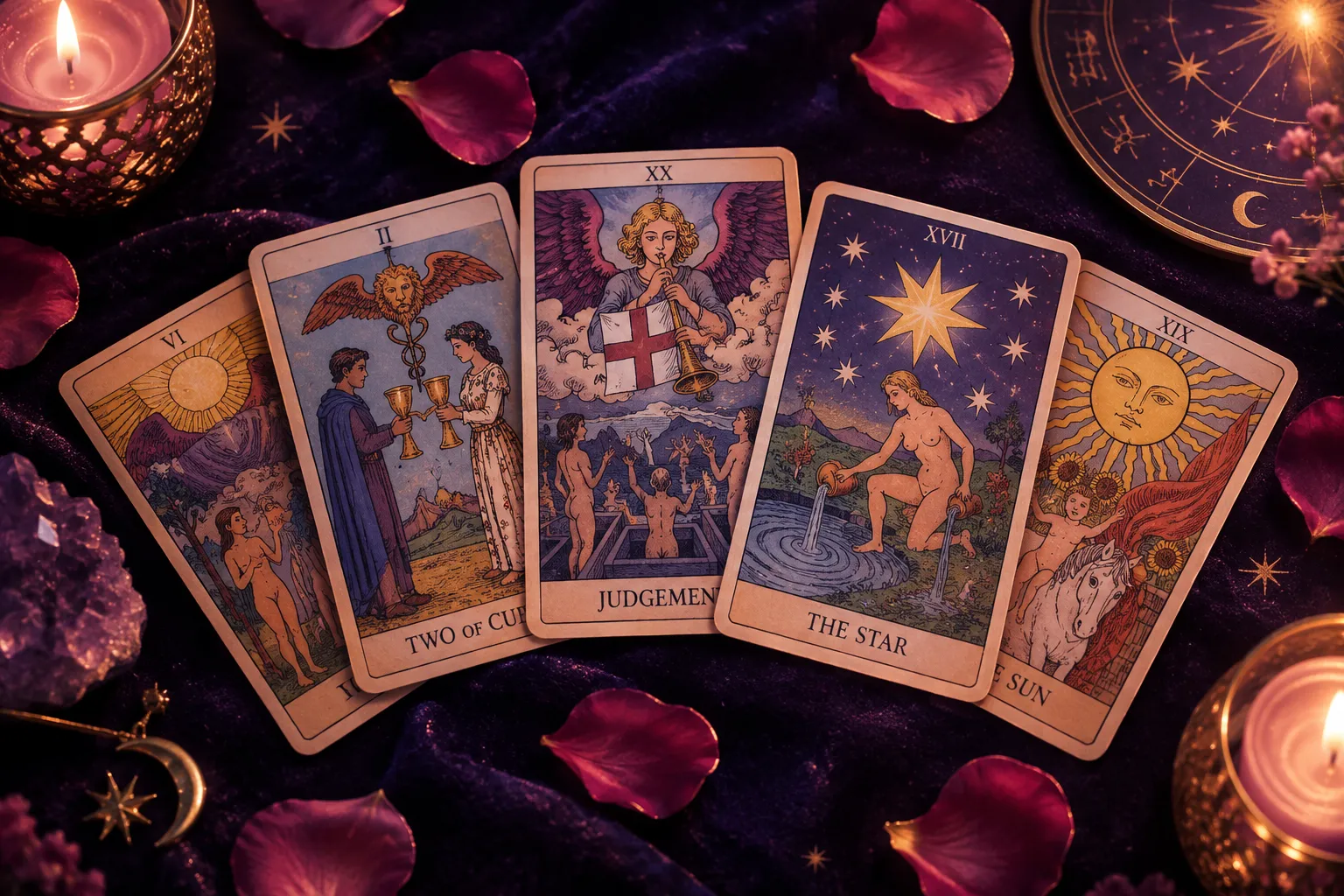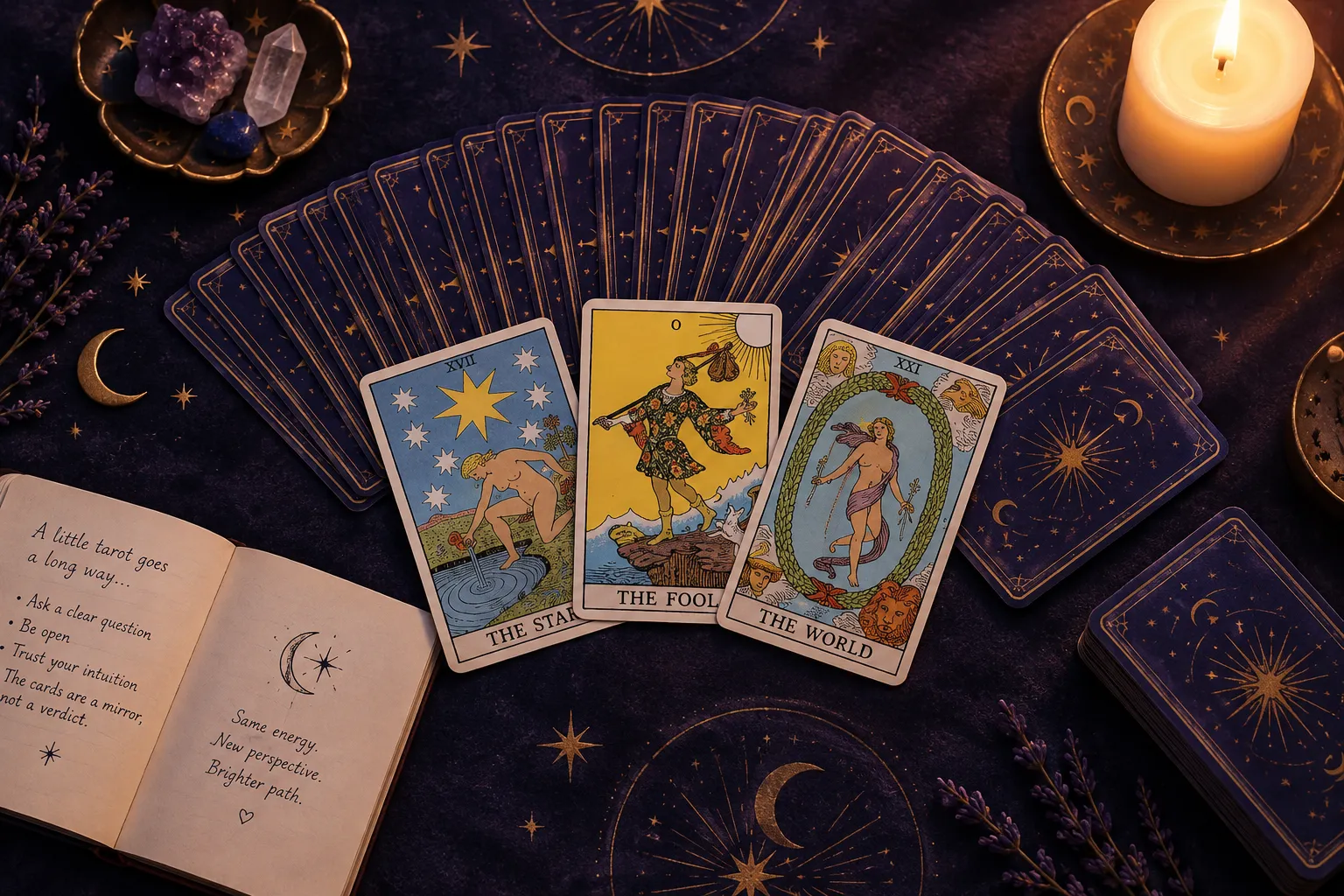


A first tarot session is a structured conversation: you share a question, the reader lays out cards, and together you discuss what each card suggests about your situation. Expect 30 to 60 minutes, a mix of listening and talking, and insights you reflect on afterward rather than a fixed prediction of your future.
Key takeaways
- A typical first in-person session lasts 30 to 60 minutes. Phone and chat readings are billed by the minute and often run 10 to 30.
- One focused, open-ended question produces a far clearer reading than a list of yes/no questions.
- Online platforms such as Keen, Kasamba and Psychic Source commonly list rates from about $1 to $10 per minute. Local in-person readers often charge $50 to $150 per hour.
- A reputable reader never claims certainty, sells curse removal or asks you to spy on someone else.
- The useful part of a reading often comes in the days afterward, when you revisit your notes and act on what stood out.
What a tarot reading session actually is
A tarot session uses a deck of 78 illustrated cards as prompts for structured reflection on a question you bring. Good readers present it as a way to see your situation from new angles. They do not treat it as a guaranteed forecast.
What tarot can and cannot do
Tarot can help you name a feeling, notice a pattern and weigh your options. It cannot diagnose an illness, predict a court verdict or tell you what another person is secretly thinking. Many respected teachers frame the practice as reflective. Mary K. Greer’s Tarot for Your Self (1984) is built around using the cards for personal insight rather than fortune-telling.
Skeptics can still get value from a session. Carl Jung’s idea of archetypes, the universal figures such as the mother, the fool and the wise elder that recur in myth, maps closely onto the tarot’s imagery. Seen this way, the cards act like a mirror. They surface ideas you already half-hold, and the reader helps you put them into words.
The deck your reader will use
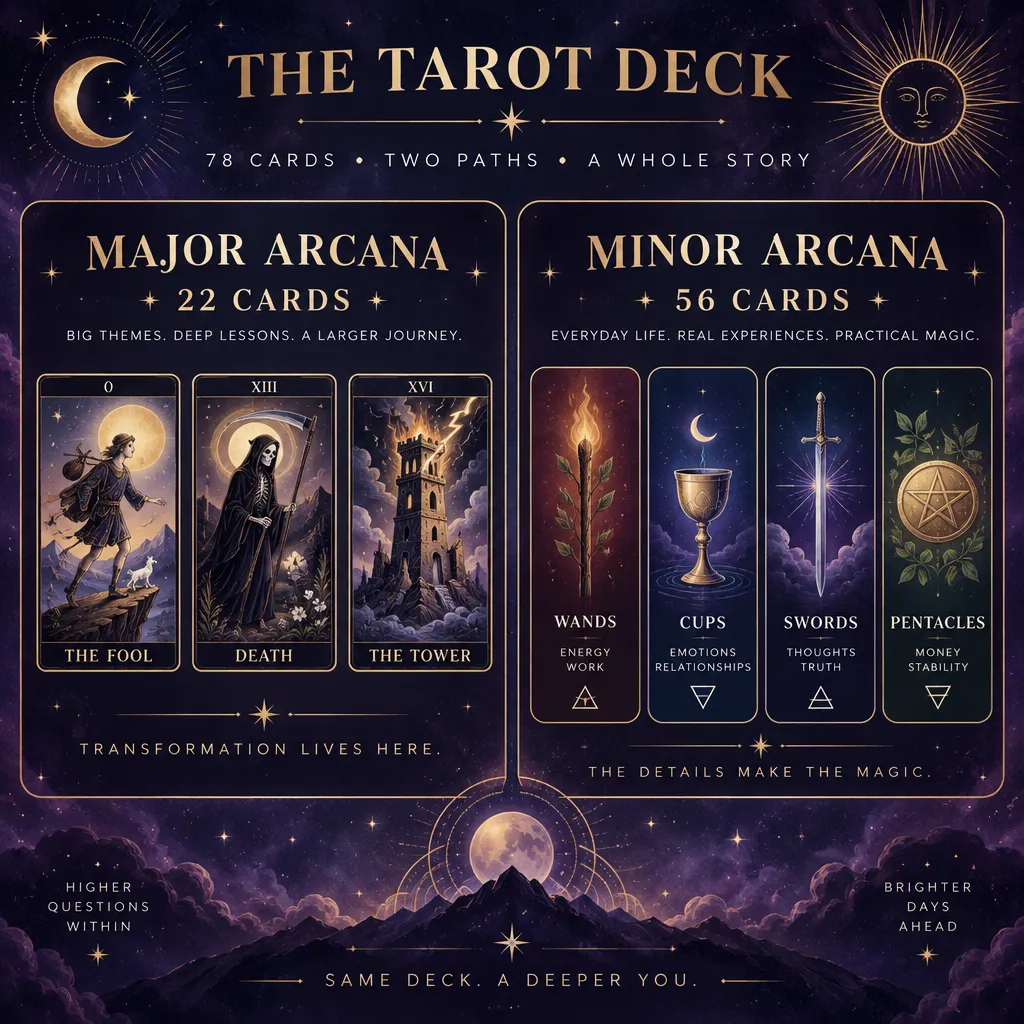
Most readers work with the Rider-Waite deck, also called Rider-Waite-Smith, or a deck modeled on it. It has two parts:
- Major Arcana (22 cards): big themes and life lessons, such as The Fool, Death and The Tower. A spread heavy in Major Arcana usually signals a significant turning point.
- Minor Arcana (56 cards): everyday matters, in four suits. Wands cover energy and work, Cups cover emotions and relationships, Swords cover thoughts and conflict, and Pentacles cover money and the body. Each suit includes four court cards (Page, Knight, Queen, King), and these often stand for people or personality traits.
Did you know?
The Rider-Waite deck was published in 1909 by William Rider & Son. It was designed with occultist A.E. Waite and illustrated by Pamela Colman Smith, which is why many readers now call it the Rider-Waite-Smith deck.
How to prepare for your first reading
Preparation comes down to one thing: arrive with a clear, open question and a settled mind. The reader can only work with what you bring.
Formulate one focused question
Open-ended “how” and “what” questions give the cards room to say something useful. Yes/no questions tend to produce a thin answer you cannot act on.
| Weaker question | Better question |
|---|---|
| Will I get the job? | What should I focus on to improve my chances in this job search? |
| Does he love me? | What do I need to understand about where this relationship is heading? |
| Should I move? | What am I not seeing about the decision to relocate? |
| Will I be rich? | What is blocking me from managing money better? |
The better versions keep you at the center of the question. That is the part of the situation you can actually change.
Preparation checklist
- Write down one main question and, at most, one backup.
- Bring a notebook or open a notes app.
- For phone, chat or video readings, find a quiet space where you will not be interrupted.
- Take a few minutes beforehand to ground yourself: slow breathing or a short walk helps.
- Skip alcohol and anything else that clouds your focus.
- Arrive open to answers you were not expecting.
- For per-minute platforms, decide in advance the most you will spend.
Write your question twice
Write your question once, then rewrite it without the words “will” or “should.” The second version is usually the one to bring to the session.
What happens during a tarot session, step by step
Most professional sessions follow the same basic arc, whatever the format.
- Opening conversation. The reader introduces themselves, explains their approach and asks what brings you in. You do not need to give your whole life story. A sentence or two of context is enough.
- Clarifying intent. Many readers help you sharpen your question at this point. Some also lead a brief grounding moment, such as a breath or a pause.
- Shuffle and cut. In person, you may be asked to shuffle or cut the deck so your energy or attention is “in” the cards. On the phone or in chat, the reader shuffles for you.
- Laying out the spread. The reader places the cards in a pattern. Each position has a set meaning, such as “past” or “obstacle.”
- Card-by-card interpretation. The reader explains each card in its position, then links the cards into a story. If a card appears upside down (reversed), the reader may read it as blocked, delayed or internal energy. Some readers do not use reversals at all.
- Your questions. You ask follow-ups, push back if something does not fit, or ask for one clarifying card.
- Closing. The reader summarizes the main message and often suggests one practical next step.
Rachel Pollack, author of Seventy-Eight Degrees of Wisdom, influenced a generation of readers who treat interpretation as a dialogue with the client. Expect to be asked “Does this resonate?” more than once.
Spreads you are likely to see
The spread sets how deep a session goes. In a 30-minute reading, expect a three-card spread or a short custom layout. A full Celtic Cross needs closer to an hour to discuss properly.
| Spread | Cards | Best for | Time to read well |
|---|---|---|---|
| Single card | 1 | Quick guidance, a daily theme | 5 to 10 min |
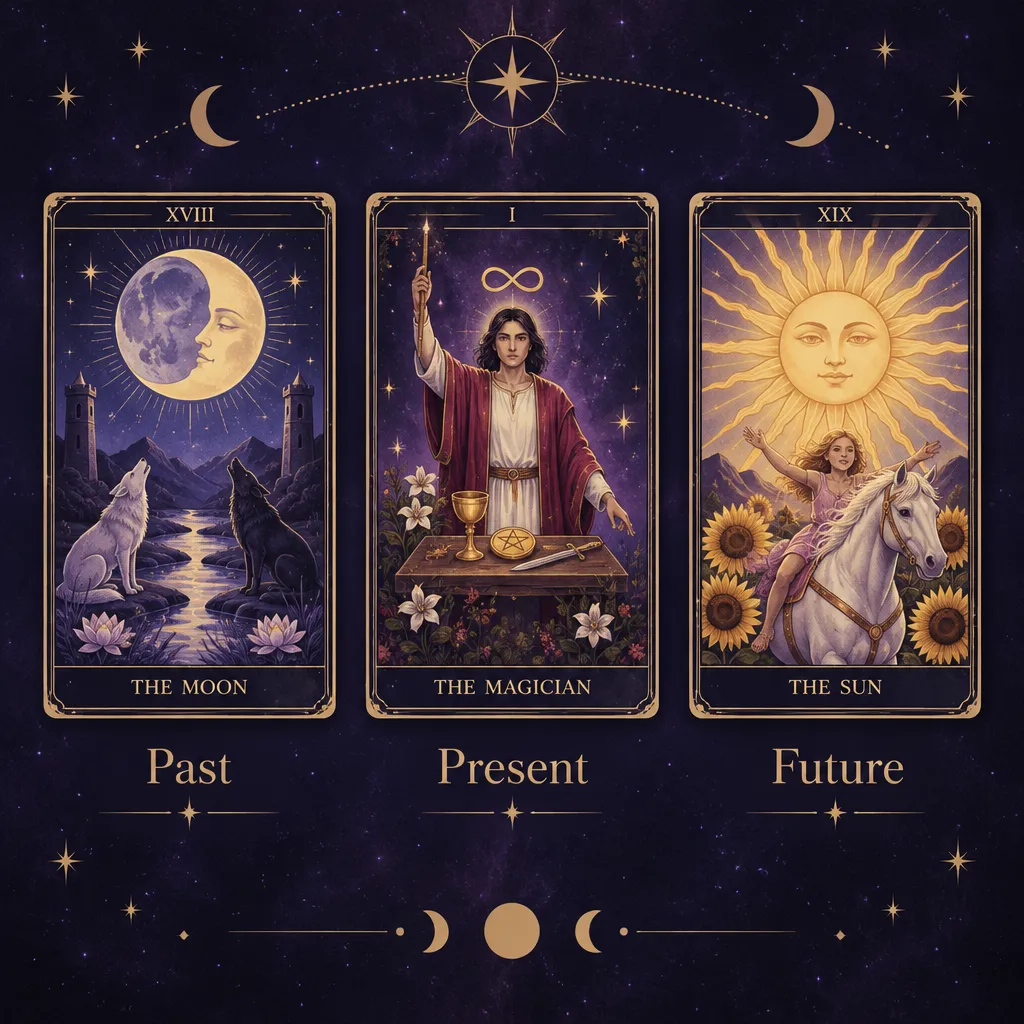
| Three-card (past/present/future, or situation/action/outcome) | 3 | A focused question, first-timers | 15 to 30 min |
| Celtic Cross | 10 | Complex situations with many factors | 45 to 60+ min |
The Celtic Cross was popularized by Waite’s 1910 book The Pictorial Key to the Tarot. It covers the present situation, the challenge, the past, near future, hopes and fears, and likely outcome.
Session lengths and formats
The right format depends on whether you want conversation, speed or a written record. Sessions range from about 5 minutes for a single-card chat to 2 hours for in-depth in-person work.
| Format | Typical length | Typical US price range | Best for |
|---|---|---|---|
| In-person | 30 to 90 min | About $50 to $150 per hour | Full experience, back-and-forth |
| Video | 20 to 60 min | Flat fee or per-minute | In-person feel from home |
| Phone | 10 to 45 min | About $1 to $10+ per minute | Live conversation, flexibility |
| Live chat | 5 to 30 min | About $1 to $10+ per minute | Privacy, built-in transcript |
| Email/async | Delivered in 1 to 3 days | Flat fee per question | Reflective readers who want everything in writing |
Online platforms vs local readers
Keen, Kasamba and Psychic Source dominate search results. They host hundreds of readers with public ratings, and each reader sets their own per-minute rate. Kasamba also offers email readings. The trade-off is that the meter runs while you type and think. Community hubs such as Biddy Tarot, founded by Brigit Esselmont, lean more toward teaching people to read for themselves, and they list certified readers too.
Local readers, found through metaphysical shops, wellness centers or word of mouth, offer longer, unhurried sessions at a flat price. For a first experience, a flat-fee hour usually costs less than an hour on a per-minute app.
Human readers vs AI tarot apps
AI tarot apps now give instant, cheap or free card pulls with generated interpretations. They work for practice and for learning card meanings. They cannot read your tone, catch the question behind your question or take ethical responsibility for what they say. On some platforms the distinction is not always obvious, so ask directly whether you are speaking with a human.
What a professional session costs
Expect to pay roughly $1 to $10 per minute online and $50 to $150 for an in-person hour in the US. Established readers with long waiting lists and party or event readers charge more. Most platforms offer discounted first-session rates, but a cheap rate does not tell you the reader is good.
A worked example: a 20-minute phone reading at $4.99 a minute costs about $100. That is close to the price of a full flat-fee hour with a local reader. Run that math before choosing a format.
Set a timer
On per-minute platforms, set a phone timer for your budget and let the reader know up front how much time you have. Good readers pace the reading to fit.
How to choose a reputable reader
Look for a clear ethical stance, consistent reviews and a reader who explains their method before you pay. Certification is not legally required anywhere, but it shows commitment. The American Tarot Association and the Tarot Association of the British Isles both publish codes of ethics for their members.
Signs of a good fit:
- Reviews that describe specific, practical insights, not only “she knew everything.”
- A stated policy on medical, legal and financial questions (they should refer you to professionals).
- Patience with first-timers and a willingness to explain the cards.
- A clear price, with no surprise extras.
Red flags
- Claims to have detected a curse, hex or “dark energy” that only paid work can remove.
- Pressure to book more sessions, buy candles or crystals, or send extra money.
- Guaranteed outcomes (“he will come back in 30 days”).
- Medical diagnoses or advice to stop treatment.
- Fear-based language meant to keep you dependent.
Did you know?
In the UK, the Consumer Protection from Unfair Trading Regulations 2008 replaced the Fraudulent Mediums Act 1951. As a result, many British psychic services state that readings are for entertainment or experimental purposes.
During the session: do’s and don’ts
Be honest about your situation, ask follow-up questions and take notes. Avoid firing off question after question. Redrawing on the same issue tends to muddy the reading rather than sharpen it.
Recording and note-taking
Ask before you record. Most readers agree to audio recording, and some send a summary afterward. Chat and email readings create their own transcript. Either way, write down the cards drawn and any phrase that struck you, because memory fades within days.
Questions to avoid and why
Ethical readers decline questions that invade a third party’s privacy or invite fatalism. The other person has not consented, and the reader cannot verify anything about them.
| Acceptable | Unacceptable |
|---|---|
| How can I communicate better with my partner? | Is my partner cheating on me? |
| What do I need to know about my role in this conflict with my coworker? | What is my coworker planning behind my back? |
| How can I support my mother through her illness? | When will my mother die? |
| What energy am I bringing to dating right now? | Who is my ex dating now? |
The rule of thumb: keep yourself as the subject. Your actions and choices are the only part of any situation a reading can help with.
After the session
Most of the value arrives after the call ends. Revisit your notes within 24 hours, again after a week, and again after a month.
Journaling prompts
- Which card or phrase surprised me, and why?
- What did I hope to hear, and what did I actually hear?
- What is one small action this reading points to?
- Looking back at the past month, where did the reading’s themes show up?
When to book a follow-up
Give an insight time to play out. Four to eight weeks is a sensible gap for the same question. Booking again within days to get a “better” answer is a sign the reading is feeding anxiety rather than easing it.
Tarot alongside therapy or coaching
Tarot can sit alongside therapy or coaching as a prompt for reflection. Some people bring a reading’s themes into a counseling session to talk them through. It does not replace licensed mental health care. A reader who discourages you from seeing a professional is showing you a red flag.
Glossary for first-timers
- Spread: the pattern the cards are laid in, with each position carrying a meaning.
- Significator: a card chosen to represent you, often a court card.
- Court cards: the Pages, Knights, Queens and Kings of the Minor Arcana.
- Reversed card: a card that lands upside down, usually read as blocked or internalized energy.
- Intuitive reading: an approach that relies on the reader’s impressions of the imagery more than on fixed book meanings.
- Clarifier: an extra card drawn to expand on one that is unclear.
Your next step
Before you book, write your question, set your budget and read the reader’s ethics policy. A clear question and a reader who respects your autonomy make for a useful first session.
FAQ
How long does a tarot reading take?
A first in-person reading typically lasts 30 to 60 minutes. Phone and chat readings often run 10 to 30 minutes, and a single-card pull can take 5. In-depth sessions using a Celtic Cross can go up to 2 hours.
What should I ask in a tarot reading?
Ask one open-ended question centered on you, such as “What should I focus on in my career this year?” Avoid yes/no questions and questions about other people’s private lives.
Is tarot reading accurate?
No scientific evidence shows that tarot predicts the future. Its value lies in reflection. The imagery prompts you to consider your situation from new angles, and a skilled reader helps you articulate what you already sense.
How much does a tarot reading cost?
Online platforms commonly charge about $1 to $10 per minute. In-person readers in the US often charge $50 to $150 per hour, with well-known readers charging more.
Can I record my tarot reading?
Usually, yes, but ask first. Most professional readers allow audio recording, and chat or email formats give you a written record automatically.
Are AI tarot apps the same as a human reading?
No. AI apps generate interpretations from card meanings but cannot respond to your tone, clarify your question or follow an ethical code. They are useful for learning, while a human reader offers a real conversation.
Add Yes No Tarot as a preferred source on Google, and the sites you pick are more likely to appear in your Top Stories.