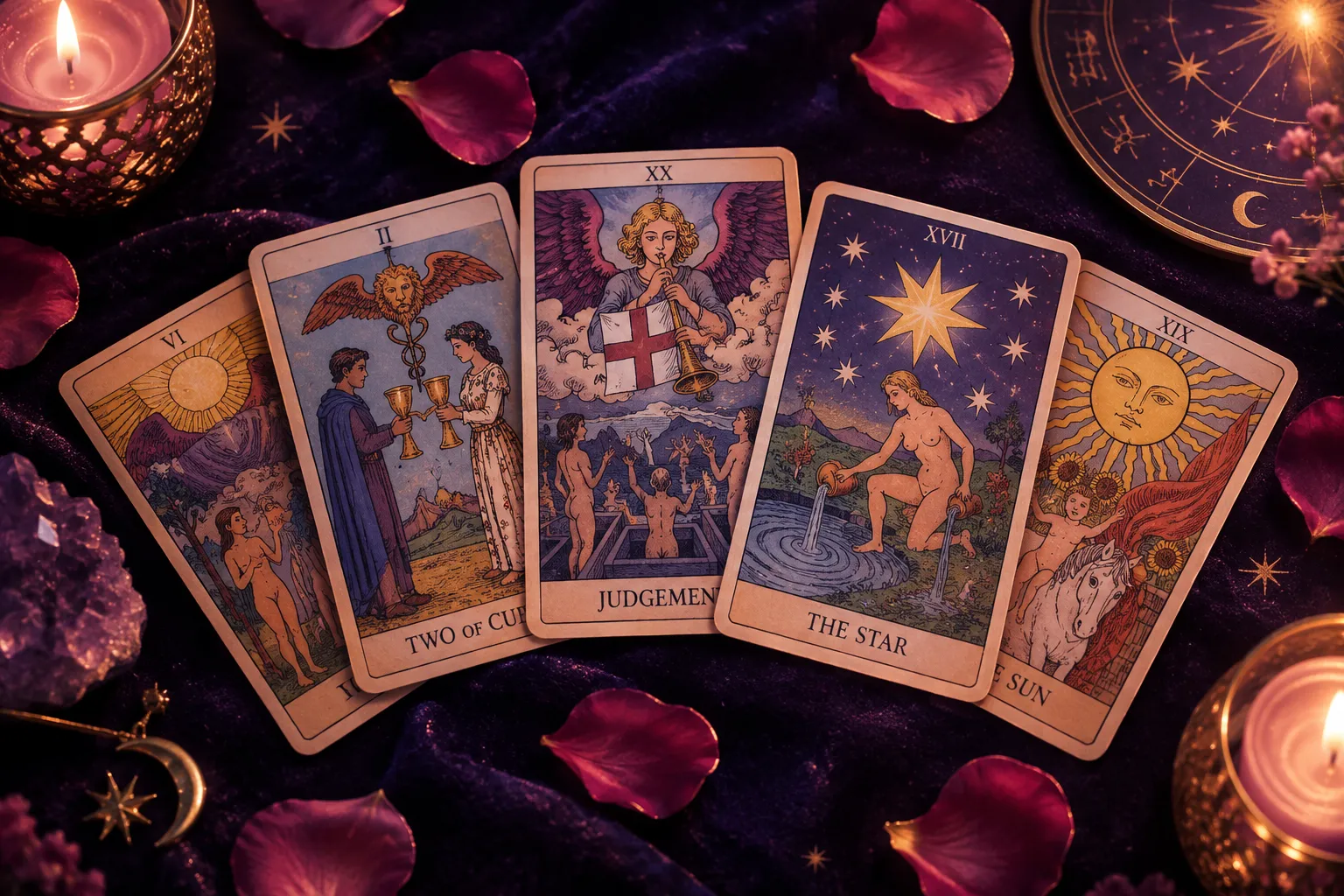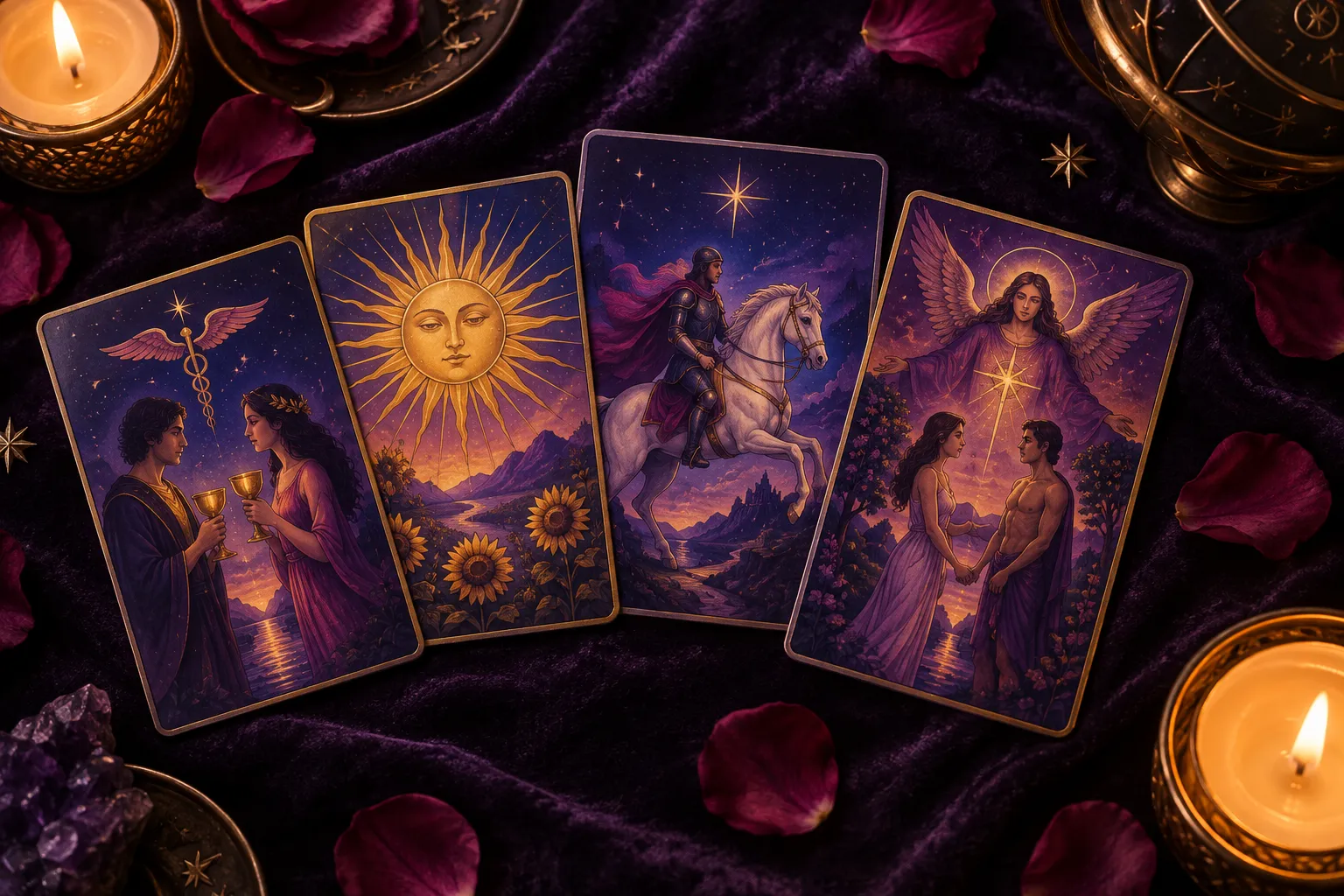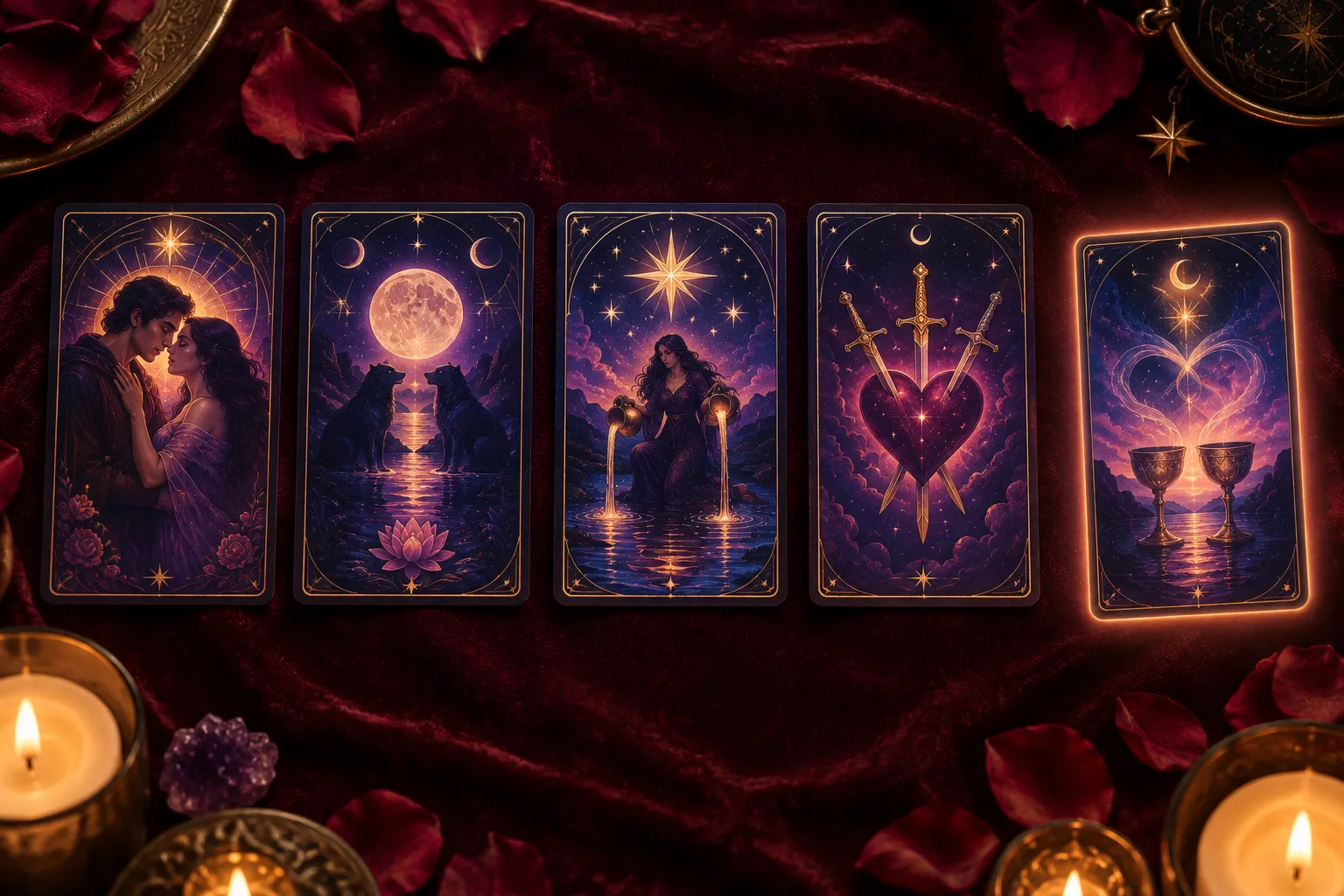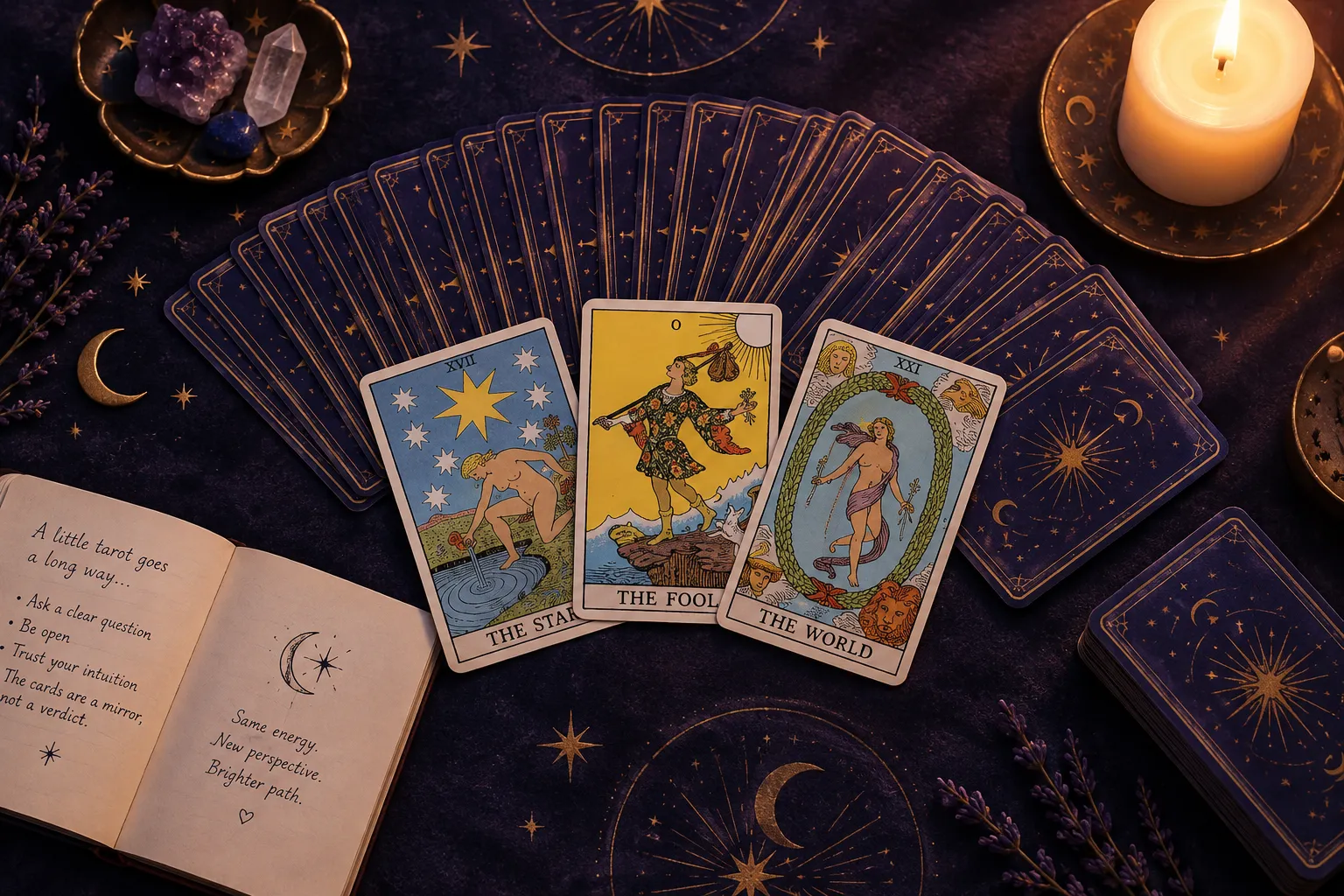

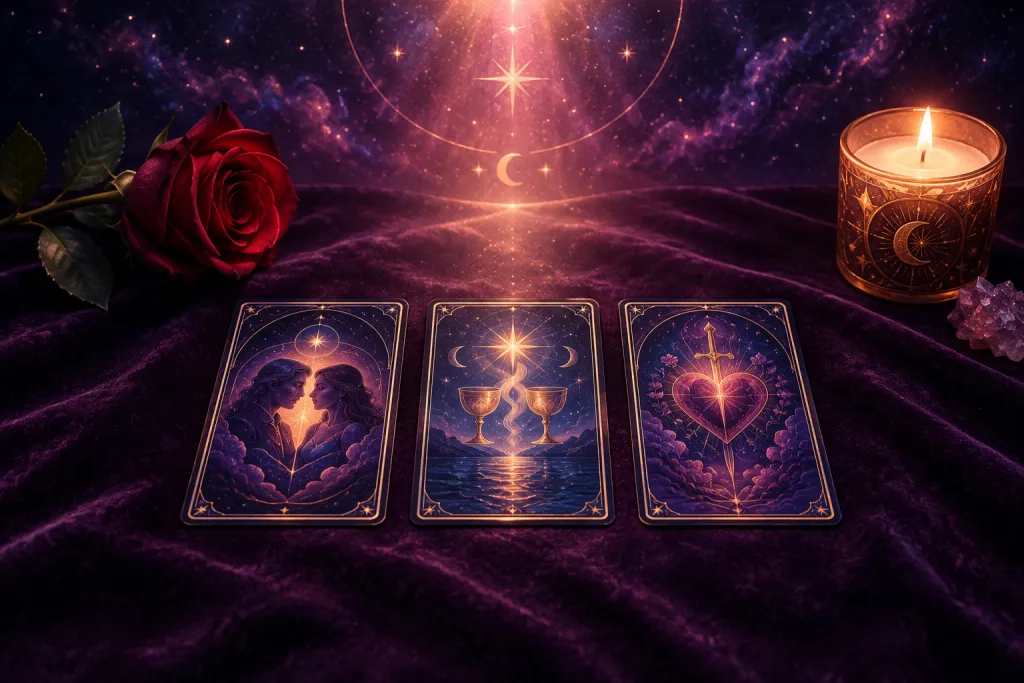
The Lovers is only one of 78 tarot cards, and in a love reading the quieter Suit of Cups usually says more about your relationship than any single dramatic draw. A love tarot reading uses chosen spreads, card meanings and well-phrased questions to help you think clearly about attraction, commitment and heartbreak. This guide covers the layouts, the cards that matter most, the questions to ask, and what tarot can and cannot tell you.
Key takeaways
- A love reading is most useful as a reflection tool for your own choices. It cannot report another person’s hidden feelings.
- The 3-card You / Them / Connection spread suits beginners. The Celtic Cross suits complicated situations.
- The Suit of Cups (water, emotion) carries most of the love meaning in a reading, while the Major Arcana flags turning points.
- Open questions (“What can I bring to this relationship?”) produce better readings than yes/no questions.
- Reversed cards usually point to blocked, delayed or internal versions of a card’s meaning, not automatic bad news.
What is a love tarot reading?
A love tarot reading is a card layout focused on romance, attraction or a specific relationship, where each card position answers part of a question. The cards work as prompts: their imagery and traditional meanings help you name feelings, patterns and options you may not have put into words.
Today’s top tarot guides frame the practice as reflective, closer to guided journaling than to fortune-telling. That framing matches the evidence. There is no scientific support for tarot predicting the future, but a structured spread can still help you slow down and examine a relationship from several angles.
Major Arcana vs Minor Arcana in love
A standard deck has 22 Major Arcana cards and 56 Minor Arcana cards, and each layer speaks at a different scale.
| Layer | Cards | What it signals in a love reading |
|---|---|---|
| Major Arcana | 22 trump cards, The Fool (0) to The World (XXI) | Big themes, life lessons, turning points: commitment, endings, karmic patterns |
| Minor Arcana | 56 cards in four suits of 14 (Ace to Ten, plus Page, Knight, Queen, King) | Day-to-day dynamics: moods, conversations, habits, practical decisions |
A spread heavy with Major Arcana suggests a significant chapter. A spread made mostly of Minor Arcana suggests the situation is in your hands through ordinary choices.
The Suit of Cups: the primary suit of love
Cups is the suit of emotion, linked to the element of water, and it covers romance, friendship, intuition and the inner life. Its arc reads like a relationship story: the Ace of Cups opens the heart, the Two of Cups forms a bond, the Three of Cups celebrates, the Five of Cups grieves, and the Ten of Cups reaches lasting emotional fulfilment.
The other suits matter too. Wands bring passion and desire, Swords bring communication and conflict, and Pentacles bring stability, money and shared practical life.
Which deck to use: Rider-Waite-Smith or Thoth
The Rider-Waite-Smith deck is the reference point for most modern love card meanings, including the ones in this guide. It was published in 1909 by William Rider & Son in London, designed by the occultist Arthur Edward Waite and illustrated by the artist Pamela Colman Smith.
Imagery matters in love readings because you read the scene as well as the keyword. Smith’s Two of Cups shows two figures exchanging cups beneath a winged lion’s head. Her Three of Swords shows a heart pierced by three blades in the rain. Those pictures carry emotional information a list of keywords misses.
The Thoth deck, created by Aleister Crowley and painted by Lady Frieda Harris, is denser and more astrological. Several Thoth cards carry one-word titles, such as “Love” for the Two of Cups and “Sorrow” for the Three of Swords. It suits experienced readers. Beginners usually learn faster with Rider-Waite-Smith or one of its many redrawn versions.
Did you know?
Pamela Colman Smith’s illustrations for the 1909 Rider-Waite-Smith deck gave nearly every numbered Minor Arcana card a full scene with people and action. Before that, mass-market decks typically showed only arranged suit symbols, so her art is a large part of why intuitive, story-based love readings became possible.
Best love tarot spreads
Choose the spread by how complicated your question is: three cards for a quick check-in, five for compatibility, ten for a situation with history and many moving parts.
| Spread | Cards | Best for | Positions |
|---|---|---|---|
| You · Them · Connection | 3 | Quick insight into a current bond | 1 You, 2 Them, 3 The connection |
| Past · Present · Future (love) | 3 | Seeing how a relationship has developed | 1 Past influence, 2 Present, 3 Likely direction |
| Compatibility | 5 | New or committed couples | 1 You, 2 Partner, 3 Shared strength, 4 Challenge, 5 Outlook |
| Celtic Cross | 10 | Complex situations, breakups, crossroads | See full list below |
The 3-card spread: You, Them, Connection
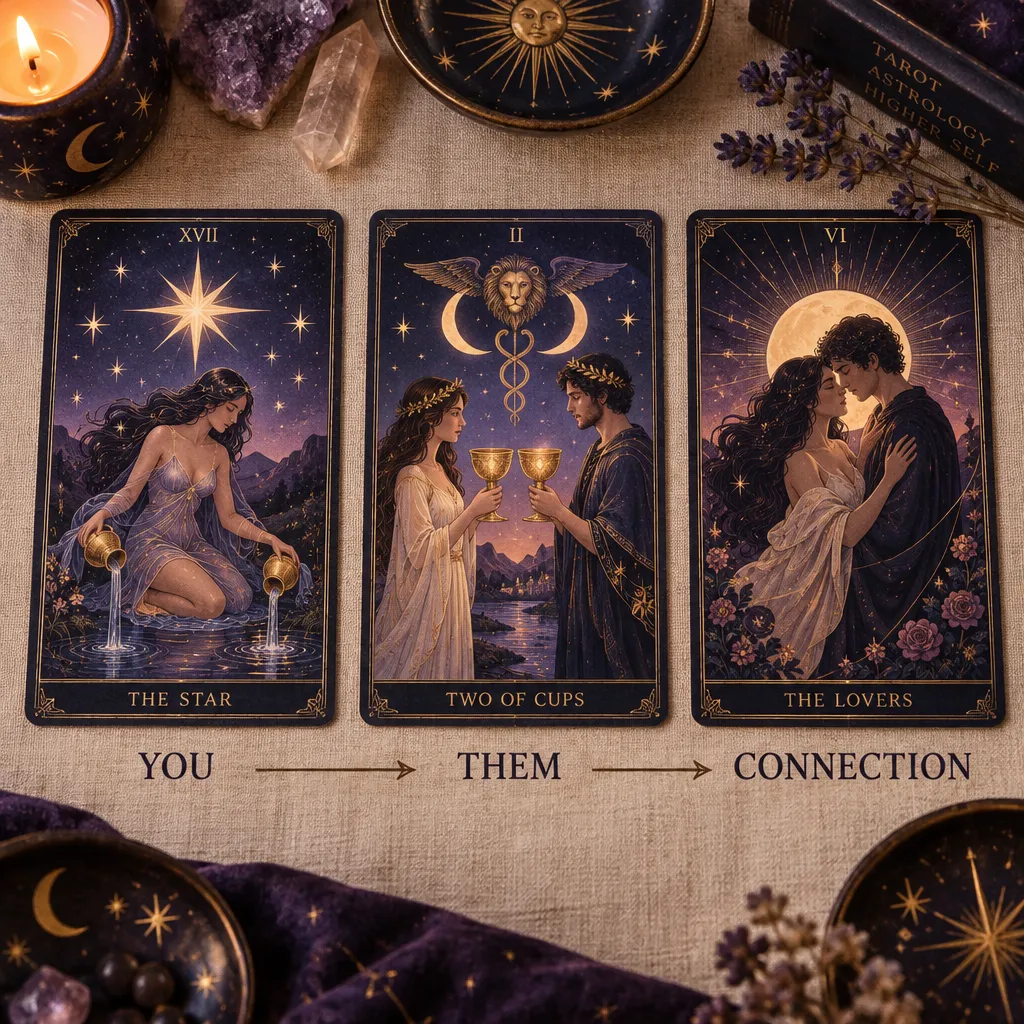
Lay three cards left to right. Card 1 shows what you are bringing to the relationship right now. Card 2 shows how the relationship looks from the other side, read as your perception of them. Card 3 shows the connection itself: its energy today and the direction it leans.
Worked example: You draw the Page of Cups, the Four of Pentacles, then the Two of Cups. You are open and playful (Page of Cups). The other person reads as guarded, possibly protecting time or money (Four of Pentacles). The connection still holds real mutual attraction (Two of Cups). The useful takeaway is practical: the bond is there, but trust and security need building before it can deepen.
The 5-card compatibility spread
- You: your emotional state and what you want.
- Your partner: their energy as it shows up in the relationship.
- Shared strength: what holds you together.
- Challenge: the friction point or blind spot.
- Outlook: where the relationship is heading if nothing changes.
Pay most attention to cards 3 and 4. A Cups card in position 3 with a Swords card in position 4 is a common pattern: strong feelings, poor communication.
The Celtic Cross for love
The Celtic Cross was popularised by A. E. Waite in The Pictorial Key to the Tarot (1910) and remains the best-known ten-card spread. For love, read the positions like this:
- The heart of the matter: your relationship situation now.
- The crossing card: what blocks or complicates it.
- Foundation: the root cause or deeper emotional history.
- Recent past: what is leaving the situation.
- Conscious aim: what you hope for.
- Near future: what is coming in the next weeks or months.
- You: your attitude and role.
- Environment: friends, family, work and outside pressure.
- Hopes and fears: often the same card, read both ways.
- Likely outcome: where current patterns lead.
The Celtic Cross rewards patience. Read position 10 last, and check it against position 7: the outcome is rarely fixed when your own attitude is the card in play.
Key cards in a love reading
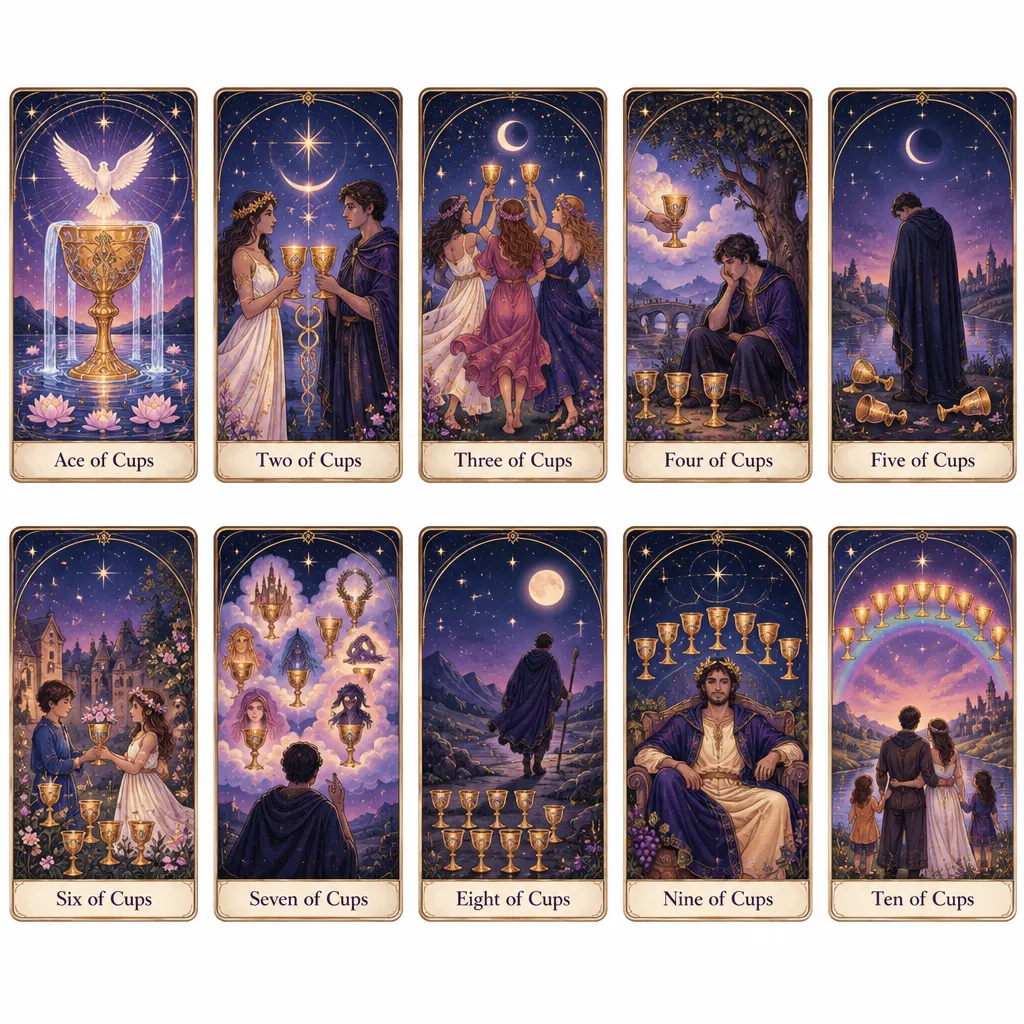
Ten to fifteen cards do most of the heavy lifting in love spreads. Learn these first and the rest of the deck becomes easier to place.
Cards you hope to see
| Card | Arcana | Love meaning |
|---|---|---|
| The Lovers (VI) | Major | Deep connection, alignment of values, a meaningful choice about commitment |
| Two of Cups | Minor, Cups | Mutual attraction, partnership, a balanced exchange of feeling |
| Ten of Cups | Minor, Cups | Lasting happiness, emotional security, family or chosen family |
| Six of Cups | Minor, Cups | Nostalgia, innocence, a past love or childhood sweetheart returning |
| Ace of Cups | Minor, Cups | New love, an open heart, a fresh emotional start |
| Knight of Cups | Minor, Cups | Romance, a declaration of feelings, an invitation |
| The Empress (III) | Major | Nurturing, sensual, abundant love |
| Four of Wands | Minor, Wands | Celebration, moving in together, engagement, a stable home |
Warning cards and how to read them
Warning cards describe pressure points, not doom. Each one names something you can work on.
- The Devil (XV): obsession, codependency or a relationship built on habit or lust more than choice. It asks what keeps you attached.
- Three of Swords: heartbreak, painful words, grief. Sometimes it marks a hurt that needs acknowledging so it can heal.
- Five of Cups: dwelling on loss. Smith’s image shows three spilled cups and two still standing, a reminder that something remains.
- The Tower (XVI): a sudden shake-up or revelation. Unstable foundations come down so something honest can be built.
- Eight of Cups: walking away from a relationship that no longer meets your emotional needs.
- Ten of Swords: a painful, definite ending, with the dawn painted on the horizon.
Reversed cards in love readings
Reversed cards usually show a card’s energy as blocked, delayed, excessive or turned inward. Many readers skip reversals entirely, which is a valid choice; decide before you shuffle.
- Reversed Knight of Cups: moodiness, mixed signals, or romance that is all words and no follow-through.
- Reversed Two of Cups: imbalance or a breakdown in communication between partners.
- Reversed Lovers: values out of step, or a choice you are avoiding.
- Reversed Three of Swords: recovery, the worst of the hurt easing.
- Reversed Devil: breaking free from an unhealthy pattern.
The last two show why reversals are not simply “bad.” A painful card reversed often signals relief.
How to do a love tarot reading, step by step
- Settle your intention. Sit somewhere quiet and decide what you want to understand. Write it down.
- Cleanse the deck. Common methods include knocking on the deck, passing it through incense smoke, or leaving it in moonlight. The practical purpose is a reset, so you are not reading with yesterday’s question in mind.
- Choose your spread from the table above and decide whether you will read reversals.
- Shuffle while holding the question. Overhand shuffling or spreading the cards face down and mixing them both work. Stop when it feels right.
- Cut and draw. Cut the deck into three piles, restack them, then draw from the top in position order.
- Read each card in its position. Note the image first, then the traditional meaning, then how it relates to your question.
- Read the spread as a whole. Count Majors against Minors, note dominant suits, and look for repeated numbers.
- Record it. Photograph or sketch the layout and write your interpretation the same day.
Pull one card today
For a simple interactive practice, ask “What does my love life need from me today?” and draw a single card each morning for a week. Log the card and one sentence about the day. Patterns across seven draws teach card meanings faster than any book.
Love tarot questions to ask
The best love tarot questions are open, focused on you, and about the present or near future. “Will they text me?” gives a reading nowhere to go. “What can I do to feel more secure while I wait to hear from them?” gives every card a job.
| Instead of | Ask |
|---|---|
| Will I get married this year? | What is helping or blocking commitment in my life right now? |
| Does my ex still love me? | What do I still need to release from my last relationship? |
| Is my partner cheating? | What is the state of trust in our relationship, and what can I do about it? |
If you are single
- What patterns have shaped my past relationships?
- What am I looking for in a partner, beneath the surface?
- How can I build my self-worth before I start dating again?
- What is keeping me from meeting the right person?
- What energy am I bringing to new connections today?
If you are in a relationship
- What is the greatest strength of our connection?
- Where is communication getting stuck between us?
- What does my partner need from me that I may be missing?
- How can we grow together over the next six months?
- What future are we building, and does it match what I want?
After a breakup or in a situationship
- What lesson did this relationship teach me?
- How can I heal and move forward?
- What do I need to ask for clearly in this situationship?
- Am I staying out of love, habit or fear?
Singles vs couples: how readings differ
The spread can stay the same, but the focus shifts. For singles, readings centre on self-worth, readiness and what to attract. The “Them” position in a 3-card spread can become “the kind of partner I am drawn to,” and timing questions work best framed as “what needs to happen first.”
For couples, readings centre on the space between two people: compatibility, communication blocks, shared goals and outlook. The 5-card compatibility spread is built for this. Some couples draw together, each taking turns to interpret, which turns the reading into a structured conversation.
Situationships sit between the two. The most useful readings here focus on your own needs and boundaries, since the other person’s intentions are exactly what tarot cannot settle.
Tarot, zodiac signs and love horoscopes
Many tarot cards carry astrological correspondences from the Hermetic Order of the Golden Dawn, the 19th-century occult society Waite and Crowley both belonged to. In that system, The Lovers corresponds to Gemini, The Devil to Capricorn, the Two of Cups to Venus in Cancer, and the Ten of Cups to Mars in Pisces.
If you also read love horoscopes or do compatibility tests by zodiac sign, these links can add a layer. A Cancer drawing the Two of Cups, for example, might read it as an especially personal card. Treat astrology as seasoning, not the main ingredient: the card’s position and your question still matter more.
Online and AI love tarot readings
Online tarot is now mainstream, from free card-of-the-day apps such as Labyrinthos and Golden Thread Tarot to AI chat tools that interpret a spread in conversational language. They are convenient for learning meanings and for quick daily pulls.
The trade-offs are real. Digital shuffles are random number generators, so the ritual element of handling cards is gone. AI interpretations can sound confident while being generic, and some paid “psychic” services use free readings to upsell expensive follow-ups. A sensible approach: use apps to learn and practise, keep paid human readings for questions that matter, and never pay for a reading that promises to “bring back” a partner. No honest reader offers that.
Ethics and limits of a love reading
Tarot reflects your perspective, your patterns and your choices. It cannot reveal what another person truly feels, and it cannot override anyone’s free will.
That is why experienced readers discourage readings about a third party’s private feelings, such as a crush, an ex’s new partner or someone you are suspicious of. The cards will still produce an answer, but it will be your hopes or fears projected onto them. Asking about your side of the connection is both more ethical and more useful.
Accuracy deserves an honest answer too. Love readings often feel accurate partly because of the Forer effect, identified by psychologist Bertram Forer in 1949: people rate vague, general statements as highly personal descriptions of themselves. Knowing this helps you use tarot well. Treat a reading as a mirror for reflection, not evidence about anyone else.
Some situations call for more than cards. If a relationship involves control, fear or abuse, speak to a trusted person, a counsellor or a domestic abuse support service rather than waiting for a spread to confirm what you already sense.
How to act on your love reading
A reading earns its value in the days after. Within 24 hours, write down three things: the card that surprised you most, the card you resisted, and one concrete action the spread suggests. A Five of Cups in the “You” position, for example, might become “spend one evening this week on something that is going well instead of replaying the argument.”
Revisit your notes after a month. Compare what happened with what you read, and notice which interpretations helped you act and which only soothed you. Over time, that journal becomes the real reading: a record of how you love, what you need, and which choices brought you closer to the relationship you want. Start with one three-card spread this week and let the cards open the conversation.
FAQ
What tarot card means love?
The Lovers (Major Arcana VI) is the card most associated with love, signalling deep connection and a meaningful choice. In the Minor Arcana, the Two of Cups means mutual attraction and partnership, and the Ten of Cups means lasting emotional happiness.
How accurate are love tarot readings?
There is no scientific evidence that tarot predicts relationship outcomes. Readings feel accurate because they prompt you to reflect on situations you already know well, and because people tend to find general statements personally meaningful. Their value lies in clarity and self-reflection, not prediction.
Can tarot predict the future of a relationship?
Tarot can show where current patterns seem to lead, which is why spreads include “outlook” or “likely outcome” positions. That outcome is not fixed. Changes in communication, boundaries or effort change the direction, and the other person’s choices are their own.
What is the best tarot spread for love?
For beginners, the 3-card You / Them / Connection spread is the best starting point. Couples get more from a 5-card compatibility spread, and complex situations such as breakups or a love triangle suit the 10-card Celtic Cross.
Is it bad to get The Devil or Three of Swords in a love reading?
Neither card is a verdict. The Devil points to attachment, obsession or an unhealthy pattern, and the Three of Swords points to heartbreak or painful truth. Both name something you can address, and reversed they often signal recovery.
Can I do a love tarot reading for myself?
Yes. Self-readings work well for reflective questions about your feelings and choices. Choose a simple spread, phrase an open question, and record your interpretation. A second opinion from a reader can help when you are too emotionally close to see the cards clearly.
Add Yes No Tarot as a preferred source on Google, and the sites you pick are more likely to appear in your Top Stories.