Five Yes or No Tarot Spreads You Can Try Tonight (With Step-by-Step Instructions)
A yes or no tarot spread strips a reading down to a single decision, usually with one to five cards. Below are five formats, from a one-card pull to the classic four-pile Ace method, with the exact steps for each and advice on when each one fits.
Before You Pull a Card
Phrase the question so it can only be answered yes or no. “Should I text him?” works. “What does he think of me?” does not, and the spread will give you mush.
Decide your scoring rule before you shuffle, not after. If you plan to read reversals as “no,” commit to it. Changing the rules once you see a card is how people talk themselves into the answer they wanted.
Set a small stone, coin or crystal on the table as your question marker. It sounds fussy, but putting the question somewhere physical keeps your mind from drifting mid-shuffle.
What’s in the deck
Every method below leans on the structure of a standard 78-card tarot deck.
| Deck component | Count | Role in yes/no reading |
|---|---|---|
| Major Arcana | 22 | Big, decisive energy; often weighted heavier |
| Minor Arcana | 56 | Everyday detail and nuance |
| Suits (Wands, Cups, Swords, Pentacles) | 4 of 14 cards each | Flavour the “why” behind an answer |
| Aces | 4 | The whole basis of Spread 5 |
| Court cards | 16 | Often read as people, not answers |
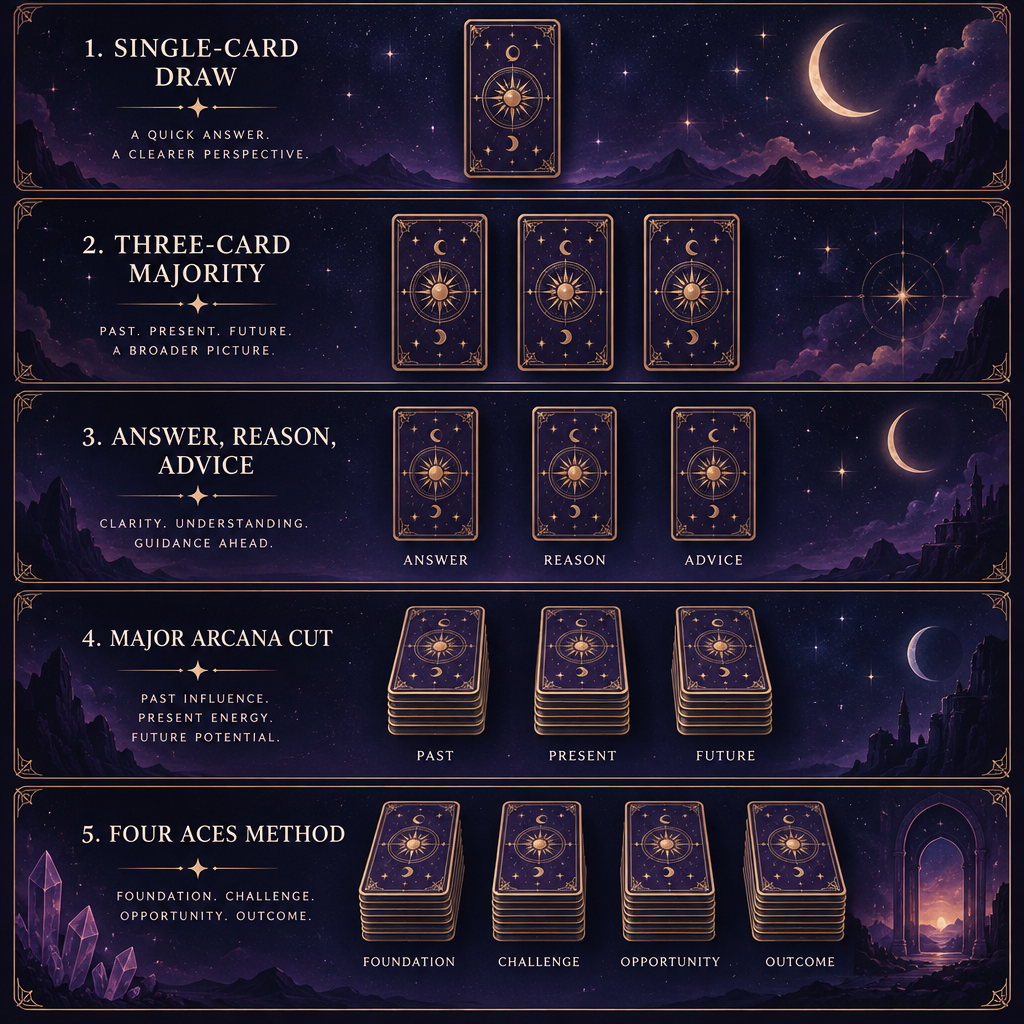
Spread 1: The Single-Card Draw
This is the fastest yes or no tarot spread and the one you will use most.
- Shuffle while holding the question in mind. Say it out loud once.
- Cut the deck once with your non-dominant hand.
- Turn over the top card of the bottom half.
- Read it with one of the two scoring systems below.
Orientation system: upright means yes, reversed means no. Simple, fast, and brutally binary.
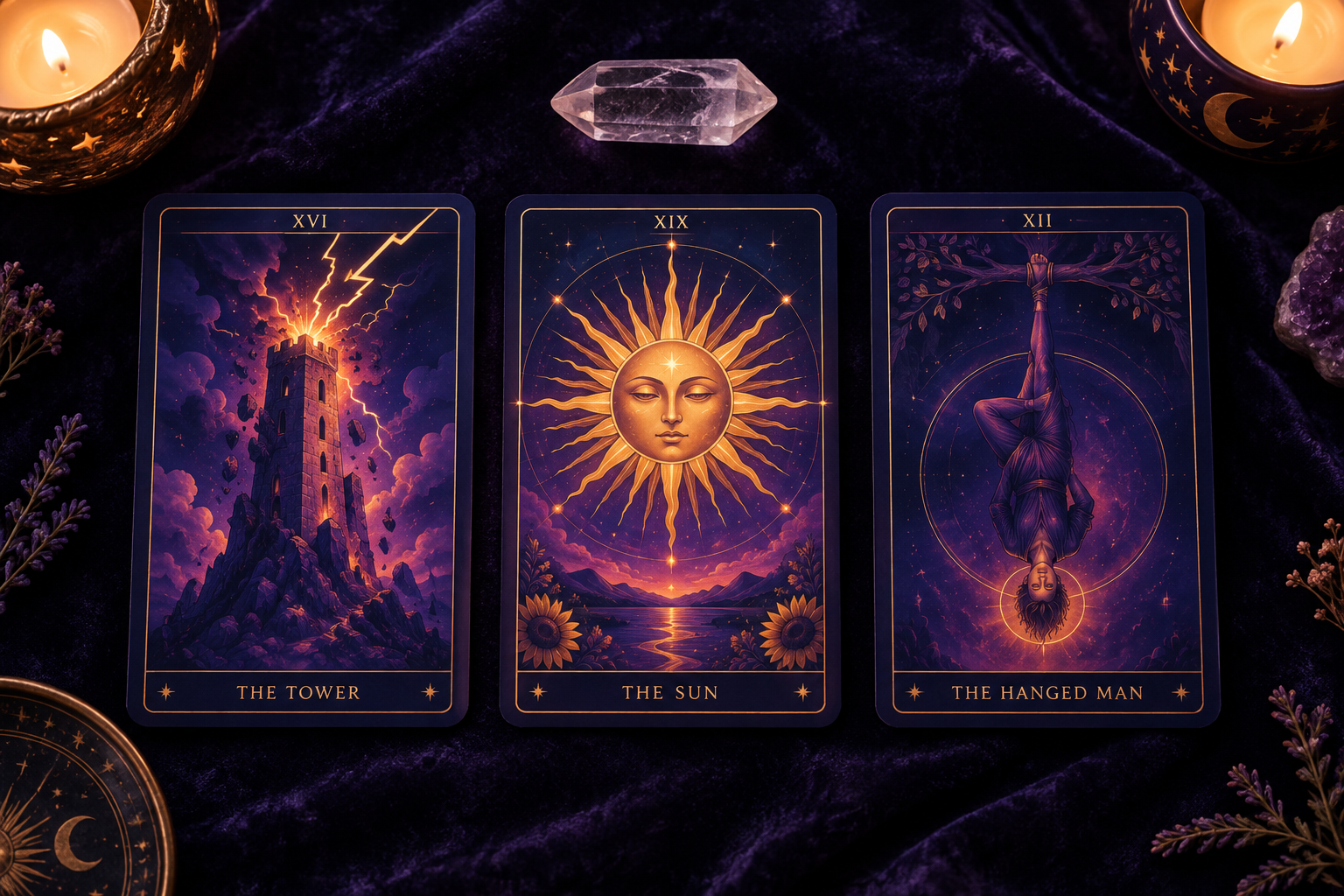
Meaning system: ignore orientation and judge the card’s energy. The Sun is a yes. The Tower is a no. The Hanged Man is “not yet.”
Use the single-card draw for low-stakes questions you need settled in under a minute. Should you go to the party tonight? Pull one card and go make dinner.
Spread 2: The Three-Card Majority
A three-card spread smooths out the randomness of a single pull.
- Shuffle and cut as above.
- Deal three cards in a row, left to right.
- Score each card as yes, no or neutral using the key further down.
- Two or more in agreement decides the answer.
- If all three disagree, the answer is “not now” and you leave it alone for a week.
The middle card gets a tiebreak role if you want one. Many readers also treat a Major Arcana card in the centre as the dominant voice, letting it override two mild minors.
This format suits questions with some weight, like whether to accept a job offer or whether a friendship is worth repairing.
Spread 3: Answer, Reason, Advice
This spread gives you the yes or no plus the context people usually want after hearing it.
| Position | Question the card answers | How to read it |
|---|---|---|
| 1 (left) | Yes or no? | Score strictly, no hedging |
| 2 (centre) | Why is that the answer? | Read for story, not polarity |
| 3 (right) | What should I do about it? | Read as practical advice |
Steps:
- Shuffle, cut, deal three cards face down.
- Flip card 1 first and lock in the answer before touching the others.
- Flip card 2 and 3 together and read them as a pair.
The order matters. If you flip all three at once, the advice card will colour your verdict on the answer card. Flipping the answer alone keeps you honest.
This is the right pick for love questions. “Will we get back together?” lands better as “No, because the Five of Pentacles shows you both still feel abandoned, and the Six of Swords says move on.”
Spread 4: The Major Arcana Cut
This method uses the deck’s structure instead of card meanings, so it works even if you are new and still learning the cards.
- Shuffle the full 78-card deck.
- Cut it into three stacks, left to right.
- Turn over the top card of each stack.
- Count the Major Arcana cards among the three.
| Majors turned up | Answer |
|---|---|
| 3 | Strong yes |
| 2 | Yes |
| 1 | Uncertain, redo in a few days |
| 0 | No |
The odds are tilted. With 22 Majors in 78 cards, roughly 28 percent of any single flip will be a Major, so a “no” is the baseline and a “yes” has to earn it. That makes this a good spread for questions where you suspect you are being optimistic.
Spread 5: The Four Aces Method
This is the oldest alternate yes or no method most readers know, and it uses the four Aces as a hidden signal.
- Shuffle thoroughly and think only of the question.
- Deal cards face up into a pile, one at a time, counting as you go.
- Stop when you reach the 13th card or turn over an Ace, whichever comes first.
- Set that pile aside and start a new one from the remaining deck.
- Repeat until you have dealt four piles.
Now count how many Aces appeared.
- Four Aces: emphatic yes.
- Three Aces: yes.
- Two Aces: maybe, with the suits telling you what the delay is about.
- One Ace: probably no.
- No Aces: no.
If you want extra detail, note which Aces showed. Ace of Cups points to emotion and love. Ace of Pentacles points to money, work and the material future. Ace of Swords is a decision or hard truth. Ace of Wands is action and drive.
Save this spread for the questions that matter. It takes three or four minutes, and the ritual of dealing out the piles is part of why the answer feels settled afterward.
Choosing the Right Spread
| Spread | Cards used | Time | Best for |
|---|---|---|---|
| Single-Card Draw | 1 | 30 seconds | Quick, low-stakes choices |
| Three-Card Majority | 3 | 2 minutes | Medium decisions needing a tiebreak |
| Answer, Reason, Advice | 3 | 3 minutes | Love and relationship questions |
| Major Arcana Cut | 3 | 1 minute | Beginners; checking optimism |
| Four Aces | up to 52 | 4 minutes | Big, specific life questions |
A Quick Card Key
For the spreads that score by meaning, here is the convention most readers use. Treat it as a starting point and adjust once you know your deck.
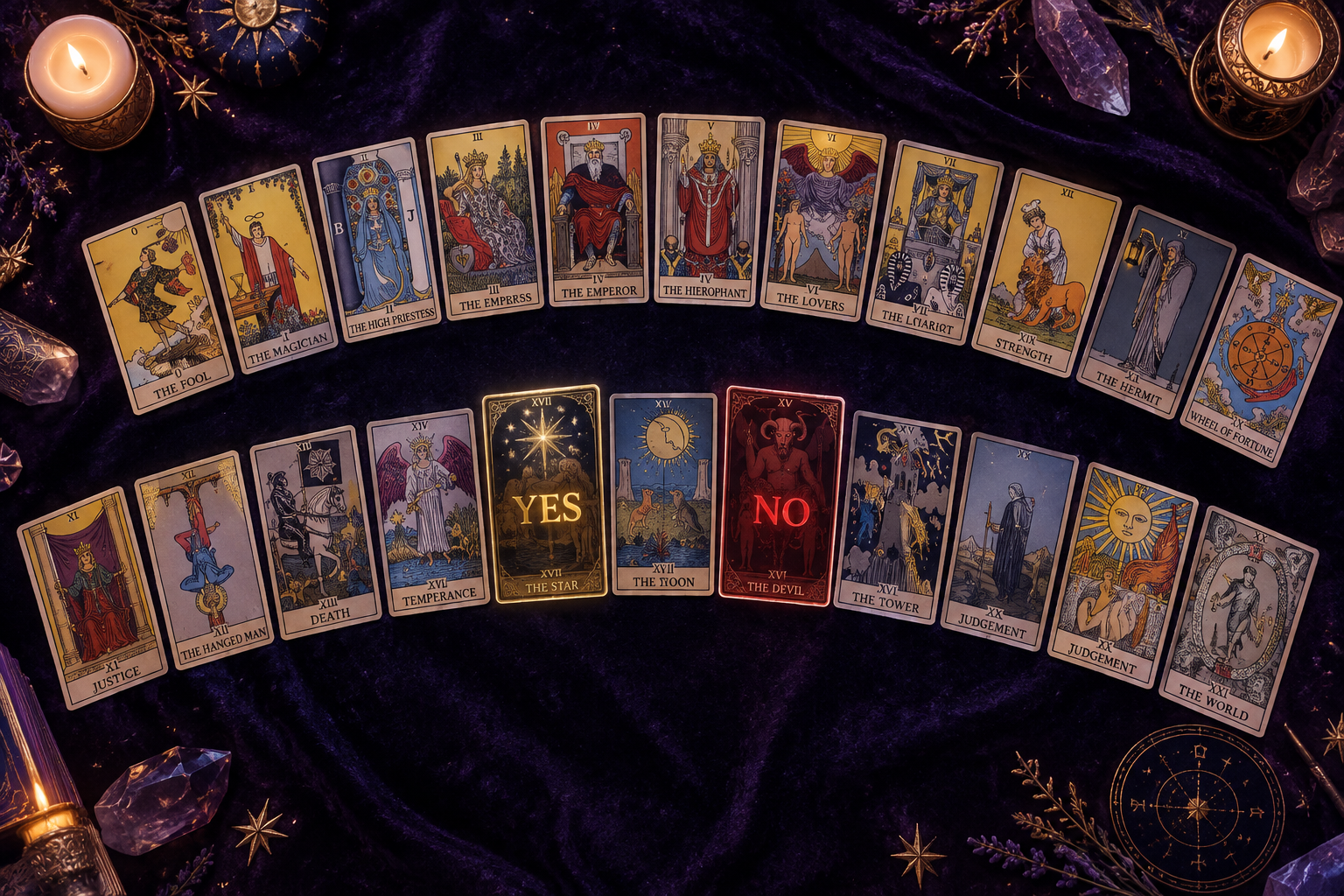
Clear yes: The Sun, The Star, The World, Wheel of Fortune, The Magician, Ace of Cups, Three of Cups, Nine of Cups, Ten of Cups, Ten of Pentacles, Six of Wands.
Clear no: The Tower, The Devil, Death, Three of Swords, Nine of Swords, Ten of Swords, Five of Pentacles, Five of Cups, Ten of Wands.
Maybe or not yet: The Hanged Man, The Moon, The High Priestess, Two of Swords, Seven of Cups, Four of Cups, Two of Pentacles.
Court cards are the awkward ones. Many readers treat them as neutral and let the other cards decide, since a Queen of Wands describes a person rather than an outcome.
FAQ
How many times can I ask the same yes or no question?
Once per night. Repeat pulls on the same question almost always produce a worse reading, because you are no longer asking, you are negotiating.
Should reversed cards always mean no?
Only if you decided that before shuffling. Plenty of readers never use reversals and judge the card’s energy instead. Either approach works as long as you pick one and stick to it.
Can I do a yes or no tarot spread for someone else?
Yes, but have them phrase the question themselves and keep it specific. Vague questions about another person’s feelings tend to come back as “maybe” cards.
What if I get a Court card as my only answer?
Pull one clarifier card beneath it. The Court card tells you who is involved; the clarifier gives you the yes or no.