
Ace Of Swords As A Person (Upright & Reversed) Tarot Card Meaning
Written by a professional tarot reader and teacher | Last updated: January 2026
The Ace of Swords as a person is the human embodiment of clarity. This is someone who values truth above comfort, thinks in straight lines, and speaks in sentences that land. When the card is upright, you are looking at an honest, decisive, intellectually sharp individual who cuts through confusion the way the sword on the card cuts through cloud. When it is reversed, that same sharpness turns inward or goes dull, and you meet someone foggy, indecisive, defensive, or quietly dishonest with themselves.
This guide walks through the full personality profile of the Ace of Swords as a person, both upright and reversed, including how they think, how they love, how they work, and how to recognise this archetype when it shows up in your life or your spread.
The Card Imagery: Where the Personality Comes From
Before reading anyone as the Ace of Swords, it helps to understand what the card actually shows, because every trait in the personality profile traces back to a symbol on the card.
- The hand emerging from a cloud. In the Rider-Waite-Smith deck, a hand appears from a grey cloud holding a single sword. The hand represents a gift from a higher source, a flash of insight or realisation that seems to arrive out of nowhere. As a person, this is someone whose ideas feel sudden, clean, and almost inevitable once spoken aloud.
- The upright sword. The blade points straight up, double-edged and unbending. It stands for mental force, truth, and the power to divide what is true from what is false. It is also a reminder that truth cuts both ways; the same blade that liberates can wound.
- The crown. Encircling the tip of the sword is a golden crown, symbolising victory, authority, and the triumph of the mind. This person tends to lead through intellect rather than charm or force.
- The laurel and the palm. Hanging from the crown are a laurel branch (victory, achievement) and a palm frond (peace, spiritual triumph). Together they suggest that success here is not just winning an argument but arriving at a higher understanding.
- The barren mountains. Below, jagged grey peaks stretch into the distance. The landscape is cold and stark, a reminder that pure logic without warmth can be a lonely place, and that the path of truth is rarely soft.
Hold these images in mind as you read the personality sections. The Ace of Swords person is the sword: clear, powerful, useful, and occasionally dangerous.
The Air Element and the Suit of Swords
Swords belong to the element of Air, which governs the mind, communication, ideas, and judgement. Air people process life through thinking first and feeling second. They ask “does this make sense?” before they ask “how does this feel?”
The Ace is the purest, most concentrated expression of its suit. Where the Two of Swords hesitates and the Three of Swords grieves, the Ace has not yet been complicated by doubt or heartbreak. It is raw mental potential: the idea before the argument, the insight before the consequences.
So the Ace of Swords person is Air in its most direct form. They are quick, verbal, curious, and analytical. They value information, they trust logic, and they get restless around vagueness or emotional manipulation. Their gift is seeing clearly. Their challenge is remembering that other people do not always want to be seen quite so clearly.
Ace of Swords Upright as a Person
Core Personality Traits
Upright, the Ace of Swords describes someone with a deep commitment to truth, integrity, and honesty. They are known for their problem-solving ability, their assertiveness, and a grounded practicality that keeps their big ideas tethered to reality. When they say something, they mean it. When they commit to something, they follow through.
Key traits include:
- Honest to the bone. They would rather deliver an uncomfortable truth than a comfortable lie, and they expect the same in return.
- Decisive. Once they have the facts, they act. They do not agonise, circle, or wait for permission.
- Justice-oriented. Fairness matters enormously to them. They notice double standards and will name them.
- Independent thinkers. They form their own opinions from evidence rather than inheriting them from a group.
- Fresh-start energy. As an Ace, they are drawn to beginnings: new projects, new ideas, new ways of framing an old problem.
Intellectual and Communication Style
This is where the Ace of Swords person truly shines. Their mind works with unusual precision. They notice the flaw in an argument almost instantly, they remember details others miss, and they can distil a complicated situation into one clear sentence.
Their communication is direct and economical. They do not pad their speech with hedges or flattery. They ask pointed questions, they listen for the actual answer, and they are not embarrassed to say “I don’t know” or “you’re right, I was wrong.” In conversation they are stimulating, sometimes challenging, and rarely boring.
They are also natural breakthrough thinkers. The hand from the cloud is a literal picture of the “aha” moment, and these people have a lot of them. They tend to be the person in the room who reframes the problem in a way that suddenly makes the solution obvious.
Emotional Characteristics
Emotionally, the upright Ace of Swords person prioritises honesty and, importantly, values upholding the truth over being right. They understand that admitting mistakes and apologising when presented with evidence is a sign of strength, not weakness, and they believe genuinely in personal growth through learning from error.
Their inner life is often marked by a kind of spiritual ascension: a drive to transcend the ego, understand themselves without flattery, and see the world as it really is. They are not afraid to confront their own flaws. This self-awareness allows them to build authentic relationships grounded in openness and transparency, and their emotional integrity tends to inspire the same in the people around them.
That said, they can struggle to express feelings even when they understand them. They may intellectualise emotion, explaining what they feel rather than showing it, and they can be uncomfortable with other people’s messier emotional states.
The Shadow Side: When Truth Becomes a Weapon
Even upright, the sword is double-edged. The shadow of the Ace of Swords person shows up when their gift for clarity outruns their compassion.
- Cutting honesty. “I’m just being honest” can become a licence to be cruel. They may deliver truths with no regard for timing, tone, or whether the other person asked.
- Being right over being kind. In an argument they can prioritise winning the logical point over preserving the relationship.
- Coldness. The barren mountains on the card are a warning. Pure logic, unwarmed by empathy, can leave people feeling judged or dismissed.
- Impatience with feelings. They may treat emotional responses as irrational noise rather than valid information.
- Black-and-white thinking. Because they see clearly, they can forget that some situations genuinely are grey.
A mature Ace of Swords person learns that a sword is a tool, not a personality. Used well, it frees people from confusion. Used carelessly, it just leaves cuts.
Career and Professional Life
Upright, this person thrives in any field where truth-seeking, analysis, and clear communication are rewarded. Think of:
- Law (litigation, advocacy, judicial roles)
- Journalism and investigative reporting
- Academia and research
- Science, data, and engineering
- Debate, policy, and public speaking
- Editing, strategy, and consulting
Their work style is focused and efficient. They dislike meetings that go nowhere and processes that exist for their own sake. As leaders they are fair, transparent, and demanding; they set clear expectations, give direct feedback, and respect people who push back with good arguments. Colleagues either love their clarity or find it intimidating, and there is rarely a middle ground.
They are especially valuable at the start of projects, when a problem needs to be defined properly before anyone starts solving it.
Love and Relationships
As a partner, the upright Ace of Swords person is honest, loyal, and reliable. They create a strong foundation of trust because they simply do not play games. If they say they will call, they call. If something is wrong, they tell you. There is enormous safety in that.
They communicate directly in love. They will state what they want, ask what you want, and expect a straight answer. They are attracted to intelligence, independence, and people who can hold their own in a conversation. Emotional manipulation, passive-aggression, or guessing games will lose them fast.
What they need from a partner is intellectual respect, honesty, and some patience around emotional expression. They may show love through problem-solving and practical support rather than grand romantic gestures. If you want them to be softer, tell them plainly; they will genuinely try, because they take feedback seriously.
Ace of Swords Reversed as a Person
Core Personality Traits
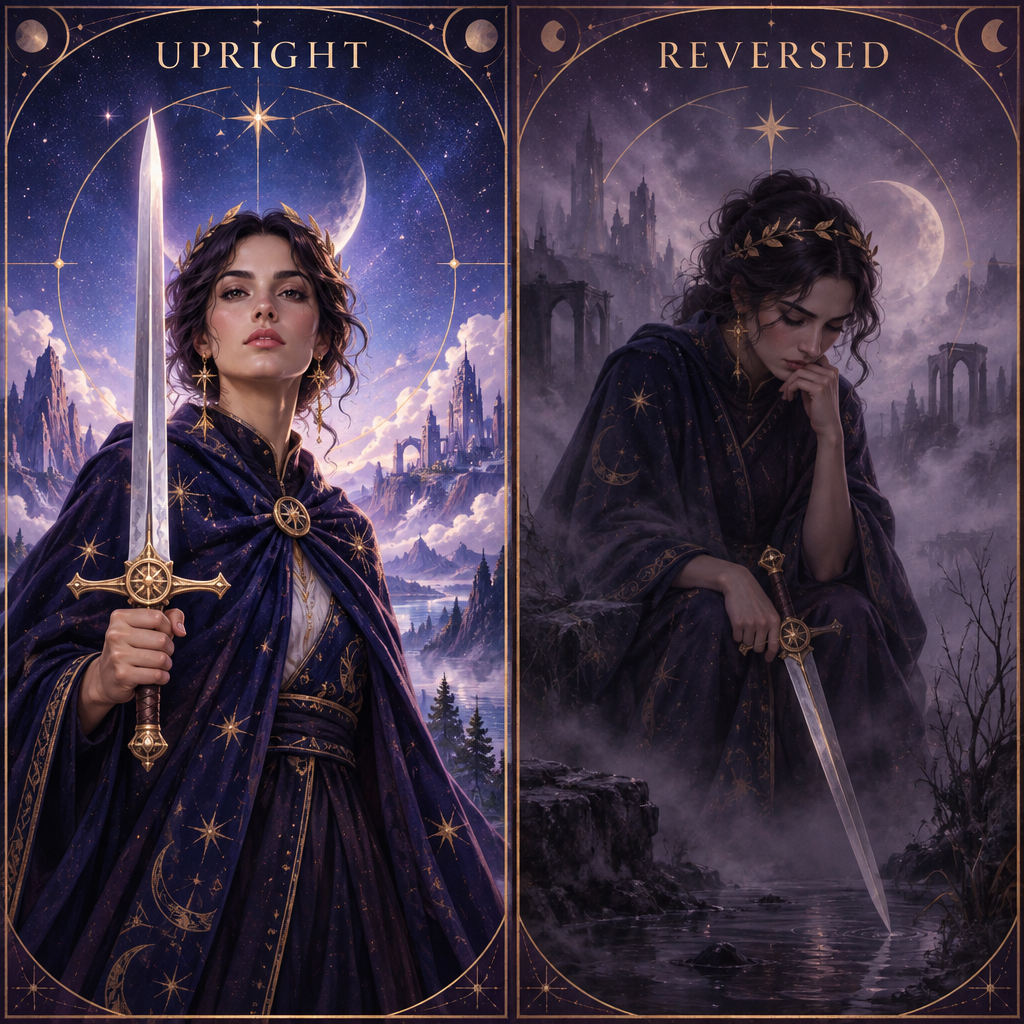
Reversed, the sword no longer points toward the crown of clarity. It points down into the fog. The Ace of Swords reversed as a person describes someone whose mental gifts are blocked, misdirected, or turned against themselves.
This person often struggles with:
- Mental fog and confusion. They cannot think straight, cannot decide, cannot find the clean answer that once came so easily.
- Indecision. They gather information endlessly but never act on it, or they change their mind so often that no one can rely on them.
- Poor communication. Words come out wrong, muddled, or not at all. They may say one thing and mean another, or avoid difficult conversations entirely.
- Self-doubt. They second-guess their own perceptions and defer to others even when their instincts are correct.
- Rigid or overcritical thinking. Alternatively, the reversal can show up as too much sharpness: harsh, narrow, judgemental thought patterns that leave no room for nuance.
- Conflict avoidance. Rather than cutting through a problem, they tiptoe around it, letting resentment build.
- Deception, including self-deception. This is the most serious expression. The reversed Ace of Swords person may lie to protect themselves, twist facts, or, more commonly, refuse to see a truth about their own life that everyone else can see.
Emotional and Mental Characteristics
Where the upright person admits mistakes readily, the reversed person becomes defensive when challenged. Where the upright person seeks truth, the reversed person seeks reassurance. They may cling to a comforting story about a relationship, a job, or their own behaviour long after the evidence has turned against it.
Emotionally they can feel stuck, anxious, or intellectually exhausted. Their inner monologue may be loud and unkind. They often know, somewhere, that they are not seeing clearly, and that awareness produces a low hum of unease.
It is worth noting that the reversed Ace of Swords is not always a bad person. Frequently it is a good mind going through a bad season: burnout, grief, information overload, or a situation so tangled that clarity simply is not available yet.
Career Implications
Professionally, the reversed Ace of Swords person tends to procrastinate. Ideas do not get started, or they get started and abandoned. They may struggle to articulate their thinking in meetings, miss obvious solutions, or make impulsive decisions that later need unpicking.
In teams they can be difficult: either withdrawn and non-committal, or overly critical of others’ work while contributing little of their own. Communication breakdowns follow them around. Projects stall because no one is quite sure what this person actually wants or thinks.
If this is you, the remedy is usually rest and simplification rather than more effort. The sword needs to be picked up again, but you cannot pick it up while carrying everything else.
Love and Relationships
As a partner, the reversed Ace of Swords person is guarded. They keep their real thoughts hidden, struggle to trust, and may withdraw into emotional detachment when things get difficult. Conversations that should be simple become confusing; you leave them less certain than when you started.
Trust issues are common in both directions. They may suspect you of dishonesty while being less than honest themselves, or they may cling to an illusion about the relationship (that it is fine, that it is doomed, that you will change) rather than looking at what is actually happening.
If you are in a relationship with someone showing reversed Ace of Swords energy, ask for clarity directly, and notice whether you get it. Someone in a temporary fog will try to answer. Someone committed to the fog will deflect.
Ace of Swords as How Someone Sees You
When this card appears in a “how do they see me” position, the meaning shifts slightly.
Upright: They see you as intelligent, honest, and refreshingly clear. You may be the person who helped them see a situation properly, or the one they trust to tell them the truth. They might also find you a little intimidating or blunt, but they respect you.
Reversed: They may see you as confusing, evasive, or hard to read. Alternatively, they might perceive you as harsh, judgemental, or “too much.” In some cases, the reversal reflects their fog rather than your behaviour: they cannot see you clearly because they are not seeing anything clearly right now.
Reading the Ace of Swords as a Person in a Spread
When it represents someone else: Look at the surrounding cards. Paired with Cups, it may describe a logical person entering an emotional situation, for better or worse. Paired with the Tower, it can be someone who delivers a truth that changes everything. Paired with the Seven of Swords reversed, be cautious; clarity may be about to expose a deception.
When it represents you: Upright, it is a call to trust your own mind, speak plainly, and start the thing you have been circling. Reversed, it asks you to admit where you are confused, stop pretending you have decided, and clear the mental clutter before acting.
Timing note: Aces are beginnings. This person is often someone new in the querent’s life, or someone stepping into a new role in it.
How the Ace Compares to Other Swords Court and Pip Cards
- Ace vs. Two of Swords: The Ace decides; the Two is blindfolded and stuck between options. If someone feels like an Ace who has lost their nerve, they may be living in Two of Swords territory.
- Ace vs. King of Swords: The King is the Ace’s mind after decades of practice: authoritative, structured, institutional. The Ace is rawer, faster, and more idealistic. The Ace has the idea; the King builds the system around it.
- Ace vs. Knight of Swords: The Knight charges in with the sword; the Ace simply holds it. The Knight is action without pause, while the Ace is insight that has not yet chosen how to act.
- Ace vs. Queen of Swords: The Queen has learned to combine clarity with lived experience and a measure of compassion. She is what the Ace’s shadow side grows into once it has been humbled a few times.
Astrological and Numerological Correspondences
Astrology: The suit of Swords corresponds to the Air signs, Gemini, Libra, and Aquarius. The Ace of Swords person often shows Gemini’s quick verbal intelligence, Libra’s hunger for fairness and justice, and Aquarius’s independent, truth-telling streak. If you know someone with a strong Air chart (especially Mercury or the Ascendant in an Air sign), the Ace of Swords archetype will probably fit. Some traditions also link the Ace to the crisp mental energy of a new season, when Air first breaks through winter.
Numerology: The Ace carries the number 1: beginnings, initiative, independence, and singular focus. This person is a starter, a pioneer, and often a bit of a loner in their thinking. They do best when they have something new to sink their mind into.
Ace of Swords Yes or No
Upright: Yes. The Ace of Swords is a clear, decisive card. It favours action, honesty, and moving forward with a plan. If the question concerns communication, decisions, contracts, or getting to the truth, the answer is a confident yes.
Reversed: No, or not yet. Reversed, the card signals confusion, poor timing, or missing information. Do not commit until you can see the situation clearly.
Affirmations and Journal Prompts
Affirmations (upright energy):
– I speak the truth with clarity and kindness.
– My mind is sharp, and I trust my own judgement.
– I choose the truth, even when comfort would be easier.
Journal prompts:
1. Where in my life am I refusing to see something clearly, and what would change if I looked?
2. When was the last time I chose being right over being kind? What did it cost?
3. What new idea or decision has been waiting for me to pick up the sword?
Shadow-work question: Is my honesty serving the other person, or is it serving my need to feel superior?
Frequently Asked Questions
What zodiac sign is the Ace of Swords as a person?
The Ace of Swords is linked to the Air signs: Gemini, Libra, and Aquarius. It is not assigned to a single sign the way court cards sometimes are, but people with strong Air placements often embody this archetype.
Is the Ace of Swords a yes or no card?
Upright, yes. Reversed, no or not yet. It is one of the clearer yes/no cards in the deck.
How do I recognise an Ace of Swords person in real life?
Look for someone who speaks directly, thinks quickly, values fairness, and is unusually willing to admit when they are wrong. They tend to reframe problems in ways that make solutions obvious, and they get visibly frustrated by vagueness or dishonesty.
Is the Ace of Swords as a person a good sign in a love reading?
Upright, it points to an honest, communicative, loyal partner, though possibly one who is more logical than romantic. Reversed, it warns of guardedness, mixed messages, or someone who is not being straight with you or with themselves.
Can the Ace of Swords represent a woman or a man?
Either. Pip cards like the Ace are not gendered. The archetype describes a way of thinking and communicating, not a physical type.
What is the difference between the Ace of Swords upright and reversed as a person, at a glance?
Upright: clear, honest, decisive, sharp, occasionally blunt. Reversed: confused, indecisive, guarded, defensive, occasionally deceptive.
Final Thoughts
The Ace of Swords as a person is someone who carries the gift of clarity and the responsibility that comes with it. Upright, they are the friend, partner, or colleague who tells you the truth and helps you see your own situation properly. Reversed, they are lost in the fog themselves, and the kindest thing you can do is ask for clarity plainly and see what comes back.
If this card describes you, remember what the imagery teaches: the sword is crowned with victory and wrapped in the palm of peace. Clarity is at its most powerful when it is also compassionate.