
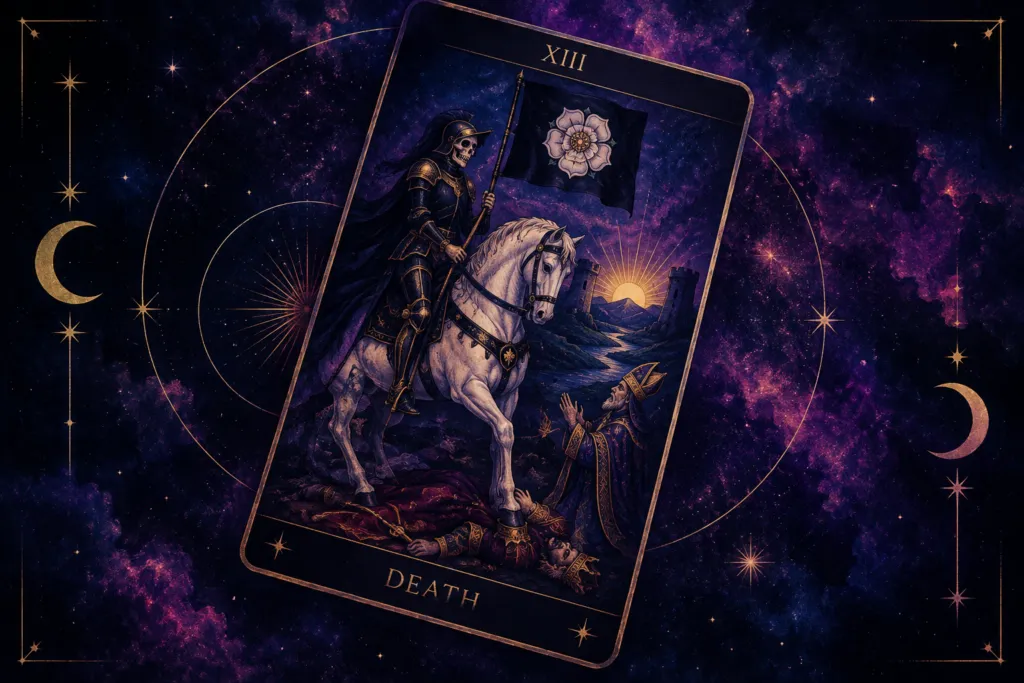
Pulling the Death card in the obstacle or challenge position of a spread tells you the block in your situation is an ending you are resisting, or one you have not finished yet. This guide reads Death (XIII) specifically in that position, upright and reversed, across love, career, money and health, with concrete steps for what to do next.
What the Obstacle Position Actually Asks
Most spreads reserve one slot for the thing standing in your way. In the Celtic Cross it is the second card, laid sideways across the first, traditionally called “what crosses you.” In a three-card situation, challenge, advice layout it is the middle card. In a Past, Present, Obstacle, Outcome spread it sits third. Whatever the layout, the question the position answers is the same: what is making this hard?
A card here is never a prediction of doom. It is a diagnosis. The obstacle card names the pressure point, and the rest of the spread tells you what to do about it.
Death in this slot is unusually direct. The obstacle is not an enemy, a rival or bad luck. The obstacle is a transition. Either something in your life has already ended and you are still living as if it has not, or something needs to end and you keep postponing the funeral. Nine times out of ten, the “challenge” Death describes is your own grip on the old version of things.
One practical note for Celtic Cross readers: because the crossing card lies horizontally, many readers do not read it as reversed at all. If you do read reversals in that position, the distinction below matters a great deal. If you do not, treat the card as upright.
The Card Itself: Number, Element, Keywords
| Attribute | Detail |
|---|---|
| Number | XIII (13) |
| Arcana | Major |
| Element | Water |
| Zodiac | Scorpio |
| Upright keywords | Ending, transition, release, closure, necessary loss |
| Reversed keywords | Stagnation, resistance, decay, unfinished grief, fear of change |
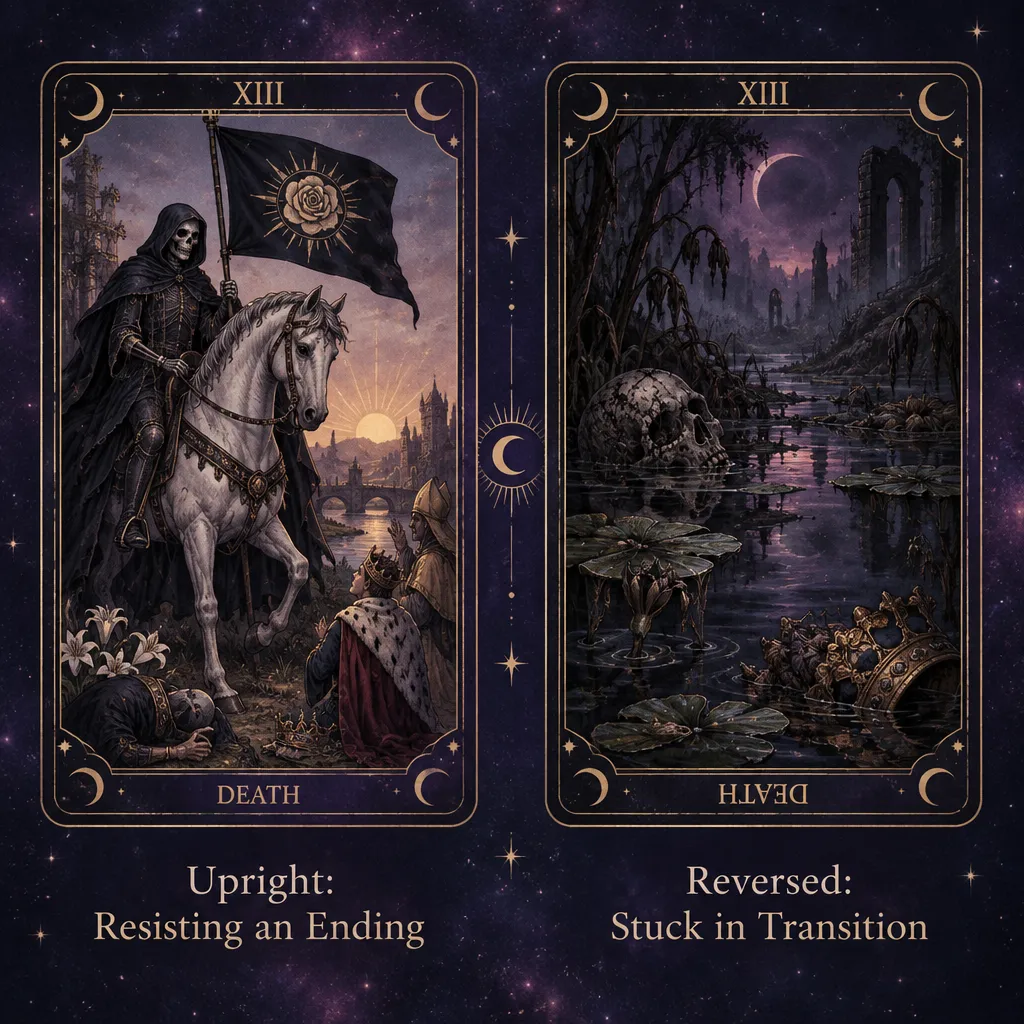
| As an obstacle (upright) | You are resisting an ending that is already happening |
| As an obstacle (reversed) | You are stuck in an ending that refuses to complete |
The Water and Scorpio associations matter for the obstacle reading. Scorpio governs the parts of life we would rather not look at directly: sex, death, debt, inheritance, power, the things that rot when ignored. Water adds the emotional depth. So when Death crosses you, the block is rarely logistical. It is emotional attachment dressed up as a practical problem.
Rider-Waite-Smith Imagery and What It Says About Your Block
The image most readers know comes from the deck illustrated by Pamela Colman Smith under A.E. Waite’s direction, published by William Rider & Son in 1909. Every element of that picture can be read as a comment on the obstacle position.
The armoured skeleton on the pale horse. Death wears black armour and rides slowly. It is not charging. This is the nature of the challenge: the ending is not sudden, and it is not negotiable. Armour means you cannot argue with it, bribe it or wait it out. The horse is white, the colour of purity, which tells you the ending is clean even if it does not feel that way.
The fallen king. A crowned figure lies dead beneath the horse’s hooves, crown rolling away. In the obstacle position this is the part of you, or the arrangement in your life, that held authority and no longer does. A title, a role, a relationship status, a version of yourself that used to run things. The king is already down. Your obstacle is that you are still saluting him.
The bishop. A figure in papal robes stands and pleads, facing Death head-on. This is bargaining. Prayer, negotiation, one more chance, one more year. When Death is your challenge, notice how much energy you are spending on appeals that will not be granted.
The woman turning away and the child with flowers. The woman kneels and looks aside; she cannot face it. The child looks straight at Death and offers a small bouquet. Two responses to the same event. The obstacle card asks which one you are.
The black banner with the white rose. Death carries a flag showing a five-petalled white rose on black. Waite linked it to the Mystic Rose, a symbol of life. The message for the obstacle position: what looks like a loss is carrying something alive inside it. You will not see that while you are looking away.
The rising sun between two towers. In the far background, a sun sits between two pillars, mirroring the towers of the Moon card. Day is coming, but you have to travel through the whole scene to reach it. The obstacle is the distance between where you stand and that horizon, and the only road runs past the horse.
The river and the boat. A small vessel crosses water on the right, an echo of the ferry across the Styx. Transition requires movement. Standing still on the bank is the obstacle.
Death Almost Never Means Physical Death
Say this plainly, because anxious readers need to hear it: Death in the obstacle position is not a prediction that someone will die. Tarot does not work that way, and no responsible reader treats card XIII as a medical or mortality forecast. In decades of published tarot instruction, from Waite onward, the card has been read as ending, transformation and transition. If you pulled this card while worried about someone’s health, read the health section below, then book the actual appointment.
Upright Death as Obstacle: The Core Meaning
Upright Death in the challenge position means something has run its course and you are still trying to keep it running. The ending is correct. Your resistance to it is the problem.
Think of a lease that has expired. The landlord is not renewing. You can keep your furniture there for a while, keep the key, keep telling people it is your address, but every day you stay you are squatting in a life that has legally ended. Upright Death as an obstacle is the eviction notice you have been treating as junk mail.
The tell that you are dealing with upright Death rather than reversed: the ending is visible. You know what it is. You could name it in one sentence if pressed. You just do not want to.
Love: Upright Death as Obstacle
In a new relationship. The block is usually a previous ending you have not completed. You are dating someone new while still emotionally under contract to an ex, a former dynamic, or an old idea of what partnership should look like. The new person cannot compete with a ghost. Alternatively, the new connection itself has already shown you its shape and you are pretending you did not see it. Two months in, the pattern is clear. Death crossing you says: stop auditioning for a role that was cast before you arrived.
In an existing relationship. The relationship as it currently operates has ended, even if the two of you have not. A phase is over: the honeymoon dynamic, the roles you fell into, the way you handled money or family or sex. The obstacle is your joint refusal to renegotiate. Couples who pull this card and survive it usually do so by naming what has died out loud. “We are not the same people who moved in together.” That sentence is the horse walking through the room. Couples who pull it and separate are usually those who chose to bargain like the bishop instead.
When asking about a potential relationship. Someone you want is not available in the way you need, and you know it. The obstacle is the fantasy version of them you have built. Let that version die and you will see clearly whether anything real remains.
Career: Upright Death as Obstacle
Three scenarios show up constantly with this card.
A job that is ending whether you like it or not. Redundancy rumours, a restructure, a contract not being renewed, a manager who has quietly stopped investing in you. You have read the signs and decided not to update your CV. The challenge is that every week of denial costs you runway.
An industry or skill set that is contracting. You built a career on something the market is walking away from. The obstacle is not the market. It is your loyalty to an identity (“I am a print designer,” “I am a bookkeeper who does it by hand”) that the fallen king represents.
A role you have outgrown. Nothing is wrong on paper. Good pay, tolerable colleagues, no drama. And you have been dead inside for eighteen months. Upright Death as an obstacle in this scenario is the most frustrating version because there is no external villain to blame. The block is your own refusal to admit that comfortable and finished are the same thing here.
Finances: Upright Death as Obstacle
Money readings with Death crossing you point to a financial arrangement that needs to end and has not. Common forms:
- A business or side project that has been losing money for over a year and is kept alive by pride and sunk-cost logic.
- A subscription lifestyle you can no longer afford after a change in income, maintained on credit.
- A property, car or asset you keep because of what it used to mean, not what it does now.
- A financial entanglement with a partner, parent or friend that stopped being fair long ago.
The obstacle is rarely the loss itself. Usually the loss has already happened on the balance sheet. The obstacle is your refusal to book it. Actionable version: pull up the actual numbers this week. Death likes daylight.
Health and Wellbeing: Upright Death as Obstacle
Here the card points to a habit, routine or self-image with an expiry date that has passed. The body has already changed and you are still treating it as if it has not. Training like you are 25 at 45. Eating and drinking like your metabolism is a rumour. Ignoring a symptom because acknowledging it would end the story that you are fine.
It can also flag the end of a treatment approach that has stopped working, or the end of a caregiving arrangement that is quietly destroying the carer. The block is attachment to the old regime. Death as your health obstacle is a prompt to let the old routine die formally, with a decision, rather than letting it collapse through neglect.
Reversed Death as Obstacle: A Different Problem
General reversed Death is usually read as resistance to change or stagnation. In the obstacle position, be more precise. Reversed Death as a challenge means an ending has stalled halfway. The old thing is dead but not buried. You are not refusing a clear ending as with the upright card; you are trapped inside an incomplete one.
The lease metaphor shifts. Upright, you refuse to leave the flat. Reversed, you moved out months ago but never returned the keys, never forwarded the mail, never cancelled the utilities, and half your boxes are still in the hallway. Neither address is home. That limbo is the obstacle.
Waite’s reversed keywords for this card are worth quoting because they describe the state exactly: inertia, sleep, lethargy, petrifaction, somnambulism. Sleepwalking. Turning to stone. The reversed obstacle is not fear of the future. It is the inability to finish grieving the past so that a future can start.
Love: Reversed Death as Obstacle
New relationship. You are technically single and technically dating, but the old relationship never got its ending. No closure conversation, no returned belongings, still checking their profile. The new person is dating a person who is half elsewhere. The obstacle is unfinished grief, and no amount of enthusiasm for the new connection will substitute for finishing it.
Existing relationship. The two of you have been “working on things” for so long that working on things has become the relationship. Nobody has left. Nobody is present either. Reversed Death crossing an established couple often describes a slow decay where both people know it is over and neither will say it, because saying it makes it real. Sometimes the kindest outcome this card points toward is a clean break. Sometimes it is a genuine reset. Either one requires someone to speak first.
Potential relationship. You cannot start because you are petrified, in the literal sense of the word: turned to stone by a previous loss. The block is not the other person’s availability. It is that a part of you decided never to be vulnerable again and has not been told the emergency is over.
Career: Reversed Death as Obstacle
You have left a job in spirit but not in fact. Or you left in fact and are still furious about it a year later, unable to interview without the bitterness leaking through. Or you announced a career change to everyone you know and have taken no step toward it in six months. The reversed obstacle in career questions is the announced-but-unexecuted ending. Half-quit, half-pivoted, fully stuck.
It can also point to a business that should have closed and is being kept in a zombie state, trading just enough to avoid the paperwork of shutting down.
Finances: Reversed Death as Obstacle
Debt you refuse to look at is the classic reversed Death money block. Unopened statements, a repayment plan you have not called about, a bankruptcy or write-off you know is coming and keep postponing. The financial death has happened; you are refusing to file the certificate. Reversed Death can also show an inheritance, settlement or payout stuck in legal limbo, and the emotional paralysis that comes from living around it.
The practical instruction is the same as upright but more urgent: complete the ending. Open the letters. Make the call. Close the account.
Health and Wellbeing: Reversed Death as Obstacle
Grief that has calcified. A loss, a diagnosis, a body change that happened years ago and was never processed, now showing up as exhaustion, low motivation or a flat depression that does not lift. The obstacle to your wellbeing is not a new problem. It is an old one that was never allowed to finish. Reversed Death here strongly favours talking to someone qualified, because the block is stored below the level where willpower reaches.
When the Obstacle Is Refusing to Accept What Already Ended
This deserves its own moment because it is the hinge of the whole card. Very often, Death in the challenge position is not warning you about an ending that is coming. It is informing you of one that has already occurred.
The relationship ended when the trust broke, not when someone moved out. The job ended when you stopped caring, not when you resign. The business ended when the numbers turned, not when the accountant says so. The obstacle, in each case, is the gap between the real ending and the official one. Close the gap and the card’s energy stops working against you.
Death Versus Similar Cards in the Obstacle Position
Readers often confuse Death with two neighbours. The differences matter for how you act.
The Tower as obstacle describes a sudden, external collapse: a structure you trusted failing without warning. Death is slower, more internal, and largely about your own attachment. Tower says “this will be knocked down.” Death says “this has finished; walk away from it.”
The Hanged Man as obstacle describes suspension, waiting, a necessary pause where nothing can move yet. It shares stuckness with reversed Death, but the Hanged Man’s pause is productive and temporary. Reversed Death’s stall is decay. If you are unsure which one describes you, ask whether the waiting is teaching you anything. If yes, Hanged Man. If it is just rotting, Death reversed.
Judgement as obstacle deals with reckoning and being called to account. Death has no verdict in it. Nobody is judging; something is simply over.
What to Do Now: Six Steps
- Name the ending in one sentence. Write it down. “My marriage as it was is over.” “This job is finished for me.” If you cannot write it, that is the obstacle, and you should sit with step one until you can.
- Identify which figure you are. Bishop bargaining, woman looking away, or child facing it with flowers. Be honest. Most people pulling this card are the bishop.
- Schedule the funeral. Endings need a formal act: the conversation, the resignation letter, the closed account, the packed box. Put a date on the calendar within fourteen days.
- Separate grief from decision. You can be sad about an ending and still execute it. Waiting until you feel fine about it is the reversed card in action.
- Take one irreversible step. Not a plan, not a list. Something you cannot undo: send the message, hand in notice, delete the account. Death rides slowly but it does not turn around.
- Read the rest of the spread. The obstacle card only tells you what is in the way. The advice and outcome positions tell you how it resolves. Death as a challenge followed by a strong outcome card is one of the more encouraging combinations in the deck.
Shadow Work and Journal Prompts
Death as an obstacle exposes avoidance patterns. Use these prompts over a week, one per day, writing by hand for at least ten minutes.
- What have I already lost that I am still pretending to have?
- Who benefits from me not ending this? Who would be upset if I did, and am I protecting them or myself?
- Which identity would I have to give up if this ended? What is the crown I am afraid to see roll away?
- What did I learn from the last major ending in my life, and what am I doing differently this time? What am I doing identically?
- If a friend described my situation to me, what would I tell them to do?
- What is the very first thing I would do the morning after this was truly over?
Affirmations, if you use them, should be specific rather than soothing. “I am allowed to finish things” works better than “I embrace change.” “The ending has already happened and I can stop fighting it” is closer to the card’s actual message than anything about transformation.
FAQ
Does Death in the obstacle position mean someone will die?
No. Death as a tarot card describes endings, transitions and release, not physical mortality. In the obstacle or challenge position it specifically points to an ending you are resisting or one that has stalled. If you have a genuine health worry about yourself or someone else, that belongs with a doctor, not a deck.
Is Death a bad card in tarot?
It is an uncomfortable card, not a bad one. In the obstacle position it is arguably useful, because it names the problem with unusual clarity: something is over and you have not accepted it. Cards that describe vague or hidden blocks are harder to act on. Death tells you exactly where to look.
Is Death worse upright or reversed as an obstacle?
Reversed is harder to work with. Upright Death crossing you means a clear ending you are resisting; the path forward is obvious even if it hurts. Reversed Death means an ending that has stalled, often with unfinished grief underneath, and those blocks tend to be older, less visible and more resistant to willpower alone. Upright asks for courage. Reversed usually asks for support as well.
What does Death mean in the challenge position of the Celtic Cross?
As the second card, laid across the first, Death says the central factor working against your situation is an unresolved or resisted ending. Read it alongside the first card to identify what exactly has finished. Because the crossing card lies sideways, many readers treat it as upright regardless of orientation. If you do read reversals there, apply the reversed obstacle meaning above.
What if Death appears as the obstacle but I don’t want anything to end?
Then the card is doing its job. The obstacle is precisely that you do not want it to end, and something is ending anyway. Check the rest of the spread for what the ending makes room for. The white rose on the banner is there for a reason.
Add Yes No Tarot as a preferred source on Google, and the sites you pick are more likely to appear in your Top Stories.