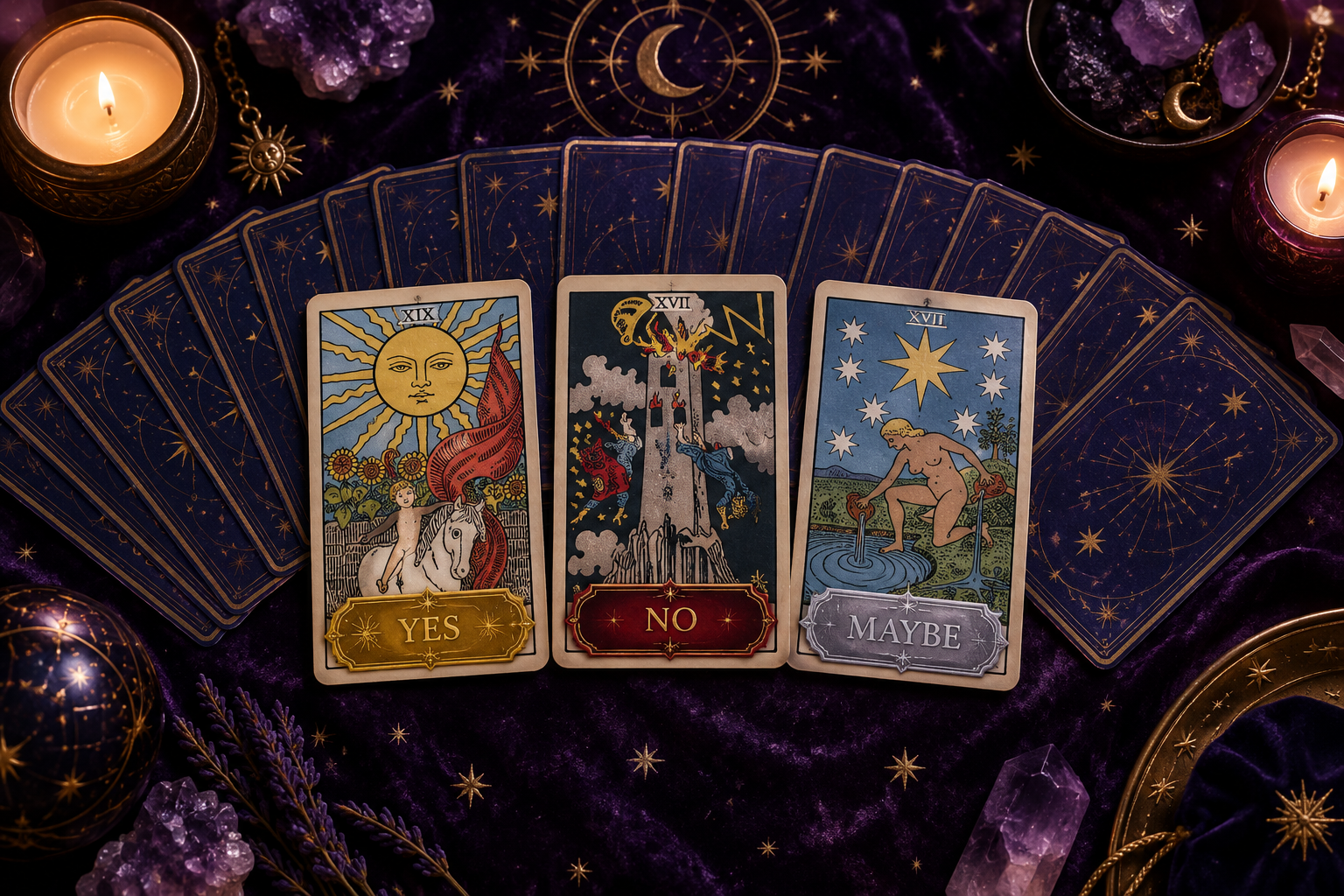
Draw the Death card on a yes or no question and you rarely get a clean verdict. Upright, it says yes to the transformation and no to things staying as they are. Reversed, it says not yet, because something you are holding onto has to end before the door opens.
Quick Answer
| Verdict | |
|---|---|
| Death upright | Maybe / conditional yes. Yes to change, endings and rebirth. No if the question is "will things continue as they are?" |
| Death reversed | No, or not yet. Resistance, stagnation, an ending being refused. The answer shifts once you let go. |
| Card number | XIII (13), Major Arcana |
| Element | Water |
| Zodiac | Scorpio |
| Keywords upright | Transformation, endings, release, transition, inevitability |
| Keywords reversed | Resistance, delay, fear of change, stagnation, incomplete endings |
| Best clarifiers | Any Ace, The Star, Judgement, Six of Swords, or a second Major Arcana |
If you only want the headline: Death is not a yes card and not a no card. It answers the question underneath your question, which is almost always “will this end?” The answer to that is yes.
Why Upright Death Is a Maybe, Not a Flat Yes
Older beginner guides file Death under “yes” because it points to positive change. That reading skips a step. Death does not promise that you get what you asked for. It promises that the current form of the situation will not survive.
Take the three most common ways the card lands:
- “Will I get the job?” Death upright says a chapter is closing. You might get the job and leave your current role, or your current role might disappear on its own. Either way, the status quo goes. Treat it as a soft yes to movement, not a guarantee of that specific offer.
- “Will we stay together?” The relationship as it exists now will not continue. It either transforms into something new or it ends. That is a no to “unchanged” and a maybe to “together.”
- “Should I do this?” Here Death is closest to a real yes. When the question is about action, letting go, or committing to a fresh start, Death backs you.
A practical rule: if your question contains the words “keep,” “stay,” “continue,” or “remain,” read upright Death as no. If it contains “start,” “leave,” “change,” or “move on,” read it as yes. Anything else is a maybe that depends on how willing you are to release what is finishing.
Death Reversed Yes or No: Not Yet
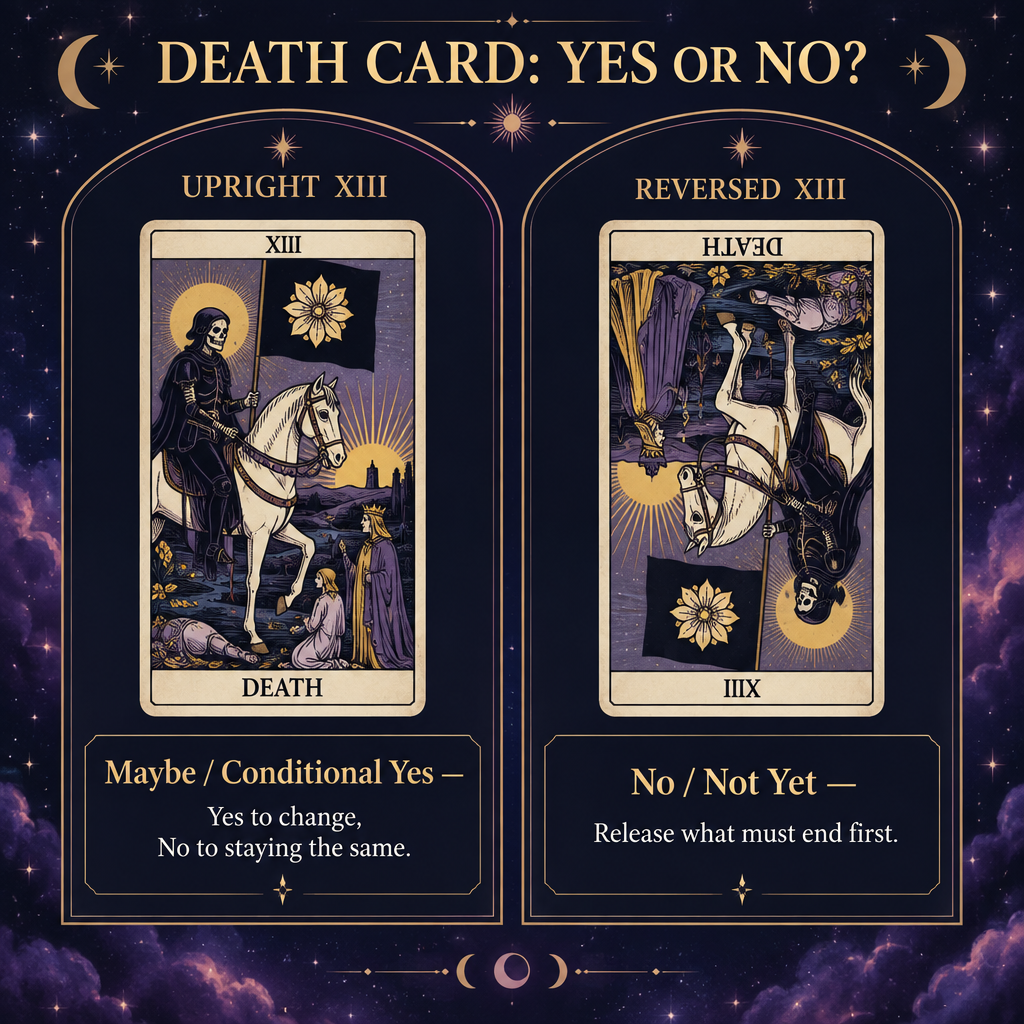
Reversed Death is the closer of the two readings to a firm no, but the more useful translation is “not yet.” The card inverted shows an ending being blocked. Someone, often the querent, is clinging to a job, a person, a habit, or a version of themselves that has already run its course.
Ask what would have to die for the answer to change. In my experience reading for clients, the reversed card almost always points to one of four things:
- A relationship that ended emotionally months ago but is still being maintained out of fear of being alone.
- A career path kept alive because of sunk costs, not because it still fits.
- A grudge or grief that has become an identity.
- A decision that has been made internally but not spoken out loud.
Until that thing is released, the reversed answer stays no. Once it is released, redraw. The card frequently flips to something forward-moving, because the block was never the outcome. It was the refusal.
Reversed Death also carries a second, quieter meaning: a narrow escape or a change avoided. If you asked “will I lose X?” and Death appears reversed, you probably keep X, at least for now. Whether that is good news depends on whether X deserves keeping.
What the Card Shows and Why It Matters for Yes or No
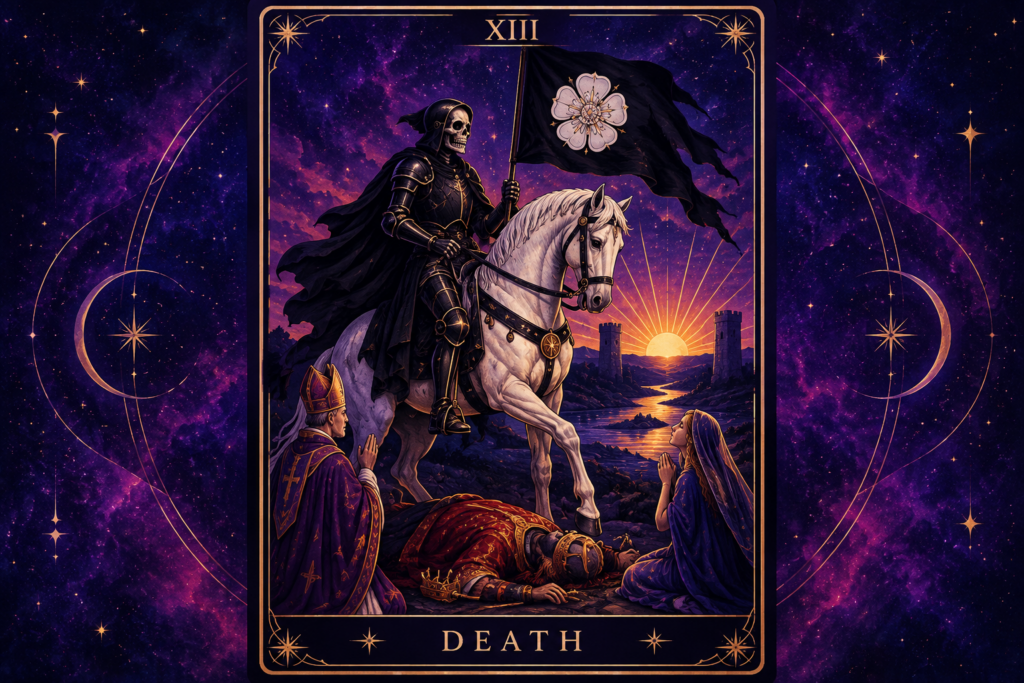
The image most people picture comes from the Rider-Waite-Smith deck, illustrated by Pamela Colman Smith and published in 1909 under Arthur Edward Waite’s direction. Every symbol on it argues against a simple yes or no.
The skeleton in black armor on a white horse. Armor means the process is unstoppable. The white horse means it is clean, not cruel. Nothing here is punishment. This is why Death rarely means catastrophe in a yes or no reading; it means inevitability.
The black flag with a white rose. The five-petaled rose is the Mystic Rose, a symbol of life and beauty carried on the banner of an ending. Read it as the promise inside the card: what grows after the ending is worth the ending. For yes or no purposes, the rose is the “yes” hidden inside the “no.”
The rising sun between two pillars. In the background, a sun sits on the horizon between two towers. Waite’s tradition reads it as rising, not setting. Whatever you are asking about, there is a next day. This is the strongest argument against reading Death as a dead end.
The fallen king. A crowned figure lies under the horse’s hooves. Power, status and control do not survive Death. If your question is about holding onto position, this figure is your answer.
The bishop with raised hands. The clergyman faces Death standing, pleading or accepting. Faith and ritual do not stop the process either, though they may soften it. Bargaining with the outcome does not work.
The kneeling woman turning away. She cannot look. She represents the reversed energy: resistance, denial, the refusal to see what is already happening.
The child with flowers. The smallest figure meets Death with curiosity and an offering. Innocence accepts change without fear. If you can approach your question like the child, the card is far more likely to work in your favor.
The boat on the river. A small vessel crosses the water behind the figures, an image drawn from the mythic river between life and afterlife. Transition is a passage, not a wall.
Put together, the picture says: this is ending, it cannot be argued with, and something is waiting on the other side. That is a maybe with a lean toward yes for anyone willing to cross.
Correspondences: Scorpio, Water, and the Number 13
Scorpio. Death is assigned to Scorpio in the Golden Dawn system that Waite worked from. Scorpio governs the hidden, the buried and the regenerating. In yes or no terms, this means the real answer is probably not on the surface. Look for what the question is avoiding.
Water. As a Water card, Death works through feeling rather than logic. You already know the answer emotionally. The card is confirming it. When Death appears on a question you have been “thinking through” for weeks, the delay was never about information.
Thirteen, reducing to four. Death is card XIII. In tarot numerology 1 + 3 = 4, which links Death to The Emperor, card IV, and to the theme of structure. The ending Death describes is not chaos. It clears space for a new framework. Thirteen also follows twelve, The Hanged Man, the card of suspension. Death is what happens when waiting ends. If you have been in limbo, the card confirms the limbo is over.
Death Yes or No in Love
Love questions are where the upright and reversed distinction, and the new versus existing distinction, matter most.
New or potential relationships
Upright: A conditional yes. Death says the connection can happen, but only after an old attachment, pattern or self-image is released. If you are asking about someone new while still tangled with someone old, the card is telling you which order things need to happen in. It also warns that the relationship will change you. That is the point of it.
Reversed: No for now. Either you or the other person is not free, emotionally or literally. Something unfinished is in the way. Pursuing it before that is resolved tends to recreate the old relationship with a new face.
Existing relationships
Upright: No to “will things stay the same,” maybe to “will we stay together.” The relationship is entering a transition. Couples who read this card together often describe it afterward as the moment they stopped pretending. Some relationships come out of that stronger. Some do not survive it. The card does not say which; it says the pretending is over.
Reversed: No. The relationship is being kept on life support. Ask honestly whether you are staying because of the relationship or because of fear of the alternative. Reversed Death on an existing partnership is one of the clearest “you already know” cards in the deck.
Reconciliation with an ex
Upright: No to the old relationship returning. A maybe, and only a maybe, to a new relationship with the same person. Death upright will not resurrect what was. If you both have changed enough to build something new, that is a different question, and worth asking separately.
Reversed: No. This is the reversed card at its most literal. You are refusing to let the ending be an ending. Reconciliation attempts under reversed Death tend to be brief and to end for the same reasons as before.
Death as feelings, or how someone feels about you
When Death shows up in a “how do they feel” position, read it as: they are in transition about you. Upright, they have moved on emotionally from a previous stage, whether that is from indifference toward interest or from love toward release. The direction depends heavily on surrounding cards. Reversed, they are stuck. They feel something they are unwilling to act on, or they are holding onto a feeling that no longer matches reality. Neither version describes settled, comfortable affection. If you needed “yes, they feel the same,” Death does not give it.
Death Yes or No for Career and Money
Career
Upright: Yes to leaving, changing, or ending a role. No to the current position remaining stable. If you asked about a promotion, Death says the role you are in now is not where you will be in a year, though it does not confirm the promotion is the reason. Redundancies, restructures and resignations all live here. So do career changes people later describe as the best decision they made.
Reversed: No. You are staying in a job you have outgrown. Applications sent under reversed Death often stall, not because you are unqualified but because you have not committed to leaving. Interviewers can tell.
Money and finances
Upright: A maybe that leans toward loss before gain. Death upright on a financial question often marks the end of an income source, a business model or a spending pattern. It is a yes to closing a bad investment and a no to an old strategy continuing to work. Debt questions get a hard answer: the current approach has to die. Rarely, Death upright signals an inheritance or money released through an ending. Do not lead with that reading unless other cards support it.
Reversed: No. Financial stagnation from refusing to cut losses. Money is tied up in something that should have been sold, closed or written off. The answer improves the moment you stop protecting the sunk cost.
Death Yes or No for Health
First, the direct statement: Death does not predict literal death in a yes or no reading, and no responsible reader tells a client otherwise.
Upright: Yes to a major change in health habits, treatment or lifestyle. It frequently appears when someone is about to quit smoking, change diet permanently, or finally address something long ignored. For recovery questions, it is a conditional yes: recovery comes through transformation, not through returning to how things were before.
Reversed: No, or slow. Habits are not shifting. A health issue is being ignored. Reversed Death on a wellness question is a prompt to stop postponing the appointment or the change you have been dodging.
Death Yes or No for Family
Family questions carry the longest histories, so Death tends to describe roles rather than people.
Upright: Yes to a role ending. The child becomes the caretaker. The peacemaker stops smoothing things over. An estrangement finalizes, or a long-standing dynamic breaks. If you asked “will things improve with my family,” Death says they will change. Improvement depends on whether the new shape is healthier than the old one, which is often the case once the old one has fully ended.
Reversed: No. The same fights, the same roles, the same silence. Someone in the family is refusing to let a dynamic die, and it may be you. Boundaries set under reversed Death fail because they are half-set.
Death in the Advice Position
When Death lands in an advice or “what should I do” slot, the yes or no framing changes. The card is no longer describing an outcome; it is prescribing an action.
Upright: Let it go. End it cleanly. Stop negotiating with something that is already over. Whatever you were asking permission to release, permission is granted.
Reversed: Stop resisting. The advice is not “hold on,” even though the reversal looks like holding on. It is a mirror showing you that holding on is the problem. Ask what you are afraid will happen if you let go, then check whether that fear is about the future or about the past.
Death in the Future Position
Upright: A transition is coming and it is not optional. Read this as a yes to change and prepare accordingly. People who see Death upright in a future position and then spend the intervening weeks tying up loose ends tend to describe the transition as manageable. People who ignore it describe it as a shock.
Reversed: The change you were hoping for gets delayed. Either you or circumstances will resist it. As a future card, reversed Death asks what you can release now to shorten the delay.
What to Do When Death Appears in a One-Card Pull
A single Death card on a yes or no question is where most people get stuck, because “maybe” feels like no answer. Three moves fix that.
Reframe the question. “Will I get X?” becomes “What has to end for X to happen?” Death answers the second question directly.
Pull one clarifier. One, not three. Pulling until you get the card you want is not a reading. Good clarifiers for Death:
- Any Ace: the new beginning is real and close. Treat the combination as a yes.
- The Star or The Sun: the transformation is healing and positive. Yes.
- Judgement: the ending is a summons, and the outcome is what you have earned. Usually yes.
- Six of Swords: a departure. Yes to leaving, and it goes more smoothly than feared.
- The Tower: the ending is abrupt and outside your control. Prepare rather than plan.
- Ten of Swords or Three of Swords: the ending hurts before it heals. Still a yes to change, but not a gentle one.
- The Devil or Eight of Swords: you are the one holding on. Reversed Death energy confirmed; no until you act.
- A reversed Court card: another person is the source of the resistance.
Sit with “not yet.” If Death is reversed and you cannot pull a clarifier, the answer is still usable. Not yet means the timeline is in your hands. Identify the one thing that would need to end, and the reading has done its job.
Common Misconceptions
“Death means someone will die.” No. Across the Major Arcana, Death is one of the least literal cards. It describes endings of situations, identities and phases. Readers who predict physical death from this card are working outside the tradition the card comes from and outside basic ethics.
“Death is always bad news.” Also no. The white rose, the rising sun and the child with flowers are on the card for a reason. Many of the best changes in a life arrive through this card. What Death is not is comfortable.
“Reversed Death is the safer version.” The reverse. Upright Death has direction and a next day. Reversed Death is the ending that drags on, which is the more exhausting of the two.
“Death upright is a straight yes.” This is the reading the older version of this guide gave, and it is too simple. Death upright is yes to transformation and no to continuation. Which one applies depends on what you actually asked.
FAQ
Is Death a yes or no card?
Neither, strictly. Upright it is a conditional yes: yes to change, no to things staying the same. Reversed it is a no or a not yet, with the answer shifting once something is released. Rephrase your question around “will this end” and the card answers clearly.
Does the Death card mean literal death?
No. It signals the end of a phase, relationship, role or belief, not a physical death. No credible tradition, including the Rider-Waite-Smith deck the imagery comes from, reads it that way in a yes or no context.
Is Death yes or no in love?
For new relationships, a conditional yes once old attachments are cleared. For existing relationships, no to “unchanged” and maybe to “together.” For reconciliation, no to the old relationship returning. Reversed, all three lean to no because someone is not letting go.
Is Death worse upright or reversed?
Reversed is harder to live with. Upright Death is decisive and includes the rising sun, meaning a clear next stage. Reversed Death is an ending being refused, which prolongs the discomfort without resolving it.
What clarifier card should I pull with Death?
Pull one card. An Ace, The Star, The Sun, Judgement or the Six of Swords turns the reading into a yes. The Tower, Ten of Swords or Three of Swords confirms the change but warns it will be rough. The Devil or Eight of Swords points to your own resistance and keeps the answer at no for now.
What does Death mean as how someone feels about me?
They are in transition about you. Upright, their feelings have shifted from one stage to another, and the direction depends on surrounding cards. Reversed, they feel something they will not act on. Neither version describes settled, secure affection.
Why is Death linked to Scorpio and the number 13?
The Golden Dawn correspondences Waite used assign Death to Scorpio, the sign of endings and regeneration, and to the Water element, which is why the card works through feeling rather than logic. Its number, XIII, reduces to 4, linking it to The Emperor and the idea that every ending clears ground for a new structure.