
The Ace of Swords is one of the most decisive yes-or-no cards in the deck, but the kind of yes it gives has a catch. Upright, it says yes because the truth of the matter supports you. Reversed, it says no, or more precisely not yet, because the facts are still muddled and any decision made now rests on fog.
Quick Answer
| Position | Verdict | Why |
|---|---|---|
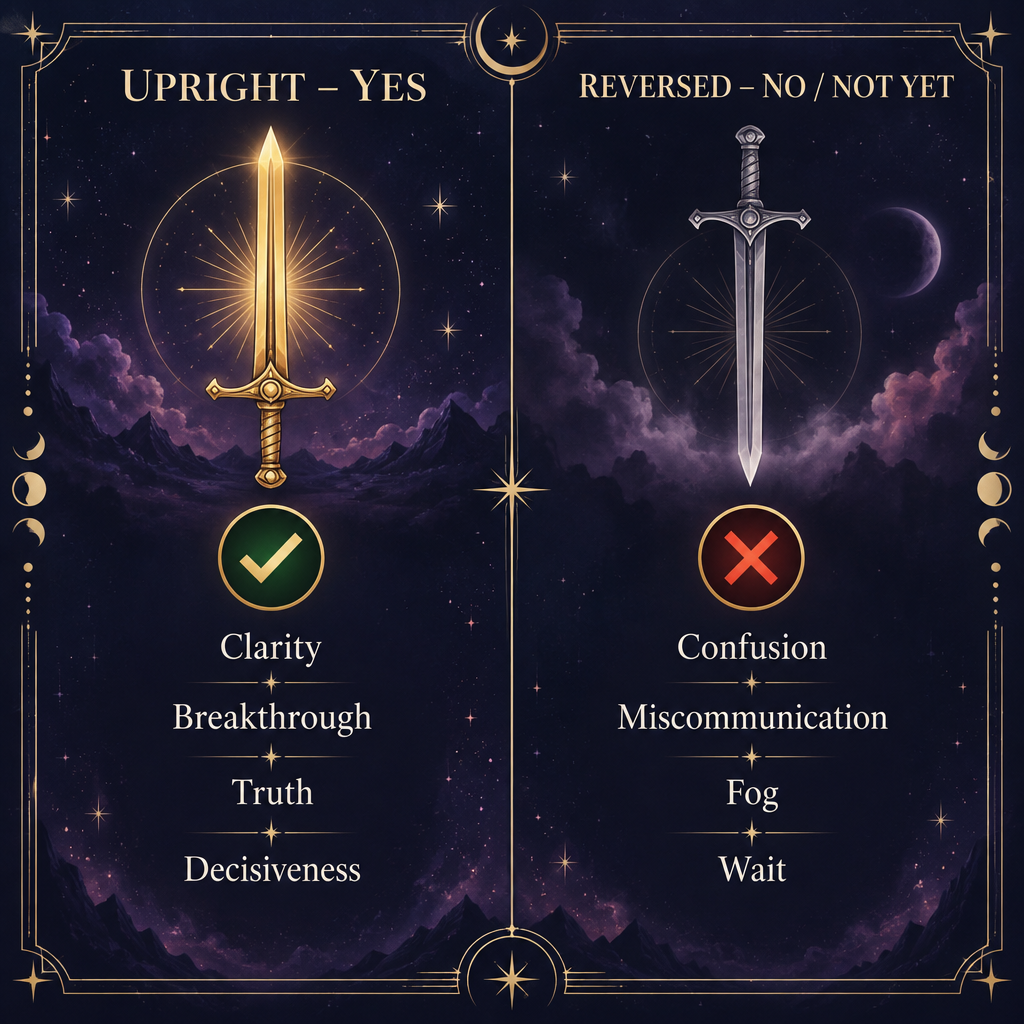
| Upright | YES | Clarity, breakthrough, truth revealed, a clean decision you can act on |
| Reversed | NO / NOT YET | Confusion, blocked communication, clouded judgment, missing information |
If you only need the one-line version: upright Ace of Swords is a yes, reversed is a no with a strong “wait for more information” flavour. Keep reading for the nuance, because this card answers the question you actually asked, not the one you hoped you were asking.
What the Card Looks Like and Why It Matters for Yes/No
In the Rider-Waite deck a single hand emerges from a grey cloud, gripping a sword point-up. The tip pierces a gold crown. An olive branch hangs from one side of the crown and a palm branch from the other. Six small yod-shaped flames drift around the blade. Below, a range of bare, jagged mountains sits under a pale sky with no trees, no water, no people.
Each part of that image tells you something about how the card behaves in a yes-or-no reading.
The hand from the cloud. All four Aces share this motif. It represents a gift or impulse arriving from outside your control. You did not manufacture this clarity; it is being handed to you. In yes/no terms, that means the answer is not conditional on you earning it. The door is already open.
The sword held upright. Swords are the suit of the mind, and an upright blade is a mind that has cut through to a single conclusion. No wavering, no double edge. This is the visual root of the card’s decisiveness.
The crown. Victory, authority, a mind that rules its situation. The crown sits on the sword’s point, so the win comes through intellect and honesty rather than force or charm.
The olive and palm branches. Olive stands for peace and mercy, palm for triumph and severity. Arthur Edward Waite described the Ace of Swords as triumph in both love and hatred. The two branches are the reminder that a sword can free you or wound you depending on where it lands. A yes from this card can still sting.
The barren mountains. Truth is not cosy. The landscape is stripped of comfort so the view is unobstructed. When this card says yes, it is saying “you can see clearly now,” not “this will feel warm.”
Keywords, Element and Correspondences
| Attribute | Detail |
|---|---|
| Suit | Swords |
| Element | Air (thought, language, logic, communication) |
| Zodiac links | Gemini, Libra, Aquarius (the three air signs) |
| Numerology | 1, the beginning of the sequence: pure potential, singular focus, a first move |
| Upright keywords | Clarity, breakthrough, truth, mental power, sharp focus, decisiveness, justice, a new idea |
| Reversed keywords | Confusion, chaos, miscommunication, mental fog, dishonesty, information overload, hostility, a plan that collapses |
| Yes/No (upright) | Yes |
| Yes/No (reversed) | No, or not yet |
The Air element is the reason this card answers so bluntly. Cups would answer with feeling, Pentacles with practicality, Wands with enthusiasm. Swords answer with what is factually the case. That is a strength when you want certainty and a problem when you want to be told what you want to hear.
The number 1 adds urgency. Aces are the seed of their suit, so the Ace of Swords is the first clear thought before any plan is built around it. A yes from an Ace confirms the idea is sound. It does not promise the whole project is finished.
The Yes of Truth, Not the Yes of Desire
This is the piece most quick-reference guides skip, and it changes how you should read the card.
The Ace of Swords does not say yes to your wish. It says yes to the truth. Ask “will I get the promotion?” and draw this card upright, and the honest reading is: the truth about your situation will become clear and you will be able to act on it decisively. Usually that means yes, you get it. Sometimes it means you finally see that the role was never going to be offered, and now you can stop waiting and apply elsewhere. Both are victories for the sword. Only one is the victory you had in mind.
For love questions this distinction matters even more. “Does he love me?” answered by an upright Ace of Swords means you are about to know, definitively, how he feels. If he does, the card is a clean yes. If he does not, the card is still doing its job by ending the ambiguity.
Practical rule: treat an upright Ace of Swords as a firm yes when your question is about clarity, decisions, communication, contracts, legal outcomes, study, or any situation where knowing the facts is itself the win. Treat it as a “yes, and brace for honesty” when your question is about whether someone else will give you what you want.
Ace of Swords Yes or No in Love
Upright: Yes
For singles, this is a yes to meeting someone, with the caveat that the connection starts in the head before the heart. Expect conversation that clicks, someone who says what they mean, and attraction built on being understood rather than swept away. It is a good card for “should I message them?” and “should I say how I feel?” because it favours directness.
For couples, an upright Ace of Swords answers yes to questions about honesty, resolving a lingering argument, or having the conversation you have been avoiding. Ask “should I tell my partner the truth about X?” and this is about as clear a yes as tarot offers.
Where it softens: “will this relationship be passionate?” or “will they commit emotionally?” get a lukewarm yes at best. The Ace of Swords deals in clarity, not warmth. A relationship question answered by this card is one where you will know exactly where you stand, which is valuable but not the same as romance.
Reversed: No
Reversed in a love reading, the card points to crossed wires. Messages misread, intentions unclear, one person saying one thing and doing another. If you asked “are we on the same page?” the answer is no. If you asked “should I confront them tonight?” the answer is also no, because right now neither of you can articulate the real issue and the conversation will go sideways.
The reversed Ace of Swords can also flag deception. Not always, but often enough that a “do they mean what they say?” question answered by this card reversed deserves a cautious no.
Ace of Swords as Feelings: What Someone Feels About You
When you ask how a specific person feels toward you and draw this card, read it as a description of their mental state rather than their heart.
Upright: They see you clearly and they have made up their mind. Their interest, if present, is direct and unambiguous. They are thinking about you in concrete terms: what they want to say, what they want to ask, what a next step looks like. This person is likely to make a move or state a position soon. Yes, there is interest, and it is the honest kind.
Reversed: They are confused about you, or about themselves. They may like you and be unable to say so, or they may be sending mixed signals because they have not resolved their own thoughts. Some readers also see the reversed Ace here as someone being calculating or withholding the truth. Either way, the answer to “do they have clear positive feelings for me?” is no, not right now.
Ace of Swords Yes or No for Reconciliation and Getting Back With an Ex
This is one of the most common reasons people pull a yes/no card, so it deserves its own answer.
Upright: Yes, with a condition. Reconciliation is possible, but only through an honest, direct conversation about what went wrong. The Ace of Swords upright often shows up when one or both people have finally understood the real reason the relationship ended. If your question is “should I reach out to my ex?” the card says yes, and it says do it plainly. No games, no vague “hey stranger” texts. Say what you want to say.
Be aware of the truth-not-desire rule here. Sometimes the upright Ace in a reconciliation question is the moment you realise, with total clarity, that you do not want them back. That is still the card working.
Reversed: No. The same old miscommunications will replay. The reversed Ace of Swords in a reconciliation reading is a picture of two people who still cannot say what they mean to each other. If there was dishonesty in the original breakup, this position suggests it has not been dealt with. Give it time, and if you do ask again, ask a different question: “what needs to be understood before we could talk again?”
Ace of Swords Yes or No in Career
Upright: Yes
This is one of the best cards to draw for a career decision. It favours new ideas, pitches, interviews, negotiations, applications, and any move that depends on thinking clearly and presenting yourself well. “Should I apply?” Yes. “Should I take the offer?” Yes, and read the contract carefully because you will understand it. “Will I pass the exam or certification?” Yes, this card loves study and mental effort.
It also answers yes to “should I speak up about a problem at work?” The Ace of Swords backs whistleblowers, honest feedback and the person who says the uncomfortable thing in the meeting.
Reversed: No
Reversed, the card describes a workplace where information is being withheld, instructions keep changing, or you are drowning in details and cannot see the actual decision. It is also the card of the idea that sounded brilliant at 2 a.m. and falls apart in daylight. “Should I quit today?” No. “Should I launch the project now?” No, the plan has a hole in it you have not found yet. Wait until you can explain the decision in two sentences to someone who knows nothing about it.
Ace of Swords Yes or No for Money and Finances
Upright: Yes
Money questions answered by this card tend to involve documents and decisions rather than windfalls. Signing a contract, agreeing a settlement, restructuring debt, cutting a subscription or commitment that no longer makes sense, choosing between two clear options. In all of these, upright means yes, and it means your reasoning is sound.
It is a particularly good card for legal or dispute-related money questions: a claim, an inheritance argument, a refund fight. The sword through the crown is justice arriving.
It is a weaker yes for “will I get rich from this?” The Ace of Swords is not a Pentacle. It confirms the thinking is right; it does not promise the harvest.
Reversed: No
Reversed, do not sign. Do not invest in the thing you do not fully understand. Do not agree to the deal where the other party keeps changing the terms or avoiding a direct question. The reversed Ace in a finance reading frequently points to fine print you have not read, a salesperson being economical with the truth, or a budget built on numbers you have not actually checked. The answer to “should I go ahead?” is no until the fog lifts.
Ace of Swords Yes or No for Health and Wellbeing
Upright: Yes
For health questions, the Ace of Swords upright is the card of the clear diagnosis, the second opinion that finally makes sense, the test result that ends months of guessing. “Will I find out what is wrong?” Yes. “Should I get this checked?” Yes. “Is my current approach working?” Yes, and you will have evidence for it.
Mentally, it is a card of sharp focus and determination. If you asked about starting a new regimen, breaking a habit, or committing to therapy, the card says yes, your mind is ready to do the work.
One note: Swords can also indicate surgery or a decisive medical intervention in some traditions. Do not read that as a prediction. Read it as “clarity comes through a decisive step” and take actual medical advice from a clinician.
Reversed: No, or Not Yet
Reversed, the card describes mental fog, anxiety loops, conflicting advice, or a diagnosis that has not landed yet. “Should I make a major health decision now?” No. “Is the information I have complete?” No. This is the position that says get another opinion, write down your symptoms properly, and stop reading forums at midnight.
Reading the Answer by Question Type
Outcome questions (“Will X happen?”). Upright leans yes with the truth caveat. Reversed leans no, and specifically no because something essential is not yet known.
Timing questions (“When will X happen?”). Aces are fast. Upright suggests soon, often within the current cycle of whatever you are asking about, and often triggered by a conversation or a piece of news. Reversed suggests delay, and the delay ends when communication clears up. Ask “what is being misunderstood?” to find the blocker.
“Do they like me?” questions. Upright is yes if the interest is there and you will find out plainly. Reversed is no, or “they do not know themselves yet.”
“Should I?” questions. This is where the card is strongest. Upright: yes, act, and be direct. Reversed: no, wait, gather facts.
Reversed Ace of Swords: Reading It as Not Yet
Most readers call the reversed Ace a no, and that is correct as a headline. But it is a specific kind of no, and knowing which kind helps you use it.
The reversed Ace of Swords is rarely a permanent closed door. Aces reversed are usually delayed or misdirected beginnings, not endings. The signals it gives are concrete:
- Confusion. You cannot state the question cleanly, which is why the answer will not come cleanly.
- Miscommunication. Two people talking past each other, an email misread, a promise heard differently by each side.
- Clouded judgment. Stress, resentment or wishful thinking is doing the deciding.
- Information overload. Too many opinions, too many tabs open, no way to weigh them.
- Dishonesty. Someone, possibly you, is not being straight about the facts.
Timing guidance: treat a reversed Ace as “ask again after a real conversation.” In practice that often means days to a few weeks rather than months. If you pull it, the most useful follow-up card question is not “will it work out?” but “what am I not seeing?”
Card Combinations That Change the Answer
The Ace of Swords rarely lands alone, and its neighbours shift the tone.
- Ace of Swords + The Lovers: A strong yes for a relationship built on honest choice. Both people know what they are choosing.
- Ace of Swords + Two of Cups: Yes, mutual and openly spoken. The mental clarity of the Ace meets the emotional agreement of the Two.
- Ace of Swords + Three of Swords: Yes, the truth comes out, and it hurts. Expect a painful revelation rather than a happy one.
- Ace of Swords + Justice: Very strong yes for legal, contractual or fairness questions. Whatever is decided will be decided correctly.
- Ace of Swords + The Tower: Yes, and the truth will demolish something. A sudden, undeniable realisation.
- Ace of Swords + Seven of Swords: Downgrade the yes. Someone is being strategic with the facts. Check what you are being told.
- Ace of Swords + The Moon: Contradiction. Clarity is available but illusions are strong. Lean toward “not yet” and dig for the missing piece.
- Ace of Swords + Page of Swords: Yes, and news is coming. Expect a message, email or conversation to trigger the outcome.
- Ace of Swords + Ace of Cups: A rare double-Ace yes. Head and heart start something new together.
How to Use This Card Well
Ask precise questions. The Ace of Swords punishes vagueness because it answers exactly what was asked. “Will things get better?” is a poor question for this card. “Should I tell my manager I want the transfer?” is a good one.
Act on an upright answer quickly. Aces are moments of opening, and a mental breakthrough not acted on becomes overthinking within a week.
Respect a reversed answer as a request for information, not a curse. Go find the fact you are missing, have the conversation you are avoiding, then pull again.
And whether you are reading with a physical deck or a single-card draw in an app, the interpretation does not change. The card is about what you know and how clearly you can say it. That applies to a phone screen as much as to a table.
FAQ
Is the Ace of Swords a yes or no card?
Yes. Upright, the Ace of Swords is a clear yes rooted in clarity, truth and decisive action. Reversed, it is a no, best read as “not yet” because confusion or miscommunication is blocking the outcome.
What does the Ace of Swords reversed mean in a yes or no reading?
It means no for now. The reversed card signals mental fog, mixed messages, incomplete information or dishonesty. Decisions made under those conditions tend to go wrong, so the card advises waiting until the facts are clear and the conversation has actually happened.
Is the Ace of Swords a good card for love?
It is a good card for honesty and communication in love, and a yes for questions about speaking up, resolving conflict or meeting someone you connect with mentally. It is a weaker card for pure passion or emotional reassurance, because it confirms the truth of a situation rather than promising warmth.
Can the Ace of Swords be negative?
Yes, in two ways. Upright, it can deliver a truth you did not want, since the card confirms what is real rather than what you hope. Reversed, it points to confusion, blocked communication and sometimes deceit, all of which are negative signals for any decision.
Does the Ace of Swords mean yes for getting back with an ex?
Upright, yes, provided the reconciliation happens through a direct, honest conversation about what went wrong. Reversed, no, because the old misunderstandings have not been resolved and will repeat.
What does the Ace of Swords mean as someone’s feelings for you?
Upright, they see you clearly and have made up their mind, and any interest they have is direct and about to be expressed. Reversed, they are confused, sending mixed signals, or not being fully honest about where they stand.
What element and zodiac signs does the Ace of Swords belong to?
The Ace of Swords belongs to the Air element and is associated with the three air signs: Gemini, Libra and Aquarius. Its number, 1, carries the meaning of a fresh start and a single clear idea.