
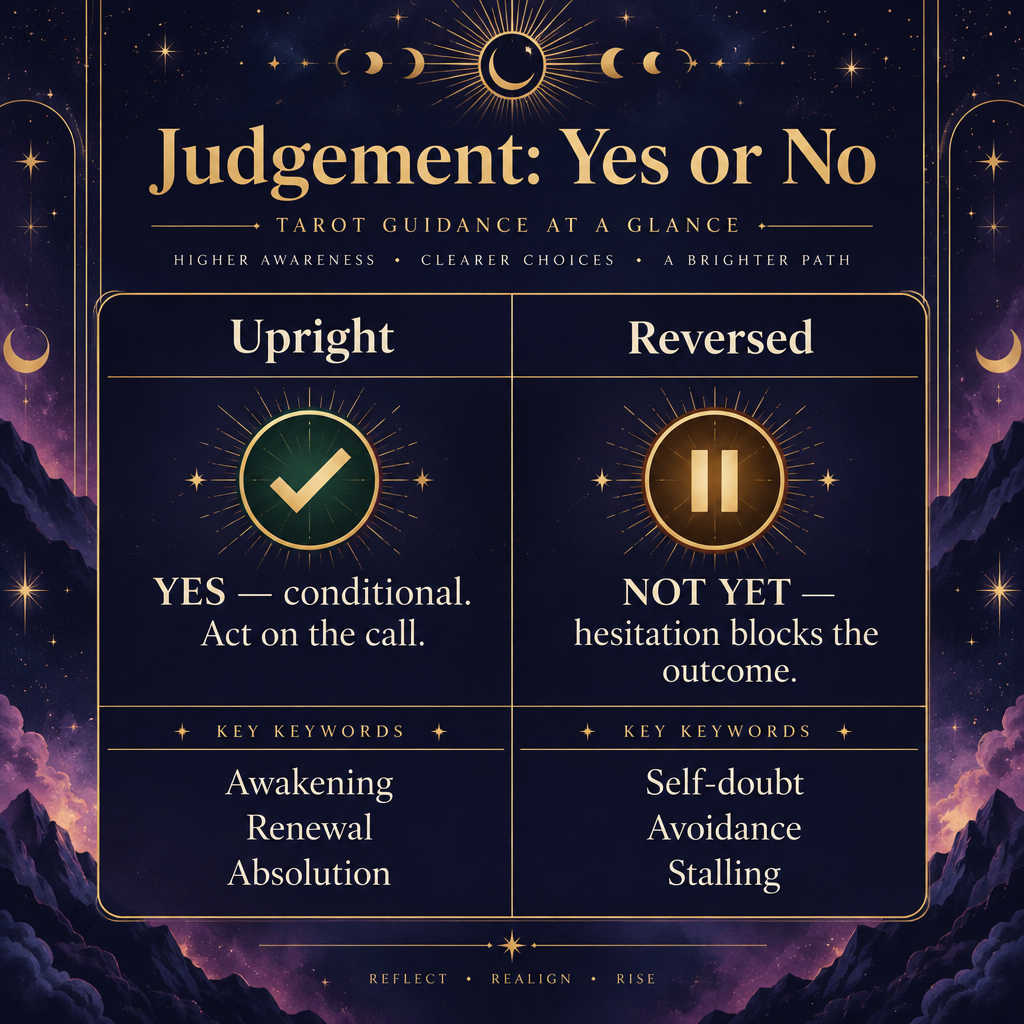
Quick answer: Judgement upright is a yes. Judgement reversed is a “not yet” that leans no. The upright card confirms your question with a condition attached: you have to answer the call it represents, not just hear it. Reversed, the card says the outcome is being blocked by hesitation, self-doubt, or a refusal to look at something honestly, and it can flip to yes once that is dealt with.
Judgement at a Glance
| Detail | |
|---|---|
| Yes or no (upright) | Yes, conditional on you acting |
| Yes or no (reversed) | Not yet / probable no |
| Upright keywords | Awakening, reckoning, absolution, renewal, a clear calling, karmic payoff |
| Reversed keywords | Self-doubt, avoidance, harsh self-criticism, stalling, ignoring the call |
| Number | XX (20), reduces to 2 |
| Element | Fire |
| Planet | Pluto (modern attribution) |
| Hebrew letter (Golden Dawn) | Shin |
| Position in the Major Arcana | Second to last, just before The World (XXI) |
| Strongest areas | Reconciliation, career turning points, decisions you have been postponing |
Why Judgement Reads as Yes
Judgement is a resurrection card. On the Rider-Waite-Smith version, the dead are literally getting up out of their coffins. Nothing about that image says “the situation is closed.” It says the situation is reopening, and on better terms than before.
That is why most readers, this writer included, count it as a yes in the same bracket as The Sun and The World. Where The Sun is an unconditional yes and The World is a completed yes, Judgement is a yes with homework. The angel is sounding the trumpet, but the figures still have to stand up. If your question is “will this happen?”, the card says the door is open. If your question is “will this happen if I keep doing exactly what I am doing?”, the honest answer shifts toward “only if you change something.”
A practical way to test this in your own reading: ask yourself whether you already know what the “call” is. Most people who pull Judgement do. There is a conversation they have been avoiding, a decision they have been sitting on, an apology or application or boundary they know they need to make. The yes is tied to that action.
The Card’s Imagery and What Each Symbol Means for a Yes/No Reading
The standard reference is the Rider-Waite-Smith deck, published in London in December 1909 by William Rider and Son, with art by Pamela Colman Smith working from Arthur Edward Waite’s instructions. Waite’s own text calls the figure “the great angel”; readers almost universally identify him as Gabriel, the archangel who sounds the trumpet at the Last Judgement in Christian tradition.
The angel and the trumpet. The call comes from above, not from the querent’s own planning. For yes/no purposes, this means the answer often arrives as a sudden clarity or an external event rather than something you negotiate your way into. Something will make the situation plain.
The red cross on the white banner. This is the St George cross, a symbol of resurrection and of protection under a higher order. In a yes/no context it signals that the outcome aligns with what is right for you, even if it is not the outcome you were hoping for. Judgement’s yes is a yes to what you need.
The grey figures rising from coffins. A man, a woman and a child in the foreground, more behind them. Their colour is deliberate: they are not yet fully alive. They are mid-transformation. This is the “level up first” part of the card. The yes is real, but you are being asked to leave an old version of yourself in the box.
Outstretched arms. The figures are receiving, not grabbing. The posture is acceptance. When Judgement appears, forcing the result usually backfires; the better move is to make yourself ready and then say yes when the opportunity shows up.
The water and the mountains. The coffins float on a sea, with a range of white peaks behind. Water is the emotional past; the mountains are the long view ahead. The card is positioned exactly at the hinge between the two. Your question is at a hinge too.
Number, Element and Planet
Judgement is trump XX, the twentieth card in the Major Arcana sequence and the twenty-first card if you count The Fool as zero. In numerology 20 reduces to 2, which links it to The High Priestess (II). That connection matters: The High Priestess is the card of intuition and knowing something before you can prove it. Judgement is the moment that inner knowledge gets confirmed out loud. If you have had a gut feeling about your question for a while, this card tends to validate it.
The Golden Dawn system assigns Judgement to the element of Fire and the Hebrew letter Shin. Fire here is purifying rather than destructive: it burns away what no longer belongs so the rest can stand. The modern planetary attribution is Pluto, the planet of death, rebirth and buried material coming to the surface. Pluto is why Judgement so often turns up when secrets come out or when a long-dormant situation suddenly reactivates.
Upright Judgement as Yes
Upright, treat the card as a yes with three characteristics.
It is a final yes. Judgement closes a chapter. If you are asking whether a drawn-out situation will resolve, it will, and the resolution will stick.
It is a fair yes. The outcome reflects what you have actually put in. People who have done the work get rewarded; people hoping to be rewarded for work they skipped get a more sobering result. This is the “reap what you sow” dimension covered below.
It is a conditional yes. The card asks you to show up differently. Say yes to the invitation, make the call, take the meeting, have the conversation. Judgement does not deliver outcomes to people lying still.
Reversed Judgement as No (or Not Yet)
The old framing of reversed Judgement as a flat no is too blunt. The more accurate reading, and the one most experienced readers now use, is “not yet.”
Reversed, the trumpet is still sounding; the problem is that the figures are not getting up. Something in you is refusing the call. The usual culprits:
- Self-judgement that has become punishment. You are so busy prosecuting yourself for past mistakes that you cannot accept a fresh start when it is offered.
- Avoidance. You know what needs to be decided and you keep finding reasons to delay.
- Fear of being seen clearly. The card is about truth coming out. Reversed, you are hiding something from others or from yourself.
- Letting someone else judge for you. Outsourcing the decision to a partner, parent or boss and then resenting the result.
The yes/no answer is therefore no for now, with a specific route back to yes. Identify which of the four blocks above fits, resolve it, and re-ask. When reversed Judgement sits next to The Star, The Sun or the Ace of Wands, the “not yet” is short. Next to the Eight of Swords, the Devil or the Five of Pentacles, the block is heavier and the answer stays no until real work is done.
Judgement Yes or No in Love
New and Potential Relationships
Upright: yes. Judgement in a new connection points to a relationship that will change you, often one where you feel recognised in a way you have not been before. The condition is honesty from the very start. This card does not tolerate performing a version of yourself; the whole point of the image is people appearing exactly as they are.
Reversed: not yet. One or both of you is carrying unfinished business from a previous relationship, and it is clouding the new one. Ask whether you are judging this person by someone else’s record.
Existing Relationships
Upright: yes, with a turning point. Something is about to be said or decided that moves the relationship to a new level. This can be a proposal, a decision to move or have children, or a frank conversation that clears years of accumulated tension. Expect the relationship to feel different afterwards, in a good way.
Reversed: the conversation is overdue and being dodged. The answer to “will things improve?” is no while the avoidance continues. Judgement reversed in an established couple usually means one partner is quietly keeping score rather than speaking up.
Reconciliation and Second Chances
Judgement is one of the strongest reconciliation cards in the whole deck, arguably ahead of the Six of Cups and Temperance because it carries the element of accountability. The Six of Cups wants to go back; Judgement wants to go forward together after a reckoning.
Upright: yes, a genuine second chance is possible. The key word is genuine. Both people have to be willing to name what went wrong. If you are the one hoping for reconciliation and you have done your own honest review of your part, the card says make the approach. If you are waiting for the other person to make the first move, this card often indicates they are closer to doing so than you think, especially with Pluto’s habit of resurfacing the past.
Reversed: not yet. One of you is not ready to face the truth of what happened. Reconciling now would mean repeating the same patterns. The no here is protective rather than final, and the timeline depends on how quickly the avoidance breaks.
Judgement as Feelings and How Someone Sees You
When you ask how a person feels about you and Judgement appears:
Upright: they are in a period of serious emotional reckoning about you. They are weighing the relationship, thinking about what they have learned from it, and feeling a pull toward either recommitting or finally letting go. It is rarely lukewarm. More often than not, the pull is toward renewal; they see you as someone who woke something up in them. People described by this card often feel that you “see through” them, which they find both uncomfortable and compelling.
Reversed: their feelings are tangled up in shame, guilt or fear of being judged by you. They may believe you think badly of them, or they may be judging themselves harshly for something they did in the relationship and projecting that onto you. The underlying feeling is often warmer than their behaviour suggests, but they are not in a position to express it yet.
Judgement Yes or No for Career
Upright: yes. This is one of the best career cards for a long-awaited decision: the promotion comes through, the offer lands, the review goes your way, the business you have been debating gets its green light. The decision feels like a verdict because it is one. Your past work is being evaluated and it holds up.
Two specific patterns to watch for. First, Judgement frequently marks a career change into work that feels like a vocation rather than a job. If you have been considering leaving a field, this is the card that says the call is real. Second, it appears when a workplace truth comes to light: a colleague’s conduct, a company’s finances, a project’s real status. Upright, that disclosure works in your favour.
Reversed: the promotion or decision stalls, usually because you have not put yourself forward or because you are second-guessing a path you already know is right. The answer is no until you stop waiting to be chosen and make your case.
Judgement Yes or No for Money and Finances
Upright: yes, with an audit. Judgement is about accounts being settled. Debts get repaid, disputes over money get resolved, the inheritance or settlement or refund finally arrives. If you are asking whether an investment or purchase is sound, the card says yes if you have done the due diligence, and it also says do the due diligence. It is not a windfall card like the Ten of Pentacles or the Wheel of Fortune; it is an earned-outcome card.
Reversed: a probable no on new financial moves until you have faced your actual numbers. Reversed Judgement in money readings almost always points to avoidance: unopened statements, a tax return not filed, a loan you are pretending is not there. The situation improves quickly once you look.
Judgement Yes or No for Health
Upright: yes, and this card is strongly associated with recovery and with getting a clear answer. If you are waiting on test results or a diagnosis, Judgement suggests clarity is coming and that the news allows for a way forward. It also appears when a health scare becomes the wake-up call that changes habits permanently. Many readers note it for mental and emotional recovery: coming out of depression, finishing therapy, forgiving yourself for a period of poor self-care.
Reversed: not yet, because something is being ignored. The appointment has not been booked, the symptom is being explained away, the advice has not been followed. The card is not a sign of serious illness; it is a sign of delay, and delay is what it asks you to fix. Tarot is not a substitute for medical care, and reversed Judgement is the card most likely to be telling you to go and see a professional.
Karma and Reaping What You Sow
Underneath every yes/no answer Judgement gives is a karmic logic: you are receiving the result of what you have put in. The angel is not deciding arbitrarily. The figures rising are the ones who are ready to rise.
This cuts both ways. If you have been honest, consistent and generous in the situation you are asking about, the card tells you that is about to be returned. If you have been cutting corners, the card still says yes to resolution, but the resolution will reflect that. Judgement does not punish; it reveals. Its promise is that the accounts will balance, which is excellent news for anyone who has felt their efforts going unseen, and uncomfortable news for anyone hoping a loose end stays loose.
Judgement Compared with Justice, Death and The World
Justice (XI) and Judgement are often confused because both involve evaluation. Justice is external and procedural: law, contracts, logical consequence, a fair ruling delivered by a third party. Judgement is internal and spiritual: a reckoning with yourself and a call to become someone new. Justice asks “what is fair?” Judgement asks “who are you now, and who are you ready to be?” In a yes/no reading, Justice means the outcome follows the facts; Judgement means the outcome follows your readiness.
Death (XIII) and Judgement are both transformation cards, but Death is the ending and Judgement is the rising afterwards. Death clears; Judgement calls you up out of what was cleared. Pulling them together is a strong signal that a complete cycle is closing.
The World (XXI) is what comes immediately after Judgement in the Fool’s Journey. Judgement is the moment you hear the call and get to your feet; The World is the moment you arrive. If you pull Judgement, you are one step from completion, which is part of why it reads as yes.
What to Do When You Draw Judgement
- Name the call. Write down, in one sentence, the decision or conversation you already know this card is about. Do not pretend you do not know.
- Do an honest review of your part. Not a flogging, a review. What did you contribute to the situation, good and bad? The card rewards accurate self-assessment and punishes neither honesty nor mistakes, only denial.
- Forgive what needs forgiving, including yourself. The grey figures are absolved. Carry the lesson, drop the sentence.
- Act within the week. Judgement is a Fire card. Its energy is time-limited. Make the call, send the application, book the appointment, have the talk.
- If reversed, find the block. Pick the one that fits from the four listed earlier, then ask a follow-up question: “What do I need to do to be ready?” Pull one more card for that.
- Say yes when the door opens. The figures receive with open arms. When the opportunity comes, and it will, do not relitigate it.
FAQ
Is Judgement a yes or no card?
Upright, Judgement is a yes. Reversed, it is a “not yet” that leans toward no until a specific block (self-doubt, avoidance, or fear of facing the truth) is resolved.
Why is Judgement a yes card?
Because its imagery and meaning are about resurrection, absolution and a clear calling. The figures on the card are rising out of their coffins toward a new life, and the card sits one step before The World, the card of completion. It signals that a situation is reopening and resolving in your favour, provided you respond to the call rather than waiting passively.
Does Judgement reversed change the answer?
Yes. Reversed Judgement shifts the answer from yes to not yet. The opportunity still exists, but you are blocking it through harsh self-judgement, procrastination or refusal to look at something honestly. Once that is dealt with, the answer can return to yes. Surrounding cards show how long the delay is likely to be.
Can Judgement mean reconciliation?
Yes, and strongly. Judgement is one of the best reconciliation cards in the Major Arcana because it combines a second chance with accountability. Upright, a genuine reunion is possible if both people face what went wrong. Reversed, one person is not ready to do that yet, and reconciling now would repeat the old pattern.
What does Judgement mean in love?
In love, upright Judgement points to a relationship reaching a decisive turning point: a commitment, a hard conversation that clears the air, or a reunion after a split. It asks for total honesty from both people. Reversed, it shows avoidance and unspoken resentment, and the relationship stalls until someone speaks up.
What does Judgement mean as feelings?
As feelings, upright Judgement means the person is seriously re-evaluating what you mean to them and is being pulled toward renewal or recommitment. Reversed, their feelings are clouded by guilt, shame or fear that you are judging them, so they are holding back even if the underlying emotion is warm.
What is Judgement’s element and planet?
Judgement is attributed to the element of Fire and, in modern tarot, to the planet Pluto. It is card XX (20), which reduces numerologically to 2 and connects it to The High Priestess.