
You asked how they feel about you and the Hermit came up. Take a breath, because this card almost never means “they don’t want you.” It means they feel something real and are processing it privately, at a pace that is slower and quieter than you would like.
The Short Answer First
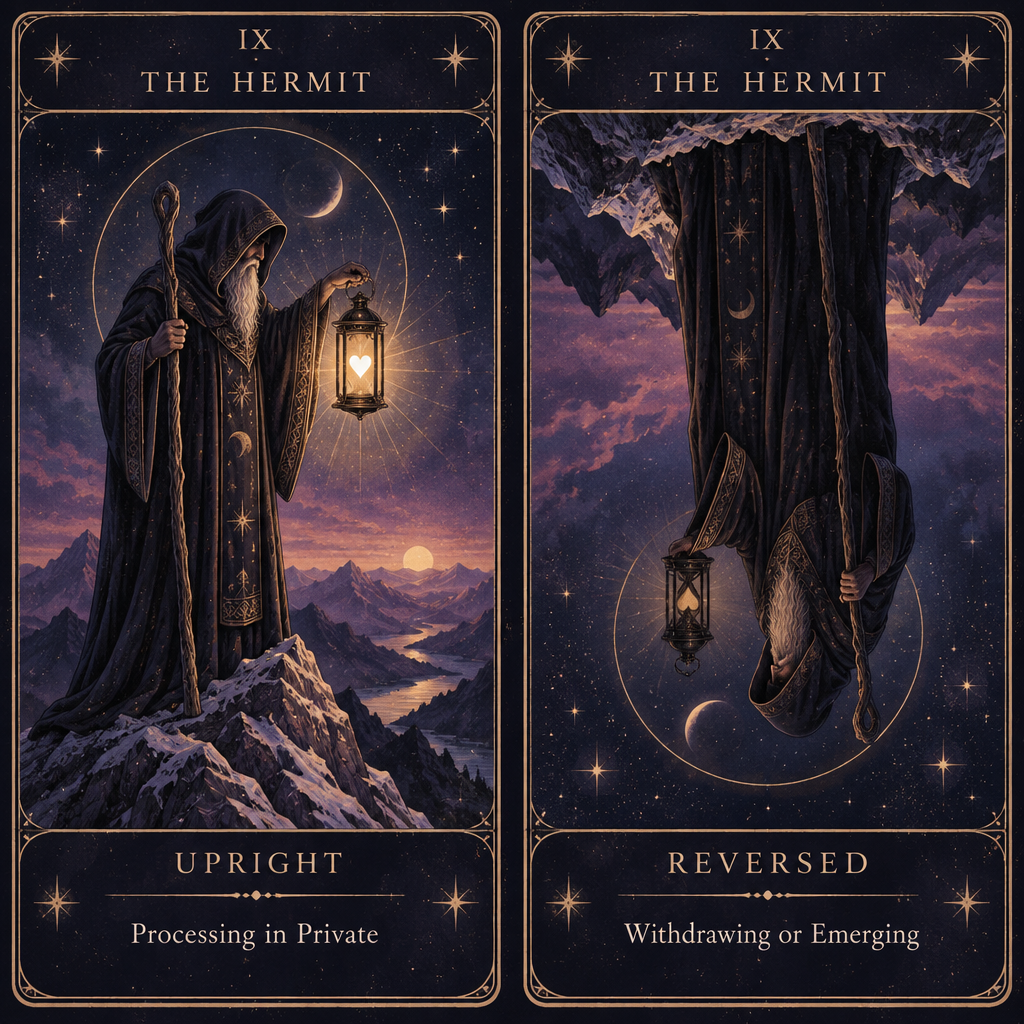
Upright, the Hermit as feelings describes a person who cares deeply but is not ready to say so out loud. Their emotions are turned inward. They are thinking about you, weighing what the connection means, and protecting themselves while they do it. The feelings are sincere. The expression is delayed.
Reversed, the picture changes. The person is either withdrawing in an unhealthy way (avoiding you, going quiet, refusing to deal with their own emotions) or, in the more hopeful version, they are finally coming out of a long period of isolation and are closer to reaching out than they have been in months.
Which one applies depends on orientation, the surrounding cards, and what you already know about this person’s behaviour. The sections below break it down by relationship stage so you can find the reading that matches your situation.
What the Card Shows, and Why It Matters for Feelings
In the Rider-Waite-Smith deck, the Hermit is an elderly figure in a hooded grey cloak standing alone on a snow-covered peak. He holds a lantern in his right hand and a tall staff in his left. His head is bowed. He is not looking at anyone, and nobody is looking at him.
Each element has a direct translation when the question is about someone’s feelings.
The solitary figure. This person processes emotion alone. They do not think out loud, they do not vent to friends about you, and they will not announce their feelings before they have fully understood them. Silence from a Hermit type is not absence of feeling. It is the sound of someone working something out.
The lantern. Inside the lantern sits a six-pointed star, the Seal of Solomon, a symbol of wisdom. The light it casts is small and only illuminates the next few steps. In feelings terms, this person is examining the relationship carefully but can only see a little way ahead. They are not planning your wedding. They are figuring out whether the next step is safe.
The staff. A symbol of authority and support. The person is leaning on their own judgement rather than asking for reassurance. They want to arrive at their feelings independently, and they tend to distrust emotions that arrive too fast.
The mountaintop. They have climbed somewhere high and cold to get perspective. Mountains in tarot represent achievement earned through effort, and also distance. The person feels removed from the day-to-day heat of romance right now, by choice, so they can see the whole landscape.
The grey cloak. Grey sits between black and white. The person is not in a decisive emotional state. They are in a neutral, observing mode, holding judgement until they know more.
When you put these together, the Hermit describes someone whose feelings are contained, considered, and private. Not cold. Contained.
Major Arcana Number Nine and the Virgo Connection
The Hermit is card number nine in the Major Arcana. Nine is the last single digit, the number of completion before a new cycle begins. In a love reading this suggests the person is wrapping up an internal chapter before they can start a new one with you. They may be finishing the work of getting over someone, rebuilding confidence after a hard year, or simply deciding what they actually want from a partner.
Astrologically, the Hermit is assigned to Virgo in the Golden Dawn system that most modern decks follow. That assignment explains a great deal about how this person loves. Virgo energy is analytical, careful, and allergic to sloppy emotional declarations. A Virgo-ruled lover shows affection by noticing details, remembering what you said three weeks ago, and quietly fixing problems for you. They rarely lead with grand speeches. If the person you are asking about has strong Virgo placements, the Hermit is practically a portrait of how they experience attraction.
Some readers also associate the Hermit with Archangel Raziel, the angel of secrets and hidden knowledge. Whether or not you work with angelic correspondences, the theme fits: this is a person holding something unspoken.
Hermit as Feelings From a Crush or New Love Interest
This is the most common version of the question, and the most anxiety-inducing. You have been talking to someone, there is clear chemistry, and then they go quiet or pull back. You pull the Hermit.
Upright, it means they are interested and they are scared of how interested they are. New attraction makes a Hermit personality uncomfortable because it threatens the controlled inner world they have built. Their response is to step back and think, not to step forward and act. They are likely asking themselves questions like “Is this real or am I just lonely?” and “Can I trust this person with the parts of me I usually hide?”
Concrete signs you are dealing with an upright Hermit crush:
- They reply thoughtfully but slowly, often hours later with a longer message than you expected.
- They ask deep questions on dates but deflect when you ask them the same thing.
- They cancel or postpone plans without a convincing reason, then reappear warm and attentive.
- They seem more comfortable one-on-one in quiet places than in groups or loud venues.
The 2024 and 2025 dating vocabulary has a word for the result: the slow burn. The Hermit is the slow-burn card. If you are in something that feels like a situationship because the other person will not define it, the Hermit tells you the lack of definition comes from their internal deliberation, not from a lack of regard for you. That distinction matters, because the fix is patience and low pressure, not an ultimatum.
Hermit as Feelings in a Committed or Long-Term Relationship
When you are already partnered and the Hermit appears as your partner’s feelings, the meaning shifts from “do they like me” to “why have they gone inward.”
Upright, your partner needs solitude and is not getting enough of it. They still love you. They may be exhausted, processing a personal setback, or simply recharging in the way introverts must. A Hermit partner who has been overstimulated becomes short, distracted, and physically present but mentally elsewhere. It feels like distance. It is actually depletion.
The reassuring part: the Hermit in a long-term reading is a sign of depth, not decay. A partner who retreats to think is a partner who takes the relationship seriously enough to reflect on it. Shallow disinterest looks like the Four of Cups or the Five of Pentacles, not this card.
Watch for these patterns in a committed relationship:
- Your partner goes quiet after big life events (a job change, a family illness, a move) rather than talking it through immediately.
- They prefer parallel activities (reading in the same room, separate hobbies) over constant interaction.
- When they do open up, it comes all at once after days of apparent silence.
The risk in a long-term setting is that the Hermit’s need for solitude gets misread as rejection, which leads to pursuing, which leads to more withdrawal. Breaking that loop is the whole job, and the practical section below covers how.
Hermit as Feelings From an Ex or in a Reconciliation Reading
Asking how an ex feels and receiving the Hermit is one of the more hopeful outcomes, with a catch.
Upright, your ex is thinking about the relationship. Genuinely thinking, not scrolling your profile out of boredom. They are reviewing what went wrong, examining their own part in it, and asking themselves whether they want to try again. The Hermit’s lantern is pointed at the past here. This is the card of the ex who has gone to therapy, started journaling, or spent a long stretch single on purpose.
The catch is timing. The Hermit does not rush, and he will not come down the mountain until he has finished what he climbed up there to do. If you are hoping for reconciliation, the Hermit says it is possible but not imminent. Reaching out before they have completed their process tends to spook them back into retreat.
Signs the Hermit reflects your ex’s current state:
- Minimal contact, but no hostility. They have not blocked you, and they respond politely if you reach out.
- They have visibly stepped back from dating and social media.
- Mutual friends report that they seem “in their own head” or “working on themselves.”
Reversed in an ex reading, read carefully. It can mean they are stuck in isolation and bitterness, replaying the breakup without growing from it. Or it can mean they are emerging and about to reconnect. Check the cards around it. The Six of Cups or the Star nearby points toward emergence. The Five of Cups or the Eight of Swords points toward stagnation.
Hermit as Feelings When You Are Single
If you are single and asked about love in general, the Hermit speaks about your own emotional state and the type of person approaching you.
For yourself, it confirms that you are in a reflective phase. You may have noticed that dating apps feel exhausting and that you would rather spend Friday night alone than on a mediocre date. The card validates that choice. The time you spend understanding your own patterns now is the reason your next relationship will be better than your last one.
For incoming love, the Hermit describes a future partner who is introspective, intelligent, and slow to commit but steady once they do. Expect this person to arrive through a quiet route: a shared class, a friend’s small dinner, a long conversation in an unlikely place. Not a club, not a swipe.
Hermit as Feelings in a Friendship or Platonic Reading
The Hermit can also describe how a friend feels about you. Upright, the friend values you deeply but needs more space than most friendships provide. They are the friend who disappears for a month and then shows up with full attention and genuine care. They are not neglecting you. Their social battery is simply small.
Reversed in a platonic context, the friend may be isolating in a way that worries you, or pulling away because of an unspoken hurt. A direct, gentle check-in is warranted.
The Hermit Reversed as Feelings: Two Very Different Stories
The reversed Hermit is where most online interpretations go wrong by collapsing everything into “loneliness.” There are two distinct readings, and they lead to opposite advice.
The Unhealthy Reversal: Avoidance, Ghosting, and Emotional Unavailability
In its negative form, the reversed Hermit is the card of someone who uses solitude as a weapon or a hiding place. This is the person who ghosts rather than having an awkward conversation. The person who says “I just need space” and then uses that space to avoid every difficult feeling indefinitely. The person who has confused being alone with being safe.
In attachment terms, this is the dismissive-avoidant pattern in full effect. Closeness triggers a shutdown. Your bids for connection feel like pressure. Instead of processing, they numb, and the lantern goes dark.
Tell-tale signs of the unhealthy reversal:
- Long silences with no warmth when contact resumes.
- Defensiveness or irritation when you ask how they feel.
- A pattern of cutting people off abruptly in their history.
- Overthinking that leads to paralysis rather than clarity. They have analysed the relationship into the ground and still cannot act.
If this matches the person you asked about, the honest reading is that their feelings may exist but they are not currently capable of showing up for them. You cannot fix that from the outside.
The Healthy Reversal: Coming Down the Mountain
The other reversed meaning is almost the opposite. Here the Hermit has finished his solitude and is turning the card right side up, so to speak. The person has done their thinking, learned what they needed to learn, and is ready to re-enter connection.
This version shows up as a sudden shift in behaviour. The quiet person starts texting first. The ex who vanished sends a thoughtful message. Your withdrawn partner suggests a weekend away. The isolation has served its purpose and is ending.
You can usually tell which reversal you are dealing with by direction of movement. Is the person moving further away from everyone, or starting to move toward people again? The first is avoidance. The second is re-emergence.
Upright vs. Reversed Hermit as Feelings: Comparison Table
| Upright Hermit | Reversed Hermit (Unhealthy) | Reversed Hermit (Healthy) | |
|---|---|---|---|
| Emotional tone | Deep, sincere, reflective | Numb, defensive, stuck | Relieved, opening, curious |
| Expression of feelings | Delayed and private, shown through actions rather than words | Suppressed or denied; may ghost | Beginning to verbalise after long silence |
| Response to conflict | Withdraws to think, returns with a considered view | Withdraws to avoid, does not return | Willing to talk it through |
| Readiness for love | Interested but needs time to trust | Not currently available | Ready to reconnect |
| What they need from you | Space and patience | Boundaries and realism | Warmth and a low-pressure opening |
The Hermit Person’s Attachment and Love Style
Understanding the type of lover the Hermit describes stops you from misreading their behaviour.
In attachment terms, the upright Hermit sits closest to a secure-leaning introvert with a strong need for autonomy. They are not afraid of intimacy, but they insist on arriving at it slowly and on their own terms. Pushed, they can slide toward avoidant behaviour, which is why pressure backfires so reliably with this card.
In the framework of love styles developed by sociologist John Alan Lee, the Hermit is a storge lover rather than an eros lover. Eros is passionate, fast, physically driven love that announces itself immediately. Storge is love that grows from friendship and shared understanding, slow to ignite and slow to fade. A Hermit type often does not realise they have fallen in love until they have known someone for months. Once they do, the loyalty is formidable.
Practical traits of the Hermit lover:
- They remember small details and act on them rather than making verbal declarations.
- They need to be asked what they feel; they rarely volunteer it, but they answer honestly when asked directly and calmly.
- They are uncomfortable with public displays of affection and comfortable with deep private conversation.
- They choose partners rarely and leave relationships rarely.
The Hermit in the Outcome or Future Position
When the Hermit lands in the outcome position of a love spread, it does not mean the relationship ends. It means the relationship will go through a period of distance or slower development before it resolves.
For a new connection, expect the pace to stay gradual. Commitment will come after a stretch where one or both of you pull back to assess. For an established couple, the outcome Hermit often points to a season of living more independently within the relationship, which strengthens it if handled well. For an ex, it suggests the answer to “will they come back” is “not until they have finished their own work,” with the door left open.
Pulled alongside the Two of Cups or the Lovers, the outcome Hermit indicates deep commitment arrived at slowly. Beside the Three of Swords or the Tower, it suggests the reflection period will reveal that the two of you want different things.
What to Do When the Hermit Appears as Someone’s Feelings
Knowing what the card means is only half the reading. Here is how to respond.
1. Stop pursuing and start inviting. Hermit types retreat from chase energy and move toward quiet openness. Replace “Why haven’t you texted?” with a single low-stakes message that leaves the door open and then leave it. One message, not three.
2. Make space explicit and time-bound. If you are in a relationship, say something like “I can tell you need some room. Take the week. Can we have dinner Saturday?” This gives the Hermit the solitude they need while removing the ambiguity that makes you anxious.
3. Ask direct, specific questions, calmly. Hermit people will not volunteer feelings but they rarely lie when asked plainly. “Do you want this to continue?” works. “Why are you being so distant?” does not, because it asks them to defend rather than disclose.
4. Communicate in writing if they shut down verbally. Many Hermit types express themselves far better with time to compose. A thoughtful message they can answer on their own schedule often gets you more honesty than a face-to-face confrontation.
5. Use the waiting time on yourself. The Hermit is also an instruction to you. While they think, you think. Reconnect with friends, pick up the project you dropped, book the trip. A person who returns from their mountain to find you have built a full life is far more compelling than one who finds you waiting at the base camp.
6. Set a private deadline. Patience is not infinite. Decide for yourself how long you are willing to wait for movement. Three months is a reasonable window for a new connection. If nothing changes by then, the Hermit has become the unhealthy reversal, and your answer is in the silence.
7. Do not interpret silence as a verdict. This is the hardest one. Your nervous system will read quiet as rejection. The Hermit says, explicitly, that quiet is thought. Hold that interpretation until behaviour proves otherwise.
FAQ
Is the Hermit a yes or no card for love?
For “does this person have feelings for me,” the Hermit upright is a soft yes: the feelings exist but are not being expressed yet. For “will this move forward soon,” it is a not yet. For “should I pursue this right now,” it is a no, wait. Reversed, treat it as a no unless surrounding cards clearly show re-emergence.
Does the Hermit mean someone loves you?
Upright, it means someone feels something serious and is taking it seriously enough to think carefully before acting. That is often the early form of love in a reflective person, especially a storge-style lover who falls slowly. It does not mean a dramatic, declared love. It means a quiet, considered one that may deepen into commitment over time.
What does the Hermit mean for an ex coming back?
It means the ex is reflecting on the relationship and has not closed the door, but they will not return until they have finished their own internal process. Reaching out too early tends to delay things. Give them space, work on yourself, and watch for the reversed Hermit or cards like the Six of Cups to signal they are ready.
Is the Hermit a bad card for relationships?
No. It is a slow card, not a bad one. The Hermit describes a relationship built on depth, reflection, and independence rather than speed and spectacle. The only time it becomes a warning is reversed with signs of avoidance, where one person is using solitude to escape rather than to grow.
What does the Hermit mean when it describes my own feelings?
You are protecting yourself. You may be more interested than you have admitted, and you are hesitating because past hurt has taught you to think before you leap. The card asks you to be honest with yourself about what you want, then to communicate it rather than retreating further.
How long does Hermit energy usually last?
Tarot does not give calendar dates, but the Hermit’s association with Virgo and with the number nine suggests a natural completion point. In practice, Hermit phases in relationships tend to run weeks to a few months. If a person has been in Hermit mode toward you for more than a season with no movement, read it as the unhealthy reversal and adjust your expectations.